"The one exclusive sign of thorough knowledge is the power of teaching." Aristotle | Disclaimer: The views and opinions expressed on this Wordpress website are the views and opinions of the content creator, Dr. Reggie Goodwin, and should not be construed as shared, or sourced from The Environmental Protection Agency, or any organizations with which they have cooperative, or business relationships.
Excited helium nuclei inflate like balloons, offering physicists a chance to study the strong nuclear force which binds the nucleus’s protons and neutrons. Kristina Armitage/Quanta Magazine
Topics: Modern Physics, Nobel Prize, Particle Physics, Quantum Mechanics, Steven Weinberg, Theoretical Physics
A new measurement of the strong nuclear force, which binds protons and neutrons together, confirms previous hints of an uncomfortable truth: We still don’t have a solid theoretical grasp of even the simplest nuclear systems.
To test the strong nuclear force, physicists turned to the helium-4 nucleus, which has two protons and two neutrons. When helium nuclei are excited, they grow like an inflating balloon until one of the protons pops off. Surprisingly, in a recent experiment, helium nuclei didn’t swell according to plan: They ballooned more than expected before they burst. A measurement describing that expansion, called the form factor, is twice as large as theoretical predictions.
“The theory should work,” said Sonia Bacca, a theoretical physicist at the Johannes Gutenberg University of Mainz and an author of the paper describing the discrepancy, which was published in Physical Review Letters. “We’re puzzled.”
For many years, physicists didn’t understand how to use the strong force to understand the stickiness of protons and neutrons. One problem was the bizarre nature of the strong force — it grows stronger with increasing distance rather than slowly dying off. This feature prevented them from using their usual calculation tricks. When particle physicists want to understand a particular system, they typically parcel out a force into more manageable approximate contributions, order those contributions from most important to least important, then simply ignore the less important contributions. With the strong force, they couldn’t do that.
Then in 1990, Steven Weinbergfound a way to connect the world of quarks and gluons to sticky nuclei. The trick was to use an effective field theory — a theory that is only as detailed as it needs to be to describe nature at a particular size (or energy) scale. To describe the behavior of a nucleus, you don’t need to know about quarks and gluons. Instead, at these scales, a new effective force emerges — the strong nuclear force transmitted between nucleons by the exchange of pions.
From the Twilight Zone season 3, episode 8, “It’s a Good Life.” Billy Mumy plays an evil little boy who terrorizes his neighborhood with his magical powers for any slight. Here, he turned a man into a jack-in-the-box.
Jesse Pinkman: You don’t want a criminal lawyer… you want a “criminal” lawyer,
Jesse Pinkman: What, dude, wouldn’t take a bribe? [That] dude in there? Saul Goodman. we’re talking about?
Walter White: Yeah. “Morally outraged,” he said. Threatened to call the police.
Jesse Pinkman: Wait, and Badger is gonna spill?
Walter White: Like the Exxon Valdez.
Jesse Pinkman: So, what do we do about it?
Aaron Paul: Jesse Pinkman on “Breaking Bad” and “Better Call Saul,” IMDB.
From the 2019 documentary, Where’s My Roy Cohn,: “Roy Cohn personified the dark arts of American politics, turning empty vessels into dangerous demagogues – from Joseph McCarthy to his final project, Donald J. Trump.” IMDB
In order to understand the mind of Donald Trump, one must acquaint themselves with the life and legacy of his mentor, Roy Cohn. He’s the notorious lawyer who tampered with evidence in order to ensure that Julius and Ethel Rosenberg were sent to the electric chair, despite the fact that their shared status as dangerous Russian spies is still hotly debated. Cohn coaxed what was later alleged as a false testimony from Ethel’s brother, David Greenglass, that affirmed her complicity in the eyes of the court. Has enough evidence subsequently come to light connecting her with Julius’ role as a recruiter of Russian spies, and have the nuclear secrets reportedly stolen by Julius been found to be of much value?
Bully. Coward. Victim. The Story of Roy Cohn, Matt Fagerholm, Roger Ebert
David Frum said it succinctly: “The President is a Crook,” in this case, the former president tried to, and is still trying to foment an insurrection because he ran and lost in 2020. Then, and now, we have the choice between the man, the presidency, and the rule of law.
The Constitution is essentially a property document. Despite the genius we proffer to the founding fathers, they were humans in the eighteenth century. The citizens they were writing to were wealthy property owners like themselves, many of them attaining that wealth through the ownership and trade of human chattel. Their women didn’t have the right to vote until the suffrage movement produced the 19th Amendment, throwing the black women who worked on suffrage “under the bus.” My mother and sister didn’t get the full right of citizenship until the 1965 Voting Rights Act. I was three years old.
The United States Constitution is a remarkable document written by men steeped in education but fallible. No document nor dogma can anticipate changes in the world and society. Barack Hussein Obama would have shocked them. They would have guffawed at a presidential candidacy of a Hillary Clinton.
Unless you’ve been on Mars or hiding under a rock, the twice-impeached president has now been twice indicted for criminal activity. After losing to E. Jean Carrol in a case accusing him of sexual assault, he doubled down on a CNN Town Hall, calling her a “whack job,” and she and her lawyer rightly sued again. The backlash and poor ratings afterward probably contributed to the firing of CNN’s former CEO, Chris Licht.
After getting his first indictment for paying off an adult film star and playboy centerfold, affairs he covered up while his third wife was pregnant with his fifth child, he strutted like a peacock. After being indicted for stealing classified information, he held a rally at his club in Bedminster, New Jersey, where arguably, one of his espionage crimes was recorded on tape.
What. is. WRONG. With. HIM? For that matter, what is wrong with our fellow citizens?
Mary Trump wrote “Too Much And Never Enough” about her malignant narcissist uncle. In chapter 3, titled “The Great I Am,” he was sent to military school in Newburg, New York, after getting aggressive with his mother and bullying issues at the age of thirteen.
“Finally, by 1959, Donald’s misbehavior—fighting, bullying, arguing with teachers—had gone too far,” Mary Trump writes.
Fred Trump was on the board of trustees for the Kew-Forest prep school that Donald Trump was attending.
“Fred didn’t mind Donald’s acting out, but it had become intrusive and time-consuming for him,” Mary Trump wrote. “When one of his fellow board members at Kew-Forest recommended sending Donald to New York Military Academy to rein him in, Fred went along with it.”
In the book, Mary Trump wrote that Trump’s mother, Mary Anne Trump, “didn’t fight for her son to stay home … a failure Donald couldn’t help but notice.”
“Over Donald’s objections, he was enrolled at NYMA,” she writes. “The other kids in the family referred to NYMA as a ‘reform school’—it wasn’t prestigious like St. Paul’s, which (older brother) Freddy had attended.”
“Nobody sent their sons to NYMA for a better education, and Donald understood it rightly as a punishment,” Mary Trump wrote.
The syndrome is characterized by “excessive, self-centered, and immature behavior.” It includes a lack of consideration for other people, recurrent temper tantrums, an inability to handle the delay of gratification, demands for having one’s own way, obstructiveness, and manipulation to get their way.Wikipedia
Professor William T. Kelley at the Wharton School of Business, let’s just say, didn’t think highly of the 45th president’s intellect (see Mystery 2). His fellow Wharton students spent their weekends in study groups. Young Trump went back to New York on weekends, tutored likely by criminals that Roy Cohn represented, inspired to create a fantasy world from the Godfather trilogy popular in his youth. John Gotti was the original “Teflon Don” until he, like Al Capone, was eventually caught. He practically struts like Marlon Brando.
“It’s not theirs. It’s mine!“ He is indicted on 37 counts, 31 for espionage. He is a criminal, but in a certain sense, he is the epoch of the spoiled brat grown-up physically. The indictment happened a day before his 77th birthday. He had issues getting lawyers in Florida, aided by his reputation of stiffing anyone who works for him and his childish stubbornness to not follow counsel: silence is golden, but he can’t shut up.
On the calendar, he’s a late-stage septuagenarian. Emotionally, he is a child. He is Billy Mumy with the magical power to manipulate an entire constituency that the GOP didn’t know they had. His wand is explicit bigotry and cruelty; his power is to give those who will follow him over the abyss cover and approval to be their worst selves. No one liked Mumy’s character portrayal, and other than fellow sociopaths, no one [really] likes him.
A political party following the machinations of an impulsive being is not sustainable. 2024 will mark 20 years since the GOP won both the electoral college and the popular vote. That can lead a party to desperation. And desperation leads to demagogues and violence.
In 1848, French chemist Louis Pasteur discovered that some molecules essential for life exist in mirror-image forms, much like our left and right hands. Today, we know biology chooses just one of these “chiral” forms: DNA, RNA, and their building blocks are all right-handed, whereas amino acids and proteins are all left-handed. Pasteur, who saw hints of this selectivity, or “homochirality,” thought magnetic fields might somehow explain it, but its origin has remained one of biology’s great mysteries. Now, it turns out Pasteur may have been onto something.
In three new papers, researchers suggest magnetic minerals common on early Earth could have caused key biomolecules to accumulate on their surface in just one mirror image form, setting off positive feedback that continued to favor the same form. “It’s a real breakthrough,” says Jack Szostak, an origin of life chemist at the University of Chicago who was not involved with the new work. “Homochirality is essential to get biology started, and this is [a possible]—and I would say very likely—solution.”
Chemical reactions are typically unbiased, yielding equal amounts of right- and left-handed molecules. But life requires selectivity: Only right-handed DNA, for example, has the correct twist to interact properly with other chiral molecules. To get [life], “you’ve got to break the mirror, or you can’t pull it off,” says Gerald Joyce, an origin of life chemist and president of the Salk Institute for Biological Studies.
Over the past century, researchers have proposed various mechanisms for skewing the first biomolecules, including cosmic rays and polarized light. Both can cause an initial bias favoring either right- or left-handed molecules, but they don’t directly explain how this initial bias was amplified to create the large reservoirs of chiral molecules likely needed to make the first cells. An explanation that creates an initial bias is a good start but “not sufficient,” says Dimitar Sasselov, a physicist at Harvard University and a leader of the new work.
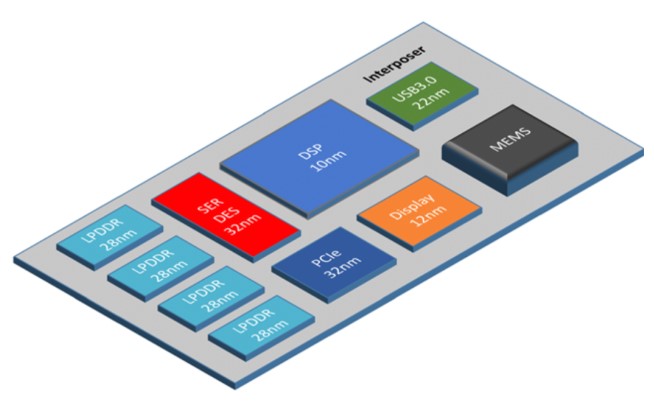
Depending on who you’re speaking with at the time, the industry’s adoption of chiplet technology to extend the reach of Moore’s Law is either continuing to roll along or is facing the absence of a commercial market. However, both assertions cannot be true. What is true is that chiplets have been used to build at least some commercial ICs for more than a decade and that semiconductor vendors continue to expand chiplet usability and availability. At the same time, the interface and packaging standards that are essential to widespread chiplet adoption remain in flux.
On the positive side of this question are existence proofs. Xilinx, now AMD, has been using 2.5D chiplet technology with large silicon interposers to make FPGAs for more than a decade. The first commercial use of this packaging technology appeared back in 2011 when Xilinx announced its Virtex-7 2000T FPGA, a 2-Mgate device built from four FPGA semiconductor tiles bonded to a silicon interposer. Xilinx jointly developed this chiplet-packaging technology with its foundry, TSMC, which now offers this CoWoS (Chip-on-Wafer-on-Substrate) interposer-and-chiplet technology to its other foundry customers. TSMC customers that have announced chiplet-based products include Broadcom and Fujitsu. AMD is now five generations along the learning curve with this packaging technology, which is now essential to the continued development of bigger and more diverse FPGAs. AMD will be presenting an overview of this multi-generation, chiplet-based technology, including a status update at the upcoming Hot Chips 2023 conference being held at Stanford University in Palo Alto, California, in August.
Similarly, Intel has long been developing and using chiplet technology in its own packaged ICs. The company has been using its 2.5D EMIB (embedded multi-die interconnect bridge) chiplet-packaging technology for years to manufacture its Stratix 10 FPGAs. That technology has now spread throughout Intel’s product line to include CPUs and SoCs. The poster child for Intel’s chiplet-packaging technologies is unquestionably the company’s Ponte Vecchio GPU, which packages 47 active “tiles” – Intel’s name for chiplets – in a multi-chip package. These 47 dies are manufactured by multiple semiconductor vendors using five different semiconductor process nodes, all combined in one package using Intel’s EMIB 2.5D and 3D Foveros chiplet-packaging techniques to produce an integrated product with more than 100 billion transistors – something not currently possible on one silicon die. Intel is now opening these chiplet-packaging technologies to select customers through IFS – Intel Foundry Services – and consequently expanding the size and number of its packaging facilities.
A new study by KTH Royal Institute of Technology and Stanford University revises of our understanding of quantum vortices in superconductors. Pictured, an artist’s depiction of quantum vortices. Credit: Greg Stewart, SLAC National Accelerator Laboratory
Topics: Modern Physics, Quantum Mechanics, Research, Superconductors
Within superconductors little tornadoes of electrons, known as quantum vortices, can occur, which have important implications in superconducting applications such as quantum sensors. Now a new kind of superconducting vortex has been found, an international team of researchers reports.
Egor Babaev, professor at KTH Royal Institute of Technology in Stockholm, says the study revises the prevailing understanding of how electronic flow can occur in superconductors, based on work about quantum vortices that was recognized in the 2003 Nobel Prize award. The researchers at KTH, together with researchers from Stanford University, TD Lee Institute in Shanghai and AIST in Tsukuba, discovered that the magnetic flux produced by vortices in a superconductor can be divided up into a wider range of values than thought.
That represents a new insight into the fundamentals of superconductivity, and also potentially can be applied in superconducting electronics.
A vortex of magnetic flux happens when an external magnetic field is applied to a superconductor. The magnetic field penetrates the superconductor in the form of quantized magnetic flux tubes which form vortices. Babaev says that originally research held that quantum vortices pass through superconductors each carrying one quantum of magnetic flux. But arbitrary fractions of quantum flux were not a possibility entertained in earlier theories of superconductivity.
Using the Superconducting Quantum Interference Device (SQUID) at Stanford University Babaev’s co-authors, research scientist Yusuke Iguchi and Professor Kathryn A. Moler, showed at a microscopic level that quantum vortices can exist in a single electronic band. The team was able to create and move around these fractional quantum vortices, Moler says.
“Professor Babaev has been telling me for years that we could see something like this, but I didn’t believe it until Dr. Iguchi actually saw it and conducted a number of detailed checks,” she says.
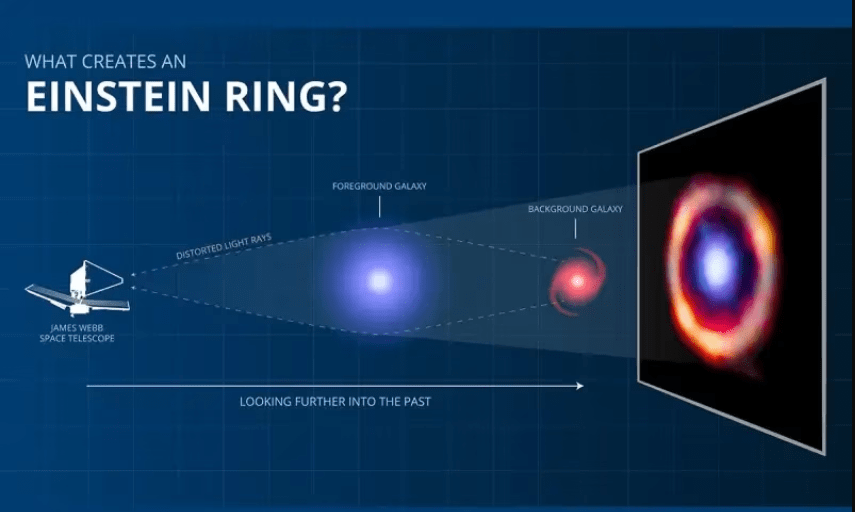
The galaxy observed by Webb shows an Einstein ring caused by a phenomenon known as gravitational lensing. Credit: S. Doyle / J. Spilker
Topics: Astrobiology, Biology, James Webb Space Telescope, Space Exploration
Researchers have detected complex organic molecules in a galaxy more than 12 billion light-years away from Earth—the most distant galaxy in which these molecules are now known to exist. Thanks to the capabilities of the recently launched James Webb Space Telescope and careful analyses from the research team, a new study lends critical insight into the complex chemical interactions that occurred in the first galaxies in the early universe.
University of Illinois Urbana-Champaign astronomy and physics professor Joaquin Vieira and graduate student Kedar Phadke collaborated with researchers at Texas A&M University and an international team of scientists to differentiate between infrared signals generated by some of the more massive and larger dust grains in the galaxy and those of the newly observed hydrocarbon molecules.
The study findings are published in the journal Nature.
“This project started when I was in graduate school studying hard-to-detect, very distant galaxies obscured by dust,” Vieira said. “Dust grains absorb and re-emit about half of the stellar radiation produced in the universe, making infrared light from distant objects extremely faint or undetectable through ground-based telescopes.”
In the new study, the JWST received a boost from what the researchers call “nature’s magnifying glass”—a phenomenon called gravitational lensing. “This magnification happens when two galaxies are almost perfectly aligned from the Earth’s point of view, and light from the background galaxy is warped and magnified by the foreground galaxy into a ring-like shape, known as an Einstein ring,” Vieira said.
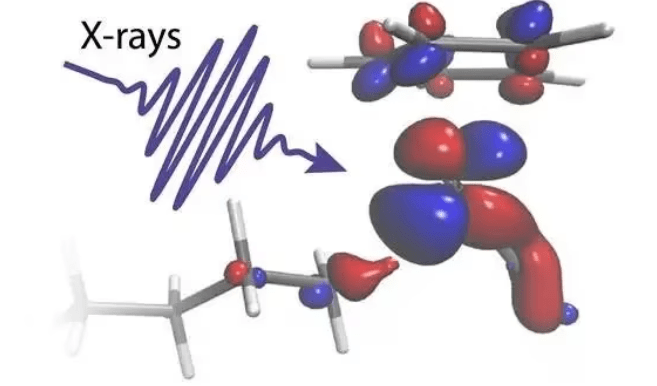
An X-ray flash illuminates a molecule. Credit: Raphael Jay
Topics: Chemistry, Climate Change, Green Tech, High Energy Physics, Research, X-rays
The use of short flashes of X-ray light brings scientists one big step closer to developing better catalysts to transform the greenhouse gas methane into a less harmful chemical. The result, published in the journal Science, reveals for the first time how carbon-hydrogen bonds of alkanes break and how the catalyst works in this reaction.
Methane, one of the most potent greenhouse gases, is being released into the atmosphere at an increasing rate by livestock farming as well as the continuing unfreezing of permafrost. Transforming methane and longer-chain alkanes into less harmful and, in fact, useful chemicals would remove the associated threats and, in turn, make a huge feedstock for the chemical industry available. However, transforming methane necessitates, as a first step, the breaking of a C-H bond, one of the strongest chemical linkages in nature.
Forty years ago, molecular metal catalysts were discovered that can easily split C-H bonds. The only thing found to be necessary was a short flash of visible light to “switch on” the catalyst, and, as by magic, the strong C-H bonds of alkanes passing nearby are easily broken almost without using any energy. Despite the importance of this so-called C-H activation reaction, it remained unknown over the decades how that catalyst performs this function.
The research was led by scientists from Uppsala University in collaboration with the Paul Scherrer Institute in Switzerland, Stockholm University, Hamburg University, and the European XFEL in Germany. For the first time, the scientists were able to directly watch the catalyst at work and reveal how it breaks those C-H bonds.
In two experiments conducted at the Paul Scherrer Institute in Switzerland, the researchers were able to follow the delicate exchange of electrons between a rhodium catalyst and an octane C-H group as it gets broken. Using two of the most powerful sources of X-ray flashes in the world, the X-ray laser SwissFEL and the X-ray synchrotron Swiss Light Source, the reaction could be followed all the way from the beginning to the end. The measurements revealed the initial light-induced activation of the catalyst within 400 femtoseconds (0.0000000000004 seconds) to the final C-H bond breaking after 14 nanoseconds (0.000000014 seconds).
Topics: Civics, Civil Rights, Civilization, Democracy, Existentialism, Fascism, Human Rights
But beyond him being (obviously) a genocidal maniac, there’s an aspect to Hitler’s rule that kind of gets missed in our standard view of him. Even if popular culture has long enjoyed turning him into an object of mockery, we still tend to believe that the Nazi machine was ruthlessly efficient and that the great dictator spent most of his time…well, dictating things.
So it’s worth remembering that Hitler was actually an incompetent, lazy egomaniac, and his government was an absolute clown show.
In fact, this may even have helped his rise to power, as he was consistently underestimated by the German elite. Before he became chancellor, many of his opponents had dismissed him as a joke for his crude speeches and tacky rallies. Even after elections had made the Nazis the largest party in the Reichstag, people still kept thinking that Hitler was an easy mark, a blustering idiot who could easily be controlled by smart people.
Why did the elites of Germany so consistently underestimate Hitler? Possibly because they weren’t actually wrong in their assessment of his competency—they just failed to realize that this wasn’t enough to stand in the way of his ambition. As it would turn out, Hitler was really bad at running a government. As his own press chief Otto Dietrich later wrote in his memoir The Hitler I Knew, “In the twelve years of his rule in Germany, Hitler produced the biggest confusion in government that has ever existed in a civilized state.”
His government was constantly in chaos, with officials having no idea what he wanted them to do, and nobody was entirely clear who was actually in charge of what. He procrastinated wildly when asked to make difficult decisions and would often end up relying on gut feeling, leaving even close allies in the dark about his plans. His “unreliability had those who worked with him pulling out their hair,” as his confidant Ernst Hanfstaengl later wrote in his memoir Zwischen Weißem und Braunem Haus. This meant that rather than carrying out the duties of state, they spent most of their time in-fighting and back-stabbing each other in an attempt to either win his approval or avoid his attention altogether, depending on what mood he was in that day.
Axios has obtained leaked private schedules of President Donald Trump showing how he’s spent his time over the past three months. According to the leaked schedules, our president has spent 60% of his “working” hours since the midterms in unstructured “Executive Time.”
Executive Time is supposed to consist of time in the Oval Office, but Trump wakes before 6 a.m. and doesn’t leave the residence for five hours. He spends that time, according to Axios, “watching TV, reading the papers, and responding to what he sees and reads by phoning aides, members of Congress, friends, administration officials, and informal advisers.” And, we can safely assume, tweeting like a madman.
Then, usually around 11:00 or 11:30 a.m., the president finally gets off his ass and actually does some work, attending an intelligence briefing with his chief of staff. The idea for Executive Time, which during the three months the leaked schedules totaled 297 hours, came from former chief of staff John Kelly because of Trump’s disdain for regular schedules.
Democracies require informed citizens. “Democracies did not originate with the founding of the United States. The term ‘democracy’ comes from two Greek words: “demos” (the people) and “”kratia” (power or authority). So, of course, DEMOCRACY is a form of government that gives power to the people. But how, when, and to which people? The answer to those questions changes through history.” See: https://www.ushistory.org/gov/1c.asp
Fascism has a self-built mythology of efficiency that generations of psychopaths have used gaslighting by pamphlet to the Internet to convince rubes and middle-of-the-road citizens that they’re “stable geniuses.” News flash: They’re not.
Fascism as a term didn’t come into vogue until Benito Mussolini in Italy. Prior to that, Jim Crow, black codes, and the Confederate South were all the foundations Mussolini based his philosophies on. Nazi Germany based its treatment of the Jews on Jim Crow, American black codes, and the Eugenics movement (which they put on steroids).
Fascism is the parent “ism” of every one of the “isms” that’s used to classify, objectify, demoralize, and categorize humans into this unmoveable hierarchy where the fascists/psychopaths have put themselves on the top: 1. They think they deserve it because of some “magical formula” that’s varied from “it’s God’s will” and evolution, post-Darwin, post-Nietzche. The formula is fungible so long as the outcome is the same. 2. The inherent “inferiority” of anyone else who isn’t a fascist/psychopath. 3. Anyone with a three-pound functional brain that can read history and reason for themselves is “woke.” America had black people. India, under the Caste system, had Dalets: the pariahs, the untouchables. Nazy Germany had Jews. Russia has Ukraine, which at this moment is destroying all of its delusions of superiority.
Fascism puts everything in the lap of the “dear leader.” Thus the responsibility for the government running efficiently, or running like a crap show, is the. “dear leader’s.” That way, when everything GOES to crap, it’s the leader’s fault, not the citizens. Since he is the source of “truth,” they await to hear, by pronouncement, tweet, or “truth social.”
“The past was alterable. The past never had been altered. Oceania was at war with Eastasia. Oceania had always been at war with Eastasia.” George Orwell, “1984”
German citizens, post-1945, claimed to “not know” anything about the atrocities. As Dumbo Gambino appears to be careening toward federal indictments, what will be the excuse in a post-MAGA world (if we ever get to a post-MAGA world)?
But since all you have to do to have a democracy is, well, inform your citizens, how would governments distract them?
The term “smartphone” was not coined until a year after the introduction of the Simon, appearing in print as early as 1995, describing AT&T’s PhoneWriter Communicator. The term “smartphone” was first used by Ericsson in 1997 to describe a new device concept, the GS88.
Abstract The use of smartphones has been increasing worldwide. Usage of these devices has been associated with addiction and adverse emotional states. This study employs a mixed methods approach to study these relationships in an Australian sample. The study comprised 164 participants aged between 18–70 who completed the Depression, Anxiety, and Stress Scale, the Smartphone Addiction Scale, and the Mindful Attention Awareness Scale. Seven participants were also interviewed, providing answers of a qualitative nature. Smartphone addiction significantly predicted higher levels of smartphone usage. Additionally, smartphone addiction and distractibility also significantly predicted higher levels of stress, depression, and anxiety. Qualitative results identified themes such as convenience, time of the day, and activities in relation to smartphone usage as well as short‐and long‐term effects of this usage. Findings indicated that both distraction and addiction have an influence on the use of smartphones and that increased usage has detrimental consequences for emotional health. Themes such as dependence and temptation, and interferences appear congruent and consistent with the results of the scales used.
Smartphone addiction, sometimes colloquially known as “nomophobia” (fear of being without a mobile phone), is often fueled by an internet overuse problem or internet addiction disorder. After all, it’s rarely the phone or tablet itself that creates the compulsion, but rather the games, apps, and online worlds it connects us to.Health Guide
Prof. Li Gang invented a novel technique to achieve breakthrough efficiency with organic solar cells. Credit: Hong Kong Polytechnic University
Topics: Chemistry, Green Tech, Materials Science, Photonics, Research, Solar Power
Researchers from The Hong Kong Polytechnic University (PolyU) have achieved a breakthrough power-conversion efficiency (PCE) of 19.31% with organic solar cells (OSCs), also known as polymer solar cells. This remarkable binary OSC efficiency will help enhance these advanced solar energy device applications.
The PCE, a measure of the power generated from a given solar irradiation, is considered a significant benchmark for the performance of photovoltaics (PVs), or solar panels, in power generation. The improved efficiency of more than 19% that was achieved by the PolyU researchers constitutes a record for binary OSCs, which have one donor and one acceptor in the photoactive layer.
Led by Prof. Li Gang, Chair Professor of Energy Conversion Technology, and Sir Sze-Yen Chung, Endowed Professor in Renewable Energy at PolyU, the research team invented a novel OSC morphology-regulating technique by using 1,3,5-trichlorobenzene as a crystallization regulator. This new technique boosts OSC efficiency and stability.
The team developed a non-monotonic intermediated state manipulation (ISM) strategy to manipulate the bulk-heterojunction (BHJ) OSC morphology and simultaneously optimize the crystallization dynamics and energy loss of non-fullerene OSCs. Unlike the strategy of using traditional solvent additives, which is based on excessive molecular aggregation in films, the ISM strategy promotes the formation of more ordered molecular stacking and favorable molecular aggregation. As a result, the PCE was considerably increased, and the undesirable non-radiative recombination loss was reduced. Notably, non-radiative recombination lowers the light generation efficiency and increases heat loss.
Bio-inspired robots, robotic systems that emulate the appearance, movements, and/or functions of specific biological systems, could help to tackle real-world problems more efficiently and reliably. Over the past two decades, roboticists have introduced a growing number of these robots, some of which draw inspiration from fruit flies, worms, and other small organisms.
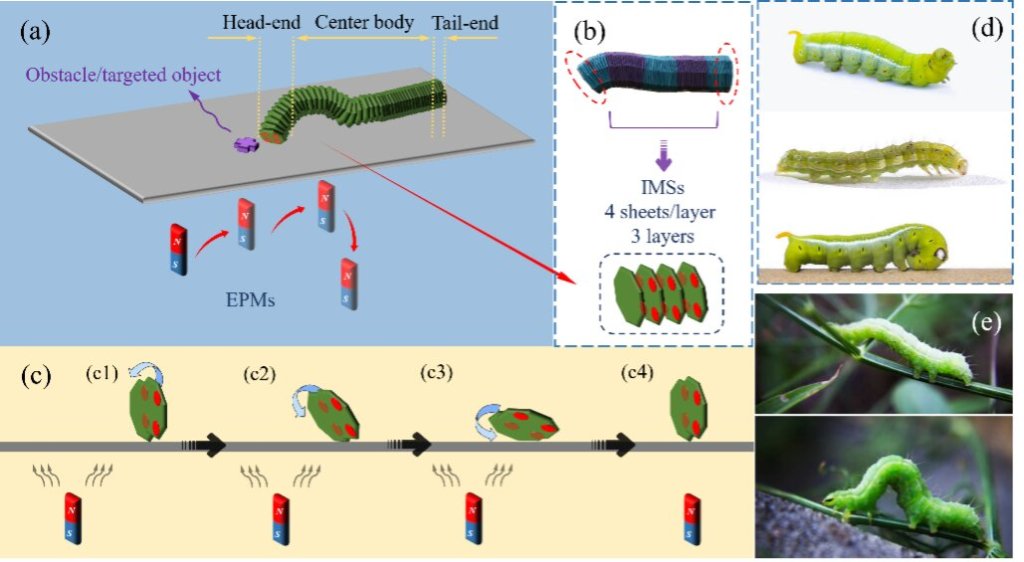
Researchers at China University of Petroleum (East China) recently developed a worm-inspired robot with a body structure that is based on the oriental paper-folding art of origami. This robotic system, introduced in Bioinspiration & Biomimetics, is based on actuators that respond to magnetic forces, compressing and bending its body to replicate the movements of worms.
“Soft robotics is a promising field that our research group has been paying a lot of attention to,” Jianlin Liu, one of the researchers who developed the robot, told Tech Xplore. “While reviewing the existing research literature in the field, we found that bionic robots, such as worm-inspired robots, were a topic worth exploring. We thus set out to fabricate a worm-like origami robot based on the existing literature. After designing and reviewing several different structures, we chose to focus on a specific knitting pattern for our robot.”





 Physics and Nano