"The one exclusive sign of thorough knowledge is the power of teaching." Aristotle | Disclaimer: The views and opinions expressed on this Wordpress website are the views and opinions of the content creator, Dr. Reggie Goodwin, and should not be construed as shared, or sourced from The Environmental Protection Agency, or any organizations with which they have cooperative, or business relationships.
An artist’s impression of the cosmic web (Volker Springel/Max Planck Institute for Astrophysics/et al)
Topics: Astronomy, Astrophysics, Cosmology, Dark Matter, Einstein, Research
Q: Why does science seem to always change its mind?
A: Because, the enterprise of science is about discovery, and a lot of discoveries happen when you have better instrumentation, apply The Scientific Method and rigorous peer review. (See the quote below by economist John Maynard Keynes)
When science tried to fit the universe into a mechanistic viewpoint, it coined something called the luminiferous aether. Albert Michelson and Edward Morley built what we now know as an interferometer to measure its existence, and ended up measuring the speed of light. It earned them the Nobel Prize. Theirs were the shoulders on which Einstein built his Theory of Relativity, along with Newton, Faraday and others. Knowing better, science changes its mind.
“When the facts change, I change my mind – what do you do, sir?” ― John Maynard Keynes
There might not be a mysterious ‘dark’ force accelerating the expansion of the Universe after all. The truth could be much stranger – bubbles of space where time passes at drastically different rates.
The passage of time isn’t as constant as our experience with it suggests. Areas of higher gravity experience a slower pace of time compared with areas where gravity is weaker, a fact that could have some pretty major implications on how we compare rates of cosmic expansion according to a recently developed model called timescape cosmology.
Discrepancies in how fast time passes in different regions of the Universe could add up to billions of years, giving some places more time to expand than others. When we look at distant objects through these time-warping bubbles, it could create the illusion that the expansion of the Universe is accelerating.
Two new studies have analyzed more than 1,500 supernovae to investigate how likely the concept could be – and found that the timescape model might be a better fit for observations than our current best model.
The standard model of cosmology does a pretty good job of explaining the Universe – provided we fudge the numbers a bit. There doesn’t seem to be enough mass to account for the gravitational effects we observe, so we invented an invisible placeholder called dark matter.
There also seems to be a strange force that counteracts gravity, pushing the cosmos to expand at accelerating rates. We don’t know what it is yet, so in the same spirit we dubbed it dark energy. All of this comes together, along with ordinary matter, to form what we call the lambda cold dark matter (ΛCDM) model.
The problem is that this model uses a simplified equation that assumes the whole Universe is smooth, and expands at the same speed everywhere. But it’s far from smooth out there: we see a colossal cosmic web, crisscrossed by filaments of galaxies separated by vast voids emptier than we can comprehend.
Timescape cosmology takes that ‘lumpiness’ into account. More matter means stronger gravity, which means slower time – in fact, an atomic clock located in a galaxy could tick up to a third slower than the same clock in the middle of a void.
When you stretch that over the huge lifespan of the Universe, billions more years may have passed in the voids than in the matter-dense areas. A mind-boggling implication of that is that it no longer makes sense to say that the Universe has a single unified age of 13.8 billion years. Instead, different regions would have different ages.
And since so much more time has passed in the voids, more cosmological expansion has taken place there. Therefore, if you look at an object on the far side of a void, it would appear to be moving away from you much faster than something on this side of the void. Over time, these voids take up a larger proportion of the Universe, creating the illusion of an accelerating expansion, without needing to conjure up any dark energy.
September 11, 2001, was on a Tuesday. We were a year from a contested election decided by the Supreme Court. We were scrambling to make sense of the senseless, and trying mightily, not to individually, or collectively go insane.
I remember President George W. Bush being told that we were under attack, and the astonished look on his face. He had received a PDB: Presidential Daily Brief, in Crawford, Texas a month before that was explicit in its description: “Bin Laden Determined to Strike in US.” The affable person everyone would “like to have a beer with” (though he’s a teetotaler) apparently said to the intelligence agent, “You’ve covered your ass now.” He was already setting a precedent, a pattern, for his republican successors in the number of days he vacationed at his ranch rather than actually work in Washington. The presidency from a distance looked like an easy job to anyone who wanted to throw their hat in the ring. Social media and Nielsen Ratings meant the only thing one had to do was something outrageous for attention and “clicks.” We have become Guy Debord’s “Society of the Spectacle.”
I remember the push after the attacks not to understand why a former intelligence asset, Osama Bin Laden, wanted to smash planes into the symbols of financial and political power, CNN reporter Peter Bergen reported on the former Mujahadeen rebel from the mountains of Afghanistan. He was hard to catch because the CIA taught him their playbook.
I remember the push to “get back to normal,” to shop, to “help the economy” as an act of defiance to then, the grossest attack on US soil that had ever been captured on film. It felt like the same push to get the economy “rocking again” during Covid.
I remember that we never collectively, sought counsel about what had then happened to us, and how it might have affected us psychologically as a country.
Posttraumatic stress disorder: Posttraumatic stress disorder (PTSD) is a psychiatric disorder that may occur in people who have experienced or witnessed a traumatic event, series of events, or set of circumstances. An individual may experience this as emotionally or physically harmful or life-threatening and may affect mental, physical, social, and/or spiritual well-being. Examples include natural disasters, serious accidents, terrorist acts, war/combat, rape/sexual assault, historical trauma, intimate partner violence and bullying.
PTSD has been known by many names in the past, such as “shell shock” during the years of World War I and “combat fatigue” after World War II, but PTSD does not just happen to combat veterans. PTSD can occur in all people, of any ethnicity, nationality or culture, and at any age. PTSD affects approximately 3.5 percent of U.S. adults every year. The lifetime prevalence of PTSD in adolescents ages 13 -18 is 8%. An estimated one in 11 people will be diagnosed with PTSD in their lifetime. Women are twice as likely as men to have PTSD. Three ethnic groups – U.S. Latinos, African Americans, and Native Americans/Alaska Natives – are disproportionately affected and have higher rates of PTSD than non-Latino whites.
People with PTSD have intense, disturbing thoughts and feelings related to their experience that last long after the traumatic event has ended. They may relive the event through flashbacks or nightmares; they may feel sadness, fear, or anger; and they may feel detached or estranged from other people. People with PTSD may avoid situations or people that remind them of the traumatic event, and they may have strong negative reactions to something as ordinary as a loud noise or an accidental touch.
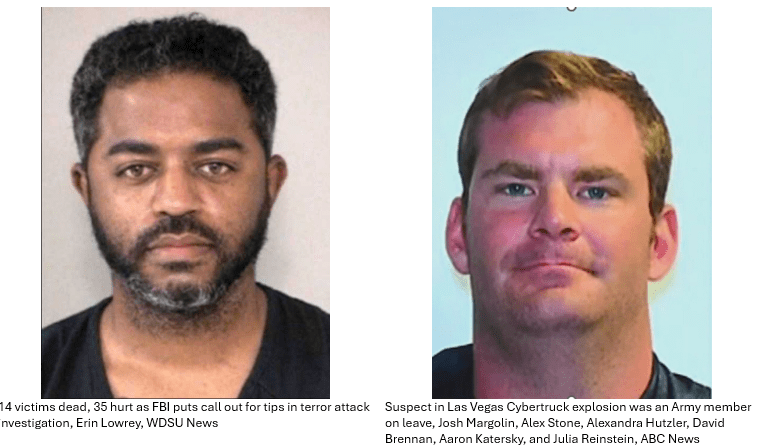
At least 14 people are dead and 35 people were injured after a man drove a truck into a crowd at Bourbon and Canal streets in New Orleans on New Year’s Day in a terrorist attack, according to the FBI.
It happened around 3:15 a.m. toward the end of New Year’s celebrations in New Orleans and hours before the expected kickoff of the Allstate Sugar Bowl, a college football quarterfinal held in the city’s Caesars Superdome.
The FBI confirmed the identity of the suspected driver of the truck as Shamsud Din Jabbar, 42, of Texas. A new photo of Jabbar was released early Thursday morning:
The FBI confirmed that despite previous reports, investigators believe Jabbar acted alone in the attack.
According to the FBI, Jabbar drove to New Orleans on Dec. 31 and posted on Facebook his support for ISIS.
14 victims dead, 35 hurt as FBI puts call out for tips in terror attack investigation, Erin Lowrey, WDSU News
*****
The suspected driver of the Tesla Cybertruck that exploded Wednesday outside the Trump International Las Vegas Hotel sustained a self-inflicted gunshot wound to the head prior to the blast, officials confirmed in a press briefing Thursday.
The Clark County Coroner identified the driver of the vehicle in this incident as 37-year-old Matthew Livelsberger of Colorado Springs, Colorado, on Thursday. His cause of death was as a result of an intraoral gunshot wound by suicide.
No one else suffered serious injuries.
Prior to his official identification, officials found overwhelming evidence — including credit cards in his name, similar tattoos, Livelsberger purchasing the weapons in the truck, and an ID card — pointing to him as the individual. The fire and explosion slowed the identification process because of the physical injuries sustained by the driver, officials said.
Jabbar and Livelsberger were US Army veterans who had been stationed at Fort Bragg/Liberty. Both men had deployed to Afghanistan after the attacks of 9/11. Both were decorated veterans who had “protected and served” their country.
Both men were broken. The country is still broken.
We lost the Vietnam War and the veterans who survived came home and were spat upon as “baby killers.” The propaganda movies by Stallone and Schwarzenegger in the 1980s tried to bring back our collective loss of esteem and testosterone. In the Reagan era, we were trying to re-establish the chutzpah of old World War II movies where the “good guys won.”
We started going dark in our entertainment with the Michael Keaton “Batman,” and the plethora of clone superhero movies spawned that had to be “grounded” in reality, involving a lot of property damage, and bloodshed. “24” was our revenge porn, and the template for things on television going … dark. We were the “good guys,” even if Jack Bauer had to torture a captive terrorist for info before the hour was up. This was copied in the live-action “Arrow” and in the animated series, Batman Beyond: “This is how you interrogate someone!” It was a subtle, inexorable change into the abyss. The fantasy entertainment made torture “cool,” and it morphed soldiers’, citizens, and politicians’ psyches.
Shamsud Din Jabbar was 42, and Matthew Livelsberger of Colorado Springs, Colorado, was 37. That would make both men 19, and 14, respectively, when 9/11 happened. They joined. They deployed. They were radicalized, and that can take many forms from many venues.
I’m talking about 2 men, a microcosm of 330 million citizens.
Before 9/11, you could walk with your loved ones to the plane they were boarding. Before 9/11, your shoes stayed on your feet, and not fed into an X-ray. Before 9/11, there wasn’t an invasive body scan or bomb dogs sniffing as you passed through the line if you didn’t have TSA Pre-Check. You weren’t separated by personnel incessantly checking your ID. Before 9/11, even if you didn’t board the plane, you were a part of the trip, departure, and return. Halcyon days before giving up our civil liberties to sit on an overcrowded bus with wings.
“United States” was always a caveat, an oxymoron for Indigenous Peoples, captured Africans, and the Chinese who built the transcontinental railroads, victims of their efficiency, and the first “war on drugs” that was a war on their competitive labor. “Melting pot” was always self-gaslighting and propaganda, a putty to hide the fissures beneath the surface of an unstable foundation that we just can’t lie our way around, or ban its history.
Something broke Jabbar and Livelsberger before they deployed to Afghanistan.
Something broke us as a country, and we still haven’t solicited counsel, or been on a couch.
Topics: Civics, Civil Rights, Civilization, Climate Change, Democracy, Education, Existentialism, Nobel Peace Prize, Nuclear Power
James Earl Carter Jr. was the 39th President of the United States. In 1980, I voted for the first time as an eighteen-year-old for his re-election. He lost to Reagan, the “Gipper,” who launched his presidential campaign in Philadelphia, Mississippi, blocks from the assassination of voting rights activists Cheney, Goodman, and Schwerner by domestic terrorists in white robes,[1] and the first uttered promise by a political candidate to “make America great again,” without defining “when” greatness was, or how he would bring it about. It has recently been revealed (long suspected) that his operatives had a secret deal with Iran to hold the hostages until after the election was “won,” then miraculously release them after Reagan’s inauguration.[2] He was the first president to comment on the climate crisis and put solar panels on the White House roof. His successor, safely in the pockets of the fossil fuels industry, promptly took them off and forgot about the crisis.[3]
Carter was an Annapolis Naval Graduate, and a Nuclear Engineer (I did wince at his southern pronunciation: “new que lure”). He rappelled into a nuclear reactor after a meltdown and lived to a hundred to tell about it.[4] Jimmy Carter negotiated peace between Egypt and Israel at Camp David in 1978, two years before I voted for him, and the year I received my driver’s license (that I am scheduled to renew this summer). He is the reason that we ratified the Panama Canal treaties. He established full-diplomatic relations with the People’s Republic of China and negotiated the SALT II Treaty with Russia (important in the Cold War/M.A.D. era). He is the reason we HAVE a Department of Education! You can see why I was proud to vote for him.
His post-presidency was astonishingly productive. He witnessed over 100 elections promoting democracy around the world. He and his wife Rosalyn built up to 1,000 homes through Habitat For Humanity. He won the Nobel Peace Prize “for work to find peaceful solutions to international conflicts, to advance democracy and human rights, and to promote economic and social development.” In addition to all of that, he still managed to teach Sunday School at Maranatha Baptist Church in Georgia. Jimmy Carter, a one-term president, and the longest-lived ex-president, was the backlash to Watergate.[5]
The Nixon administration years brought us Watergate and the lack of trust in our institutions, which we currently still endure today. It started with his first Vice President, Spiro Agnew, accepting bags of money in the White House (as he had as Maryland’s governor),[6] Richard Nixon’s departure before impeachment and removal, and his pardon by his unelected Vice President, Gerald Ford, which gave a green light for future presidents to skirt the law.[7] He colluded with a foreign power to win an election before collusion was “cool.”[8]
If history is not propagandized, obfuscated, or “banned” beyond this moment, Jimmy Carter will go down as our only authentically Christian president. I say authentic versus “cultural,” now used to describe people who like the ritual, music, and customs around holidays (Christmas just concluded, unless you include Epiphany), but may be non-practicing, non-theist, apathetic, trans-theist, deist, pantheist, or atheist, like Richard Dawkins,[9] of “The God Delusion.” For Jimmy Carter, God was no delusion. He walked out his faith, while other politicians memorized scriptures to spout from podiums.
He was our first openly Evangelical Christian President, and it’s why politicos like Michelle Bachmann supported him initially. He ran afoul of the religious right when he applied federal law and the Bible against Bob Jones University for their anti-miscegenation (“interracial dating” and generally not wanting African Americans as students – old school terminology).[10] The right pivoted to a B-Movie actor who could “act” presidential but showed zero interest in being of intellectual heft to BE presidential. Hence, a former reality show host isn’t much of a departure from the Reagan model.
They’ve never been about that “Jesus’ life.” Jimmy Carter always was.
Like many people after the election, I retreated from corporate media, which is anything on television and in print now. GE/Comcast, News Corps/Fox, Disney, Viacom, Time Warner, and CBS: six corporations control 90% of what we passively consume after long hard days of work on what was affectionately dubbed “the boob tube” (and it was not a compliment). The distinction between mainstream media and corporate couldn’t be more stark. “Mainstream” (noun) is “a prevailing current or direction of activity or influence,” and (adjective) is “having, reflecting, or being compatible with the prevailing attitudes and values of a society or group” – Merriam-Webster. We gravitate towards outlets that reflect and reinforce our viewpoints, and we feel it’s “mainstream,” but none of these outlets is doing anything for the “public good”: they are answering to boards of directors, CEOs, and Wall Street. I began my retreat by rereading an old book that seemed strange when published in 1985. Neil Postman’s central argument was the danger of CNN:
“We were keeping our eye on 1984. When the year came and the prophecy didn’t, thoughtful Americans sang softly in praise of themselves. The roots of liberal democracy had held. Wherever else the terror had happened, we, at least, had not been visited by Orwellian nightmares.
But we had forgotten that alongside Orwell‘s dark vision, there was another – slightly older, slightly less well-known, equally chilling: Aldous Huxley‘s Brave New World. Contrary to common belief even among the educated, Huxley and Orwell did not prophesy the same thing. Orwell warns that we will be overcome by externally imposed oppression. But in Huxley‘s vision, no Big Brother is required to deprive people of their autonomy, maturity, and history. As he saw it, people will come to love their oppression, to adore the technologies that undo their capacities to think.
What Orwell feared were those who would ban books. What Huxley feared was that there would be no reason to ban a book, for there would be no one who wanted to read one.Orwell feared those who would deprive us of information. Huxley feared those who would give us so much that we would be reduced to passivity and egoism. Orwell feared that the truth would be concealed from us. Huxley feared the truth would be drowned in a sea of irrelevance.Orwell feared we would become a captive culture. Huxley feared we would become a trivial culture, preoccupied with some equivalent of the feelies, the orgy porgy, and the centrifugal bumblepuppy. As Huxley remarked in Brave New World Revisited, the civil libertarians and rationalists who are ever on the alert to oppose tyranny “failed to take into account man’s almost infinite appetite for distractions.” In 1984, Orwell added, people are controlled by inflicting pain. In Brave New World, they are controlled by inflicting pleasure. In short, Orwell feared that what we fear will ruin us. Huxley feared that what we desire will ruin us.
This book is about the possibility that Huxley, not Orwell, was right.”
We say something is “Orwellian” when it reminds us of “1984,” where the Cambridge dictionary defines it as “a political system in which the government tries to control every part of people’s lives.” The loss of bodily autonomy by over 50% of the population qualifies as Orwellian. But also, the naming of a device a “smartphone” which is a supercomputer on our hips capable of using global positioning satellites to guide us better than a Rand McNally map (old school), and give us meaningless drivel from TikTok. That qualifies as the “equivalent of the feelies, the orgy porgy, and the centrifugal bumblepuppy.” Yet even though these supercomputers would compete well with Star Trek Tricorders: “21% of adults in the US are illiterate in 2024. 54% of adults have literacy below a 6th-grade level (20% are below a 5th-grade level). Low levels of literacy cost the US up to 2.2 trillion per year.” Source: The National Literacy Institute – Literacy Statistics 2024- 2025 (Where we are now)
Our Cellular Ones, I-Phones, Galaxies, and Motorola “centrifugal bumble-puppies” do not appear to be making us, their owners “smarter.”
I keep hearing “Don’t check out.” I haven’t checked out. I’ve checked in to reading actual books offline about history, and science, climate change, and critical thinking.
Even before this dichotomy between Huxley and Orwell, the three original television stations’ only incentive structure was based on Nielsen Ratings, which used to go for sitcoms after Harry Reasoner and Walter Cronkite scared the crap out of you. We needed something then to tamp us down. We currently have nothing of the sort. As “trickledown” was Orwellian doublespeak for “siphon up,” every form of media – social, print, and television must engage our emotions before our intelligence, it must strategically induce Intermittent Explosive Disorder (with the ironic initials, “I.E.D.”). It’s not enough to sell “if it bleeds, it leads,” corporate media must induce the bleeding. They must convince us that our neighbor is “the other”: alien, dangerous, trying to destroy with liberal or fascistic policies. “I’m mad as hell, and I’m not going to take it anymore!” The movie “Network’s” mantra has to be shouted from windows, Capitols have to be stormed and defecated on, billionaire celebrities have to join “joy campaigns” to fight a dreaded, pending tyranny, and when the election is over, we’re supposed to go back to “normal” like nothing was ever uttered.
Well, I’m “mad as hell.” And I’m reading every book I can get my hands on. Ten so far this year. Read the Financial Times and other overseas journals – there is this new thing called “The Internet.” I’m walking two miles a day, meditating, and taking pleasure in my immediate life without thinking that I’m on some great quest for the “Dawn of the Age of Aquarius” by any means necessary! That’s where the lit powder keg explodes.
Try it. Breath. Relax. Talk to your neighbors, especially the ones whose political signs you disagreed with. Control the things you can. Play chess. Your blood pressure will lower, I promise. And vote: It pisses off the small cadre of nincompoops who like Brain the Mouse want to “take over the world!” But he, and Pinky, are just that, mice, not men.
The hills in Mars’ Australe Scopuli region, located near the planet’s south pole, are covered in carbon dioxide ice. The darker areas are layers of dust. (Image credit: ESA/DLR/FU Berlin)
Topics: Astrophysics, Environment, ESA, Mars, NASA, Planetary Science, Space Exploration
Snow dots the Martian landscape in these images from ESA’s Mars Express orbiter and NASA’s Mars Reconnaissance Orbiter.
Hoping for a white Christmas this year? Well, even if there’s no snow where you live, at least you can enjoy these images of a “winter” wonderland on Mars.
Taken by the German-built High-Resolution Stereo Camera (HRSC) on the European Space Agency’s (ESA) Mars Express orbiter in June 2022, and by NASA’s NASA’s Mars Reconnaissance Orbiter using its High-Resolution Imaging Science Experiment (HiRISE) camera on September 2022, these images showcase what appears to be a snowy landscape in the Australe Scopuli region of Mars, near the planet’s south pole.
But the “snow” seen here is quite different from what we have on Earth.
In fact, it’s carbon dioxide ice, and at Mars’ south pole, there’s a 26-foot-thick (8-meter-thick) layer of it year-round. (These images were actually taken near the summer solstice, not the winter one — it’s very cold here all year long.)
So what looks like a beautiful pastoral winter scene in these Mars Express images is actually a dynamic summer scene, where gas jets spew dust across the surface. Hey, at least it’s still cold outside — just a casual -193°F (-125°C).
The company has established a “data collection factory” to gather real-world data through activities like folding clothes and doing laundry.
A Chinese robotics firm has started mass-producing humanoid robots for general use, while its US counterparts, like Tesla, are aiming for such a feat in 2026.
Agibot, or Zhiyuan Robotics, showcased footage of its manufacturing facility on its official website and revealed that it’s on course to produce 1,000 units by the end of the year, according to a Chinese online news outlet.
Founded in February 2023 by Peng Zhihui, a former participant in Huawei’s “Genius Youth” program, the Shanghai-based startup launched its first humanoid robot model, the Raise A1, in August 2023.
On August 18, the company introduced five new wheeled and bipedal humanoid robot models designed for various tasks, including domestic chores and industrial work.
First Law: A robot may not injure a human being or, through inaction, allow a human being to come to harm.
Second Law: A robot must obey the orders given it by human beings except where such orders would conflict with the First Law.
Third Law: A robot must protect its own existence as long as such protection does not conflict with the First or Second Law.
The figure illustrates three events in Minkowski spacetime. Event 𝐵 is neither in the past nor in the future of 𝐴, 𝐴 ∼ 𝐵, and event 𝐶 is neither in the past nor in the future of 𝐵, 𝐵 ∼ 𝐶. Despite this, 𝐶 ≁ 𝐴. Indeed, 𝐶 is in the future of 𝐴: 𝐶 ≻ 𝐴. Credit: Scientific Reports (2024). DOI: 10.1038/s41598-024-71907-0
Topics: General Relativity, High Energy Physics, Theoretical Physics
A group of Brazilian researchers has presented an innovative proposal to resolve a decades-old debate among theoretical physicists: How many fundamental constants are needed to describe the observable universe? Here, the term “fundamental constants” refers to the basic standards needed to measure everything.
The study is published in the journal Scientific Reports.
The group argues that the number of fundamental constants depends on the type of space-time in which the theories are formulated; and that in a relativistic space-time, this number can be reduced to a single constant, which is used to define the standard of time. The study is an original contribution to the controversy sparked in 2002 by a famous article by Michael Duff, Lev Okun, and Gabriele Veneziano published in the Journal of High Energy Physics.
The whole story had begun ten years earlier, in the summer of 1992, when the three scientists met on the terrace of the cafeteria at CERN, the European Organization for Nuclear Research. During an informal conversation, they discovered that they disagreed on the number of fundamental constants.
“In the summer of 2001, we returned to the subject and discovered that our opinions were still different. So we decided to explain our positions,” the three write in the abstract of their article.
In short, Okun stated that three basic units—meter (length), kilogram (mass), and second (time)—were necessary to measure all physical quantities. In other words, he reaffirmed the so-called MKS system (M, for meter; K, for kilogram; S, for second), which was later incorporated into the International System of Units (SI). Veneziano, for his part, argued that in certain contexts two units would suffice: one for time and one for length. Duff was equivocal, stating that the number of constants could vary depending on the theory in question.
Explaining the new article, Matsas says, “The goal is to find the most fundamental description of physics possible. The question raised by Okun, Duff, and Veneziano is by no means trivial. As physicists, we’re faced with the need to understand what’s the minimum number of standards we need to measure everything.”
I was on the workgroup out of Washington for the Office of Chemical Safety and Pollution Prevention (OCSPP) on this project. Perchloroethylene (Perc) is a common solvent for dry cleaning, selected for its low flash point, in comparison to kerosene and gasoline (yikes). OCSPP found it carcinogenic via inhalation and skin contact, instituting a 10-year phaseout of Perc, and trichloroethylene (T.C.E.):
I am the author of the companion Dry Cleaning National Emissions Standard for Hazardous Air Pollutants (NESHAP) in my Research Triangle Park office, the Minerals and Manufacturing Group (MMG) to be published in the Federal Register and Regulations.gov, pending the Administrator’s signature (soon).
You now have enough government acronyms to last a lifetime.
*****
Now, we all tick-tock to December 20th at midnight, for hopefully not a government shutdown (an abysmal kabuki theater since Gingrich inaugurated this bloodsport in ‘94).
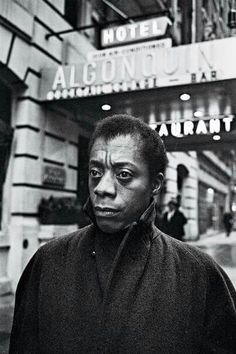
After reading Dr. Eddie Glaude Jr.’s book “Begin Again,” based on the writer and civil rights activist James Baldwin, I began seeking writings from James Baldwin, particularly to frame the times we’re in now, as what we’re experiencing started somewhere; it had an origin. I found this essay he wrote 40 years ago. To use Eddie’s term of affection, it was as if “Jimmy” was peering into our now.
What strikes me about this essay is that in April 1984, I probably missed it, as my focus and attention were on Ebony and Jet for the monthly centerfold. I was 21 years old, and four months from the first time I would be a “best man” in my A&T college friends Leon (deceased) and Vickie Nowlin’s wedding in Fayetteville, NC, on August 26, 1984, 12 days after my 22nd birthday. 15 years later, my father died on this date. Four years later on this date, Motorola laid me off in 2003, in the fourteenth round of what amounted to a slow torture for those who survived the economic downturn for that long.
What also strikes me about this essay is how timely it still is, forty years from its publication to this date in our calendar, this time of choosing between democracy, or dictatorship. We are here, in 2024, because some have embraced the delusion of “replacement” when brotherhood and sisterhood are more tolerable, reasonable, and survivable. Where we are, in 2024, started here, in 1984, when another president wanted to take us backward to an imagined, glorious, façade past that he often confused with his Hollywood persona, playing soldiers in WWII while not being one, chanting a mantra famous from the KKK and Nazi Germany to “make America (Germany) great again.”
Then, as now, we still don’t know fully what that means. It seems Jimmy did.
*****
On Being White and Other Lies
James Baldwin, in Essence Magazine, April 1984
The crisis of leadership in the white community is remarkable – and terrifying – because there is, in fact, no white community.
This may seem an enormous statement – and I’m willing to be challenged. I’m also willing to attempt to spell it out.
My frame of reference is, of course, America, or that portion of the North American continent that calls itself America. And this means I am speaking, essentially, of the European vision of the world, or more precisely, the European vision of the universe. It is a vision as remarkable for what it pretends to include as for what it remorselessly diminishes, demolishes, or leaves totally out of account.
There is, for example – at least, in principle – an Irish community: here, there, anywhere, or more precisely, Belfast, Dublin, and Boston.
There is a German community: both sides of Berlin, Bavaria, and Yorkville. There is an Italian community: Rome, Naples, the Bank of the Holy Ghost, and Mulberry Street. And there is a Jewish community, stretching from Jerusalem to California to New York. There are English communities. There are French communities. There are Swiss consortiums. There are Poles: in Warsaw (where they would like us to be friends) and in Chicago (where because they are white, we are enemies). There are, for that matter, Indian restaurants and Turkish baths. There is the underworld—the poor (to say nothing of those who intend to become rich) are always with us—but this does not describe a community. It bears terrifying witness to what happened to everyone who got here and paid the price of the ticket. The price was to become “white.” No one was white before he/she came to America. It took generations, and a vast amount of coercion, before this became a white country.
It is probable that it is the Jewish community or more accurately, perhaps, its remnants—that in America has paid the highest and most extraordinary price for becoming white. For the Jews came here from countries where they were not white, and they came here, in part, because they were not white; and incontestably in the eyes of the Black American (and not only in those eyes) American Jews have opted to become white, and this is how they operate. It was ironical to hear, for example, former Israeli prime minister Menachem Begin declare some time ago that “the Jewish people bow only to God” while knowing that the state of Israel is sustained by a blank check from Washington. Without further pursuing the implication of this mutual act of faith, one is nevertheless aware that the Black presence, here, can scarcely hope—at least, not yet—to halt the slaughter in South Africa.
And there is a reason for that.
America became white—the people who, as they claim, “settled” the country became white—because of the necessity of denying the Black presence and justifying the Black subjugation. No community can be based on such a principle—or, in other words, no community can be established on so genocidal a lie. White men—from Norway, for example, where they were Norwegians—became white: by slaughtering the cattle, poisoning the wells, torching the houses, massacring Native Americans; raping Black women.
This moral erosion has made it quite impossible for those who think of themselves as white in this country to have any moral authority at all—privately, or publicly. The multitudinous bulk of them sit, stunned, before their TV sets, swallowing garbage that they know to be garbage, and—in a profound and unconscious effort to justify this torpor that disguises a profound and bitter panic pay a vast amount of attention to athletics: even though they know that the football player (the Son of the Republic, their sons!) is merely another aspect of the money-making scheme. They are either relieved or embittered by the presence of the Black boy on the team. I do not know if they remember how long and hard they fought to keep him off it. I know that they do not dare have any notion of the price Black people (mothers and fathers) paid and pay. They do not want to know the meaning, or face the shame, of what they compelled—out of what they took as the necessity of being white—Joe Louis or Jackie Robinson or Cassius Clay (aka Muhammad Ali) to pay I know that they, themselves, would not have liked to pay it.
There has never been a labor movement in this country, the proof of the absence of a Black presence in the so-called father-to-son unions. There are, perhaps, some niggers in the window; but Blacks have no power in the labor unions.
Just so does the white community, as a means of keeping itself white, elect, as they imagine, their political (!) representatives. No nation in the world, including England, is represented by so stunning a pantheon of the relentlessly mediocre. I will not name names I will leave that to you.
But this cowardice, this necessity of justifying a totally false identity and of justifying what must be called a genocidal history, has placed everyone now living in the hands of the most ignorant and powerful people the world has ever seen: And how did they get that way?
By deciding that they were white. By opting for safety instead of life. By persuading themselves that a Black child’s life meant nothing compared with a white child’s life. By abandoning their children to the things white men could buy. By informing their children that Black women, Black men, and Black children had no human integrity that those who call themselves white were bound to respect. And in this debasement and definition of Black people, they debased and defamed themselves.
And have brought humanity to the edge of oblivion: because they think they are white. Because they think they are white, they do not dare confront the ravage and the lie of their history. Because they think they are white, they cannot allow themselves to be tormented by the suspicion that all men are brothers. Because they think they are white, they are looking for, or bombing into existence, stable populations, cheerful natives, and cheap labor. Because they think they are white, they believe, as even no child believes, in the dream of safety. Because they think they are white, however vociferous they may be and however multitudinous, they are as speechless as Lot’s wife—looking backward, changed into a pillar of salt.
However-! White being, absolutely, a moral choice (for there are no white people), the crisis of leadership for those of us whose identity has been forged, or branded, as Black is nothing new. We—who were not Black before we got here either, who were defined as Black by the slave trade—have paid for the crisis of leadership in the white community for a very long time, and have resoundingly, even when we face the worst about ourselves, survived, and triumphed over it. If we had not survived and triumphed, there would not be a Black American alive.
And the fact that we are still here—even in suffering, darkness, danger, endlessly defined by those who do not dare define, or even confront, themselves is the key to the crisis in white leadership. The past informs us of various kinds of people—criminals, adventurers, and saints, to say nothing, of course, of popes—but it is the Black condition, and only that, which informs us concerning white people. It is a terrible paradox, but those who believed that they could control and define Black people divested themselves of the power to control and define themselves.
The Fate of Empires and Search for Survival, Sir John Glubb, Abe Books
In these inspiring essays, Sir John Glubb examines the human race over 4,000 years and finds the same patterns of rise and fall of national greatness on the same timescale.
I. Pioneers – In the video, these are the explorers. They used the technology of their time, usually sailing ships to traverse vast distances to new lands.
II. Conquests – Colonization in Western culture typically involves subjugation of the land, and the peoples on the land, sometimes to the point of depopulation, or extinction.
III. Commerce – Global trade in the Americas started with the first genocidal assaults, and kidnapping of Africans to subjugate the land because past the conquering stage, the colonizers remote control their commerce with the crack of whips and brutality.
IV. Affluence – With great wealth from commerce/slave trading and breeding, one can build castles, plantations with wraparound porches and mint julip tea.
V. Intellect – The video alludes to the building of Ivy League institutions: Harvard, Yale, Princeton, etc. Public colleges emulate the model. Everyone becomes crendentialed.
VI. Decadence – “Internal division, an influx of foreigners, materialism, and frivolity. A welfare state, weakening religion, and a defensive mindset.” Sounds eerily familiar.
Entropy (noun): a thermodynamic quantity representing the unavailability of a system’s thermal energy for conversion into mechanical work, often interpreted as the degree of disorder or randomness in the system.
“the second law of thermodynamics says that entropy always increases with time”
“The End of History and the Last Man,” by Francis Fukuyama “a 1992 book of political philosophy by American political scientist Francis Fukuyama argues that with the ascendancy of Western liberal democracy—which occurred after the Cold War (1945–1991) and the dissolution of the Soviet Union (1991)—humanity has reached “not just … the passing of a particular period of post-war history, but the end of history as such: That is, the end-point of mankind’s ideological evolution and the universalization of Western liberal democracy as the final form of human government.”Wikipedia
I had a short dialogue with two younger relatives:
Me: I canceled my Amazon Prime membership due to Jeff Bezos’s cowardice.
Relative: I honestly think this was more so because his Washington Post has been failing, and as a businessman, he’s using the non-endorsement as a tactic to get it back on track. I also don’t think news outlets should endorse presidential candidates, don’t we want reliable, unbiased news?
Me: They started the endorsement after Watergate. It was the daily reporting by Carl Bernstein and Bob Woodward that held Nixon accountable. He went from a landslide victory to almost being removed from office via impeachment.
We had a news media when I was younger. What we had held the powerful accountable. When our media is owned by billionaires, it is more accurately defined as corporate media. When the powerful own our journalism, it’s hard, if not impossible to hold the powerful accountable. Google “oligarchy.”
Offline, I have been reading (a lot of) books, mostly on history. In “The Craft: How the Freemasons Made the Modern World,” by historian John Dickie. I excerpt Chapter 14 – Salamanca: Hyenas And Concubines:
“In Nationalist Spain, the army and right-wing vigilantes imposed a reign of terror. The intention was loudly proclaimed, to ‘cleanse’ the Fatherland of its political and cultural ‘pollutants.’ Anyone associated with the Republic and its institutions, with the political Left, and even with secular modernity, was liable to be arrested, tortured, and executed: trade unionists and politicians, workers and peasants, liberals and intellectuals, emancipated women and homosexuals. Tens of thousands died. Among them were many Freemasons.” (pages 323 – 324)
Hitler: I will get rid of the communist “vermin.”
Him: Repeated verbatim.
Hitler: I will take care of the “enemy within.”
Him: I will take care of the “threat from within.”
Hitler: Jews and migrants are poisoning Aryan blood.
Him: Migrants are poisoning the blood of our country.
Hitler: One people, one realm, one leader.
Him: One people, one family, one GLORIOUS nation.
In The Recount on Instagram, two African American Nevadans explained why they no longer support Democrats (and democracy) and “wish both parties would do better.” They also felt that the “him” I mentioned is “the only politician who hasn’t lied to them.” I assume that means politicians from both parties stretch the truth, and when caught, the news alerts blaring on our cell phones stoke the outrage to Olympian heights. The “him” I mentioned is a pathological liar, always lying, therefore, is “truthful” in his obfuscations.
The problem is that they probably don’t know their relatives, have never paid attention in school, and think that history began with the last thing they Googled on their phones.
They did not have the benefit (and honor) of being raised by a man drafted into the Second World War into the United States Navy, (to fight actual Nazis), only for the “GI Bill” to be bifurcated: white soldiers and sailors received academic and financial benefits like home loans that set them up for generations of prosperity. My father, with all the other black soldiers and sailors got trade school, that set us up for where we lived: the ghetto.
The Civil Rights era scenes are in YouTube videos played as they slept in their high school history classes, and Googled the answers to the take-home exam without meditation. It was never their big sister’s bloodied face patched by your nurse mother in the middle of the living room after marching for rights that in east Winston-Salem, NC, did not exist.
It is this proud ignorance of history and refusal to inquire about it from books written by experts, or by inquiring from the experts themselves. It is the modern, and young, notion that history didn’t exist before web pages and search engines. It is their overwhelming confidence that they can “get the gist” of any situation, no matter how dire, or life-threatening. If we lose our government in a coup, they’ll post something clever, or march and shout to shame the powerful into submission (the “him” wanted to shoot protestors in the leg during George Floyd and COVID). It makes a modern fascist/nationalist movement hard to believe is occurring in America because some of them have not received an alert on their cell phones from Instagram, or TikTok. And nothing exists if it hasn’t gone “viral.”






 Physics and Nano