"The one exclusive sign of thorough knowledge is the power of teaching." Aristotle | Disclaimer: The views and opinions expressed on this Wordpress website are the views and opinions of the content creator, Dr. Reggie Goodwin, and should not be construed as shared, or sourced from The Environmental Protection Agency, or any organizations with which they have cooperative, or business relationships.
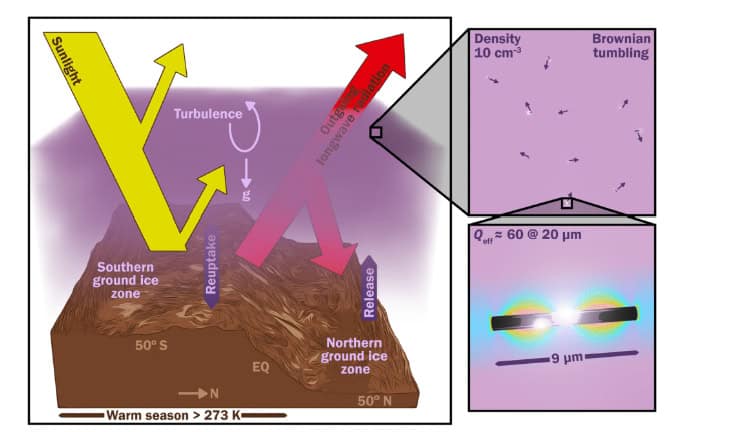
Heat trap The proposed nanoparticle warming method. (Courtesy: Aaron M. Geller, Northwestern Center for Interdisciplinary Exploration and Research in Astrophysics)
Suffice it to say, Mr. Musk’s nuking the Martian planet idea is impractical, and a nonstarter, but to show that he’s mature about it, he has T-shirts, because that always makes bad ideas palatable, like a spoon [full] of sugar to help bitter medicine go down (Mary Poppins thought so). The “real-life Tony Stark” he’s not.
If humans released enough engineered nanoparticles into the atmosphere of Mars, the planet could become more than 30 K warmer – enough to support some forms of microbial life. This finding is based on theoretical calculations by researchers in the US, and it suggests that “terraforming” Mars to support temperatures that allow for liquid water may not be as difficult as previously thought.
“Our finding represents a significant leap forward in our ability to modify the Martian environment,” says team member Edwin Kite, a planetary scientist at the University of Chicago.
Today, Mars is far too cold for life as we know it to thrive there. But it may not have always been this way. Indeed, streams may have flowed on the red planet as recently as 600 000 years ago. The idea of returning Mars to this former, warmer state – terraforming – has long kindled imagination, and scientists have proposed several ways of doing it.
One possibility would be to increase the levels of artificial greenhouse gases, such as chlorofluorocarbons, in Mars’ currently thin atmosphere. However, this would require volatilizing roughly 100,000 megatons of fluorine, an element that is scarce on the red planet’s surface. This means that essentially all the fluorine required would need to be transported to Mars from somewhere else – something that is not really feasible.
An alternative would be to use materials already present on Mars’ surface, such as those in aerosolized dust. Natural Martian dust is mainly made of iron-rich minerals distributed in particles roughly 1.5 microns in radius, which are easily lofted to altitudes of 60 km and more. In its current form, this dust actually lowers daytime surface temperatures by attenuating infrared solar radiation. A modified form of dust might, however, experience different interactions. Could this modified dust make the planet warmer?
Nanoparticles designed to trap escaping heat and scatter sunlight
In a proof-of-concept study, Kite and colleagues at the University of Chicago, the University of Central Florida, and Northwestern University analyzed the atmospheric effects of nanoparticles shaped like short rods about nine microns long, which is about the same size as commercially available glitter. These particles have an aspect ratio of around 60:1, and Kite says they could be made from readily available Martian materials such as iron or aluminum.
Mr. Chairman, I join my colleague Mr. Rangel in thanking you for giving the junior members of this committee the glorious opportunity of sharing the pain of this inquiry. Mr. Chairman, you are a strong man, and it has not been easy but we have tried as best we can to give you as much assistance as possible.
Earlier today, we heard the beginning of the Preamble to the Constitution of the United States: “We, the people.” It’s a very eloquent beginning. But when that document was completed on the seventeenth of September in 1787, I was not included in that “We, the people.” I felt somehow for many years that George Washington and Alexander Hamilton just left me out by mistake. But through the process of amendment, interpretation, and court decision, I have finally been included in “We, the people.”
Today I am an inquisitor. A hyperbole would not be fictional and would not overstate the solemnness that I feel right now. My faith in the Constitution is whole; it is complete; it is total. And I am not going to sit here and be an idle spectator to the diminution, the subversion, the destruction, of the Constitution.
“Who can so properly be the inquisitors for the nation as the representatives of the nation themselves?” “The subjects of its jurisdiction are those offenses which proceed from the misconduct of public men.” And that’s what we’re talking about. In other words, [the jurisdiction comes] from the abuse or violation of some public trust.
If you fly into Austin-Bergstrom International Airport, as I often do, you will first be greeted by the artwork of Brian Joseph, a friend who on the off-sale of a portrait in his City of Austin Office, he started a new career as an internationally known commercial artist of characters he calls “BYDEE” bringing you delightful and entertaining experiences.
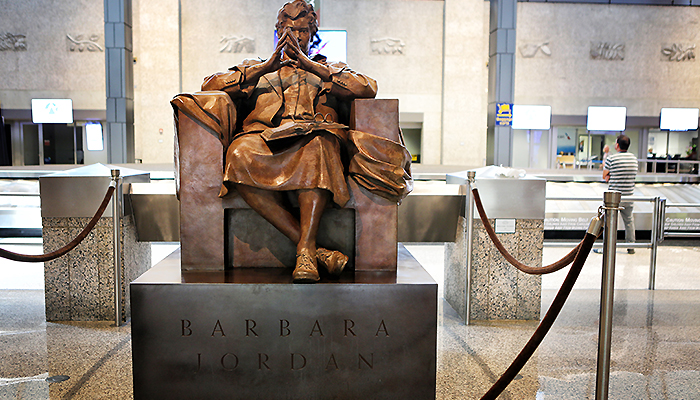
Walking from your gate to baggage claim, as you exit the escalator, you cannot miss the towering statue of the eloquent congresswoman who said that her “faith in the Constitution is whole; it is complete; it is total.” The words were the opening salvo of holding the powerful accountable, of being a nation of “laws and not of men” that James Madison envisioned. It held the misconduct of public men to account and reaffirmed that we do not have a king, and the president is accountable to the people s/he serves.
Absolute immunity reestablishes absolute monarchy. it makes us a nation of one man, and not of laws, therefore, we are subject to the whims and delusions of such a man not as citizens, but as serfs. Reestablishing a “mad King George” monarchy has hindered our progress: the Civil Rights, Women’s Rights, and LGBT Rights eras’ continued advances are in jeopardy. It hurtles all not originally included in “We The People” back into involuntary servitude, docile kowtowing, and invisibility. Such a bizarre Camelot can only be maintained by systematic, pathological violence.
The misconduct of men is driven by weakness. Nixon ordered the break-in to the DNC Headquarters, Watergate Building because he colluded with the Vietnam government to extend the war, hurting his then-Democratic opponent, Lyndon Baines Johnson, and in doing so, violated the Logan Act.
The former president had good cause to prevaricate. Nixon’s actions to sabotage the peace talks were, “highly inappropriate, if true” as Kissinger later put it, and in seeming violation of the law that prohibits private citizens from trying to “defeat the measures of the United States” or otherwise meddle in its diplomacy. As the U.S. code reads:
Any citizen of the United States, wherever he may be, who, without authority of the United States, directly or indirectly commences or carries on any correspondence or intercourse with any foreign government or any officer or agent thereof, with intent to influence the measures or conduct of any foreign government or of any officer or agent thereof, in relation to any disputes or controversies with the United States, or to defeat the measures of the United States, shall be fined under this title or imprisoned not more than three years, or both.
Though rarely employed over the years, the Logan Act was enacted by the founders to address just such a situation. It is named for George Logan, who conducted private negotiations with the French government during the administration of President John Adams. Logan, a member of the political opposition, used their notoriety to win election to the U.S. Senate.
By the time Election Day had come and gone, far too many interests were aware of Chennault’s actions—the White House, the FBI, the South Vietnamese, the Nixon and Humphrey campaigns—to keep a lid on the scandal.
A citizen conducting private negotiations with a foreign power is a violation of the Logan Act. You or I could go to jail for several years trying to negotiate anything without being connected to a government agency tasked with such powers, e.g., the Secretary of State.
Unless an activist Supreme Court reaches beyond the Magna Carte, and anoints a king.
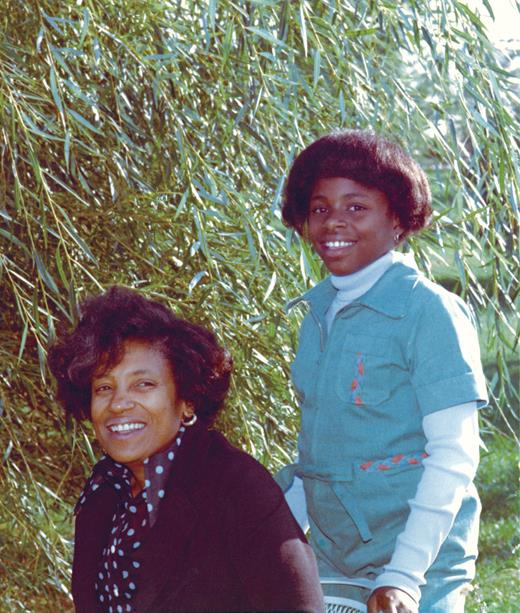
Willie Hobbs Moore (left) with her daughter, Dorian, in the 1980s. (Courtesy of the Ronald E. Mickens Collection on African-American Physicists, AIP Niels Bohr Library and Archives.)
Topics: African Americans, Civil Rights, Diversity in Science, Education, History, Theoretical Physics, Women in Science
The first African American woman to earn a PhD in physics remains little known. But her legacy is enormous.
There was a time when I believed that Shirley Ann Jackson, who received her PhD in physics from MIT in 1973, was the first African American woman to attain that degree. I realized that view was incorrect around 1984 when I learned that Willie Hobbs Moore (1934–94) finished her PhD in physics at the University of Michigan in 1972. At that time, for more than a decade I had been collecting data on African Americans with advanced degrees in physics—and had even published a list of Black physicists. Needless to say, learning about Moore came as a welcome surprise for me.
The fact that Moore received her degree from Michigan was of additional interest to me because of the long-standing connection between its physics department and that of Fisk University in Nashville, Tennessee. While I was at Fisk, first as an undergraduate student in 1960–64 and later as a professor, the physics department had several faculty members who obtained their doctorates from Michigan, including Nelson Fuson in 1938, James Lawson in 1939, and Herbert Jones in 1959. Moreover, Elmer Imes, who received his BA and MA from Fisk in 1903 and 1915, respectively, became the second African American to earn his PhD in physics, from Michigan in 1918 (see my article in Physics Today,October 2018, page 28).
For some unexplained reason, Moore and I never ended up at a conference or workshop together. We never met! By the time I gained a better understanding of who she was, her research, her career in industrial research and management, her role as a mentor, and her community involvement, she had died of cancer. One of my greatest personal and professional regrets is that I didn’t have the opportunity to meet her in person. I am certain that the two of us would have had much to discuss.
Abstract Edward Alexander Bouchet was born in New Haven, Connecticut, USA in 1852 during a period of racial segregation and injustice. He overcame tremendous odds and obtained a quality education at Hopkins Grammar School, preparing him for Yale College. In 1876, Edward Bouchet became the first person of color to obtain a Ph.D. in any field, not only from Yale but in the United States. However, due to the disenfranchisement and discrimination against African Americans, Bouchet’s career advancement in Physics was stifled. Despite these challenges, Bouchet became a dedicated educator and advocate for the education of colored youth, until his death in 1918. Keywords: Edward Alexander Bouchet; physics; history; black history; education; science, reconstruction era; graduate school
I read the poem “Seeds” at my wife’s family reunion. For African Americans, reunions are a chance to connect with family members without associating it with a casket. Black life in general has always been dangerous and treacherous since 1619. Ripped from the African continent, the survivors of cargo vessels like “The Good Ship Jesus” lost their culture, languages, indigenous religious practices. As a culture, we had to reestablish this through being thrown together from different tribes with different customs, infusing what we found with distant memories reconstructed into the language of our oppressors, the religions that gaslit us into an Anglo “Imago Dei” to ensure that the enslaved “obeyed their [white] masters.” Mother Dear and Paw-Paw were the culmination of this remarkable adjustment, despite a psychopathological caste system that would rather ban books than learn from its history. The secret weapon of all people in oppressive systems is joy.
The history of this reunion started with a story,
Repeated with many African American families,
The patriarch almost lost his life for the audacity of voting.
Assaulted by Klansmen,
Three years before the lynching of Emmitt Till in Mississippi.
The inspiration for the March on Washington, eight years later.
The cowardly Klansmen’s ancestors dressed in sheets,
Pretending to be malevolent spirits,
Attempting to frighten newly freed citizens from voting,
Helped by Poll Taxes, Constitutional Quizzes, and guessing the number of soap bubbles.
(They now use repealing parts of the Voting Rights Act, gerrymandering, voter suppression, and voter purging.)
Paw-Paw was assaulted,
Eleven years before the assassination of a fellow Traveling Man, Medgar Evers.
To survive, people of color had to find joy. Many times it was and is through what outsiders, particularly the dominant culture, think of as primitive, unsophisticated religious rituals. These rituals were and are our therapy before the invention of what we now know as psychology, our tribal gathering, our ministers the tribal leaders. Many gotten drunk on their power have abused the relationship with vulnerable congregants, but on the positive tip, they can provide centers for meetings that galvanize actions like the Civil Rights movement, which in itself is a response to reparations given to former plantation oligarchs, and the formerly enslaved and their descendants never seeing “forty acres and a mule.”
Can “Joy and Hope,” the slogan of the Harris-Walz campaign, help Democrats to win the 2024 election? Patrick Healy, deputy opinion editor of the New York Times, is doubtful. “I cringed a little in the convention hall Tuesday night when Bill Clinton said Kamala Harris would be the ‘president of joy’,” Healy wrote in a recent op-ed, comparing the Democratic focus on joy to Donald Trump’s embrace of his anointment as a divinity by his most fervent followers. “Joy is not a political strategy. And God is not a political strategy.”
I disagree. As I have written in Strongmen, positive emotions such as love, solidarity, and yes, joy, have been part of successful anti-authoritarian political strategies. Positive emotions motivate people to engage in politics when they might have grown apathetic or cynical about the possibility of change.
Dear Mr. Healy: “Hope and change” wasn’t a strategy either, but it worked.
‘A lot has changed in the past three hundred years,’ the ship’s captain Jean-Luc Picard tells him. ‘People are no longerobsessed with the accumulation of things. We’ve eliminated hunger, want, the need for possessions. We’ve grown out of our infancy.’
Instead of working just to live, humans are free to spend their time exploring the cosmos, or inventing, or making art—and sometimes doing all three. This optimistic view of human nature is in stark contrast to films such as Pixar’s Wall-E, which follows the right-wing line of thinking that achieving a post-scarcity society (what Keynes calls the ‘economic problem’) would lead to sloth and hedonism, and ultimately the demise of humanity.
Although it is Lucas’s much maligned 1999 prequel, Episode I: The Phantom Menace, which is usually thought of as the series’ most politics-heavy entry, I think there is something of value in looking at each film and trying to decode the way in which it reflects the world from which it emerged. As much credit, and criticism, as George Lucas and his collaborators deserve, they were all products of a changing geo-political environment which helped to shape them even as they were creating and shaping these films. George Lucas may have directed Star Wars, but it was real life that directed George Lucas. Just as surely as the collapsing skyscrapers seen in the likes of The Avengers, Man of Steel, Transformers 4, and Star Trek into Darkness reflect the realities of our post-9/11 world, so too did the real world seep into Lucas’s magnum opus. The Politics of Star Wars: Race and Resistance in American Popular Culture and Cinema, Dr. Darren Reid
September 10, 2001, in the world that existed before the Tuesday that changed the planet, you could walk your loved ones up to the door of an airplane to say goodbye. Your body wasn’t imaged by a scanner, and your shoes and laptop did not go onto a conveyor belt for x-ray analysis. There had been a terror attack on the World Trade Center in 1993, and the Oklahoma City Bombing in 1995. We were not a “nonviolent” world, but we were less apocalyptic and “prepping for doomsday.” September 11, 2001 brought with it depression, hopelessness, a dark existentialism that we (in my opinion), became addicted to and victim of its PTSD. Covid, the deaths of one million American citizens, isolation, social media and “Zoom fatigue” exacerbated it, and birthed QAnon.
Kiefer Sutherland became the larger-than-life antihero of “24,” and Hollywood dramatized torture before Abu Ghraib. Star Trek: The Original Series, saw a world that had somehow eliminated its attachment to racial hierarchies and “the affirmative action of generational wealth,” and Luke Skywalker was introduced in Star Wars as a “New Hope.”
An Army friend (I’m an Air Force vet) called me on November 5, 2008, and asked:
“Reg, did you ever think that we would live to see this?”
Of course not. As black men, we lived in the tyranny of low expectations. We were the textbook cases for which “Mis-Education of the Negro” was written by Dr. Carter G. Woodson. The United States managed to have 43 white males as the chief executive from George Washington to George W. Bush. Other democratic nations like Denmark, England, Finland, India, Israel have managed to have women as chief executives, and a diversity of cultures at the helm of state power. We also tend to be the only democratic government with an “electoral college,” that sounds academic until you realize it gives undue power to southern states that held human beings enslaved, and wrote laws to continue the “peculiar institution” of the antebellum South in perpetuity. The former enslaver’s descendants would like some of those laws to make a comeback.
“Hope and change” and “joy” are not strategies, but it does give us something to live for.
“Your future is whatever you make it. So make it a good one.” Dr. Emmett Brown, “Back to the Future, Part III.”
Medical applications Laboratory tests showed how the 3D printed material molds and sticks to organs such as this porcine heart. (Courtesy: Casey Cass/CU Boulder)
Topics: 3D Printing, Additive Manufacturing, Hydrogels, Polymer Science
A new method for 3D printing, described in Science, makes inroads into hydrogel-based adhesives for use in medicine.
3D printers, which deposit individual layers of a variety of materials, enable researchers to create complex shapes and structures. Medical applications often require strong and stretchable biomaterials that also stick to moving tissues, such as the beating human heart or tough cartilage covering the surfaces of bones at a joint.
Many researchers are pursuing 3D printed tissues, organs and implants created using biomaterials called hydrogels, which are made from networks of crosslinked polymer chains. While significant progress has been made in the field of fabricated hydrogels, traditional 3D printed hydrogels may break when stretched or crack under pressure. Others are too stiff to sculpt around deformable tissues.
Researchers at the University of Colorado Boulder, in collaboration with the University of Pennsylvania and the National Institutes of Standards and Technology (NIST), realized that they could incorporate intertwined chains of molecules to make 3D printed hydrogels stronger and more elastic – and possibly even allow them to stick to wet tissue. The method, known as CLEAR, sets an object’s shape using spatial light illumination (photopolymerization) while a complementary redox reaction (dark polymerization) gradually yields a high concentration of entangled polymer chains.
Amanda Montañez; Source: “Slaveholder Ancestry and Current Net Worth of Members of the United States Congress,” by Neil K. R. Sehgal and Ashwini R. Sehgal, in PLOS ONE. Published online August 21, 2024
Topics: Civics, Civil Rights, Civilization, Democracy, Education, History
U.S. Senators and Representatives whose family had a history of enslaving others have greater present-day wealth.
Members of the U.S. congress whose ancestors enslaved people have had a higher median net worth than those whose ancestors did not, according to a new analysis published on Wednesday in PLOS ONE.
The analysis used genealogical data published last year by an investigative team at Reuters, which found that in 2021, at least 100 members of Congress were descended from enslavers. This included 8 percent of Democrats and 28 percent of Republicans.
This reporting caught the eye of Neil K. R. Sehgal, a Ph.D. student and computational social science researcher at the University of Pennsylvania. He wondered what this unique genealogical data might reveal when combined with other publicly available information about members of Congress—particularly their financial disclosure forms.
“Just the fact that this was available—this detailed genealogical data and these financial disclosures for members of Congress—allowed us to explore this link,” Sehgal says.
The racial wealth gap in the U.S. is staggering. More than one in five white households have a net worth of more than $1 million, whereas more than one in five Black households have zero or negative net worth. This extreme imbalance began with slavery and has been perpetuated by racist policies and practices in housing, education, hiring, voting, and more that prevent many Black Americans from attaining and passing on generational wealth.
Topics: Astrobiology, Biology, Instrumentation, James Webb Space Telescope, Research, SETI
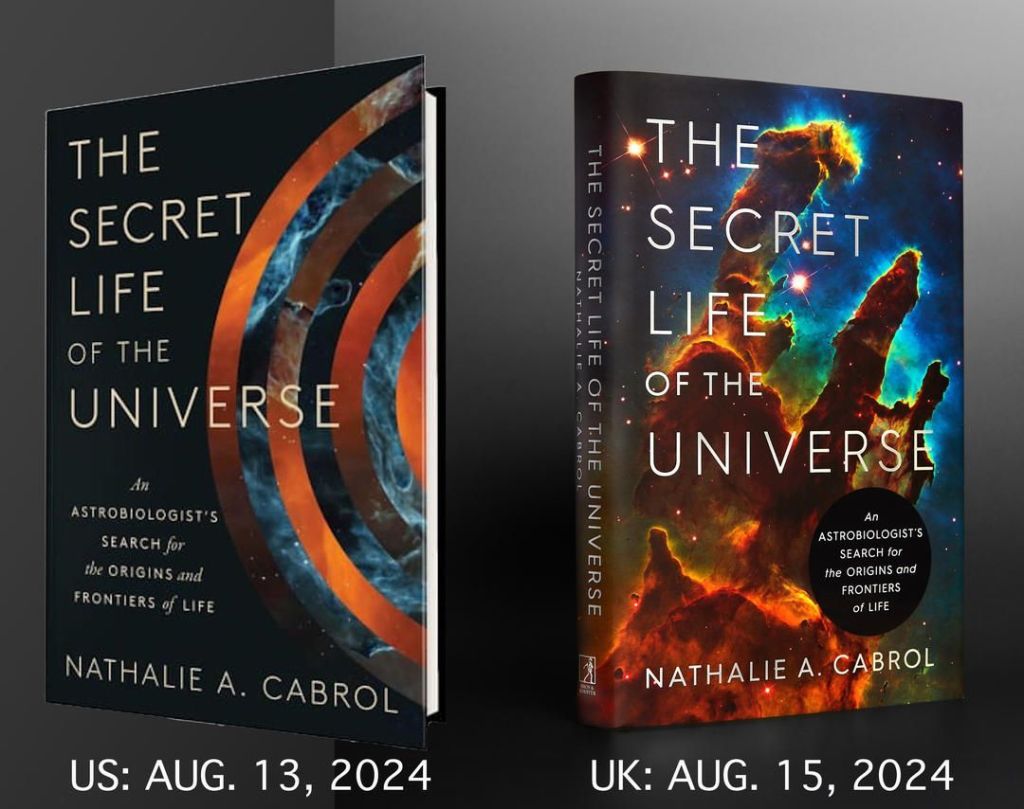
“The Secret Life of the Universe” by Dr. Nathalie Cabrol, the SETI Institute’s chief scientist and Director of the Carl Sagan Center at the SETI Institute, is coming out this week, both in the US (August 13, 2024) and in the UK (August 15, 2024). Scriber/Simon & Schuster publishes both editions. Cabrol articulates an overview of where we stand today in our search for life in the universe, what’s coming, and how looking out for life beyond Earth teaches us about our place on our planet.
Here is an excerpt to inspire you:
On July 11, 2022, the James Webb Space Telescope (JWST) returned its first images, penetrating the wall of time to show us the universe just a few hundred million years after its formation. In a marvelous cosmic irony, this immersion into the depths of our origins propels us into the future, where a revolution looms large in astronomy, in cosmology, and in astrobiology—the search for life in the universe. JWST comes after a few decades of space and planetary exploration during which we have discovered countless habitable environments in our solar system—for (simple) life as we know it, but also thousands of exoplanets in our galaxy, some of them located in the habitable zone of their parent stars.
We are living in a golden age in astrobiology, the beginning of a fantastic odyssey in which much remains to be written, but where our first steps bring the promise of prodigious discoveries. And these first steps have already transformed our species in one generation in a way that we cannot foresee just yet.
Copernicus taught us long ago that the Earth was neither at the center of the universe nor the center of the solar system, for that matter. We also learned from the work of Harlow Shapley and Henrietta Swan Leavitt that the solar system does not even occupy any particularly prominent place in our galaxy. It is simply tucked away at the inner edge of Orion’s spur in the Milky Way, 27,000 light-years from its center, in a galactic suburb of sorts. Our sun is an average-sized star located in a galaxy propelled at 2.1 million kilometers per hour in a visible universe that counts maybe 125 billion such cosmic islands, give or take a few billion. In this immensity, the Kepler mission taught us that planetary systems are the rule, not the exception.
This is how, in a mere quarter of a century, we found ourselves exploring a universe populated by as many planets as stars. Yet, looking up and far into what seems to be an infinite ocean of possibilities, the only echoes we have received so far from our explorations have been barren planetary landscapes and thundering silence. Could it be that we are the only guests at the universal table? Maybe. As a scientist, I cannot wholly discount this hypothesis, but it seems very unlikely and “an awful waste of space,” and for more than one reason.
Topics: Astrophysics, High Energy Physics, Particle Physics
Each week Quanta Magazine explains one of the most important ideas driving modern research. This week, physics staff writer Charlie Wood explains why many researchers are looking to outer space for signs of “new physics.”
Fundamental physics has a problem. Some researchers say the field faces a “nightmare scenario.” Some say it’s “in crisis.” To others it’s merely “stuck.” Whatever word they use, most particle physicists acknowledge that progress has slowed. After a rip-roaring 20th century that saw the discovery of general relativity, quantum theory, and a dozen or so fundamental particles, the first quarter of the 21st century has mainly brought further confirmation of those theories.
Physicists know their hard-won understanding of nature’s laws is incomplete. They don’t know why certain particles have mass, what sort of invisible stuff seems to be holding galaxies together, or what sort of energy is driving the universe’s expansion. But their biggest blind spot is one of scale. Physicists have equations that predict how molecules zig and zag, how atoms split, and how the heart of the atom holds together. They can continue zooming into the sub-sub-subatomic world for quite a while, but eventually — for any event playing out on a stage roughly 10⁻³⁵ meters across — they run out of equations. The universe seems to have rules that tell it what to do in those situations (it follows them during black hole formation, for instance), but physicists are ignorant of these instructions.
Particle physicists have pushed their frontier of ignorance back to this minuscule realm by repeatedly crashing particles closer and closer together, watching what happens, and developing the mathematics to capture the strange and surprising behaviors they witness. This strategy has culminated in Europe’s Large Hadron Collider, a 27-kilometer ring that can summon the energies needed to collide protons and study nature at 10⁻¹⁹ meters. The international physics community aims to build a next-generation collider — perhaps with a 100-kilometer circumference — this century. But the money, time and technology required to go much further boggles the mind. Numerous clever non-collider experiments are searching for subtle deviations from predictions and could lead to a major discovery any day, but researchers are ultimately facing similar problems as their experiments grow more and more intricate. Particle physicists are approaching a technological and financial wall as they attempt to probe ever deeper layers of reality.
One of the most promising avenues for new discoveries is the detection of ripples in space-time known as gravitational waves. Researchers have now racked up dozens of chirps originating from cataclysmic crashes between black holes, and they are rapidly developing ways of picking up cosmic clangs indicative of even more dramatic events. Particle physicists are anxiously awaiting the 2030s, when they hope to see a trio of satellites known as the Laser Interferometer Space Antenna (LISA) go into operation. If it flies, LISA will be capable of picking up gravitational waves generated during the first fractions of a second after the Big Bang, an intense era in cosmic history at the frontier of the known laws of physics. In those early moments, some physicists expect, the universe existed in multiple phases at once — like a pot of boiling water. If so, the bubbling would have set off space-time ripples that LISA will be listening for.
Tech bros (n): someone, usually a man, who works in the digital technology industry, especially in the United States, and is sometimes thought to not have good social skills and to be too confident about their own ability. Source: Cambridge Dictionary
Always and inevitably, everyone underestimates the number of stupid individuals in circulation. (E.g., Nazi Germany)
The probability that a certain person is stupid is independent of any other characteristics of that person. (E.g., economics, education level, skillset)
A stupid person is a person who causes losses to another person or a group of persons while himself deriving no gain and even possibly incurring losses. (E.g., authoritarian governments who destroy their countries, financial meltdowns, etc.)
Non-stupid people always underestimate the damaging power of stupid individuals. In particular, non-stupid people constantly forget that at all times and places and under any circumstances, to deal with and (or) to associate with stupid people always turns out to be a costly mistake. (E.g., downplaying their impact, giving them the benefit of the doubt)
A stupid person is more dangerous than a pillager. (E.g., Bandits act typically in self-interest. Stupid people don’t consider collateral damage, even to themselves.)
Call it “Dunning-Kruger” on steroids. The lead description on Amazon is ominous:
An economist explains five laws that confirm our worst fears: stupid people can and do rule the world
Throughout history, a powerful force has hindered the growth of human welfare and happiness. It is more powerful than the Mafia or the military. It has global catastrophic effects and can be found anywhere from the world’s most powerful boardrooms to your local bar.
It is human stupidity.
I apply stupidity not to intelligence, but to behavior that, once achieving arguable success in an area of life, it thus empowers said person to feel they have a right, and in their mind, a duty, to pontificate on other areas of life that they have no experience in, or clue.
In 1862, a famous Irish physicist and mathematician, Lord Kelvin, estimated that Earth was between 20-million and 400-million years old. While that is an enormous span of time, even an age of 400 million years would make the planet quite young in relation to the rest of the universe. Lord Kelvin based his conclusion on a calculation of how long it would have taken Earth to cool if it had begun as a molten mass. While his estimate was wrong by a significant margin, his technique of drawing conclusions based on observations and calculations was an accurate scientific method.How Did Scientists Calculate the Age of Earth? NatGeo Education
Suffice to say, Lord Kelvin, for whom the Kelvin scale in Thermodynamics is named for reflecting a “complete absence of thermal energy,” was WAY out over his skis!
Lord Kelvin, God bless him, exhibited the logical fallacy called “appeal to authority.” He appealed to the fact that he was a superstar in thermodynamics (KNIGHTED, for crying out loud), so he had to be right! The geologists, ahem, the people who study the structure and composition of the Earth, in his mind, were wrong.
So, the “bros” (and most of them are male), have the unfortunate habit of assuming after they conquered the hill in Silicon Valley, became “new money” millionaires and billionaires, they have a right, and an obligation to pontificate on matters in society they have no experience in, or clue. The bros might spread misinformation online on a platform they bought that is arguably failing to attract other customers, and might sue those who have left. They might use their leverage to turn over precedents in our nation’s highest court. They are Einstein in their areas of expertise, but Fredo in all others. They are over their skis. They read the Cliff Notes to Atlas Shrugged, and forgot that Ayn Rand ended up on the collectivist scheme she railed against in her latter years: Social Security. For the bros, the government is daddy bailing them out of a jam of their creation usually, and everyone else isn’t “special,” or daddy’s favorite: they are. And they want what they want, damn the economy, the environment, and the planet. He who dies last with the gold wins.
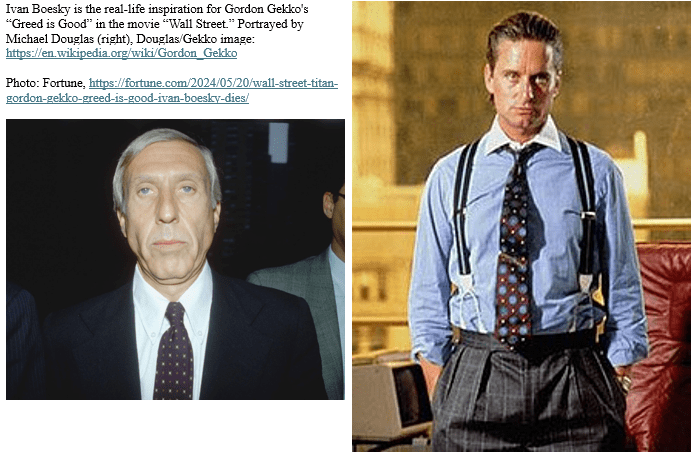
The “bros” should study earnestly the real and fictional outcomes of Boesky and Gekko.