"The one exclusive sign of thorough knowledge is the power of teaching." Aristotle | Disclaimer: The views and opinions expressed on this Wordpress website are the views and opinions of the content creator, Dr. Reggie Goodwin, and should not be construed as shared, or sourced from The Environmental Protection Agency, or any organizations with which they have cooperative, or business relationships.
Topics: Astrobiology, Philosophy, SETI, Space Exploration
In my freshman seminar at Harvard last semester, I mentioned that the nearest star to the sun, Proxima Centauri, emits mostly infrared radiation and has a planet, Proxima b, in the habitable zone around it. As a challenge to the students, I asked: “Suppose there are creatures crawling on the surface of Proxima b? What would their infrared-sensitive eyes look like?” The brightest student in class responded within seconds with an image of the mantis shrimp, which possesses infrared vision. The shrimp’s eyes look like two ping-pong balls connected with cords to its head. “It looks like an alien,” she whispered.
When trying to imagine something we’ve never seen, we often default to something we have seen. For that reason, in our search for extraterrestrial life, we are usually looking for life as we know it. But is there a path for expanding our imagination to life as we don’t know it?
In physics, an analogous path was already established a century ago and turned out to be successful in many contexts. It involves conducting laboratory experiments that reveal the underlying laws of physics, which in turn apply to the entire universe. For example, around the same time when the neutron was discovered in the laboratory of James Chadwick in 1932, Lev Landausuggested that there might be stars made of neutrons. Astronomers realized subsequently that there are, in fact, some 100 million neutron stars in our Milky Way galaxy alone—and a billion times more in the observable universe. Recently, the LIGO experiment detected gravitational-wave signals from collisions between neutron stars at cosmological distances. It is now thought that such collisions produce the precious gold that is forged into wedding bands. The moral of this story is that physicists were able to imagine something new in the universe at large and search for it in the sky by following insights gained from laboratory experiments on Earth.
“If you tell a lie big enough and keep repeating it, people will eventually come to believe it. The lie can be maintained only for such time as the State can shield the people from the political, economic, and/or military consequences of the lie. It thus becomes vitally important for the State to use all of its powers to repress dissent, for the truth is the mortal enemy of the lie, and thus by extension, the truth is the greatest enemy of the State.” Image, and quote from the Jewish Virtual Library.
Topics: Civics, Civil Rights, Existentialism, Fascism, Human Rights
The novel was published during the heyday of fascism in Europe, which was reported on by Dorothy Thompson, [Sinclair] Lewis’s wife.[3] The novel describes the rise of Berzelius “Buzz” Windrip, a demagogue who is elected President of the United States, after fomenting fear and promising drastic economic and social reforms while promoting a return to patriotism and “traditional” values. After his election, Windrip takes complete control of the government and imposes totalitarian rule with the help of a ruthless paramilitary force, in the manner of European fascists such as Adolf Hitler and Benito Mussolini. The novel’s plot centers on journalist Doremus Jessup’s opposition to the new regime and his subsequent struggle against it as part of a liberal rebellion. Source: Wikipedia, “It Can’t Happen Here,” Sinclair Lewis
The former Republican Party published an autopsy of their failed efforts to make President Barack Obama a one-term executive after 2012. They lost backing the bastion of latte Republicanism, Mitt Romney, who lied his ass off in the first presidential debate, yet his warnings about Russia in the second have stood the test of time. The Growth and Opportunity Project is a double entendre: the capitalized lettering obviously referring to the former party by its acronym, a suggestion that with a few tweaks, they could meet the changing demographics clear-eyed, with a strategy for growth, and success. Commissioned by the first of three serial Chiefs of Staff, Reince Priebus, it was soon as published turned to political toilet paper.
There is a potent currency to whiteness, ever since it was created in 1681 after the Bacon Rebellion by the one percent of the day. Efficiently separating citizens into “us,” and “others” is effective in not having accountability for sadistic policies. It’s not that executive boards of predominately cisgender white men sought to take their jobs overseas to pay pennies on the dollar for what amounts to sweatshop slave labor. It’s “those blacks,” “those Mexicans,” “those Haitians,” “those Afghanis,” “those climate refugees,” those “others” that took your job. You can blame others for every missed opportunity, every failure to obtain a promotion and financial security. It’s an effective gaslighting tool when your marks participate in the con.
If you’re seeing a commercial by an outfit called American Edge Project, they are a part of an impressive list of Dark Money groups Open Secrets documents that are completely fine with the continuation of the con job that allows them to pay little, or no taxes, yet have outsized influence in our legislation, and laws through what is ostensibly “legal” bribes. Many of those legal bribes come from social media behemoths.
The Wall Street Journal did an expose on Facebook (NPR article), and its ancillary product Instagram on its negative effects on preteen, and teenage girls that they apparently knew about, and for the sake of Mammon, and sacrifices on the altar of Moloch, did little, or nothing to mitigate its deleterious effects. The attempted coup was in part, organized on its platform, vaccine hesitancy, and abject quackery, as well as other iterations of social media. Social media is the main propagator of propaganda, yet hold onto the notion they’re not “journalism,” therefore cannot be held accountable by those standards. Seventy-three percent of election misinformation dropped worldwide when the modern propagator of the “Big Lie” got his Twitter account permanently closed.
The so-called Cyber Ninjas not only proved once again that Joe Biden won, but they also found him more votes. They owe Arizona an apology and reimbursement of money to taxpayers for despoiled voting machines. But the “Big Lie” persists in Texas, ordering an audit where the former Oval Office occupant won the red state handily, a cynical, craven move by Greg Abbott to protect his right flank from the true crazies that want his job in a GOP primary. That is the point behind voter restrictions, and draconian abortion “posses.” He is the American analog of Saddam Hussein holding back ISIS. Texans teeter towards Gilead.
Modern fascists don’t wear swastikas, but aren’t morally opposed to the useful rubes that insist on them, and goosestep like peacocks in parades to “scare the blacks,” “scare the Mexicans,” and “own the libs.” True fascists work from boardrooms, have lobbyists funneling dark money on Capitol Hill to Democratic “moderates,” and Republican empty suits. Modern fascists wear expensive Italian suits, jut their tanned, California-surfer-dude chins out, contradict their last statements made after the Capitol insurrection, and manage six-figure salaries essentially treading water. Other democratic republics like England, Germany, France, and Israel, form coalition governments of parties that resemble our duopoly in the US, and the fringes that so far in a communications analogy, are kept as low noise to the broader signal of democratic governance. It’s messy, but coalescing the “will of the governed” is always messy. We, by the way, have and insist on a duopoly because the lobbyists can easily “split the baby” in the management of their legal bribes.
Which is why I wonder: if the Keystone Cops Coup, on January 6, 2021, was successful, or any other subsequent coup by a more competent fascist ended the “democratic experiment,” would Corporate America follow a moral obligation to save our federal republic?
The documentary shows the development of the contemporary business corporation, from a legal entity that originated as a government-chartered institution meant to affect specific public functions to the rise of the modern commercial institution entitled to most of the legal rights of a person. The documentary concentrates mostly upon corporations in North America, especially in the United States. One theme is its assessment of corporations as persons, as a result of an 1886 case in the Supreme Court of the United States in which a statement by Chief JusticeMorrison Waite[nb 1] led to corporations as “persons” having the same rights as human beings, based on the Fourteenth Amendment to the United States Constitution.
Topics: Applied Physics, Einstein, General Relativity, Special Relativity
According to Einstein’s theory of special relativity, first published in 1905, light can be converted into matter when two light particles collide with intense force. But, try as they might, scientists have never been able to do this. No one could create the conditions needed to transform light into matter — until now.
Physicists claim to have generated matter from pure light for the first time — a spectacular display of Einstein’s most famous equation.
This is a significant breakthrough, overcoming a theoretical barrier that seemed impossible only a few decades ago.
What does E=mc2 mean? The world’s most famous equation is both straightforward and beyond comprehension at the same time: “Energy equals mass times the speed of light squared.”
At its most fundamental level, it means energy and mass are various forms of the same thing. Energy may transform into mass and vice versa under the right circumstances.
However, imagine a light beam transforming into, say, a paper clip, and it seems like pure magic. That’s where the “speed of light squared” factors in. It determines how much energy a paper clip or any piece of matter contains. The speed of light is the factor needed to make mass and energy equal. If every atom in a paper clip could be converted to pure energy, it would generate 18 kilotons of TNT. That’s around the size of the Hiroshima bomb from 1945.
(Still can’t picture it? Me neither.)
You can go the other way, too: if you crash two highly energized light particles, or photons, into each other, then you can create energy and mass. It sounds simple enough, but no one has been able to make it happen.
Since they couldn’t accelerate light particles, the team opted for ions, and used the Relativistic Heavy Ion Collider (RHIC) to accelerate them at extreme speeds. In two accelerator rings at RHIC, the accelerated gold ions to 99.995% of the speed of light. With 79 protons, a gold ion has a strong positive charge. When a charged heavy ion is accelerated to incredible speeds, a strong magnetic field swirls around it.
That magnetic field produces “virtual photons.” So, in a roundabout way, they accelerated light particles by piggybacking them on an ion.
When the team sped the ions in the accelerator rings with significant energy, the ions nearly collided, allowing the photon clouds surrounding them to interact and form an electron-positron pair — essentially, matter. They published their work in the journal Physical Review Letters.
To build the metaverse, Facebook needs us to get used to smart glasses.
Last week Facebook released its new $299 “Ray-Ban Stories” glasses. Wearers can use them to record and share images and short videos, listen to music, and take calls. The people who buy these glasses will soon be out in public and private spaces, photographing and recording the rest of us, and using Facebook’s new “View” app to sort and upload that content.
My issue with these glasses is partially what they are, but mostly what they will become, and how that will change our social landscape.
How will we feel going about our lives in public, knowing that at any moment the people around us might be wearing stealth surveillance technology? People have recorded others in public for decades, but it’s gotten more difficult for the average person to detect, and Facebook’s new glasses will make it harder still since they resemble and carry the Ray-Ban brand.
That brand’s trusted legacy of “cool” could make Facebook’s glasses appeal to many more people than Snap Spectacles and other camera glasses. (Facebook also has roughly 2 billion more users than Snapchat.) And Facebook can take advantage of the global supply chain and retail outlet infrastructure of Luxottica, Ray-Ban’s parent company. This means the product won’t have to roll out slowly—even worldwide.
Magnetic prosthetic: A magnetic sensing array enables a new tissue tracking strategy that could offer advanced motion control in artificial limbs. (Courtesy: MIT Media Lab/Cameron Taylor/Vessel Studios)
In recent years, health and fitness wearables have gained popularity as platforms to wirelessly track daily physical activities, by counting steps, for example, or recording heartbeats directly from the wrist. To achieve this, inertial sensors in contact with the skin capture the relevant motion and physiological signals originating from the body.
As wearable technology evolves, researchers strive to understand not just how to track the body’s dynamic signals, but also how to simulate them to control artificial limbs. This new level of motion control requires a detailed understanding of what is happening beneath the skin, specifically, the motion of the muscles.
Skeletal muscles are responsible for almost all movement of the human body. When muscle fibers contract, the exerted forces travel through the tendons, pull the bones, and ultimately produce motion. To track and use these muscle contractions in real-time and with high signal quality, engineers at Massachusetts Institute of Technology (MIT) employed low-frequency magnetic fields – which pass undisturbed through body tissues – to provide accurate and real-time transcutaneous sensing of muscle motion. They describe their technique in Science Robotics.
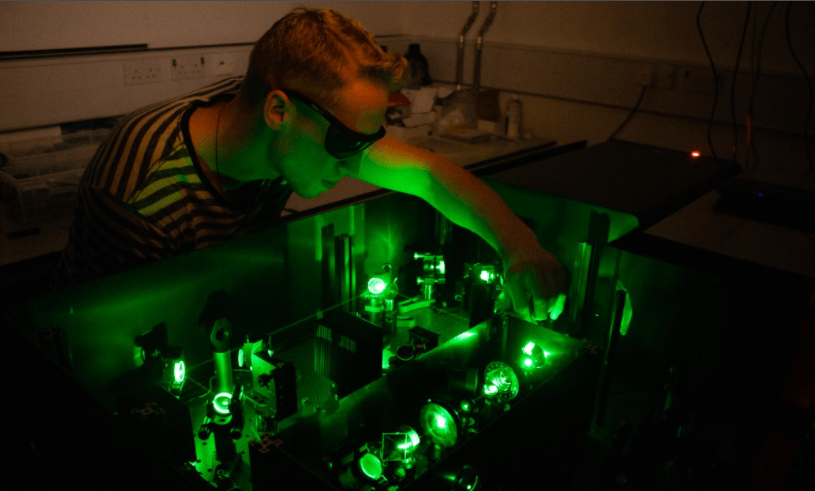
Surfing excitons: Cambridge’s Alexander Sneyd with the transient-absorption microscopy set-up. (Courtesy: Alexander Sneyd)
Topics: Alternate Energy, Applied Physics, Materials Science, Nanotechnology, Solar Power
Organic solar cells (OSCs) are fascinating devices where layers of organic molecules or polymers carry out light absorption and subsequent transport of energy – the tasks that make a solar cell work. Until now, the efficiency of OSCs has been thought to be constrained by the speed at which energy carriers called excitons to move between localized sites in the organic material layer of the device. Now, an international team of scientists led by Akshay Rao at the UK’s University of Cambridge has shown that this is not the case. What is more, they have discovered a new quantum mechanical transport mechanism called transient delocalization, which allows OSCs to reach much higher efficiencies.
When light is absorbed by a solar cell, it creates electron-hole pairs called excitons and the motion of these excitons plays a crucial role in the operation of the device. An example of an organic material layer where light absorption and transport of excitons takes place is in a film of well-ordered poly(3-hexylthiophene) nanofibers. To study exciton transport, the team shone laser pulses at such a nanofiber film and observed its response.
Exciton wave functions were thought to be localized due to strong couplings with lattice vibrations (phonons) and electron-hole interactions. This means the excitons would move slowly from one localized site to the next. However, the team observed that the excitons were diffusing at speeds 1000 times greater than what had been shown for similar samples in previous research. These speeds correspond to a ground-breaking diffusion length of about 300 nm for such crystalline films. This means energy can be transported much faster and more efficiently than previously thought.
Topics: Civics, Civil Rights, Climate Change, COVID-19, Existentialism, Fascism, Human Rights
In a speech 40 years ago to a group of conservative preachers, Heritage Foundation founder Paul Weyrich said, “Now many of our Christians have what I call the ‘goo-goo syndrome.’ Good government. They want everybody to vote. I don’t want everybody to vote. Elections are not won by a majority of people. They never have been from the beginning of our country, and they are not now.
“As a matter of fact,” he continued, “our leverage in the elections quite candidly goes up as the voting populace goes down.”
Weyrich’s idea continues to animate the GOP today. In dismissing a Democratic push for reforms, including vote-by-mail, same-day registration, and early voting to assist state-run elections in the midst of the deadly COVID-19 pandemic, Donald Trump opined, “They had things, levels of voting that if you’d ever agreed to it, you’d never have a Republican elected in this country again.”
Starting with Nixon’s “Southern Strategy” in 1968, through Weyrich’s candid acknowledgment in 1980, to Donald Trump’s numerous rants, the GOP has consistently stood against reasonable voter registration laws and fair and equitable access to the polls — because they know they lose in a battle of ideas.
Bill Dwyer, Oak Park, and River Forest Letters to the Editor, Opinion: Wednesday Journal November 18, 2020, Updated February 11, 2021
The modern “gang of Putin” is Paul Weyrich’s wet dream. There is a through-line from Barry Goldwater to Weyrich, Weyrich to Nixon, Nixon to Reagan, Reagan to Orange Satan. Goldwater got some disingenuous ads against him, painting him as crazy enough to start a thermonuclear war. Lyndon Baines Johnson won 486 electoral votes to Goldwater’s 52. It was then Goldwater, years before Watergate, coined “you’ve got to hunt where the ducks are.” The ducks were the disaffected southern Dixiecrats in deep depression because Civil Rights and Voting Rights from the US Constitution were being extended to African Americans. When you have privilege, equal justice seems like persecution. Privilege is a kind of willful blindness. For white supremacist power, party insiders weren’t, and aren’t, willing to remove the scales.
Former President George W. Bush indicted [the] January 6, 2021 attempted coup in his remarks at the 20-year anniversary observance of 9/11. Bush, however, appointed federal judges during his tenure in a nod to Goldwater, Weyrich, and Nixon’s “Southern Strategy.” George W. Bush signed the reauthorization of the Voting Rights Act when it was a bipartisan affair: it is now seen as existential for Democrats, and disposable for Republicans. The 2000 election was controversial: Bush won the electoral college and lost the popular vote, the second Republican presidential candidate to do so in this century. His party’s nominees have lost the popular vote in seven out of eight presidential elections, and, by their admission, they are demographically shrinking. Bush’s defense attorneys in Florida were Chief Justice John Roberts, and Justices Brett Kavanaugh, and Amy Coney Barrett, three of five judges appointed by presidents who lost the popular vote. The Patriot Act was seen as government overreach into civil liberties and birthed a lot of blogs on the left as mainstream media ignored it for access journalism. We’re reeling from the expense of the Afghanistan and Iraq Wars, one too long in duration, and the other added via obfuscation. He may not have been as extreme as we currently see his party exhibiting, but he did inadvertently till the soil of institutional doubt.
It is obvious today that America has defaulted on this promissory note insofar as her citizens of color are concerned. Instead of honoring this sacred obligation, America has given its colored people a bad check, a check that has come back marked “insufficient funds.” But we refuse to believe that the bank of justice is bankrupt. We refuse to believe that there are insufficient funds in the great vaults of opportunity of this nation. So we have come to cash this check, a check that will give us upon demand the riches of freedom and security of justice. We have also come to his hallowed spot to remind America of the fierce urgency of Now.
Dr. Martin Luther King Jr., “I Have A Dream,” August 28, 1963
“The Wages of Whiteness” a book by David R. Roediger I use to juxtapose the check America is still trying to cash with African Americans without sufficient funds. The wage of this whiteness was supposed to have sufficiency in perpetuity. All it needed were pariahs that they could blame for any societal faux pas: the economy and welfare were the faults of “young bucks,” and “welfare queens,” not oligarchs and tax cheats. We were patriotic and resolute until Iran-Contra occurred, flooding weapons to the Contras, and drugs to Compton. Culture wars were always the right’s “whitewashed sepulchers,” dead tombs with the façade of rose-covered balconies, and rainbow farts out of unicorns. The pariah label was extended to all BIPOC, and karma is making them the majority by 2042. The check for the balance of supremacy is draining inexorably from the church bank account of the whitewashed sepulcher.
The latest in a trilogy of one word title tomes by Bob Woodward starting with “Fear,” “Rage” and the apt-named “Peril” where the current Chair of the Joint Chiefs of Staff wanted to ensure that the former occupant of the Oval Office didn’t launch World War III to stay in power. The Russian Puppet and his cult followers confuse treason to The Constitution with loyalty to him. Fun fictional fact: Star Trek’s version of Armageddon happens in 2026.
Texas is a laboratory for instigating “The Handmaid’s Tale.” Second Amendment rights trumps (pun intended) bodily autonomy. South Dakota’s governor always looks high, giving the middle finger to masks and Lakota sacred grounds on the 4th of July during the alpha phase of the pandemic, and Florida’s governor has the well-earned nickname “Death Santis” that will stick in his bid for re-election, and higher office. A heat map of COVID hotspots in California is almost an exact replica of the electoral areas that started the California recall. You can replicate that map in red states versus blue states. The entire party has devolved into a Dunning-Kruger death cult.
People tend to hold overly favorable views of their abilities in many social and intellectual domains. The authors suggest that this overestimation occurs, in part, because people who are unskilled in these domains suffer a dual burden: Not only do these people reach erroneous conclusions and make unfortunate choices, but their incompetence robs them of the metacognitive ability to realize it. Across 4 studies, the authors found that participants scoring in the bottom quartile on tests of humor, grammar, and logic grossly overestimated their test performance and ability. Although their test scores put them in the 12th percentile, they estimated themselves to be in the 62nd. Several analyses linked this miscalibration to deficits in metacognitive skill, or the capacity to distinguish accuracy from error. Paradoxically, improving the skills of participants, and thus increasing their metacognitive competence, helped them recognize the limitations of their abilities.
After Watergate, the right deliberately designed an echo chamber to tell itself everything they wanted to hear: good, not bad, propaganda not history, fiction, not reality. Karl Rove told reporter Ron Suskind: “The aide said that guys like me were ‘in what we call the reality-based community,’ which he defined as people who ‘believe that solutions emerge from your judicious study of discernible reality.’ […] ‘That’s not the way the world really works anymore,’ he continued. ‘We’re an empire now, and when we act, we create our own reality. And while you’re studying that reality—judiciously, as you will—we’ll act again, creating other new realities, which you can study too, and that’s how things will sort out. We’re history’s actors…and you, all of you, will be left to just study what we do.'” There is a district in Texas that every two years, consciously reelects Louie Gohmert to the US House of Representatives, the “disparage my asparagus” former judge, and lawyer. Nonplussed initially, Former Attorney General Eric Holder responded with the sickest burn a year later in 2014: “good luck with your asparagus.”
North Carolina US Republican Representative Madison Cawthorne crashed a school board meeting in Henderson, NC to troll Governor Roy Cooper about masks. Key point: he wasn’t there. Couple that with his abysmal grades the one year he attended college, at this point, I cannot take him, or the rest of his party seriously. I may not have been a fan of Ronald Reagan, but Reaganism stood for something; Trumpism is sadistic Seinfeld. They’re all white grievance minstrels, performance artists, professional trolls, and nihilists. “Owning the libs” is all they live for. The asylum inmates running for office currently are mean-girl teenagers running on the population, and likes of their Instagram and Twitter accounts. Their platform is an empty wagon: making a lot of noise, and doing nothing.
“Idiocracy” did not take 500 years of political Entropy: it just took the desperation of a party that sees its power waning, and is clinging to power at all cost, even if that wage paid is the republic.
“The fundamental cause of the trouble is that in the modern world the stupid are cocksure while the intelligent are full of doubt.” ― Bertrand Russell
Topics: NASA, Space Exploration, Spaceflight, SpaceX, Star Trek
Dr. King revealed to Nichols that TOS was the only show that he and his wife, Coretta, allowed their little children to stay up and watch. Further, he told Nichols what the show meant to him personally and detailed the importance of her having created a character with “dignity and knowledge.” Nichols took it all in and finally said, “Thank you so much, Dr. King. I’m really going to miss my co-stars.” Dr. King’s smile, Nichols recalled, vanished from his face.
“He said, ‘What are you talking about?'” the actress explained. “I told him. He said, ‘You cannot,’ and so help me, this man practically repeated verbatim what Gene said. He said, ‘Don’t you see what this man is doing, who has written this? This is the future. He has established us as we should be seen. Three hundred years from now, we are here. We are marching. And this is the first step. When we see you, we see ourselves, and we see ourselves as intelligent and beautiful and proud.’ He goes on and I’m looking at him and my knees are buckling. I said, ‘I…, I…’ And he said, ‘You turn on your television and the news comes on and you see us marching and peaceful, you see the peaceful civil disobedience, and you see the dogs and see the fire hoses, and we all know they cannot destroy us because we are there in the 23rd century.’
Note: At this posting, she made history yesterday.
Sian Proctor is making history as the first-ever Black female spacecraft pilot.
Proctor, a geoscientist, artist and science communicator, has been paving the way in the space sector for decades. Now, years after being a finalist in NASA’s astronaut candidate program back in 2009, she is realizing her dream of becoming an astronaut as she launches to orbit with the Inspiration4 mission tonight (Sept. 15).
While the mission itself is making history as the first all-civilian mission to launch to orbit, Proctor is accomplishing a major first herself as the first Black female spacecraft pilot.
“I’m really grateful to be here and to have this opportunity,” Proctor said Sept. 14 during a news conference with reporters. “There have been three Black female astronauts that have made it to space, and knowing that I’m going to be the fourth means that I have this opportunity to not only accomplish my dream, but also inspire the next generation of women of color and girls of color and really get them to think about reaching for the stars and what that means.”
The Royal Society of Chemistry: Thorium (named for a certain Marvel character).
If China’s experimental reactor is a success it could lead to commercialization and help the nation meet its climate goals.
Scientists are excited about an experimental nuclear reactor using thorium as fuel, which is about to begin tests in China. Although this radioactive element has been trialed in reactors before, experts say that China is the first to have a shot at commercializing the technology.
The reactor is unusual in that it has molten salts circulating inside it instead of water. It has the potential to produce nuclear energy that is relatively safe and cheap, while also generating a much smaller amount of very long-lived radioactive waste than conventional reactors.
Construction of the experimental thorium reactor in Wuwei, on the outskirts of the Gobi Desert, was due to be completed by the end of August — with trial runs scheduled for this month, according to the government of Gansu province.
Thorium is a weakly radioactive, silvery metal found naturally in rocks, and currently has little industrial use. It is a waste product of the growing rare-earth mining industry in China and is, therefore, an attractive alternative to imported uranium, say researchers.
The pulsar J0030 appears to have two to three hotspots on its southern hemisphere only – a finding astronomers didn’t expect. NASA’s Goddard Space Flight Center/CI Lab (animation on the page link below)
NASA’s NICER instrument reveals that neutron stars are not as simple as we thought.
Pulsars are the lighthouses of the universe. These tiny, compact objects are neutron stars — the remnants of once-massive stars — that spin rapidly, beaming radiation into space. Now, for the first time, astronomers have mapped the surface of a 16-mile-wide pulsar in exquisite detail. The discovery calls into question astronomers’ textbook depiction of pulsar appearance and opens the door to learning more about these extreme objects.
The Neutron star Interior Composition Explorer, or NICER, searches for X-rays from extreme astronomical objects such as pulsars from its perch on the exterior of the International Space Station. Researchers used NICER to observe the pulsar J0030+0451, or J0030 for short, which is located 1,100 light-years away in the constellation Pisces, in a series of papers published in The Astrophysical Journal Letters. Two teams, one led by researchers at the University of Amsterdam and the other by researchers at the University of Maryland, used X-ray light from J0030 to map the pulsar’s surface and calculate its mass. Both teams arrived at a conclusion that was unexpected.
A New Picture
What the teams found presented a different picture: J0030 has two or three hotspots, all of which are located in the southern hemisphere. The researchers at the University of Amsterdam believe the pulsar has one small, circular spot and one thin, crescent-shaped spot spinning around its lower latitudes. The University of Maryland team discovered that the X-rays could be coming from two oval spots in the star’s southern hemisphere, as well as one cooler spot near the star’s south pole.
Neither result is the simple picture astronomers expected, indicating that the pulsar’s magnetic field, which causes the hotspots, is likely even more complex than originally assumed. While the result certainly leaves astronomers wondering, “It tells us NICER is on the right path to help us answer an enduring question in astrophysics: What form does matter take in the ultra-dense cores of neutron stars?” NICER science lead and study co-author Zaven Arzoumanian said in a press release.
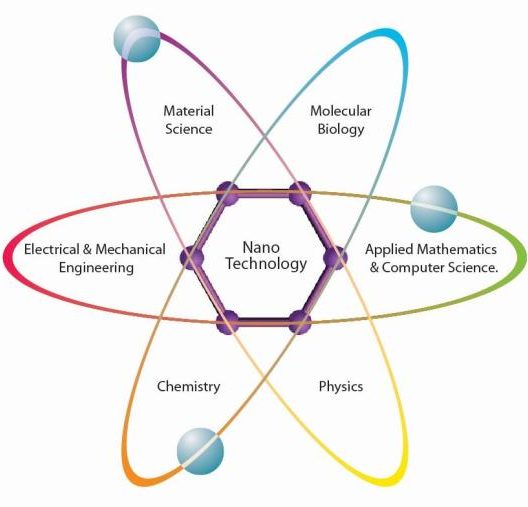








 Physics and Nano