"The one exclusive sign of thorough knowledge is the power of teaching." Aristotle | Disclaimer: The views and opinions expressed on this Wordpress website are the views and opinions of the content creator, Dr. Reggie Goodwin, and should not be construed as shared, or sourced from The Environmental Protection Agency, or any organizations with which they have cooperative, or business relationships.
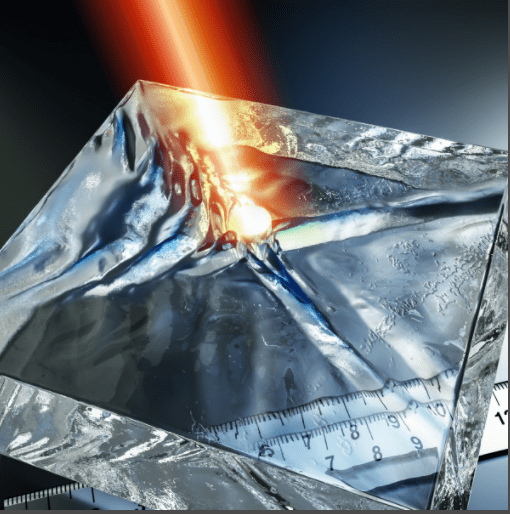
Quasiparticles in motion: illustration of ghost polaritons in a calcite crystal being “launched” to record distances by a gold microdisk. (Courtesy: HUST)
Topics: Condensed Matter Physics, Modern Physics, Quantum Mechanics
The existence of ghost hyperbolic surface polaritons has been demonstrated by an international collaboration including researchers in China and the US. Based at Huazhong University of Science and Technology (HUST), National University of Singapore (NUS), National Center for Nanoscience and Technology (NCNST), and the City University of New York (CUNY), the team showed that the polariton – a hybrid light-matter quasiparticle – has a record-breaking propagation distance of three times its photon wavelength. This ghost polariton is an exciting discovery that has applications in sub-wavelength, low-loss imaging, sensing, and information transfer. The full study is described in Nature.
Previously, hyperbolic polaritons, which arise from the strong coupling of electromagnetic radiation to lattice vibrations (phonons) in anisotropic crystals, had only been observed in two forms: bulk polaritons and surface polaritons. Bulk, volume-confined, hyperbolic polaritons (v-HPs) have a real out-of-plane wavevector and hence can propagate within the material supporting them. Surface-confined hyperbolic polaritons (s-HPs), however, have an entirely imaginary out-of-plane wavevector, and so decay exponentially away from the crystal surface, a property called evanescence. The hyperbolic dispersion of these polaritons is the result of the crystal’s dielectric anisotropy, which results in hyperbolic isofrequency contours in k-space (momentum space) and concave wavefronts in real space.
Most studies on v-HPs and s-HPs have been performed in thin layers of van der Waals crystals. These crystals comprise stacks of covalently bound 2D layers that are held together by weak van der Waals forces. However, in such crystal layers, there is no control over the optical axis. This is the direction in which propagating light experiences no birefringence and it is typically aligned with the layers.
Complementarity A new twist on the double-slit experiment. (Courtesy: Shutterstock/Andrey VP)
Topics: Modern Physics, Quantum Mechanics, Theoretical Physics
One of the most counterintuitive concepts in physics – the idea that quantum objects are complementary, behaving like waves in some situations and like particles in others – just got a new and more quantitative foundation. In a twist on the classic double-slit experiment, scientists at Korea’s Institute for Basic Sciences (IBS) used precisely controlled photon sources to measure a photon’s degree of wave-ness and particle-ness. Their results, published in Science Advances, show that the properties of the photon’s source influence its wave and particle character – a discovery that complicates and challenges the common understanding of complementarity.
The double-slit experiment is the archetypal example of complementarity at work. When a single photon encounters a barrier with two thin openings, it produces an interference pattern on a screen placed behind the openings – but only if the photon’s path is not observed. This interference pattern identifies the photon as a wave since a particle would create only one point of light on the screen. However, if detectors are placed at the openings to determine which slit the photon went through, the interference pattern disappears, and the photon behaves like a particle. The principle of complementarity states that both experimental outcomes are needed to fully understand the photon’s quantum nature.
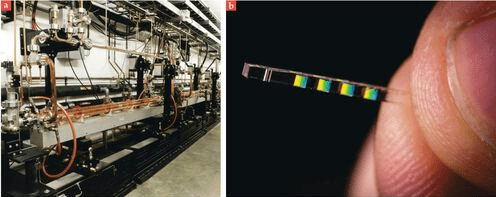
Figure 1. The size contrast between conventional accelerator facilities and chip-based accelerators is dramatic. (a) The Next Linear Collider Test Accelerator facility at SLAC was used for early laser-acceleration experiments in 2012–15. (Image courtesy of the Archives and History Office/SLAC National Accelerator Laboratory.) (b) The first dielectric laser accelerator chips demonstrated at SLAC were made of fused silica and were each the size of a grain of rice. (Image courtesy of Christopher Smith/SLAC National Accelerator Laboratory.)
Topics: Applied Physics, Modern Physics, Particle Physics
Particle accelerators are among the most important scientific tools of the modern age. Major accelerator facilities, such as the 27-km-circumference Large Hadron Collider in Switzerland, where the Higgs boson was recently discovered, allow scientists to uncover fundamental properties of matter and energy. But the particle energies needed to explore new regimes of physics have increased to the TeV scale and beyond, and accelerator facilities based on conventional technologies are becoming prohibitively large and costly. Even lower-energy, smaller-scale accelerators used in medicine and industry are often cumbersome devices; they can weigh several tons and cost millions of dollars.
Efforts are consequently underway to develop more compact, less expensive accelerator technologies. One approach, a dielectric laser accelerator (DLA), uses an ultrafast IR laser to deliver energy to electrons inside a microchip-scale device. Efficient, ultrafast solid-state lasers and semiconductor fabrication methods developed over the past two decades have enabled a new breed of photonic devices that can sustain accelerating fields one to two orders of magnitude larger than conventional microwave-cavity accelerators.
The approach has the potential to dramatically shrink particle accelerators, thereby enabling ultrafast tabletop electron diffraction and microscopy experiments and tunable x-ray sources. An international effort is now underway to develop a laser-driven accelerator integrated on a silicon photonics platform: an “accelerator on a chip.”
The origin of life is one of the great unanswered questions in science. One piece of this puzzle is that life started on Earth 4.5 billion years ago, just a few hundred million years after the formation of the Solar System, and involved numerous critical molecular components. How did all these components come to be available so quickly?
One potential explanation is that the Earth was seeded from space with the building blocks for life. The idea is that space is filled with clouds of gas and dust that contain all the organic molecules necessary for life.
Indeed, astronomers have observed these buildings blocks in interstellar gas clouds. They can see amino acids, the precursors of proteins, and the machinery of life. They can also see the precursors of ribonucleotides, molecules that can store information in the form of DNA.
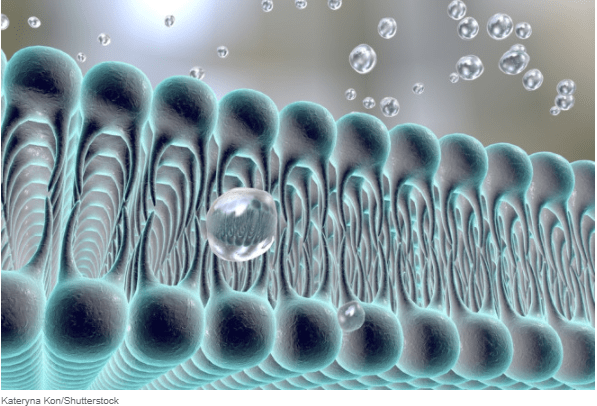
But there is another crucial component for life – molecules that can form membranes capable of encapsulating and protecting the molecules of life in compartments called protocells. On Earth, the membranes of all cells are made of molecules called phospholipids. But these have never been observed in space. Until now.
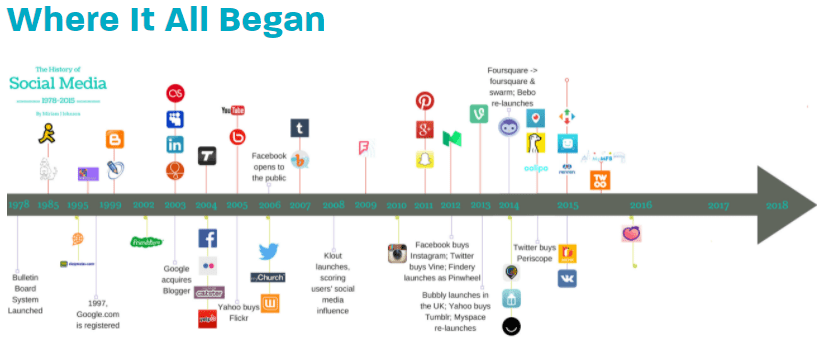
Timeline source: Key Media Solutions: “The Reverse Evolution of Social Media Platforms”
Topics: Civics, Civil Rights, Fascism, Human Rights, Politics, Star Trek
What happens when media and politics become forms of entertainment? As our world begins to look more and more like Orwell’s 1984, Neil’s Postman’s essential guide to the modern media is more relevant than ever.
“It’s unlikely that Trump has ever read Amusing Ourselves to Death, but his ascent would not have surprised Postman.” –CNN
Originally published in 1985, Neil Postman’s groundbreaking polemic about the corrosive effects of television on our politics and public discourse has been hailed as a twenty-first-century book published in the twentieth century. Now, with television joined by more sophisticated electronic media—from the Internet to cell phones to DVDs—it has taken on even greater significance. Amusing Ourselves to Death is a prophetic look at what happens when politics, journalism, education, and even religion become subject to the demands of entertainment. It is also a blueprint for regaining control of our media so that they can serve our highest goals.
“A brilliant, powerful, and important book. This is an indictment that Postman has laid down and, so far as I can see, an irrefutable one.” –Jonathan Yardley, The Washington Post Book World
The “corrosive effects of television” Dr. Postman’s polemic critiqued was [ironically], CNN, launched June 1, 1980, on a television executive’s “big idea.”
Movies like the Rocky Horror Picture Show and Star Wars became cult classics because as long as customers were buying tickets and popcorn, theater owners would play the show for months, and in the case of the two mentioned, each over a year. Ted Turner’s “big idea” was inspired by the creation of HBO: Home Box Office. It was the single, and only cable entertainment that expanded Hollywood’s earning power, as measured by Nielsen ratings. It was unique as most television stations ended their day’s programming at midnight, and so did HBO, initially. Mission creep extended their air time to twenty-four hours. “Saturday Night Live” — essentially, an improv show was crafted for night owls, as it tiptoed past that demarcation point, by design. Ted would develop a 24-hour news service of “infotainment.” The Nielsen altar gods needed satisfaction and a gimmick.
I always thought infotainment was coined by actor, and filmmaker Mario Van Peeples, but its origin was as a pejorative: “soft” news, versus hard, serious news. At a joint conference in the UK for media academicians, the infotainers put on comedy skits from 1980 – 1990 in their gatherings. The madness became a method as it’s obviously been copied on either of the cable news outlets that cloned themselves on Ted Turner’s model. We evolved from a nation that went from President Richard Nixon winning forty-nine out of fifty states, thereby becoming the first Republican to sweep the south with his “Law and Order” shtick post-Kent State and the violence at the Democratic National Convention, to the reality that he would be impeached in the House, and likely convicted in the Senate by members of his party due to the Watergate break-ins. It was the sober digestion of information from ABC, CBS, NBC — noncable, pre-infotainment outlets, by an “informed citizenry” regarding the culpability of a criminal president, a president that many had voted for.
Star Trek: Enterprise premiered on September 26, 2001. Due to its unfortunate timing fifteen days after 9/11, and theme of a hopeful future, as well as the former CBS president Les Moonves’ stated aversion to science fiction, ended after four seasons. His helm at CBS imploded with a sex scandal thanks to #MeToo movement accountability.
“24“: I’ve only seen two episodes, and my casual observation is Kiefer Sutherland as Jack Bauer reasonably kept audiences on-edge. The show entered the national zeitgeist in 2001: In a post-Vietnam, post-9/11 world, we needed some heroes, Tom Clancy novels were the water cooler conversation rage, Sly Stallone in Rocky version 17, or Rambo; Arnold Schwarzenegger in just about anything: we were itching for some ass to kick. Dennis Haysbert introduced the idea of an African American president before Barack Obama appeared on the scene, then all of a sudden, it wasn’t a good idea beyond fantasy and Nielsen ratings. The show ran from 2001 – 2010. Liz Cheney is lionized for upholding The Constitution since the January 6, 2021 insurrection, but her dad fantasized he was a character on 24, Jack Bauer maybe, or Jack Ryan from Tom Clancy novels. In our discernment between reality and fantasy, we were collectively “jacked.” The intersection between information and entertainment might have impacted her dad’s decisions that led to launching a 20-year war in Afghanistan, prior to which the Taliban offered Osama Bin Laden (but war makes more money than justice); lying about, or “sexing up” intelligence about weapons of mass destruction in Iraq, destabilizing that nation birthing ISIS, and the atrocities at Abu Ghraib, and Guantanamo. Lawmakers on both sides profit mightily from world instability, not world peace. But we live in reality, not a cartoon.
What South Dakota Governor Kristi Noem is doing, what Texas Governor Greg Abbot is doing, what Florida Governor Ron DeSantis is doing, what Arkansas Governor Asa Hutchinson wasdoing, the lamentations of Alabama Governor Kay Ivey-post her lifting mask orders and encouraging “common sense,” is the multigenerational poisoning of “whiteness,” where, in a self-fictitious story, every move you make works out; every conclusion is Pollyannaish with white picket fences: the “good guys” (you) always “win” at the end of a bloodless cartoon, roll credits. This alternative, fact-free non-reality isn’t five-dimensional chess: it’s a societal dissociative disorder. It’s the aftermath of centuries of lying to one’s selves and preferring the lie over the truth. Pollyannaish vision is why after 20 years and trillions of dollars, we’re shocked that our efforts in Afghanistan, or Iraq didn’t work, that “when they stand up, we’ll stand down” was always an empty slogan. Not facing the realities of a deadly pandemic, and its to-be-announced future Greek letter variants because of “free dumb” is figuratively, and literally a “no-brainer.”
Apocalypse: It’s a great title to a movie, story, supervillain, or blog post. It literally means “to uncover,” or “to reveal.” Biblical tradition translates and assigns it to the entire last book of the sacred text. Barbara Rossing tried to reclaim the negative interpretation of doom-and-gloom from evangelicals in her 2005 book “The Rapture Exposed.” She saw this interpretation as dangerous, and lending to the United States engaging in risky international actions that could lead to Mutually Assured Destruction, or totally ignore climate change as a problem that will be solved only by the Second Coming. Fatalism like this led to our actions in Afghanistan, and Iraq. Pollyannaish viewpoints like this “kick the can down the road” to the next presidential administration, trillions of dollars wasted on corruption in Kabul that could have been invested in roads, education; universal healthcare in the US. Former Secretary of State Mike Pompeo is an example of the peril of someone in power taking our continued existence for granted, and that “their side” will be the ones to survive. Not many former Secretaries of State have ever been called “doomsday clowns.”
All Americans, Native Americans, African Americans, Asian Americans, Hispanic Americans, LGBTQ Americans, Women, immigrants are being affected by the anti-democratic efforts of Republican legislatures to either pick the voters they want to be counted, or if elections don’t quite go their way, THROW out the results! Dr. King referred to that as “interposition, and nullification.” The reason Democrats pass symbolic bills in the House named for John Lewis, or the “For the People Act” is because they KNOW they will die in the Senate. The filibuster has been adjusted, carved out, flipped, manipulated for less than our ability to call ourselves a federal republic than for billionaire Oligarchs’ tax cuts. Both parties are invested in the “status quo.” It is ghoulish. It needs to change, our leadership needs to change, or our continuance as a country, as a human species, is in serious question.
I hope this post is a revelation, and with its act of uncovering and facing reality, we take different actions. I’m sure that was the whole intent of Dr. Neil Postman’s warnings of simply cable; before social media proliferated; before phone apps were invented, before our news outlets consolidated, and morphed into self-deluding echo chambers kowtowing to Nielsen ratings, before politicians became craven liars in stark evidence of insurrection, and would rather rule over a smoldering ruin of feces than serve in an actual democracy. Our nation and the world deserve better.
Our nation and the world get better when “we the people” demand better.
Nolite te bastardes carborundorum, Margaret Atwood, “The Handmaid’s Tale”: Don’t let the bastards grind you down. Demonstrate. Protest. Vote.
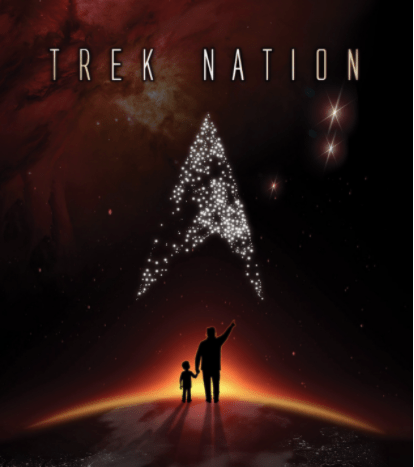
Image source: The Roddenberry Foundation link below
Topics: Planetary Science, Space Exploration, Spaceflight, Star Trek
NASA is helping the legacy of inspiration, hope, and diversity fostered by the creator of Star Trek to live long and prosper. The agency will observe the late Gene Roddenberry’s 100th birthday with a special program called, Celebrating Gene Roddenberry: Star Trek’s Bridge and NASA – a panel discussion airing on NASA Television, the agency’s website, the NASA App, and NASA social media at 2 p.m. EDT Thursday, Aug. 19.
The program includes introductory remarks by NASA Administrator Bill Nelson followed by a panel discussion moderated by Rod Roddenberry, son of Gene Roddenberry. Special guest George Takei, a Star Trek actor, and activist will participate in the question-and-answer session.
Coinciding with the program, NASA will broadcast into space a 1976 recording of Gene Roddenberry’s remarks on diversity and inclusion through the agency’s Deep Space Network of radio antennas. NASA also is inviting people on social media to join celebrating Roddenberry’s 100th birthday on Thursday by posting a Vulcan salute selfie with the hashtag #Roddenberry100.
An artist’s rendering shows how the National Ignition Facility’s 192 beams enter an eraser-size cylinder of gold and heat it from the inside to produce x-rays, which then implode the fuel capsule at its center to create fusion.
LAWRENCE LIVERMORE NATIONAL LABORATORY
Topics: Energy, Environment, Modern Physics, Nuclear Fusion, Nuclear Power
More than a decade ago, the world’s most energetic laser started to unleash its blasts on tiny capsules of hydrogen isotopes, with managers promising it would soon demonstrate a route to limitless fusion energy. Now, the National Ignition Facility (NIF) has taken a major leap toward that goal. Last week, a single laser shot sparked a fusion explosion from a peppercorn-size fuel capsule that produced eight times more energy than the facility had ever achieved: 1.35 megajoules (MJ)—roughly the kinetic energy of a car traveling at 160 kilometers per hour. That was also 70% of the energy of the laser pulse that triggered it, making it tantalizingly close to “ignition”: a fusion shot producing an excess of energy.
“After many years at 3% of ignition, this is super exciting,” says Mark Herrmann, head of the fusion program at Lawrence Livermore National Laboratory, which operates NIF.
NIF’s latest shot “proves that a small amount of energy, imploding a small amount of mass, can get fusion. It’s a wonderful result for the field,” says physicist Michael Campbell, director of the Laboratory for Laser Energetics (LLE) at the University of Rochester.
“It’s a remarkable achievement,” adds plasma physicist Steven Rose, co-director of the Centre for Inertial Fusion Studies at Imperial College London. “It’s made me feel very cheerful. … It feels like a breakthrough.”
And it is none too soon, as years of slow progress have raised questions about whether laser-powered fusion has a practical future. Now, according to LLE Chief Scientist Riccardo Betti, researchers need to ask: “What is the maximum fusion yield you can get out of NIF? That’s the real question.”
Fusion, which powers stars, forces small atomic nuclei to meld together into larger ones, releasing large amounts of energy. Extremely hard to achieve on Earth because of the heat and pressure required to join nuclei, fusion continues to attract scientific and commercial interest because it promises copious energy, with little environmental impact.
Topics: Astrophysics, Planetary Science, SETI, Space Exploration
Even as a child, before he devoted his life to the search for extraterrestrial life, Frank Drake wondered whether Earth was alone in its ability to harbor life. He wasn’t the first or the only one to wonder. There’s a reason so many are fascinated by the question: Its answer helps reveal humankind’s place in the cosmos.
Drake’s musings inspired him to pursue astronomy, serving as director of the Arecibo Observatory in Puerto Rico and president of the SETI Institute — which, as the acronym suggests, is devoted to the Search for Extraterrestrial Intelligence, and exploring the possibilities of life elsewhere in the universe. Drake is perhaps most famous for his eponymous equation — an estimate of how many alien civilizations might exist in our galaxy. Presented in 1961, the equation is generally considered as the start of a new era of searches for extraterrestrial intelligence.
But decades after the invention of that famous equation, Drake has conceded that his estimates were overly conservative. Among the too-moderate assumptions was that a potentially inhabited other world must be orbiting a star — overlooking the possibility of life on rogue planets.
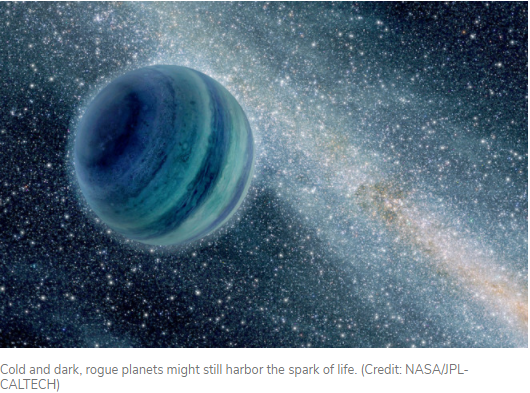
Sometimes called “nomads of the galaxy” or “orphan planets,” these cold, dark worlds careen through space with no home, no solar system, no sun to orbit. Long ago, they formed around a star, but were flung out, abandoned by their parents. There are billions of rogue planets — astronomers estimate there could be at least one for every star — wandering the galaxy.
It may seem futile to search for life in such cold, desolate environments, but over the last two decades, astronomers have come up with a number of possible scenarios that would make life possible on a planet without a star.
NASA’s Integrated System for Autonomous and Adaptive Caretaking, or ISAAC, is advancing new technology for robots to take care of spacecraft. Researchers recently demonstrated the tech aboard the International Space Station using Astrobee, NASA’s free-flying robotic assistants. Credits: NASA/Ames Research Center
Topics: International Space Station, NASA, Space Exploration, Spaceflight
In April 2021, Bumble, one of the free-flying Astrobee robots aboard the International Space Station, was put to the test to investigate a simulated anomaly. In the simulation, the station’s life support systems detected a high concentration of carbon dioxide. A similar situation, in reality, could be very dangerous for the seven people who are living and working aboard the microgravity laboratory.
During the test, the small, cube-shaped robot adeptly navigated the station to find the location designated as a “vent” used for cabin air circulation, and used computer vision to automatically detect the foreign object blocking the vent – an “astronaut sock,” represented by a printed image of a sock. Then, Bumble called for help to clear the blockage. For its next test, Bumble completed a survey of Bay 6 of the space station’s Japanese Exploration Module, building a high-resolution multi-sensor 3D map. During this journey, Bumble found itself bumping into and untangling itself from stray cables, and coping with simulated space-to-ground communication interruptions. It ultimately persevered and completed its mission objectives, with a little timely help from ground operators.
This simulated fault scenario marked the end of the first phase of testing for software designed to enable autonomous operations of a spacecraft’s operating and robotic systems. The software’s name is ISAAC – the Integrated System for Autonomous and Adaptive Caretaking.
“ISAAC is far more than just a management tool for our robotics and spacecraft systems,” said Trey Smith, the project manager for ISAAC at NASA’s Ames Research Center in California’s Silicon Valley. “Our long-term vision is that it can transform a spacecraft into an autonomous robotic system itself.”
NASA’s future Artemis missions to the Moon and beyond will take humans farther than they ever have before – and a host of robotic and mechanical systems will go with them. On the space station, much closer to home, astronauts have been able to stay full time, surpassing 20 years of continuous human presence – something that won’t be possible in deep space for some time. How can future spacecraft operate smoothly without that consistent human touch? ISAAC aims to deliver technologies to enable remote and autonomous caretaking during long periods of time when the astronauts are not aboard to perform maintenance, logistics management, and utilization tasks, as well as when communicating with ground controllers is limited or simply unavailable.
Topics: Civics, Civil Rights, COVID-19, Existentialism, Fascism, Human Rights
A statement by Michael Scriven & Richard Paul, presented at the 8th Annual International Conference on Critical Thinking and Education Reform, Summer 1987.
Critical thinking is the intellectually disciplined process of actively and skillfully conceptualizing, applying, analyzing, synthesizing, and/or evaluating information gathered from, or generated by, observation, experience, reflection, reasoning, or communication, as a guide to belief and action. In its exemplary form, it is based on universal intellectual values that transcend subject matter divisions: clarity, accuracy, precision, consistency, relevance, sound evidence, good reasons, depth, breadth, and fairness.
Matthew Taylor Coleman, 40, is charged with two counts of foreign murder of a United States national in the slaying of his 2-year-old son and 10-month-old daughter. He is accused of shooting them with a spearfishing gun on Monday in Rosarito — a beach community 30 minutes south of Tijuana, according to the U.S. Attorney’s Office.
Coleman runs the Lovewater Surf Co., a surfing school based in Santa Barbara, and is an alumnus of Point Loma Nazarene University in San Diego, according to the company’s website.
Coleman told FBI agents he killed his children by shooting a spear into their chests, explaining that he had been “enlightened by QAnon and Illuminati conspiracy theories” and “believed he was saving the world from monsters,” according to an affidavit in support of the complaint.
Then, there was this: A fraternity brother sent me a Messenger video: “The Vaccine Itself is Dangerous! Please listen.” The word vaccine was spelled with “V (o_9) cc,” or an emoji. That makes it legit, right?
My response: “I’ve had the vaccine, and so has my family. I’m not magnetic, I don’t have a chip inside of me (except Sun Chip Garden Salsa). As a doctoral student, I have to take and pass EIGHT safely classes annually, specifically now centered on COVID-19 to work in my research facility. I’m not going to listen to this brother, respectfully.”
His qualifier for the videographer? She was a young lady he met in passing, whom he found to be very attractive. “No sir I’m not taking anyone’s word and I’m not taking anyone’s vaccine, my brother from another mother. And, if your job requires it, I think they’re infringing on your civil liberties. But I say this again my brother, know exactly what you have put in your body.”
I pointed out he didn’t know the ingredients of what he eats in a restaurant. He retorted he did, and it was a fellow frat that revealed his recipe secrets. He, of course, left out the fact that there are other restaurants ON THE PLANET he’s probably patronized, and every chef in every restaurant is not going to be that forthcoming.
Me: “Do you have a stop sign or a speed limit on your street? Ever heard of ‘no shirt, no shoes, no service?’ How did those things NOT violate your ‘civil liberties?’ The only people I encounter that know nothing about civil liberties, or civics are libertarians. Fun fact: there aren’t any countries that follow libertarian philosophy. There might be a good reason why.”
That was the end of it. I blocked him. I guess I’ll see him at the convention (maybe).
From medical professionals being threatened by parents that somehow think “freedom” (rhymes with “free dumb”) is more important than keeping their kids from being intubated or dying, to my fraternity brother accepting info from a pretty passing face, as a nation, we’re bereft not only in civics but critical thinking. We’re at the end of a fifty-year campaign of gaslighting that started with the 1971 Powell memo. Summarized excellently by Thom Hartmann, it’s a corporate reaction to Rachel Carson’s “Silent Spring,” DDT, and avoiding environmental catastrophe, leading to cigarettes-not-causing-lung-cancer disinformation, continued with fossil fuel industry obfuscations on climate change since the 1970s; launched 10 years later by Ronald Reagan with his famous “government is the problem” inauguration speech, culminating in the current “American Carnage” we’re all living through. We’ve gotten used to lying to ourselves: our nation’s full history with all its brutality, mistakes, scars, and being lied to. We’re all primed to likely take advice from a pretty stranger passing in a stairwell that you might want to date or a social media post that conforms and confirms your internal biases.
The abject stupidity of this moment is by design; it does not lead to a stable republic.
“One of the things taken out of the curriculum was civics,” Zappa went on to explain. “Civics was a class that used to be required before you could graduate from high school. You were taught what was in the U.S. Constitution. And after all the student rebellions in the Sixties, civics was banished from the student curriculum and was replaced by something called social studies. Here we live in a country that has a fabulous constitution and all these guarantees, a contract between the citizens and the government – nobody knows what’s in it. And so, if you don’t know what your rights are, how can you stand up for them? And furthermore, if you don’t know what’s in the document, how can you care if someone is shredding it?”