"The one exclusive sign of thorough knowledge is the power of teaching." Aristotle | Disclaimer: The views and opinions expressed on this Wordpress website are the views and opinions of the content creator, Dr. Reggie Goodwin, and should not be construed as shared, or sourced from The Environmental Protection Agency, or any organizations with which they have cooperative, or business relationships.
Topics: Biology, Biotechnology, COVID-19, Research
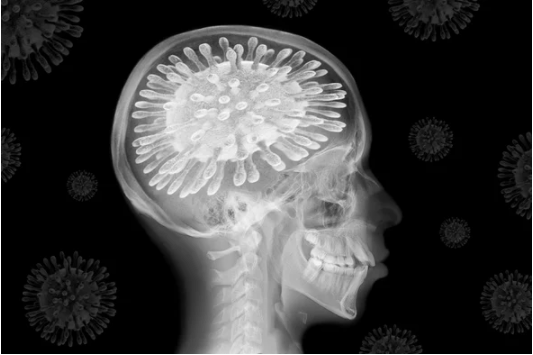
To advance a novel concept of debulking virus in the oral cavity, the primary site of viral replication, virus-trapping proteins CTB-ACE2 were expressed in chloroplasts and clinical-grade plant material was developed to meet FDA requirements. Chewing gum (2 g) containing plant cells expressed CTB-ACE2 up to 17.2 mg ACE2/g dry weight (11.7% leaf protein), have physical characteristics and taste/flavor like conventional gums, and no protein was lost during gum compression. CTB-ACE2 gum efficiently (>95%) inhibited entry of lentivirus spike or VSV-spike pseudovirus into Vero/CHO cells when quantified by luciferase or red fluorescence. Incubation of CTB-ACE2 microparticles reduced SARS-CoV-2 virus count in COVID-19 swab/saliva samples by >95% when evaluated by microbubbles (femtomolar concentration) or qPCR, demonstrating both virus trapping and blocking of cellular entry. COVID-19 saliva samples showed low or undetectable ACE2 activity when compared with healthy individuals (2,582 versus 50,126 ΔRFU; 27 versus 225 enzyme units), confirming greater susceptibility of infected patients for viral entry. CTB-ACE2 activity was completely inhibited by pre-incubation with SARS-CoV-2 receptor-binding domain, offering an explanation for reduced saliva ACE2 activity among COVID-19 patients. Chewing gum with virus-trapping proteins offers a generally affordable strategy to protect patients from most oral virus re-infections through debulking or minimizing transmission to others.
Henry Daniell, Smruti K. Nair, Nardana Esmaeili, Geetanjali Wakade, Naila Shahid, Prem Kumar Ganesan, Md Reyazul Islam, Ariel Shepley-McTaggart, Sheng Feng, Ebony N. Gary, Ali R. Ali, Manunya Nuth, Selene Nunez Cruz, Jevon Graham-Wooten, Stephen J. Streatfield, Ruben Montoya-Lopez, Paul Kaznica, Margaret Mawson, Brian J. Green, Robert Ricciardi, Michael Milone, Ronald N. Harty, Ping Wang, David B. Weiner, Kenneth B. Margulies, Ronald G. Collman
KASULO, Democratic Republic of Congo — A man in a pinstripe suit with a red pocket square walked around the edge of a giant pit one April afternoon where hundreds of workers often toil in flip-flops, burrowing deep into the ground with shovels and pickaxes.
His polished leather shoes crunched on dust the miners had spilled from nylon bags stuffed with cobalt-laden rocks.
The man, Albert Yuma Mulimbi, is a longtime power broker in the Democratic Republic of Congo and chairman of a government agency that works with international mining companies to tap the nation’s copper and cobalt reserves, used in the fight against global warming.
Mr. Yuma’s professed goal is to turn Congo into a reliable supplier of cobalt, a critical metal in electric vehicles, and shed its anything-goes reputation for tolerating an underworld where children are put to work and unskilled and ill-equipped diggers of all ages get injured or killed.
“We have to reorganize the country and take control of the mining sector,” said Mr. Yuma, who had pulled up to the Kasulo site in a fleet of SUVs carrying a high-level delegation to observe the challenges there.
But to many in Congo and the United States, Mr. Yuma himself is a problem. As chairman of Gécamines, Congo’s state-owned mining enterprise, he has been accused of helping to divert billions of dollars in revenues, according to confidential State Department legal filings reviewed by The New York Times and interviews with a dozen current and former officials in both countries.
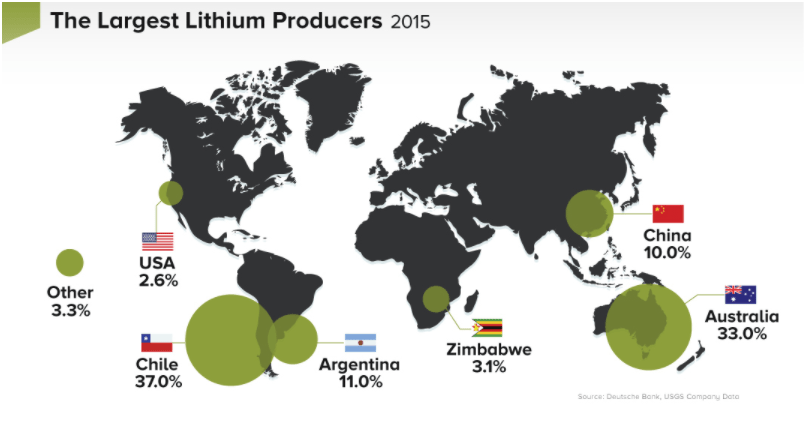
California and the Biden administration are pushing incentives to make the United States a global leader in a market that’s beginning to boom: the production of lithium, the lightweight metal needed for the batteries of electric vehicles, and for the storage of renewable energy from power plants.
At the moment nearly all the lithium used in the United States must be imported from China and other nations. But that trend could shift within two years if an efficient method is found to remove lithium from power plant waste in California.
Since the 1970s, California has built power plants that make electricity from geothermal energy—steam from saltwater heated by magma from the molten core of the Earth. It now accounts for 6 percent of California’s power, but it is more expensive to produce than other forms of renewable energy, such as solar and wind power.
But that calculus could change if the wastewater from the process—a whitish, soup-like brine that contains a mixture of dissolved minerals and metals including lithium—can be separated so the lithium could be extracted.
According to a study by the Department of Energy, the Salton Sea in California’s Imperial Valley—one of two large geothermal energy production sites in the state—could produce as much as 600,000 tons of lithium annually.
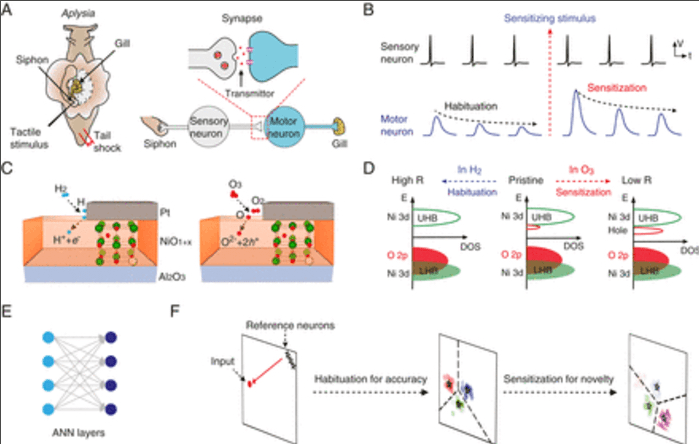
Rutgers researchers and their collaborators have found that learning – a universal feature of intelligence in living beings – can be mimicked in synthetic matter, a discovery that in turn could inspire new algorithms for artificial intelligence (AI). (Courtesy: Rutgers University-New Brunswick)
Quantum materials known as Mott insulators can “learn” to respond to external stimuli in a way that mimics animal behavior, say researchers at Rutgers University in the US. The discovery of behaviors such as habituation and sensitization in these non-living systems could lead to new algorithms for artificial intelligence (AI).
Neuromorphic, or brain-inspired, computers aim to mimic the neural systems of living species at the physical level of neurons (brain nerve cells) and synapses (the connections between neurons). Each of the 100 billion neurons in the human brain, for example, receives electrical inputs from some of its neighbors and then “fires” an electrical output to others when the sum of the inputs exceeds a certain threshold. This process, also known as “spiking”, can be reproduced in nanoscale devices such as spintronic oscillators. As well as being potentially much faster and energy-efficient than conventional computers, devices based on these neuromorphic principles might be able to learn how to perform new tasks without being directly programmed to accomplish them.
Topics: Civics, Civil Rights, Climate Change, Existentialism, History, Human Rights
There is a high price for willful ignorance.
The above is Dr. Carl Sagan, an Astrophysicist, five years fresh off of the success of the original Cosmos series. He’s speaking about mitigating the effects of greenhouse gases, what is now referred to as global warming in 1985. The administration was Reagan and Bush I in the first year of their lame duck, a little before the Iran-Contra scandal.
This address to Congress is thirty-six years before COP26, which because the rich European and wealthy nations have refused to pay climate reparations, we are whistling in the dark towards a climate tipping point that we will not be able to escape by penis rockets, virtual reality, or opiates.
The mitigation ideas he suggested weren’t that radical and could have been put in place before our current crisis of once-in-a-century storms on almost a monthly basis (take, for example, Washington State’s flooding). Each occurrence of “The Day After Tomorrow” is met with a collective, societal shrug as distractions are more alluring than impending disasters, unless it directly affects us, and interrupts our current video streaming, or Orwellian “reality TV.” We elected a narcissist in 2016 because WE are a nation of narcissists.
After a century of wielding extraordinary economic and political power, America’s petroleum giants face a reckoning for driving the greatest existential threat of our lifetimes.
An unprecedented wave of lawsuits, filed by cities and states across the US, aims to hold the oil and gas industry to account for the environmental devastation caused by fossil fuels – and cover up what they knew along the way.
Coastal cities struggling to keep rising sea levels at bay, midwestern states watching “mega-rains” destroy crops and homes, and fishing communities losing catches to warming waters, are now demanding the oil conglomerates pay damages and take urgent action to reduce further harm from burning fossil fuels.
I read the print version of “O is for Oligarchy” in the Austin Chronicle in 2010. Prescient, as the consensus wouldn’t be reported in Business Insider (originally in The Telegraph by Zachary Davies Boren) until 2014. To be fair, Vox published a rebuttal to the oligarchy thesis two years later. Our collective experience belies the rebuke.
Our performance during this pandemic points to a system that is sluggish to the masses of people that funds its tax base, and lightning-fast for the 400 families in the US to get their needs met in whatever legislation they want to be pushed, and whatever new tax break they wish to receive. Critical thinking isn’t encouraged. Tribal “us, versus them” has been used to divide the masses since the founding of the republic, whether Native Americans, kidnapped Africans, women, LGBT, immigrants, genteel “wink-and-nod” racism cum “Critical Race Theory.” It is a con, passed down from father to scion, reinforced by exclusive gatherings at Bilderberg, the Bohemian Club, and Trilateral Commission. These were once the fodder of myth and conspiracy theories, but they actually have websites. I doubt if they’re discussing supporting the spread of democratic ideals across the globe. More likely, how to maintain the gaslighting of disdained “bewildered herds” of humanity and to continue to line their pockets.
They are, unfortunately, in an Ayn Rand-Atlas-Shrugged-Fountain-Head-Elysium of their own minds. A utopia of their zip codes, blithely unaware that as the poet John Donne stated, they are not gods, but “each is a piece of the continent, a part of the main.”
As Dr. Carl Sagan pointed out to a young Senator Al Gore in 1985, before he rendered his concerns in PowerPoint slides to Nobel laureate and an Oscar for the related documentary “An Inconvenient Truth,” and the aptly-named “An Inconvenient Sequel: Truth to Power,” pushing the problem off to future generations isn’t just intellectually lazy, it has in it a perverse and sadistic callousness. “Eat, drink, and be merry” now Epicurus, for indeed “tomorrow we may die.” However, tomorrow should not be one of the casualties in the pursuit of callous, temporal pleasures. For the lack of starships and despite exclusive cul de sacs, scions and serfs cohabit Terra Firma. I have ONE burning question:
How well can billions spend on a dystopian planet?
The amounts of heavy elements such as gold created when black holes merge with neutron stars have been calculated and compared with the amounts expected when pairs of neutron stars merge. The calculations were done by Hsin-Yu Chen and Salvatore Vitale at the Massachusetts Institute of Technology and Francois Foucart at the University of New Hampshire using advanced simulations and gravitational-wave observations made by the LIGO–Virgo collaboration. Their results suggest that merging pairs of neutron stars are likely to be responsible for more heavy elements in the universe than mergers of black holes with neutron stars.
Today, astrophysicists have an incomplete understanding of how elements heavier than iron are made. In this nucleosynthesis process, lighter nuclei must be able to capture neutrons from their surroundings. Astrophysicists believe this can happen in two ways, each producing about half of the heavy elements in the universe. These are the slow process (s-process) that occurs in large stars and the rapid process (r-process), which is believed to occur in extreme conditions such as the explosion of a star in a supernova. However, exactly where the r-process can take place is hotly debated.
One event that could support the r-process is the merger of a pair of neutron stars, which can result in a huge explosion called a kilonova. Indeed, such an event was seen by LIGO–Virgo in 2017, and simultaneous observations using light-based telescopes suggest that heavy elements were created in that event.
“The two most powerful warriors are patience and time,” Leo Tolstoy, War, and Peace
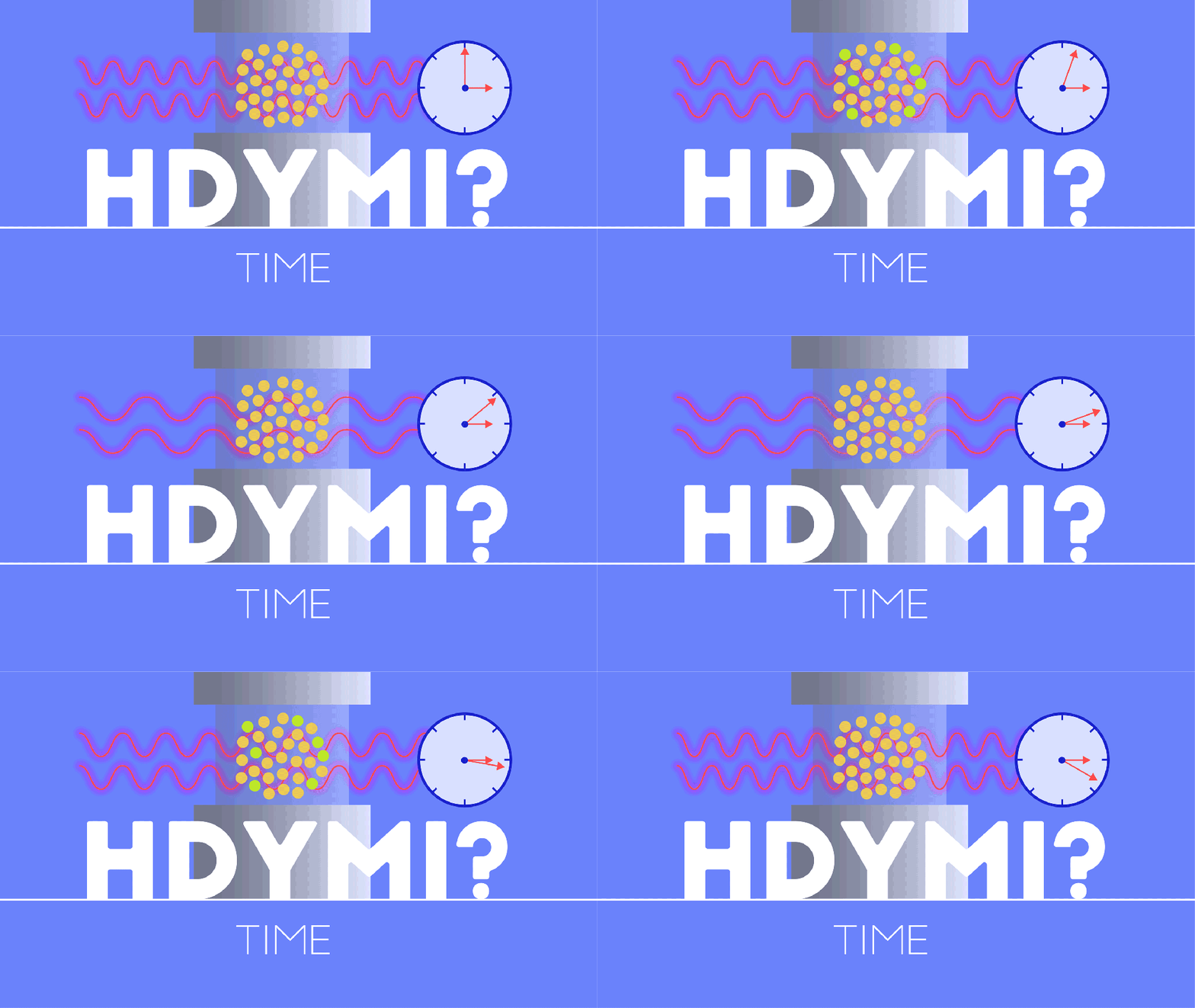
The short answer We can measure time intervals — the duration between two events — most accurately with atomic clocks. These clocks produce electromagnetic radiation, such as microwaves, with a precise frequency that causes atoms in the clock to jump from one energy level to another. Cesium atoms make such quantum jumps by absorbing microwaves with a frequency of 9,192,631,770 cycles per second, which then defines the international scientific unit for time, the second.
The answer to how we measure time may seem obvious. We do so with clocks. However, when we say we’re measuring time, we are speaking loosely. Time has no physical properties to measure. What we are really measuring is time intervals, the duration separating two events.
Throughout history, people have recorded the passage of time in many ways, such as using sunrise and sunset and the phases of the moon. Clocks evolved from sundials and water wheels to more accurate pendulums and quartz crystals. Nowadays when we need to know the current time, we look at our wristwatch or the digital clock on our computer or phone.
The digital clocks on our computers and phones get their time from atomic clocks, including the ones developed and operated by the National Institute of Standards and Technology (NIST).
Note: I have friends who thankfully survived infection now affected by this phenomenon. The article thus grabbed my attention.
SARS-CoV-2 appears to travel widely across the cerebral cortex
“Brain fog” is not a formal medical descriptor. But it aptly describes an inability to think clearly that can turn up in multiple sclerosis, cancer, or chronic fatigue. Recently, the condition has grabbed headlines because of reports that it afflicts those recovering from COVID-19.
COVID’s brain-related symptoms go beyond mere mental fuzziness. They range across a spectrum that encompasses headaches, anxiety, depression, hallucinations, and vivid dreams, not to mention well-known smell and taste anomalies. Strokes and seizures are also on the list. One study showed that more than 80 percent of COVID patients encountered neurological complications.
The mystery of how the virus enters and then inhabits the brain’s protected no-fly zone is under intensive investigation. At the 50th annual meeting of the Society for Neuroscience, or SFN (held in virtual form this month after a pandemic hiatus in 2020), a set of yet-to-be-published research reports chronicle aspects of the COVID-causing SARS-COV-2 virus’s full trek in the brain—from cell penetration to dispersion among brain regions, to disruption of neural functioning.
FIG. 1. Temporal evolution of chamber pressure assuming nominal operation for 30 s followed by a 40 s interval with flow rate reduced 100× 100×. The colors correspond to 1 kW, 10 kW, 100 kW, and 1 MW power levels. The process is then repeated.
Topics: Applied Physics, Computer Modeling, NASA, Space Exploration, Spaceflight
Abstract
Hall effect thrusters operating at power levels in excess of several hundreds of kilowatts have been identified as enabling technologies for applications such as lunar tugs, large satellite orbital transfer vehicles, and solar system exploration. These large thrusters introduce significant testing challenges due to the propellant flow rate exceeding the pumping speed available in most laboratories. Even with proposed upgrades in mind, the likelihood that multiple vacuum facilities will exist in the near future to allow long-duration testing of high-power Hall thrusters operating at power levels in excess of 100 kW remains extremely low. In this article, we numerically explore the feasibility of testing Hall thrusters in a quasi-steady mode defined by pulsing the mass flow rate between a nominal and a low value. Our simulations indicate that sub-second durations available before the chamber reaches critical pressure are sufficiently long to achieve the steady-state current and flow field distributions, allowing us to characterize thruster performance and the near plume region.
I. INTRODUCTION
Hall effect thrusters (HETs) are spacecraft electric propulsion (EP) devices routinely used for orbit raising, repositioning, and solar system exploration applications. To date, the highest power Hall thruster flown is the 4.5 kW BPT-4000 launched in 2010 aboard the Advanced EHF satellite1 (which the HET helped to deliver to the correct orbit after a failure of the primary chemical booster), although a 13 kW system is being readied for near-term flight operation as part of the Lunar Gateway,2 and thrusters at 503,4–100 kWs power levels have been demonstrated in the laboratory. Solar cell advancements and a renewed interest in nuclear power have led the aerospace community to consider the use of Hall thrusters operating at even higher power levels. Multi-hundred kW EP systems would offer an economical solution for LEO to GEO orbit raising or for the deployment of an Earth-to-Moon delivery tug, and power levels in excess of 600 kW could be utilized for crewed transport to Mars.5–9 While such power levels could be delivered using existing devices, a single large thruster requires less system mass and has a reduced footprint than a cluster of smaller devices.10
This came as the school board directed staff to begin removing “sexually explicit” books from library shelves, after voting 6-0 in favor of the removal, the Lance-Star reported. The board has plans to review how certain books or materials are defined as “objectionable,” the paper said, which opens the door for other content to be removed.
Courtland representative Rabih Abuismail and Livingston representative Kirk Twigg both championed burning the books that have been removed.
“I think we should throw those books in a fire,” Abuismail said. Meanwhile, Twigg said he wanted to “see the books before we burn them so we can identify within our community that we are eradicating this bad stuff.”
November starts with the intensity of electoral politics. For other nations, the election cycle isn’t “big business.” The only similarity between The New York Times, and Newsmax is each follows a business model that relies on orchestrated anxiety and eyeballs. The “fourth estate” is yellow journalism now if it ever was something else noble.
Elections in other countries have weekends for early voting, and the event is a holiday in many places. The forces that don’t want a “crisis of democracy” in the United States prefer to keep our current malaise at the slow speed of the status quo, and if possible, reverse time politically in defiance of the Second Law of Thermodynamics and time’s arrow.
November should be the time to remove the October festival/Halloween decorations and begin to think of family gatherings (that we can do now that vaccination rates are going up), and the gentle pressure to advertise the Christmas/Hannukah/Solstice season on radio, television, and department store muzak.
A synagogue in Austin was set ablaze. “Antisemitic and racist stickers and flyers were found at Ramsey Park in central Austin Tuesday morning,” according to KXAN.com. The antisemites were arrested for their crimes.
Ryan Faircloth was arrested for firebombing the DNC headquarters in Austin, Texas. He was later released on a mere $2,500 bond. Elected officials are getting death threats. Election workers are getting death threats. This didn’t have to happen. The model existed before 2016. Fascism is born of fear. The fear is they are going to be the numerical minority, that the default “norm” will no longer be white culture and Norman Rockwell greeting cards.
Bill O’Reilly harangued Dr. George Tiller (“Tiller, the baby killer“) until he was murdered by anti-abortion terrorist Scott Roeder.
Sarah Palin posted “don’t retreat: RELOAD!” along with gunsights over the headquarters of democrats, including Arizona Representative Gabby Giffords. The conservative democrat survived an assassination attempt by Jared Lee Loughner, answering the call of the former Wasilla Mayor as if it came from Mount Sinai or Mount Olympus.
There is shouting at medical professionals, teachers in classrooms, and people wearing masks on planes, or in public places. For peace of mind, good people will not serve as election officials, seek public office, work in medicine, or education. Since “nature abhors a vacuum,” we will see the rise of what used to be the mad quackery that John Boehner and Paul Ryan tolerated from Paul Gosar to “win.” The quackery will become the center and the “Grand Old Party” is no longer the “Party of Lincoln,” but a banana republic.
Terrorism (noun): the unlawful use of violence and intimidation, especially against civilians, in the pursuit of political aims.
Reuters identified more than 100 threats of death or violence made to U.S. election workers and officials, part of an unprecedented campaign of intimidation inspired by Trump’s false claims that the 2020 election was stolen. The response so far: only four known arrests and no convictions.
“Kristallnacht, (German: “Crystal Night”), also called Night of Broken Glass or November Pogroms, was the night of November 9–10, 1938, when German Nazis attacked Jewish persons and property. The name Kristallnacht refers ironically to the litter of broken glass left in the streets after these pogroms. The violence continued during the day of November 10, and in some places, acts of violence continued for several more days.”