"The one exclusive sign of thorough knowledge is the power of teaching." Aristotle | Disclaimer: The views and opinions expressed on this Wordpress website are the views and opinions of the content creator, Dr. Reggie Goodwin, and should not be construed as shared, or sourced from The Environmental Protection Agency, or any organizations with which they have cooperative, or business relationships.
Topics: Civilization, International Space Station, Politics, Space Exploration
ALMATY, March 30 (Reuters) – A U.S. astronaut and two Russian cosmonauts safely landed in Kazakhstan on Wednesday after leaving the International Space Station aboard the same capsule despite heightened antagonism between Moscow and Washington over the conflict in Ukraine.
The flight — carrying NASA’s Mark Vande Hei and Russians Anton Shkaplerov and Pyotr Dubrov back to Earth — had been closely watched to determine whether escalating strife had spilled over into longtime cooperation in space between the two former Cold War adversaries.
Russian space agency Roscosmos broadcast footage of the landing from the Kazakh steppe and said a group of technical and medical specialists had been dispatched to help the astronauts out of the capsule.
“The crew is feeling good after landing, according to rescuers,” Roscosmos chief Dmitry Rogozin wrote on Telegram messenger.
Vande Hei, who had completed his second ISS mission, logged a U.S. space-endurance record of 355 consecutive days in orbit, surpassing the previous 340-day record set by astronaut Scott Kelly in 2016, according to NASA.
A radical reimagining of information processing could greatly reduce the energy use—as well as greenhouse gas emissions and waste heat—from computers. Credit: vchal/Getty Images
In case you had not noticed, computers are hot—literally. A laptop can pump out thigh-baking heat, while data centers consume an estimated 200 terawatt-hours each year—comparable to the energy consumption of some medium-sized countries. The carbon footprint of information and communication technologies as a whole is close to that of fuel used in the aviation industry. And as computer circuitry gets ever smaller and more densely packed, it becomes more prone to melting from the energy it dissipates as heat.
Now physicist James Crutchfield of the University of California, Davis, and his graduate student Kyle Ray have proposed a new way to carry out computation that would dissipate only a small fraction of the heat produced by conventional circuits. In fact, their approach, described in a recent preprint paper, could bring heat dissipation below even the theoretical minimum that the laws of physics impose on today’s computers. That could greatly reduce the energy needed to both perform computations and keep circuitry cool. And it could all be done, the researchers say, using microelectronic devices that already exist.
In 1961 physicist Rolf Landauer of IBM’s Thomas J. Watson Research Center in Yorktown Heights, N.Y., showed that conventional computing incurs an unavoidable cost in energy dissipation—basically, in the generation of heat and entropy. That is because a conventional computer has to sometimes erase bits of information in its memory circuits in order to make space for more. Each time a single bit (with the value 1 or 0) is reset, a certain minimum amount of energy is dissipated—which Ray and Crutchfield have christened “the Landauer.” Its value depends on ambient temperature: in your living room, one Landauer would be around 10–21 joule. (For comparison, a lit candle emits on the order of 10 joules of energy per second.)
When a magnetic material is bombarded with short pulses of laser light, it loses its magnetism within femtoseconds (10–15 seconds). The spin, or angular momentum, of the electrons in the material, thus disappears almost instantly. Yet all that angular momentum cannot simply be lost. It must be conserved – somewhere.
Thanks to new ultrafast electron diffraction experiments, researchers at the University of Konstanz in Germany have now found that this “lost” angular momentum is in fact transferred from the electrons to vibrations of the material’s crystal lattice within a few hundred femtoseconds. The finding could have important implications for magnetic data storage and for developments in spintronics, a technology that exploits electron spins to process information without using much power.
In a ferromagnetic material, magnetism occurs because the magnetic moments of the material’s constituent atoms align parallel to each other. The atoms and their electrons then act as elementary electromagnets, and the magnetic fields are produced mainly by the spin of the electrons.
Because an ultrashort laser pulse can rapidly destroy this alignment, some scientists have proposed using such pulses as an off switch for magnetization, thereby enabling ultra-rapid data processing at frequencies approaching those of light. Understanding this ultrafast demagnetization process is thus crucial for developing such applications as well as for better understanding the foundations of magnetism.
Chemotherapy disrupts cancer cells’ ability to reproduce by frustrating cell division and damaging the cells’ DNA. In response to the pharmaceutical onslaught, cancer cells acquire mutations that reduce the therapy’s effectiveness. Compounding the challenge of fighting cancer: Under chemical and other stresses, mutation rates increase.
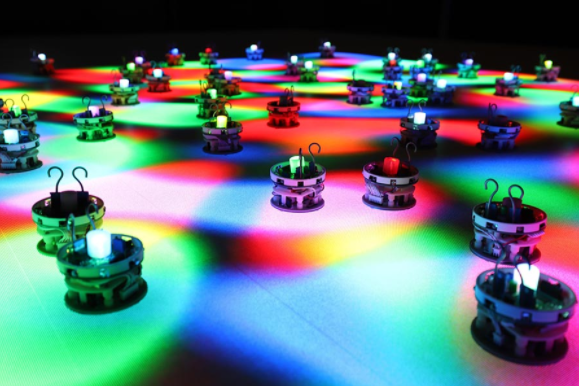
A team led by Princeton University’s Robert Austin and Chongqing University’s Liyu Liu has developed a novel approach to study—and potentially thwart—cancer cells’ adaptation to chemotherapy. Their cancer cell analogs are wheeled, cylindrical robots about 65 mm in diameter and 60 mm in height (see photo above). Fifty of the robots roll independently of each other over a square table, whose 4.2 × 4.2 m2 surface is covered by 2.7 million LEDs (see photo below). Light from the LEDs serves as the robots’ food. Once a robot has “eaten” the light beneath it, the corresponding LEDs are dimmed until they recover a fixed time later.
The bottom surface of each robot is equipped with four semiconductor-based sensors that can detect the intensities and spatial gradients of the three colors of light emitted by the light table: red, green, and blue (RGB). Each robot’s six-byte genome analog determines how sensitive it is to the three colors. The sensitivity, in turn, determines how readily the robot moves in response to the colors’ intensities and spatial gradients.
Topics: Alternate Energy, Battery, Green Tech, Nanotechnology, Quantum Mechanics
Note: I’m in the semifinals of the 3-Minute Thesis competition, so I decided to focus on my presentation. Wish me luck. This does, however, relate to our need as a species to get off fossil fuels as soon as possible, so things like Ukraine, Crimea, and the dismemberment of Jamal Khashoggi are not facilitated by our need for energy and our tolerance for tyrants.
Whether it’s photovoltaics or fusion, sooner or later, human civilization must turn to renewable energies. This is deemed inevitable considering the ever-growing energy demands of humanity and the finite nature of fossil fuels. As such, much research has been pursued in order to develop alternative sources of energy, most of which utilize electricity as the main energy carrier. The extensive R&D in renewables has been accompanied by gradual societal changes as the world adopted new products and devices running on renewables. The most striking change as of recently is the rapid adoption of electric vehicles. While they were hardly seen on the roads even 10 years ago, now millions of electric cars are being sold annually. The electric car market is one of the most rapidly growing sectors, and it helped propel Elon Musk to become the wealthiest man in the world.
Unlike traditional cars which derive energy from the combustion of hydrocarbon fuels, electric vehicles rely on batteries as the storage medium for their energy. For a long time, batteries had far lower energy density than those offered by hydrocarbons, which resulted in very low ranges of early electric vehicles. However, gradual improvement in battery technologies eventually allowed the drive ranges of electric cars to be within acceptable levels in comparison to gasoline-burning cars. It is no understatement that the improvement in battery storage technology was one of the main technical bottlenecks which had to be solved in order to kickstart the current electric vehicle revolution.
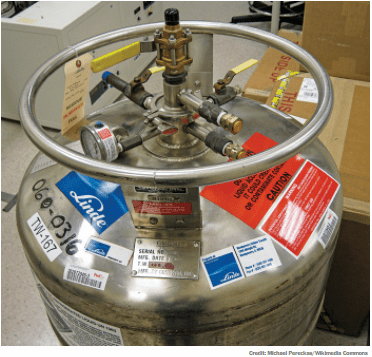
Transport dewars like this carry crucial cryogens for scientific instruments.
Topics: Chemistry, Instrumentation, Nuclear Magnetic Resonance, Physics, Research
Scientists who need the gas face tough choices in the face of reduced supply and spiking prices.
Helium supplies, already dicey, got worse this past week when production shut down in Arzew, Algeria. The curtailment joins ongoing disruptions in supplies from Russia and the US Federal Helium Reserve as well as planned maintenance at facilities in Qatar. Helium users in several locations say they are struggling to get the gas they need to keep their scientific instruments running.
“The shortage is scaring most NMR spectroscopists,” says Martha Morton, the director of research instrumentation at the University of Nebraska–Lincoln. Nuclear magnetic resonance instruments and related tools use liquid helium to cool superconducting magnets.
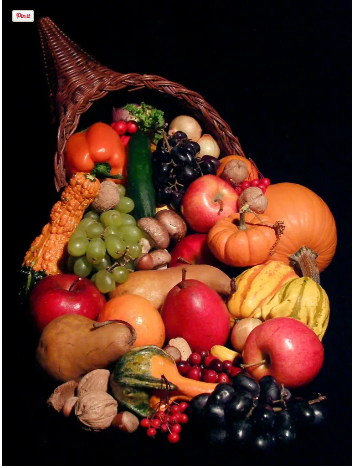
The cornucopia’s history lies in Greek mythology. There are a lot of different stories it might have originated from, but the most common one tells the story of the lightning god, Zeus. As an infant, Zeus was in great danger from his father, Cronus. Zeus was taken to the island of Crete and cared for and nursed by a goat named Amalthea. One day, he accidentally broke off one of her horns, and in order to repay her, he used his powers to ensure that the horn would be a symbol of eternal nourishment, which is where we get the idea that the cornucopia represents abundance.
Russia’s war highlights the fragility of the global food supply — sustained investment is needed to feed the world in a changing climate.
Six boxes of wheat seed sit in our cold store. This is the first time in a decade that my team has not been able to send to Ukraine the improved germplasm we’ve developed as part of the Global Wheat Program at the International Maize and Wheat Improvement Center in Texcoco, Mexico. International postal and courier services are suspended. The seed had boosted productivity year on year in the country, which is now being devastated by war.
Our work builds on the legacy of Norman Borlaug, who catalyzed the Green Revolution and staved off famine in South Asia in the 1970s. Thanks to him, I see how a grain of wheat can affect the world.
Among the horrifying humanitarian consequences of Russia’s invasion of Ukraine are deeply troubling short-, medium- and long-term disruptions to the global food supply. Ukraine and Russia contribute nearly one-third of all wheat exports (as well as almost one-third of the world’s barley and one-fifth of its corn, providing an estimated 11% of the world’s calories). Lebanon, for instance, gets 80% of its wheat from Ukraine alone.
Want another reason to loathe Russia’s invasion of Ukraine? Just look at how it may completely doom the Paris climate accords — and our planet.
According to United Nations Secretary-General Antonio Guterres, the problem of climate change — which he admitted was “not solved” during the COP26 climate summit in Glasgow at the end of 2021 — “is getting worse” as Russia invades Ukraine.
As if things weren’t bad enough, Guterres insisted that the conflict is making climate change much worse, given how it’s disrupted fossil fuel supply chains in Europe.
“Countries could become so consumed by the immediate fossil fuel supply gap that they neglect or knee-cap policies to cut fossil fuel use,” Guterres said in a speech to The Economist‘s Sustainability Summit, his first climate change-focused addressed since COP26, continuing: “This is madness. Addiction to fossil fuels is mutually assured destruction.”
“How do you ask a man to be the last man to die for a mistake?” John Kerry, C-SPAN, as spokesman for Veterans Against the Vietnam War, now the U.S. Special Presidential Envoy for Climate.
Paraphrased, “how rich are you as the last richest man on a dead planet?”
A screenshot of the loitering munition known as the KUB-BLA in English. Credit: Kalashnikov Group.
Topics: Civics, Civil Rights, Existentialism, Fascism, Human Rights
Note: Coming up for air (briefly). Still writing the dissertation. My plan is to post Tuesday – Friday of next week. Blogging will be my sanity in an insane world.
Using pictures out of Ukraine showing a crumpled metallic airframe, open-source analysts of the conflict there say they have identified images of a new sort of Russian-made drone, one that the manufacturer says can select and strike targets through inputted coordinates or autonomously. When soldiers give the Kalashnikov ZALA Aero KUB-BLA loitering munition an uploaded image, the system is capable of “real-time recognition and classification of detected objects” using artificial intelligence (AI), according to the Netherlands-based organization Pax for Peace (citing Jane’s International Defence Review). In other words, analysts appear to have spotted a killer robot on the battlefield.
President Biden signed a bill allocating 800 million dollars of military aid short of an official no-fly zone by either US forces or NATO. It does include anti-aircraft missiles and drones, specifically the Switchblade. Both organizations have argued establishment of a no-fly zone isn’t casual: it means enemy planes will be challenged in the air, and enemy planes, Russian planes, if not retreating, will be shot down. We then go from World War Two and one half to WWIII.
Wars are like avalanches. They may start with a snow flurry someone rounds into a snowball. Someone, a child perhaps, throws it innocently. As it descends the incline of a mountain, it gathers speed and adds mass. By the time it reaches civilization, the accumulated mass and momentum make it all but impossible to divert or stop. It starts with a snow flurry, then it escalates. Tit for tat. Switchblades for Kalashnikovs.
There are some things that give me simultaneously hope and concern:
Casualties: The Russians have lost more troops in three weeks than the US lost in 20 years in Afghanistan.
Cyberwarfare: It hasn’t happened. The Russian GRU used ransomware to shut down Colonial Pipeline. The threat of shutting down power in Ukraine (or here): hasn’t happened.
Putin was a mid-level bureaucrat in the KGB, and not looked at as an asset. He had one main talent of getting kompromat – compromising information – and using it to leverage someone to betray their country for Russia. His problem is like his Manchurian Candidate in America that he pushed into the presidency, he’s a malignant narcissist, and quite the opposite of a “strongman.” He, like the former faux billionaire host of “The Apprentice,” is acting. Two euphemisms come to mind: “fake it until you make it” and “faking the funk.”
To answer that question, you have to understand the power and information ecosystems around dictators. I’ve studied and interviewed despots across the globe for more than a decade. In my research, I’ve persistently encountered a stubborn myth—of the savvy strongman, the rational, calculating despot who can play the long game because he (and it’s typically a he) doesn’t have to worry about pesky polls or angry voters. Our elected leaders, this view suggests, are no match for the tyrant who gazes into the next decade rather than fretting about next year’s election.
Reality doesn’t conform to that rosy theory.
Autocrats such as Putin eventually succumb to what may be called the “dictator trap.” The strategies they use to stay in power tend to trigger their eventual downfall. Rather than being long-term planners, many make catastrophic short-term errors—the kinds of errors that would likely have been avoided in democratic systems. They hear only from sycophants and get bad advice. They misunderstand their population. They don’t see threats coming until it’s too late. And unlike elected leaders who leave the office to riches, book tours, and the glitzy lifestyle of a statesman, many dictators who miscalculate leave office in a casket, a possibility that makes them even more likely to double down.
At Nuremberg, Hermann Goering was asked by Gustave Gilbert as to “why he and the others had been such abject “yes men,” Goering replied: “Please show me a ‘no man’ in Germany who is not six feet under the ground today.”
The “Dictator’s Trap” is set by his narcissism (it almost always is a male pronoun leader). Unable to “handle the truth,” he surrounds himself with yes men, whose careers and livelihoods are directly proportional to their degree of sycophancy. In sadistic cases, their lives depend on kowtowing to limbo levels. People do tend to get shot, poisoned, die of radiation poisoning, and fall spontaneously out of windows in the eleven-time zone prison known as Russia. He’s also such a pathological liar, and so keenly good at gaslighting, he has a tendency to believe his [own] press, thus gaslighting himself.
I don’t speak Russian. However, the body language in this rant (Twitter link below) is shouting to the rooftops. This man is panicking.
He didn’t house arrest his intelligence chiefs because he’s displeased: they’re KGB like him. He’s isolating the competition for power before he outright eliminates them.
I don’t speak Russian, but I can tell when someone is terrified:
This is not only a nutball fascist rant, but man, it is *full* of projection. Putin’s own inner circle could be the people he’s talking about – and especially their children, who are watching all of this from London and Paris, and New York.Tom Nichols, @RadioFreeTom
When you surround an army, leave an outlet free. Do not press a desperate foe too hard. Sun Tzu, “The Art of War.”
I’m re-reposting this because it contains a lot of information that, unfortunately, is still applicable in our current crisis. Yes, I’m still typing my dissertation, despite the apocalypse.
*****
This was originally posted on March 31, 2017. I’ve updated it with the YouTube video by Channel 4 London on Cambridge Analytica (CNNMoney.com and The Guardian details). The original blog post has aged well, Ukraine is another added crack in the mirror.
COINTELPRO The FBI began COINTELPRO—short for Counterintelligence Program—in 1956 to disrupt the activities of the Communist Party of the United States. In the 1960s, it was expanded to include a number of other domestic groups, such as the Ku Klux Klan, the Socialist Workers Party, and the Black Panther Party. All COINTELPRO operations were ended in 1971. Although limited in scope (about two-tenths of one percent of the FBI’s workload over a 15-year period), COINTELPRO was later rightfully criticized by Congress and the American people for abridging first amendment rights and for other reasons.
Had his story ended when he retired as a candy-maker, Robert Welch Jr. might have made his mark on history as the father of the Sugar Daddy, Sugar Babies, and Junior Mints. But Welch, whose shrewd leadership helped grow his brother’s Massachusetts candy business a hundred-fold from 1935 to 1956, shifted his aim from caramels to communists.
On this day, Dec. 9, in 1958, Welch — then retired from the candy business — founded the ultraconservative John Birch Society along with 11 like-minded “Americanists,” as they referred to themselves. Their goal was to expose and eradicate the growing leftist threat in America, which they believed to be 40 to 60 percent communist-controlled, according to a 1961 TIME report. Members of the John Birch Society saw communists wherever they looked, from the Oval Office of Dwight Eisenhower (“A conscious agent of the communist conspiracy,” per Welch) to the Bay of Pigs (“a theatrical performance jointly sponsored by Castro and ‘his friends in the U.S. Government’ in order to strengthen the communist hold on Cuba,” as paraphrased in TIME).
The “growing leftist threat”…
COINTELPRO was the government version of John Birch. Though the write-up eludes to other groups the FBI had under surveillance, it was felt by African American communities the most, specifically the Black Panther Party; the Nation of Islam; the Southern Christian Leadership Conference, etc. The approval of the Communist Manifesto by the likes of Huey Newton and the unrest in the streets likely gave J. Edgar Hoover much alarm. It couldn’t have been the treatment of American citizens by their fellow citizens and de facto/de jure Jim Crow laws against them. It was easy to wrap surveillance in the flag and patriotism to hide the racist overtones of the act.
The “growing leftist threat”…
If the Birch philosophy sounds familiar, it’s because one of its ardent members was the famous Koch Brother’s father, Frank Koch, an MIT oil engineer. He infamously built oil refineries for Nazi Germany and did a considerable amount of business with the Russians.
The Nazis… the Russians…
It was “American” to oppose godless communism. It was easy for the right to demonize the left as unpatriotic, out-of-touch, and not fluent in the deified “free market.”
Added: Opposition to Russia used to be a staple of Republicanism, that is until they realized their policies are moribund to most people, and their chances of legitimately winning elections are teetering towards nil. If you can’t beat ’em, make sure they can’t vote you out. Authoritarianism is the temptation for fossilized political imaginations.
The reclusive billionaire hedge fund manager Robert Mercer has been known to fund right-wing groups in this country (Steve Bannon) and overseas (Nigel Farage). Like many of the self-made billionaires, he’s likely a fan of Ayn Rand and her apotheosis of selfishness in “Fountainhead” and “Atlas Shrugged,” lauded by Congressman Ron Paul, Senator Rand Paul, Speaker Paul Ryan, and President Ronald Reagan. It’s funny how an avowed enemy of religion as sickness can be so praised by those who put the Ten Commandments, godly masculinity, and “family values” on high pedestals.
During the 1960s, COINTELPRO was concerned that foreign powers were infiltrating us and destabilizing our republic in the various Civil Rights organizations. They, along with the John Birch Society, were decidedly anti-communist, such that the Republican Party made this stance a litmus test for two generations. At that time, foreign Russian interference would have been called the KGB (Komitet gosudarstvennoy bezopasnosti, or the Committee for State Security). If they were infiltrating Civil Rights organizations, it was a time and an environment ripe for manipulation.
Fast-forward 40 years: 1968 – 2008. Forty years after the assassinations of Martin Luther King and Robert F. Kennedy, the country has gone through a massive experiment in forced busing that would eventually be objected to and eliminated. Cities would through economic opportunities and structured stratification re-segregate more so than in 1968. The former Soviet Union would fall in that window in 1989. Then-President George Bush (41) and Prime Minister Margaret Thatcher would opine on the “Peace Dividend.” The previous Russian Politburo was their 1%. As I recall from Air Force ROTC class in college, they were the ones with the actual money while their populations starved. They had access to things like fashion, food, sex all the while pretending that the Politburo was “temporary” and eventually there would be pure Communism with no hierarchy, no stratification: no “income inequality” as we now call it. It never came. An attempt at reformation from the previous authoritarian communist regime – Democratization – would be attempted and fail. Some would say it was a weakness of Russian civil society, as democratization usually entails a beneficial tug-of-war from above and below. If citizens aren’t putting pressure on their leadership, that leadership will eventually go back to what they know well: ironclad, authoritarian control.
2008 saw the election of the country’s first African American president, Barack Hussein Obama, for the first time in 232 years of the republic during a financial free fall compared quite literally to the Great Depression, a concern that furrowed his brow and eventually grayed his mane. A graduate of two elite schools, a Constitutional Scholar, and a community organizer, he “dotted every ‘i’ and crossed every ‘t’.” His crowds were compared to rock concerts. We quickly spat out the bubblegum philosophy of a “post-racial” society. We had “grown-up” Dr. Maya Angelou commented; poems were composed, t-shirts were made, tearful hymns were sung: we had finally “overcome.”
President Obama’s name was a source of angst to his legitimacy. Then the Tea Party arose, AstroTurf-fed by dark money – Koch, Mercer, et al – as a faux grass movement, their bigotry was hidden – at least initially from their Tea Party selves – behind clever slogans and jingoism: “I want my country back!” The demographics were decidedly, predominately the only original creation of the American continent: “whiteness,” and a few people of color comfortable in tokenism and able to maneuver within a religion of white supremacy, that itself masquerades as a faux evangelical Christianity.
The KGB became the FSB (Federalnaya Sluzhba Bezopasnosti, or Federal Security Service). Some rumors that they would weaponize misinformation on a scale heretofore unseen. As the former KGB observed an opening in the Civil Rights unrest, the FSB noticed Birtherism, the bigotry, the calling out “YOU LIE” during a president’s State of the Union; the praying of Psalms 109:8 and callously calling themselves “Christians.” They saw faux voter integrity ID laws designed to act as a 21st Century poll tax; they saw the slaughter of Trayvon Martin, Jordan Davis, Renisha McBride, Eric Garner, Tamir Rice, John Crawford III, and countless others. Add to it the lack of any jurisprudence/convictions of their slayers (the noted exceptions in Davis and McBride): note also the rush to call them “thugs” and disappointed Kentucky fans “students.” The clever bigotry giving way to blatant racism, our national pathology laid naked to any intelligence officers to manipulate. From the ascendancy of a rock star African American president, the situation demanded his precise antithesis as a counterbalance.
It was simply a change in strategy: if COINTELPRO was correct (though biased), the infiltration was through some Civil Rights organizations. If our current intelligence is correct, the infiltration was through our obvious bigotry: it was designed to shatter our institutional norms, and internationally like democratic republics from within.
With fake news by bots and hackers, servers between Moscow and New York; backroom deals that may have been caught with (possible) FISA-warranted incidental communications monitoring, the Russians merely enacted in real-time cyber attacks the poignant observation President Lyndon Baines Johnson made on a trip to the south with journalist Bill Moyers:
“If you can convince the lowest white man he’s better than the best-colored man, he won’t notice you’re picking his pocket. Hell, give him somebody to look down on, and he’ll empty his pockets for you.”
With Brexit proceeding in the UK, spurred broadly by bigotry, their next targets to destabilize western democracies are France and Germany, with the ultimate goals of dismantling NATO and the European Union. There would be in essence a “New World Order” – not of the conspiratorial kind – but under the same conditions when “IRA” stood for Irish Republican Army (not Individual Retirement Account): there were a lot of bombings, death, and instability. Before the EU, European countries often warred among themselves. That can’t be good for tourism, …or world peace.
We have “given them the store” of white supremacist bigotry, and our republic. I’m concerned apathy, racism, stupidity, and tribalism may well not allow us… to get it back.