"The one exclusive sign of thorough knowledge is the power of teaching." Aristotle | Disclaimer: The views and opinions expressed on this Wordpress website are the views and opinions of the content creator, Dr. Reggie Goodwin, and should not be construed as shared, or sourced from The Environmental Protection Agency, or any organizations with which they have cooperative, or business relationships.
A team of researchers in China has unveiled a technique that — theoretically — could crack the most commonly used types of digital privacy using a rudimentary quantum computer.
The technique worked in a small-scale demonstration, the researchers report, but other experts are skeptical that the procedure could scale up to beat ordinary computers at the task. Still, they warn that the paper, posted late last month on the arXiv repository1, is a reminder of the vulnerability of online privacy.
Quantum computers are known to be a potential threat to current encryption systems. However, the technology is still in its infancy, and researchers typically estimate that it will be many years until it can be faster than ordinary computers at cracking cryptographic keys.
Researchers realized in the 1990s that quantum computers could exploit peculiarities of physics to perform tasks that seem to be beyond the reach of ‘classical’ computers. Peter Shor, a mathematician now at the Massachusetts Institute of Technology in Cambridge, showed in 19942 how to apply the phenomena of quantum superposition and interference to factoring integer numbers into primes — the integers that cannot be further divided without a remainder.
One of Murphy’s hired hands, McCloskey, joins Tunstall while Doc attempts to court Murphy’s ward, Yen Sun. Murphy’s men kill Tunstall, leading his lawyer friend Alexander McSween to arrange for the Regulators to be deputized and given warrants for the killers’ arrest. Hotheaded Billy challenges Dick’s authority as the group’s foreman as the Regulators attempt to take Murphy’s henchmen alive. Instead, Billy guns down several unarmed men, including McCloskey, whom he suspects of still working for Murphy. Newspapers paint the Regulators as a deadly gang headed by a larger-than-life outlaw, “Billy the Kid.”
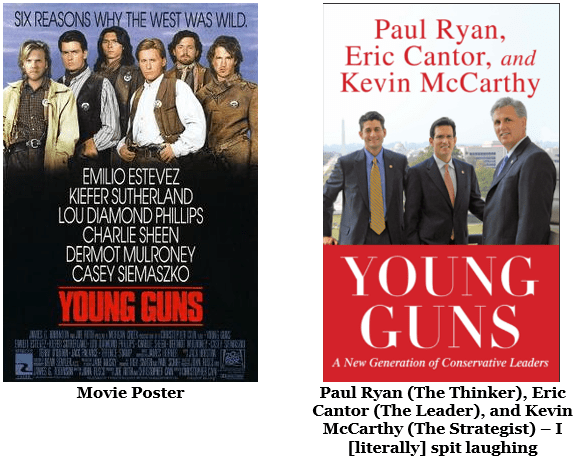
Make no mistake: Congressmen Eric Cantor, Paul Ryan, and Kevin McCarthy are proud Republicans. But they believe the party had lost sight of the ideals it believes in, like economic freedom, limited government, the sanctity of life, and putting families first. This isn’t your grandfather’s Republican party. These Young Guns of the House GOP—Cantor (the leader), Ryan (the thinker), and McCarthy (the strategist)—are ready to take their belief in the principles that have made America great and translate it into solutions that will make the future even better, solutions that will create private sector jobs, maximize individual freedom, and establish a better world for our children. This groundbreaking book is a call to action that sets forth a plan for growth, opportunity, and commitment to propel this country to prosperity. Together, the Young Guns are changing the face of the Republican party and giving us a new road map back to the American dream.
Young Guns A New Generation of Conservative Leaders By Eric Cantor, Paul Ryan, and Kevin McCarthy, published by Simon & Schuster
A Faustian bargain is a pact whereby a person trades something of supreme moral or spiritual importance, such as personal values or the soul, for some worldly or material benefit, such as knowledge, power, or riches.Britannica online
When Kev sought the Speakership previously, he eighty-sixed himself by his gaffe on Benghazi and Hillary Clinton (saying the quiet part out loud) and an alleged affair (when Republicans CARED about things like that). My favorite Kev-ism is the one that came and went like a silent, deadly fart: “I think Putin pays Trump” a month before Orange Satan clinched the nomination, and we’ve been in the Twilight Zone ever since.
Kevin McCarthy said that the “President bore responsibility for the Capital Riot on January 6,” then voted with the insurrectionists who wanted to overthrow a free and fair election. He followed that up with a whirlwind tour of Butt-kissing down at the gaudy resort of the twice-impeached leader of the Republican Party in Florida. He could have invoked the 25th Amendment. He could have whipped the votes in the House from Republican members to support impeachment BOTH times! He raised money for the “Taliban 20” that voted against his Speakership, and Marjorie Taylor, “Secret Jewish Space Lasers,” found out the hard way to get what he wants – power – he would lie to even the QUEEN of MAGA. To enter into a Faustian bargain, one assumes “The Kev” had a soul to haggle with the Orange Devil from Mar-a-Lard-o in trade. Jellyfish have more spine.
“Created realities” and the vote for Speaker.
This is the first time in a century that there’s been a failed vote for Speaker. “Kev” is like the Republican Party: no agenda, no platform, and no ideology to govern. All this after copious Butt-kissing on the altar of the graven image of Orange Cheeto. The party has a problem with facts and reality. Kev is the last man standing for the “Young Guns.” The Tea Party drove out the former. Kev-o is being driven crazy in prime time.
*****
The aide said that guys like me [Suskind] were “in what we call the reality-based community,” which he defined as people who “believe that solutions emerge from your judicious study of discernible reality.” I nodded and murmured something about enlightenment principles and empiricism. He cut me off. “That’s not how the world works anymore,” he continued. “We’re an empire now, and we create our own reality when we act. And while you’re studying that reality — judiciously, as you will — we’ll act again, creating other new realities, which you can study too, and that’s how things will sort out. We’re history’s actors … and all of you will be left to study what we do.” [The New York Times Magazine] Attributed to Karl Rove, which he denies.
*****
The GOP Leader in the House cursed at his chaotic, fractious, raucous caucus, and Gunboat Barbie, Lauren Boebert, cursed him back.
Hakeem Jeffries got 212 votes (in one round), Kev 202, and Jim Jordan 20 after THREE. He failed to get elected Speaker SIX TIMES on Wednesday (by Thursday, as I type this, that count went to ten), and by the House Clerk not gaveling when time expired, it allowed them to sneak a few more votes in to get the ONE successful vote out of seven: to adjourn, and avoid at the time a seventh defeat. Nathanial Banks of Massachusetts holds the longest, most contentious record at 133 – right before the poorly-named Civil War, and I think Kev-a-Tron is going for the Guinness Book of World Records. We now have Kev-bro, or likely Steve Scalese, self-described as “David Duke without the baggage.” What did that MEAN, anyway? Even if Kev managed to limp to the Speakership, he’s already the WEAKEST Speaker in the nation’s history. We haven’t gotten to funding the government, raising the debt ceiling, or funding Ukraine against Russian aggression. Whoever’s Speaker, the next two years should be “fun.” Thanks to Jonah Goldberg, his “fecal festival” observation has become part of my lexicon. So apropos for the two-year anniversary of an insurrection that sadly involved feces and urine from barbarians.
If spineless Kev-muffins wants to “play Speaker” so badly, why doesn’t he BUY a gavel and podium at Walmart or Amazon? It would be FAR cheaper and less humiliating. He could knock himself out all day and post selfies. That is the only functionality other than breathing and going to the bathroom that the “raucous caucus” appears to have mastered. The House Republicans aren’t lawmakers: they’re the logical conclusion of electing the poorly spelled, grammatically challenged comments on Facebook.
Whatever soulless deals “the Kev” promised with the “Space Lasers Caucus,” the next Speaker, if it’s not him, will have to continue it to maintain a modicum of sanity for as long as humanly possible before like Ryan, Cantor, Boehner, and Kev-ums to leave Arkham Asylum to save it. Al Qaeda, the Taliban (original, and 20), QAnon, MAGA, and all terrorists have the same common goal: make America (not “great”) but ungovernable. If you truly believe that “Government is not the solution to our problem, the government is the problem” (Reagan), you CAN’T ALLOW it to function for anyone other than billionaires. In such a nihilistic, sadomasochistic, Murchassen-by-proxy worldview, this demonstrated chaos to elect a Speaker, without which there IS no 118th Congress, on the second anniversary of the January 6 Insurrection is not a bug: it’s a desired, psychotic feature.
This is embarrassing and has shown the American people that the slim majority the Republicans enjoy should be erased in 2024. They should not be allowed to govern until they take their jobs more seriously than their social media followers.
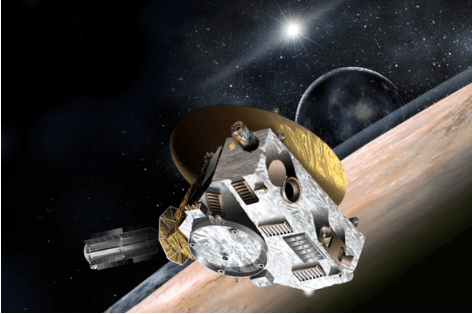
An artist’s concept of New Horizons during the spacecraft’s planned encounter with Pluto and its moon Charon. The craft’s miniature cameras, radio science experiments, ultraviolet and infrared spectrometers, and space plasma experiments would characterize the global geology and geomorphology of Pluto and Charon, map their surface compositions and temperatures, and examine Pluto’s atmosphere in detail. Credit: Johns Hopkins University Applied Physics Laboratory/Southwest Research Institute (JHUAPL/SwRI)
Topics: Astronomy, Astrophysics, NASA, Planetary Science, Space Exploration
Only two spacecraft have ever left our solar system and lived to tell the tale. In 2012 and 2019, NASA’s Voyager 1 and 2 spacecraft respectively broke through the heliopause, the boundary at which our sun’s sphere of influence gives way to the interstellar medium. They have sent back remarkable riches from this distant location, humanity’s first foray into the limitless bounds beyond our solar system’s edge. Hot pursuit is a far more advanced vehicle, sporting improved instruments, updated optics, and even a means to sample the interstellar medium itself. New Horizons was launched from Earth in 2006 on a mission to visit Pluto, arriving in 2015 and revealing incredible details during its all-too-brief flyby. The spacecraft has continued its cruise toward interstellar frontiers ever since. It has now begun its second extended mission. It is soon set to wake up from a deep hibernation, opening a wealth of new scientific opportunities in the outer solar system. “It takes a long time to get to where our spacecraft is,” says Alice Bowman, mission operations manager for New Horizons at the Johns Hopkins University Applied Physics Laboratory (JHUAPL) in Maryland. “When you have a spacecraft that is out in that part of the solar system, it is a huge asset to the scientific community. There are so many unique things that a spacecraft that is out that far can do. We definitely want to take advantage of that.”
For New Horizons, those “unique things” include unprecedented studies of the planets Uranus and Neptune, sampling of the local dust, studies of the background light in the universe, and more. The sum total will be a new phase of the mission that is “really unique and interdisciplinary in nature,” says Alan Stern, the lead on the mission at the Southwest Research Institute (SwRI) in Texas. In October, this two-year second extended mission officially began, but in 2023 it will pick up the pace as the spacecraft exits hibernation and begins its scientific program in earnest. “There were lots of good ideas for how to do things in astrophysics, heliophysics, and planetary science,” Stern says. “We took the very best of those.” There is even the tantalizing possibility of visiting another object in the Kuiper Belt, the region of asteroids and icy objects that lurks beyond Neptune, in which New Horizons has already visited one object—Arrokoth in 2019—after its Pluto encounter. Even without such a possibility, there was more than enough reason for NASA to extend the mission. “New Horizons is at a unique location in the solar system with an amazing suite of functioning instruments on board,” says Becky McCauley Rench, New Horizons program scientist at NASA Headquarters in Washington, D.C. “[It] can provide valuable insights to the heliosphere and the solar wind, astronomical observations of the cosmic background radiation, and valuable data about Uranus and Neptune that can be applied to our knowledge about ice giant planets.”
A team of researchers from Università di Firenze, the University of South Florida, California Institute of Technology, and Princeton University has found an incidence of a quasicrystal formed during an accidental electrical discharge.
In their paper published in Proceedings of the National Academy of Sciences, the group describes their study of a quasicrystal found in a sand dune in Nebraska.
Quasicrystals, as their name suggests, are crystal-like substances. They possess characteristics not found in ordinary crystals, such as a non-repeating arrangement of atoms. To date, quasicrystals have been found embedded in meteorites and in the debris from nuclear blasts. In this new effort, the researchers found one embedded in a sand dune in Sand Hills, Nebraska.
A study of the quasicrystal showed it had 12-fold, or dodecagonal, symmetry—something rarely seen in quasicrystals. Curious about how it might have formed and ended up in the sand dune, the researchers did some investigating. They discovered that a power line had fallen on the dune, likely due to a lightning strike. They suggest the electrical surge from either the power line or the lightning could have produced the quasicrystal.
The researchers note that the quasicrystal was found inside a tubular piece of fulgurite. They suggest it was also formed during the electrical surge due to the fusing of melted sand and metal from the power line.
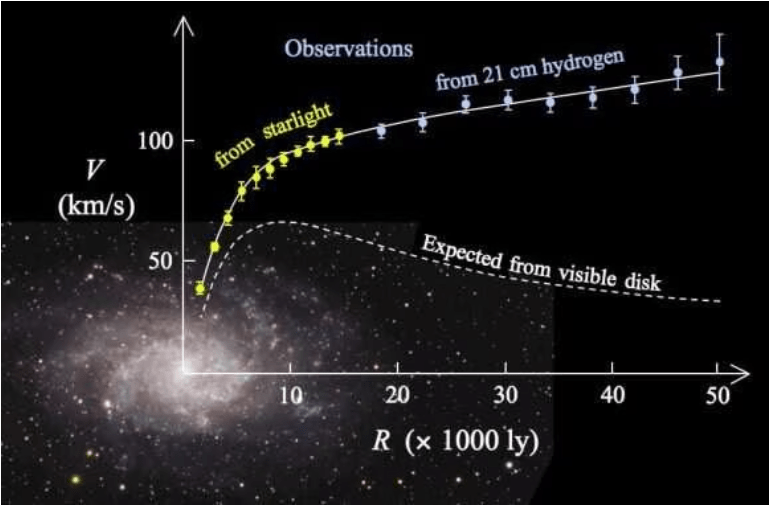
Rotation curve of the typical spiral galaxy M 33 (yellow and blue points with error bars) and the predicted one from the distribution of the visible matter (white line). The discrepancy between the two curves is accounted for by adding a dark matter halo surrounding the galaxy. Credit: Wikipedia
Topics: Astronomy, Astrophysics, Cosmology, Dark Matter
Although dark matter is central to the standard cosmological model, it’s not without its issues. There continue to be nagging mysteries about the stuff, not the least of which is the fact that scientists have found no direct particle evidence of it.
Despite numerous searches, we have yet to detect dark matter particles. Some astronomers favor an alternative, such as modified Newtonian dynamics (MoND) or the modified gravity model. And a new study of galactic rotation seems to support them.
The idea of MoND was inspired by galactic rotation. Most of the visible matter in a galaxy is clustered in the middle, so you’d expect that stars closer to the center would have faster orbital speeds than stars farther away, similar to the planets of our solar system. We observe that stars in a galaxy all rotate at about the same speed. The rotation curve is essentially flat rather than dropping off. The dark matter solution is that a halo of invisible matter surrounds galaxies, but in 1983 Mordehai Milgrom argued that our gravitational model must be wrong.
At interstellar distances, the gravitational attraction between stars is essentially Newtonian. So rather than modifying general relativity, Milgrom proposed modifying Newton’s universal law of gravity. He argued that rather than the force of attraction as a pure inverse square relation, gravity has a small remnant pull regardless of distance. This remnant is only about ten trillionths of a G, but it’s enough to explain galactic rotation curves.
“I’ve been a fan of Octavia Butler since reading my first novel by her, “Mind of My Mind,” about a vampiric telepath named Doro: an immortal from Africa that devours your soul, so he can essentially be immortal at the cost of what makes you “you”: your mind and soul. Butler makes us, through fiction, look at race, class, gender, and the impact of a hierarchical society whose behaviors reflect our slavery past in America. Notice that no other nation has our domestic violence problems: the Second Amendment was specifically designed for quelling slave rebellions. The fact that the first African American president was elected re-elected, and the response was a vaudevillian reality TV pretend billionaire, Kindred, could not be more timely. We need more from her, NK Jemison, and other speculative BIPOC writers. It’s been a long time coming.”
My wife and I watched it on Hulu, and like “The Handmaid’s Tale,” she was immediately hooked. She had never been a fan of science fiction, but I corrected her by saying that Margaret Atwood and Octavia Butler are speculative fiction writers:
A type of story or literature that is set in a world that is different from the one we live in or that deals with magical or imagined future events: She tells readers that she writes “speculative fiction,” defined as “fiction in which impossible things happen.” Her speculative fiction novel is set in the near future.Cambridge Dictionary
I’m a Trekkie, but in Kindred, the protagonist, Dana, time travels (a popular science fiction trope) to the antebellum south, where she meets two of her ancestors: a black woman and her slave owner obsessed with her. Her technology isn’t going at superluminal speeds and whipping around the sun: her tech is the terror of thinking she’s going to die, which pulls her back to Rufus Weylan, and Alice, his father’s slave. Butler doesn’t explain the mechanism of how this is done (like, do we really know how warp drive would work?), but the writing by Butler and the 21st Century adaptors of her fiction pulls you into the story. Dana is going back in time to ensure the (in this case) “grandmother paradox” favors her being born.
Terror as a tech: the United States, the John Winthrop self-professed “shining city on a hill,” has been at war 93% of the time since 1776. Assaulting the indigenous inhabitants and kidnapping an uncompensated labor force from the African continent: the only way you can keep such a psychopathic system in some semblance of “functionality” is with violence. That terror pulls Dana through the corridors of time from 2016 to the 19th Century, where her interracial relationship with Kevin could not be seen as possible or desirable. Her travels aren’t with Industrial Light and Magic special effects and light shows: it is raw, guttural fear, shrieks, and screams audible to her neighbors that remind you of Mrs. Kravitz and her patient husband Abner from the TV series “Bewitched,” which I’m sure inspired Butler when she wrote the characters. Dana is repelled by the rigid codes that don’t respect her autonomy and compelled by the need to rescue Rufus at several key epochs where he could have perished, and she would thereby cease to exist.
America prides itself on being E Pluribus Unum: out of many, one people. Yet the stratification of our society into classes, types, and colors frame our politics, our discourse, our understanding of history, our rejection of facts, and our nostalgia for a halcyon era where we were “great”: sequestered on reservations, enslaved, segregated, closeted, miserable, except for the dominant culture at the top of the Great Seal Pyramid.
Selfish desires are burning like fires. Among those who hoard the gold As they continue to keep the people asleep And the truth from being told Racism and greed keep people in need From getting what’s rightfully theirs Cheating, stealing, and double-dealing As they exploit the people’s fears
Now, Dow Jones owns the people’s homes And all the surrounding land Buying and selling their humble dwelling In the name of the Master Plan
And this framework keeps us at each other’s throats, clawing for scraps on a planet that surpassed 8 billion humans last month. Every structure of violence has within it the kernel of resource allocation: who gets WHAT. When you define yourselves at the top of the pyramid, you must convince the rest of society that this evolved or divine position is correct, “logical,” and “rational.” Your progeny inherit this “superiority” in perpetuity. Anyone disagreeing with you is met with violence, even unto death.
The Myth of Race, Robert Wald Sussman; The Emperor’s New Clothes, The Race Myth, Joseph L. Graves, Jr.; Racism, Not Race, Alan M. Goodman, Joseph L. Graves, Jr., all give credible, anthropological, biological data pointing to that we are all humans sharing the same planet with 8 billion other humans. Even if we could accelerate a rocket to near-light speed, we’re parsecs from anything resembling the current planet on which we’ve evolved. Climate change is a real dilemma we currently face that threatens our survival. Due to laws of physics and causality, time travel and warp speed have yet to materialize. We can face the future by reconciling with our past. The future is rocky and uncertain if we don’t.
Despite the gaslighting, we are Kindred.
I invite you to stream the Hulu series, write a review online, and treat one another like we’re related: because, ultimately, we are. This will also support getting a Season 2.
“God has made of one blood all peoples of the earth” – Acts 17:26
The man who was least deserving of the Presidential Medal of Freedom in history is the beginning of the roots of white fragility. It wasn’t that he might have had learning disabilities or wasn’t suited for college. He turned his focus outward to “others”: immigrants, feminists, the LGBT, and minorities. Once he settled into a syndicated broadcast on AM Talk Radio that proved more lucrative than what his WWII veteran father earned as a fighter pilot, lawyer, and legislator, he founded a cottage industry of handling that fragility by blaming others for personal shortcomings with no sense of hypocrisy in the party he championed labeling itself the “party of personal responsibility and family values.”
In 1969 Limbaugh graduated from Cape Girardeau Central High School, where he played football and was a Boys State delegate.[15][16][17][18] At age 16, he worked his first radio job at KGMO, a local radio station. He used the air name Rusty Sharpe having found “Sharpe” in a telephone book.[12][19] Limbaugh later cited Chicago DJ Larry Lujack as a major influence on him, saying Lujack was “the only person I ever copied.”[20] In deference to his parents’ desire toattend college, he enrolled at Southeast Missouri State University but dropped out after two semesters. According to his mother, “he flunked everything […] he just didn’t seem interested in anything except radio.”[12][21] Biographer Zev Chafets asserts that Limbaugh’s life was largely dedicated to gaining his father’s respect.[22] Source: Wikipedia/Rush_Limbaugh
The high priest of gridlock
In the 1994 campaign season, to offer an alternative to Democratic policies and to unite distant wings of the Republican Party, Gingrich and several other Republicans came up with a Contract with America, which laid out 10 policies that Republicans promised to bring to a vote on the House floor during the first 100 days of the new Congress if they won the election.[61] The contract was signed by Gingrich and other Republican candidates for the House of Representatives. The contract ranged from issues such as welfare reform, term limits, crime, and a balanced budget/tax limitation amendment, to more specialized legislation such as restrictions on American military participation in United Nations missions.[62]
In the November 1994 midterm elections, Republicans gained 54 seats and took control of the House for the first time since 1954. Long-time House Minority LeaderBob Michel of Illinois had not run for re-election, giving Gingrich, the highest-ranking Republican returning to Congress, the inside track at becoming Speaker. The midterm election that turned congressional power over to Republicans “changed the center of gravity” in the nation’s capital.[63]Time magazine named Gingrich its 1995 “Man of the Year” for his role in the election.[3] Source: Wikipedia/Newt_Gingrich
The apotheosis of grift
“Government is not the solution to our problem; government is the problem.” President Ronald Reagan’s inaugural address.
Despite the propaganda from the “Never-Trumper” folks, Saint Ronnie Reagan wasn’t: a saint. Reagan had a racist conversation with Richard Nixon, mocking an African delegation as “monkeys.” He was famous for referencing African Americans with the terms “young bucks” and “welfare queens.” Ironically, the Nixon administration came after Donald and his father for discriminatory housing practices. TO THIS DAY and with DNA evidence, he still wants the Central Park Exonerated Five rearrested and executed. Trump came down that escalator in his Ivory Tower and talked like a racist white man from Queens, famous for attacking black children in the 1970s. Reagan did his racism with winks and nods, plausible denial for any blacks who supported him: Trump was, and is, who he has always been.
After railing before the election about inflation and gas prices, they immediately, on a DIME, switched to Hunter Biden’s laptop, A.K.A. Benghazi 2.0, without a SHRED of shame or cognizance of hypocrisy. They had no political platform in 2020 and none in the midterms. They eeked a majority out of gerrymandered districts and refused to campaign about the fifty-year project of overturning Roe vs. Wade. Because when you have no policies or a framework to govern, trolling is what you do. If Elon kills Twitter, that might be the best thing he’s ever done. It’s dumbed down our public discourse and allowed conspiracy theories to run rampant as “free speech.”
The fact that Trumpism is largely a reincarnation of the German American Bund is beyond dispute. To paraphrase Thom Hartmann’s latest article, we are in late-stage Reaganism. Lauren Boebert and Matt “pedo” Gaetz refused to stand or applaud during Voldemyr Zelinski’s address to Congress (you know, like normal humans), and “Boe” is on the outs with the former Mrs. Marjorie Taylor “Nazi Barbie, Secret Jewish Space Lasers” Greene. There was no “red wave,” but elections were razer close: we almost got Herschel Walker as a Senator from Georgia, and the aforementioned mean girls got reelected. We are FAR from out of the authoritarian woods yet. If January 6, 2021, isn’t punished, including Trump and other plotters, it was a dry run practice before the next bloody coup.
We went from a B-Movie actor whose film credits included “Bedtime with Bonzo” to a reality television star that was a carefully-crafted public fiction by Jeff Zucker and NBC. Mark Burnett had to replace his office furniture that had long succumbed to Entropy. We as a nation are at the endpoint of the Lewis Powell memo. Before it, lobbyists were rare to nonexistent. The confluence of government and corporations hasn’t always been our “normal.” We have to decide IF we’re a “nation of laws and not of men” or if the only men that will count in the opposite of a democratic republic are wealthy, white, male, cisgender American oligarchs. “Fascism should more properly be called corporatism because it is the merger of state and corporate power.” — Benito Mussolini; however, it’s unlikely he ever said this, but what it outlines is disturbing nonetheless. We give far too much attention and power to narcissists with itchy Twitter fingers and deep pockets to corrupt politicians.
We can have either a functioning Constitutional Republic or we can have the Hunger Games. We cannot have both.
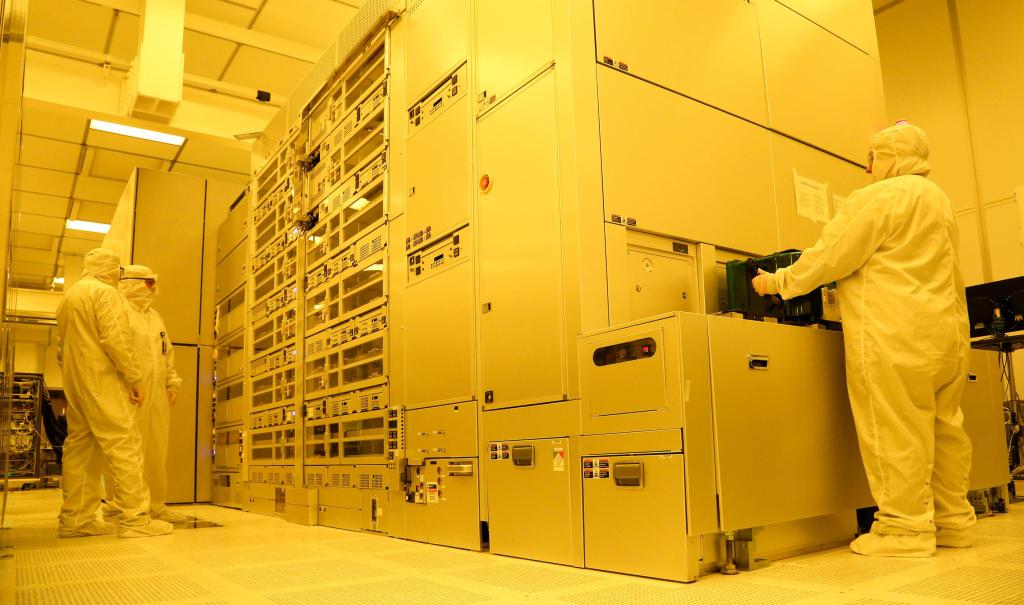
GAITHERSBURG, Md. — The U.S. Department of Commerce’s National Institute of Standards and Technology (NIST) has entered into a cooperative research and development agreement with AIM Photonics that will give chip developers a critical new tool for designing faster chips that use both optical and electrical signals to transmit information. Called integrated photonic circuits, these chips are key components in fiber-optic networks and high-performance computing facilities. They are used in laser-guided missiles, medical sensors, and other advanced technologies.
AIM Photonics, a Manufacturing USA institute, is a public-private partnership that accelerates the commercialization of new technologies for manufacturing photonic chips. The New York-based institute provides small and medium-sized businesses, academics, and government researchers access to expertise and fabrication facilities during all phases of the photonics development cycle, from design to fabrication and packaging.
Thirteen viruses from tens of thousands of years ago have been recovered and reactivated, according to a preprint paper published in BioRxiv. These threats had been idling in the Siberian tundra for approximately 30,000 to 50,000 years before being brought back.
Thanks to climate change, the thawing of the frozen terrain could revive an assortment of ancient pathogens, creating a potential threat that these viral “zombies” could pose.
“Zombie” Viruses
Permafrost — the frigid terrain that stays frozen throughout the year — comprises over 10 percent of our planet’s surface and substantial swaths of the Arctic, a circumpolar area containing Alaska, Scandinavia, and Siberia. But the Arctic’s temperatures are warming almost four times faster than the average worldwide, and the permafrost there is fading fast, freeing all sorts of frozen organisms, including microbes and viruses from thousands of years ago.
An abundance of research has delved into the diversity of microbes that have been freed by the thawing of the permafrost, but far fewer researchers have described the viruses. In fact, though these threats can sometimes resume their activity following their thaw, scientists have studied this process of viral recovery and reactivation only two other times, in 2014 and in 2015.
Credit: NASA, ESA, CSA, and Jupiter ERS Team; Image processing by Ricardo Hueso/UPV/EHU and Judy Schmidt
Topics: Astronomy, Astrophysics, Planetary Science, Space Exploration
Jupiter’s rings, its moons Amalthea (bright point at left) and Adrastea (faint dot at left tip of rings), and even background galaxies are visible in this image from JWST’s NIRCam instrument. Whiter areas on the planet represent regions with more cloud cover, which reflects sunlight, especially Jupiter’s famous Great Red Spot; darker spots have fewer clouds. Perhaps the most stunning feature is the blue glow of the planet’s auroras at the north and south poles. These light shows result when high-energy particles streaming off the sun hit atoms in Jupiter’s atmosphere. Auroras are found on any planet with an atmosphere and a magnetic field, which steers the sun’s particles to the poles; besides Earth and Jupiter, telescopes have seen auroras on Saturn, Uranus and Neptune.






 Physics and Nano