"The one exclusive sign of thorough knowledge is the power of teaching." Aristotle | Disclaimer: The views and opinions expressed on this Wordpress website are the views and opinions of the content creator, Dr. Reggie Goodwin, and should not be construed as shared, or sourced from The Environmental Protection Agency, or any organizations with which they have cooperative, or business relationships.
The Bulletin of the Atomic Scientists shifted the Doomsday Clock to 90 seconds to midnight at a news conference in January 2023. From left, Siegfried Hecker, Daniel Holz, Sharon Squassoni, Mary Robinson and Elbegdorj Tsakhia (Photo credit: Patrick Semansky).
Topics: Astrobiology, Civilization, Existentialism, Science Fiction, SETI, Space Exploration
A few weeks ago, I posted “Wine of Consciousness” on Friday without commentary. There were many directions I could have taken. I did want to see how readers would react. As I postulated, the viewership was limited. There were many directions that I COULD have taken the post. Still, I decided every iteration was getting a little too “pop science” for my taste, and that can quickly cross over into pseudo without critical thinking.
Avi Loeb is popularly known for his hypothesis that Oumuamua (“scout” in Polynesian) wasn’t a meteor or comet but a possible extraterrestrial probe sent by an intelligence with a similar understanding of physics and the limitations of intergalactic travel: without something like 99% the speed of light (warp velocity is still the providence of science fiction), such journeys are not possible within the normal span of lifetimes. Dr. Loeb is a theoretical physicist in the Department of Astronomy at Harvard.
I’m from the generation that grew up hearing about “UFOs” (unidentified flying objects), “flying saucers,” and “little green men.” Green succumbed to gray, grey, or “the grays/greys” (E.T.: The Extra-Terrestrial), and now we’re discussing UAPs (unidentified aerial phenomena).
When someone asks me if I believe there is life elsewhere in the universe, I will say yes. Amoeba is life, bacteria is life, viruses: the jury is still out on whether or not they are alive in the biological sense.
I have often wondered if intelligence is its own Entropy: that the very systems any sentient species would create for itself in governing resources, governments, commerce, and space exploration would be its undoing, which might answer The Fermi Paradox.
The hope of extraterrestrials existing and interacting with Earth mortals might be a cultural wish: a hope that despite our alarming tendency to screw things up, we either might survive our boundless hubris, or SOMEONE will save us from our stupidity, Deus ex machina, or benevolent Vulcans.
Topics: Civilization, Climate Change, Energy, Environment, Existentialism, Global Warming
Another week, another catastrophic, record-setting, history-making flood, this time in Kentucky.
Preliminary assessments indicate rainfall in Graves County last week likely set a new record for most precipitation in a 24-hour period, with 11.28 inches of rain. This would make it yet another “1,000-year” flood event, which had, according to historical projections, less than a 0.1 percent chance of occurring in any given year. One of the towns that experienced flash flooding was Mayfield, a community still rebuilding from a 2021 tornado that killed 57 people.
This was just one of the 11 flash flood emergencies in as many days in the United States, according to Weather Channel meteorologist Heather Zons. These events have claimed multiple lives: 2-year-old Mattie Shiels, 9-month-old brother, Conrad, and their mother, Katie Seley drowned after getting swept away by flash flooding in Pennsylvania, during an event that killed at least four others. In New York earlier this month, 43-year-old Pamela Nugent was swept away trying to evacuate a flooded area; 63-year-old Stephen Davoll drowned in his home in Vermont.
Other catastrophic, deadly flooding events have occurred almost simultaneously around the globe. Just this weekend, 10 inches of rain fell on parts of Nova Scotia, Canada, which is about as much as the region experiences over a period of three months. Four people, including two children, are still missing.
A mathematical tool called a fast Fourier transform maps the structure in a way that reveals the 12-fold symmetry of the quasicrystal. The fast Fourier transform of the electron microscope image of the quasicrystal is shown on the left, while the transform of the simulated crystal is shown on the right. Image credit: Mirkin Research Group, Northwestern University, and Glotzer Group, University of Michigan.
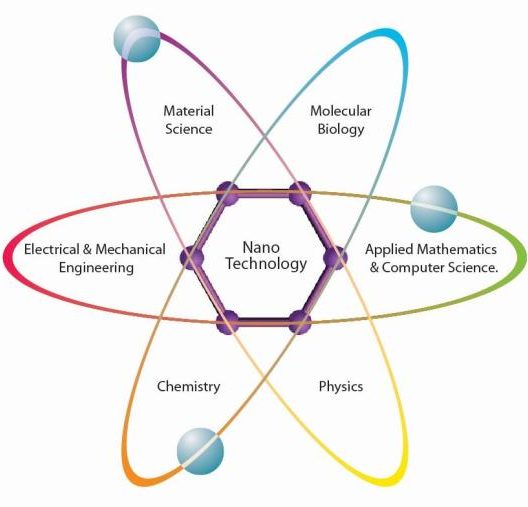
ANN ARBOR—Nanoengineers have created a quasicrystal—a scientifically intriguing and technologically promising material structure—from nanoparticles using DNA, the molecule that encodes life.
The team, led by researchers at Northwestern University, the University of Michigan, and the Center for Cooperative Research in Biomaterials in San Sebastian, Spain, reports the results in Nature Materials.
Unlike ordinary crystals, which are defined by a repeating structure, the patterns in quasicrystals don’t repeat. Quasicrystals built from atoms can have exceptional properties—for example, absorbing heat and light differently, exhibiting unusual electronic properties such as conducting electricity without resistance, or their surfaces being very hard or very slippery.
Engineers studying nanoscale assembly often view nanoparticles as a kind of ‘designer atom,’ which provides a new level of control over synthetic materials. One of the challenges is directing particles to assemble into desired structures with useful qualities, and in building this first DNA-assembled quasicrystal, the team entered a new frontier in nanomaterial design.
“The existence of quasicrystals has been a puzzle for decades, and their discovery appropriately was awarded a Nobel Prize,” said Chad Mirkin, the George B. Rathmann Professor of Chemistry at Northwestern University and co-corresponding author of the study. “Although there are now several known examples, discovered in nature or through serendipitous routes, our research demystifies their formation and, more importantly, shows how we can harness the programmable nature of DNA to design and assemble quasicrystals deliberately.”
Artist’s rendition of the electron correlation, or the ability of electrons to talk with each other, can occur in a special kind of graphite (pencil lead). @ Sampson Wilcox, MIT Research Laboratory of Electronics
MIT physicists have metaphorically turned graphite, or pencil lead, into gold by isolating five ultrathin flakes stacked in a specific order. The resulting material can then be tuned to exhibit three important properties never before seen in natural graphite.
“It is kind of like one-stop shopping,” says Long Ju, an assistant professor in the MIT Department of Physics and leader of the work, which is reported in the October 5 issue of Nature Nanotechnology. “Nature has plenty of surprises. In this case, we never realized that all of these interesting things are embedded in graphite.”
Further, he says, “It is very rare to find materials that can host this many properties.”
Graphite is composed of graphene, which is a single layer of carbon atoms arranged in hexagons resembling a honeycomb structure. Graphene, in turn, has been the focus of intense research since it was first isolated about 20 years ago. Then, about five years ago, researchers, including a team at MIT, discovered that stacking individual sheets of graphene and twisting them at a slight angle to each other can impart new properties to the material, from superconductivity to magnetism. The field of “twistronics” was born.
In the current work, “we discovered interesting properties with no twisting at all,” says Ju, who is also affiliated with the Materials Research Laboratory.
He and colleagues discovered that five layers of graphene arranged in a certain order allow the electrons moving around inside the material to talk with each other. That phenomenon, known as electron correlation, “is the magic that makes all of these new properties possible,” Ju says.
Bulk graphite–and even single sheets of graphene–are good electrical conductors, but that’s it. The material Ju and colleagues isolated, which they call pentalayer rhombohedral stacked graphene, becomes much more than the sum of its parts.
Reference Correlated insulator and Chern insulators in pentalayer rhombohedral-stacked graphene
Tonghang Han, Zhengguang Lu, Giovanni Scuri, Jiho Sung, Jue Wang, Tianyi Han, Kenji Watanabe, Takashi Taniguchi, Hongkun Park & Long Ju
Physicists and philosophers recently met to debate a theory of consciousness called panpsychism.
More than 400 years ago, Galileo showed that many everyday phenomena—such as a ball rolling down an incline or a chandelier gently swinging from a church ceiling—obey precise mathematical laws. For this insight, he is often hailed as the founder of modern science. But, Galileo recognized that not everything was amenable to a quantitative approach. Such things as colors, tastes, and smells “are no more than mere names,” Galileo declared, for “they reside only in consciousness.” These qualities aren’t really out there in the world, he asserted, but exist only in the minds of creatures that perceive them. “Hence, if the living creature were removed,” he wrote, “all these qualities would be wiped away and annihilated.”
Since Galileo’s time, the physical sciences have leaped forward, explaining the workings of the tiniest quarks to the largest galaxy clusters. But explaining things that reside “only in consciousness”—the red of a sunset, say, or the bitter taste of a lemon—has proven far more difficult. Neuroscientists have identified a number of neural correlates of consciousness—brain states associated with specific mental states—but have not explained how matter forms minds in the first place. As philosopher Colin McGinn put it in a 1989 paper, “Somehow, we feel, the water of the physical brain is turned into the wine of consciousness.” Philosopher David Chalmers famously dubbed this quandary the “hard problem” of consciousness.*
Scholars recently gathered to debate the problem at Marist College in Poughkeepsie, N.Y., during a two-day workshop focused on an idea known as panpsychism. The concept proposes that consciousness is a fundamental aspect of reality, like mass or electrical charge. The idea goes back to antiquity—Plato took it seriously—and has had some prominent supporters over the years, including psychologist William James and philosopher and mathematician Bertrand Russell. Lately, it is seeing renewed interest, especially following the 2019 publication of philosopher Philip Goff’s book Galileo’s Error, which argues forcefully for the idea.
Artist’s depiction of an extra-solar system that is crowded with giant planets. Credit: NASA/Dana Berry
Topics: Astronomy, Astrophysics, Planetary Science, Space Exploration
Giant gas planets can be agents of chaos, ensuring nothing lives on their Earth-like neighbors around other stars. New studies show in some planetary systems, the giants tend to kick smaller planets out of orbit and wreak havoc on their climates.
Jupiter, by far the biggest planet in our solar system, plays an important protective role. Its enormous gravitational field deflects comets and asteroids that might otherwise hit Earth, helping create a stable environment for life. However, giant planets elsewhere in the universe do not necessarily protect life on their smaller, rocky planet neighbors.
An Astronomical Journalpaper details how the pull of massive planets in a nearby star system is likely to toss their Earth-like neighbors out of the “habitable zone.” This zone is defined as the range of distances from a star that are warm enough for liquid water to exist on a planet’s surface, making life possible.
Unlike most other known solar systems, the four giant planets in HD 141399 are farther from their star. This makes it a good model for comparison with our solar system, where Jupiter and Saturn are also relatively far from the sun.
“It’s as if they have four Jupiters acting like wrecking balls, throwing everything out of whack,” said Stephen Kane, UC Riverside astrophysicist and author of the journal paper.
Taking data about the system’s planets into account, Kane ran multiple computer simulations to understand the effect of these four giants. He wanted specifically to look at the habitable zone in this star system and see if an Earth could remain in a stable orbit there.
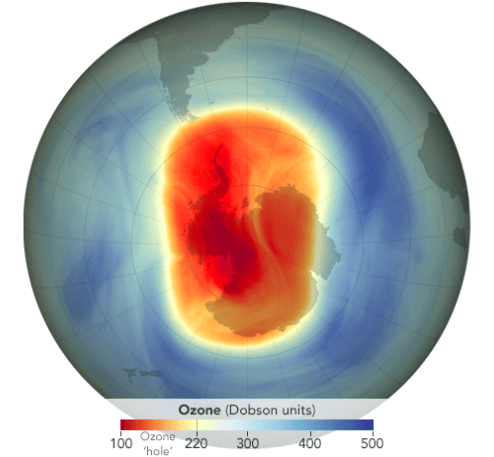
This map shows the size and shape of the ozone hole over the South Pole on September 21, 2023, the day of its maximum extent, as calculated by the NASA Ozone Watch team. Moderate ozone losses (orange) are visible amid widespread areas of more potent ozone losses (red).
Editor’s note: This article has been updated to clarify the ranking of the 2023 ozone hole. It is the 12th largest single-day hole on record and the 16th largest when averaged from Sept 7 to Oct 13.
The 2023 Antarctic ozone hole reached its maximum size on Sept. 21, according to annual satellite and balloon-based measurements made by NASA and NOAA. At 10 million square miles, or 26 million square kilometers, the hole ranked as the 12th largest single-day ozone hole since 1979.
During the peak of the ozone depletion season from Sept. 7 to Oct. 13, the hole this year averaged 8.9 million square miles (23.1 million square kilometers), approximately the size of North America, making it the 16th largest over this period.
“It’s a very modest ozone hole,” said Paul Newman, leader of NASA’s ozone research team and chief scientist for Earth sciences at NASA’s Goddard Space Flight Center in Greenbelt, Maryland. “Declining levels of human-produced chlorine compounds, along with help from active Antarctic stratospheric weather, slightly improved ozone levels this year.”
In what is now “old school Internet” (or web surfing for fogies), I will get a friend request from someone on Facebook/Meta who is in cryptocurrency. I quote myself in the first paragraph of what I refer to as my “public service announcement):
I am not INTERESTED in crypto. As someone who worked with cryptography as a matter of national security, holding a TS/SCI clearance, when you start your message with “let me explain to YOU how crypto works,” expect to get blocked.
Invariably, I still do, which makes me wonder if they read the PSA or think “they will be the one” to sign me. News flash, pilgrim…I now have another pertinent reason to ignore your blockchain solicitations, actually, several good reasons.
Every time we turn on a light in our homes, there is a thermal budget that we are being charged for (that’s how Duke Power makes its money in North Carolina and Perdernales Electric Cooperative in Texas). Bitcoin/Blockchain (I think) caught the imagination because it seemed like a “Federation Credit” from Star Trek, where no one explains fully how a society that is “post-scarcity” somehow feels the need for some type of currency in utopia. It’s kind of like magic carpets: you go with the bit for the story – warp drive, Heisenberg compensators, Federation credits. The story, and if you are thoroughly entertained after the denouement, not the physics, is what matters.
You might not be extracting anything from the planet directly, but Bitcoin mining has a massive impact on the planet’s environment.
Mining resources from our planet can take a devastating toll on the environment, both local and global. Even beyond this, using the resource could cause disastrous effects on our planet, and dependence on a single resource can wreak havoc on a country’s economy. Yet, many of these resources are needed for our daily lives — sometimes as a luxury, sometimes as a necessity. Any responsible country or company should always take pause to consider what impact mining of any kind can have on the planet.
It turns out that these days, one type of mining might be the worst for Earth’s environment: bitcoins. Yes, the “mining” of virtual currency makes its mark on our planet. The unequal distribution of Bitcoin mining across the globe means that some countries are making a much larger dent into the planet’s climate and environment than others … all for a “resource” that is far from necessary for our society.
Bitcoin mining uses a lot of computing power to solve the cryptographic puzzles that lie at the heart of the industry. As of today (October 30, 2023), each Bitcoin is worth over $34,000, and with the multitude of other cryptocoins out there, using computers to unlock more can be a profitable endeavor. Almost half a trillion dollars of the global economy runs on these “virtual currencies.”
Topics: Applied Physics, Astrophysics, Computer Modeling, Einstein, High Energy Physics, Particle Physics, Theoretical Physics
In the search for new physics, a new kind of scientist is bridging the gap between theory and experiment.
Traditionally, many physicists have divided themselves into two tussling camps: the theorists and the experimentalists. Albert Einstein theorized general relativity, and Arthur Eddington observed it in action as “bending” starlight; Murray Gell-Mann and George Zweig thought up the idea of quarks, and Henry Kendall, Richard Taylor, Jerome Freidman and their teams detected them.
In particle physics especially, the divide is stark. Consider the Higgs boson, proposed in 1964 and discovered in 2012. Since then, physicists have sought to scrutinize its properties, but theorists and experimentalists don’t share Higgs data directly, and they’ve spent years arguing over what to share and how to format it. (There’s now some consensus, although the going was rough.)
But there’s a missing player in this dichotomy. Who, exactly, is facilitating the flow of data between theory and experiment?
Traditionally, the experimentalists filled this role, running the machines and looking at the data — but in high-energy physics and many other subfields, there’s too much data for this to be feasible. Researchers can’t just eyeball a few events in the accelerator and come to conclusions; at the Large Hadron Collider, for instance, about a billion particle collisions happen per second, which sensors detect, process, and store in vast computing systems. And it’s not just quantity. All this data is outrageously complex, made more so by simulation.
In other words, these experiments produce more data than anyone could possibly analyze with traditional tools. And those tools are imperfect anyway, requiring researchers to boil down many complex events into just a handful of attributes — say, the number of photons at a given energy. A lot of science gets left out.
In response to this conundrum, a growing movement in high-energy physics and other subfields, like nuclear physics and astrophysics, seeks to analyze data in its full complexity — to let the data speak for itself. Experts in this area are using cutting-edge data science tools to decide which data to keep and which to discard and to sniff out subtle patterns.
I admit I had heard of this before, but I didn’t know the government gave it his name. It figures because Cleve was clever (see what I did there?) amid the Second World War and the secret Manhattan Project, led by Robert J. Oppenheimer and now a popular movie from Christopher Nolan. Cleve honestly thought the story was crap, but I can see why the FBI got so excited. Fiction writers are storytellers, and storytellers recognize patterns in human nature and the logical outcomes of scientific research. Instead of the devices that horribly leveled Hiroshima and Nagasaki (“Little Boy” and “Fat Man”), we very well could have had Philip K. Dick’s predicted “Heisenberg Device” (“The Man in the High Castle,” 1962, also a fascinating alternative history series on Amazon Prime).
The Amazon description (even though they don’t have a copy in print):
WHY DID THE FBI WANT “DEADLINE” CENSORED? Hugo and Nebula Award winner Robert Silverberg says, “Deadline’s publication caus[ed] the FBI to investigate Cartmill, Astounding Science Fiction, John W. Campbell, Isaac Asimov, Robert A. Heinlein, and L. Sprague de Camp.” Author Cleve Cartmill, editor John W. Campbell, publishers Street & Smith, Isaac Asimov, Robert A. Heinlein, and L. Sprague de Camp were only some of those who came under government investigation after security officials learned of the contents of what was to become science fiction’s most controversial brainchild? Why? You will discover the startling answers in Jean Marie Stine’s amazing introduction to this first-ever collection of Golden Age author Cartmill’s work. Included in this mammoth volume are four complete novellas: The Too-close to Reality for the Government, “Deadline,” the noirish outer space mystery, “Some Day We’ll Find You,” the intellectual thriller of an attempted revolution against a future theocracy; “With Flaming Swords,” and the thought-provoking story of a man whose desire to be a normal, patriotic citizen inadvertently lead to his society’s “Overthrow.” But, be warned: Cartmill questioned authority and traditional explanations and told his stories to inspire readers to see and question the shortcomings of their own society. So, if you are completely comfortable with your government, society, and life and never want to doubt what you’re told, put down this book immediately and do not read any further. Cleve Cartmill (1908-1964) was a reporter, radio operator and inventor. He is most famous for “Deadline,” the Murchison And Co., Space Salvagers series, and his short novels for the legendary Unknown magazine. This book’s editor, Jean Marie Stine, is a well-known science fiction author and anthologist. During the late 1960s, she served as a personal assistant to Star Trek creator Gene Roddenberry, and in the 1970s, she wrote the classic The Prisoner: A Day in the Life, based on Patrick McGoohan’s cult television series.
*****
One of my favorite, and most powerful Trek episodes I saw as a youth was “Let That Be Your Last Battlefield.“ Recall the 60s weren’t just “make love, not war”: there was a lot of both. Vietnam overseas, protests of the war, and Civil Rights/Voting Rights marches at home. Suspicions that any deviance from the John Birch Society’s authoritarian “norm” was judged subversive; communists, therefore, were necessarily purged and crushed from existence. Judging from the airing date, its first showing came nine months after the sad assassination of Dr. Martin Luther King.
It also aired during the climate of the Cold War, a period many seemingly LONG to get back to (that madness), where the nuclear “plan” was called MAD: mutually assured destruction. We still possess that insane power, essentially holding humanity hostage, guns to our own heads.
Gene Roddenberry put an interracial, international crew together: Nyota Uhura (literally: “Freedom Star” in Kiswahili); Hikaru Sulu (for the Sulu sea, meant to represent all of Asia, but of fictional Japanese origin); Pavel Andreievich Chekov (a RUSKIE for crying out loud!). In this fictional treatment, Bele and Lokai “stood their ground” until the end. As I’ve commented before, Roddenberry developed his own eschatology, y. Yet, it is positive and relevant that we might just survive our own hubris, essentially stemming from old tribal conflicts and current contemporary displays of breathtaking stupidity and arrogance.
This episode was a stark warning of the inevitable consequences of NOT…
“Let That Be Your Last Battlefield” is the fifteenth episode of the third season of the original science fiction television show Star Trek. It was first broadcast on January 10, 1969, and repeated on August 12, 1969. It was written by Oliver Crawford, based on a story by Gene L. Coon (writing under his pen name “Lee Cronin”) and directed by Jud Taylor. The script evolved from an outline by Barry Trivers for a possible first-season episode called “A Portrait in Black and White.” The script was accepted for the third season following budget cuts. The episode guest-stars Lou Antonio and Frank Gorshin, best known for his role as The Riddler in the Batman live-action television series. Contrary to popular rumors and articles, Gorshin was not Emmy nominated for this role.
In this episode, the Enterprise picks up two survivors of a war-torn planet who are still committed to destroying each other aboard the ship.
Once the Ariannus mission is completed, Bele takes control of the Enterprise again, but this time, he deactivates the auto-destruct in the process and sends the ship to Cheron. Once there, the two aliens find the planet’s population completely wiped out by a global war fueled by insane racial hatred. Both Lokai and Bele stare silently at the destruction on the monitor and realize they are the only ones left of their race (or, as they see it, their “races”).
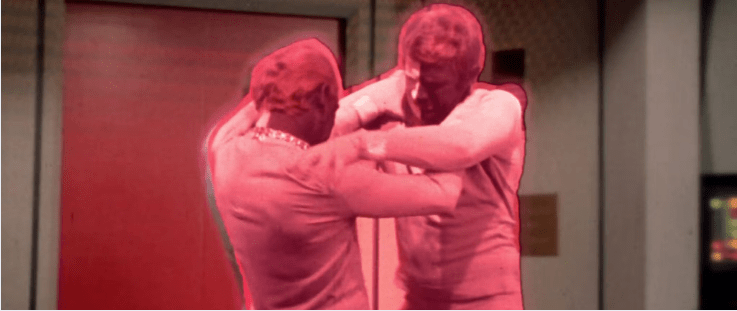
Instead of calling a truce, the two beings begin to blame each other for the destruction of the planet, and a brawl ensues. As the two aliens fight, their innate powers radiate, cloaking them with an energy aura that threatens to damage the ship. With no other choice, Kirk sadly allows the two aliens to chase each other down to their obliterated world to decide their own fates, consumed by their now self-perpetuating mutual hate. Forlorn, Lt. Uhura asks if their hate is all they ever had. Kirk ruefully says no…but it is all they have left.
Bele and Lokai. Black on one side and white on the other. Mirror images of each other. Cain and Abel. Brahman and Dalit. German and Jewish. Catholic and Protestant. Hutu and Tutsi. Ukrainian and Russian. Ishmael and Isaac, imago alterius. Of the same genome and lands, on the same PLANET, yet hating one another for the most superficial, if you want to call it this, “reasoning.” Which is the more excellent sacrifice? Who is the Abrahamic son of blessing? Though I invoke Biblical struggles, the current crisis started almost with the birth of the modern nation of Israel and the displacement of Palestinians after the Second World War. Vox gives a nice primer on the history. All conflict boils down to a struggle over resources: oil, minerals, rare earth, jewels, water, holy ground, and the faux hierarchies the few use to justify the grand theft of resources from the many.
Let’s be clear: Hamas is a terrorist organization, as the Russian Federation is a terrorist state. Both are not invested in world order (a “Boogie Man” term) because disorder is their only superpower. A coalition between Israel and Saudi Arabia is as disastrous to Hamas as Ukraine is on the border of Russia: they are, ironically, the “threat of a good example” (Noam Chomsky). How do you justify the destruction of a nation when two monotheistic governments cooperate? How do you justify a dictatorship when there is a democracy on your border, that Russians have relatives there, and many have intermarried? “Superpower” is a documentary filmed by the actor Sean Penn at the beginning of the conflict. If you saw Putin’s expression the one time he and Volodymyr Zelinsky were on stage together, and Zelinsky defied Putin’s version of events, I don’t need to study Russian to see when a dictator is incensed. These wars are personal. He and Hamas are Bele.
A planet or a nation in the Near East. The pattern is recognizable, as is its conclusion.
* * * * *
“Our scientific power has outrun our spiritual power. We have guided missiles and misguided men.”
“A nation that continues year after year to spend more money on military defense than on programs of social uplift is approaching spiritual doom.”
“We must learn to live together as brothers or perish together as fools.” “The choice is not between violence and nonviolence but between nonviolence and nonexistence.”
Tao produces one One produces two Two produce three Three produce myriad things Myriad things, backed by yin and embracing yang Achieve harmony by integrating their energy What the people dislike Are alone, bereft, and unworthy But the rulers call themselves these terms
So, with all things Appear to take loss but benefit Or receive benefits but lose What the ancients taught I will also teach The violent one cannot have a natural death I will use this as the principle of all teachings
(Tao te Ching verse 42, translation by Derek Lin, 2006)