"The one exclusive sign of thorough knowledge is the power of teaching." Aristotle | Disclaimer: The views and opinions expressed on this Wordpress website are the views and opinions of the content creator, Dr. Reggie Goodwin, and should not be construed as shared, or sourced from The Environmental Protection Agency, or any organizations with which they have cooperative, or business relationships.
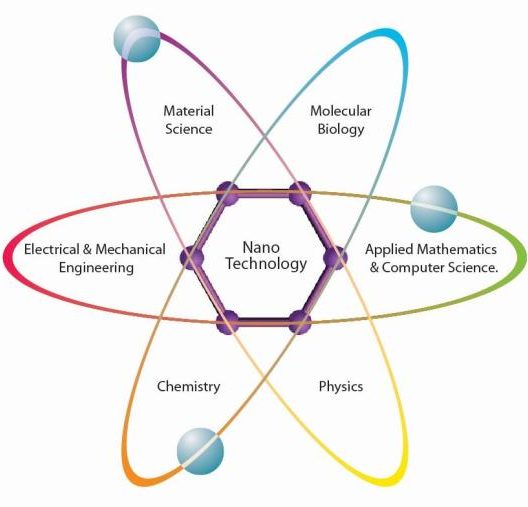
Artist’s rendition of the electron correlation, or the ability of electrons to talk with each other, can occur in a special kind of graphite (pencil lead). @ Sampson Wilcox, MIT Research Laboratory of Electronics
MIT physicists have metaphorically turned graphite, or pencil lead, into gold by isolating five ultrathin flakes stacked in a specific order. The resulting material can then be tuned to exhibit three important properties never before seen in natural graphite.
“It is kind of like one-stop shopping,” says Long Ju, an assistant professor in the MIT Department of Physics and leader of the work, which is reported in the October 5 issue of Nature Nanotechnology. “Nature has plenty of surprises. In this case, we never realized that all of these interesting things are embedded in graphite.”
Further, he says, “It is very rare to find materials that can host this many properties.”
Graphite is composed of graphene, which is a single layer of carbon atoms arranged in hexagons resembling a honeycomb structure. Graphene, in turn, has been the focus of intense research since it was first isolated about 20 years ago. Then, about five years ago, researchers, including a team at MIT, discovered that stacking individual sheets of graphene and twisting them at a slight angle to each other can impart new properties to the material, from superconductivity to magnetism. The field of “twistronics” was born.
In the current work, “we discovered interesting properties with no twisting at all,” says Ju, who is also affiliated with the Materials Research Laboratory.
He and colleagues discovered that five layers of graphene arranged in a certain order allow the electrons moving around inside the material to talk with each other. That phenomenon, known as electron correlation, “is the magic that makes all of these new properties possible,” Ju says.
Bulk graphite–and even single sheets of graphene–are good electrical conductors, but that’s it. The material Ju and colleagues isolated, which they call pentalayer rhombohedral stacked graphene, becomes much more than the sum of its parts.
Reference Correlated insulator and Chern insulators in pentalayer rhombohedral-stacked graphene
Tonghang Han, Zhengguang Lu, Giovanni Scuri, Jiho Sung, Jue Wang, Tianyi Han, Kenji Watanabe, Takashi Taniguchi, Hongkun Park & Long Ju
Physicists and philosophers recently met to debate a theory of consciousness called panpsychism.
More than 400 years ago, Galileo showed that many everyday phenomena—such as a ball rolling down an incline or a chandelier gently swinging from a church ceiling—obey precise mathematical laws. For this insight, he is often hailed as the founder of modern science. But, Galileo recognized that not everything was amenable to a quantitative approach. Such things as colors, tastes, and smells “are no more than mere names,” Galileo declared, for “they reside only in consciousness.” These qualities aren’t really out there in the world, he asserted, but exist only in the minds of creatures that perceive them. “Hence, if the living creature were removed,” he wrote, “all these qualities would be wiped away and annihilated.”
Since Galileo’s time, the physical sciences have leaped forward, explaining the workings of the tiniest quarks to the largest galaxy clusters. But explaining things that reside “only in consciousness”—the red of a sunset, say, or the bitter taste of a lemon—has proven far more difficult. Neuroscientists have identified a number of neural correlates of consciousness—brain states associated with specific mental states—but have not explained how matter forms minds in the first place. As philosopher Colin McGinn put it in a 1989 paper, “Somehow, we feel, the water of the physical brain is turned into the wine of consciousness.” Philosopher David Chalmers famously dubbed this quandary the “hard problem” of consciousness.*
Scholars recently gathered to debate the problem at Marist College in Poughkeepsie, N.Y., during a two-day workshop focused on an idea known as panpsychism. The concept proposes that consciousness is a fundamental aspect of reality, like mass or electrical charge. The idea goes back to antiquity—Plato took it seriously—and has had some prominent supporters over the years, including psychologist William James and philosopher and mathematician Bertrand Russell. Lately, it is seeing renewed interest, especially following the 2019 publication of philosopher Philip Goff’s book Galileo’s Error, which argues forcefully for the idea.
Artist’s depiction of an extra-solar system that is crowded with giant planets. Credit: NASA/Dana Berry
Topics: Astronomy, Astrophysics, Planetary Science, Space Exploration
Giant gas planets can be agents of chaos, ensuring nothing lives on their Earth-like neighbors around other stars. New studies show in some planetary systems, the giants tend to kick smaller planets out of orbit and wreak havoc on their climates.
Jupiter, by far the biggest planet in our solar system, plays an important protective role. Its enormous gravitational field deflects comets and asteroids that might otherwise hit Earth, helping create a stable environment for life. However, giant planets elsewhere in the universe do not necessarily protect life on their smaller, rocky planet neighbors.
An Astronomical Journalpaper details how the pull of massive planets in a nearby star system is likely to toss their Earth-like neighbors out of the “habitable zone.” This zone is defined as the range of distances from a star that are warm enough for liquid water to exist on a planet’s surface, making life possible.
Unlike most other known solar systems, the four giant planets in HD 141399 are farther from their star. This makes it a good model for comparison with our solar system, where Jupiter and Saturn are also relatively far from the sun.
“It’s as if they have four Jupiters acting like wrecking balls, throwing everything out of whack,” said Stephen Kane, UC Riverside astrophysicist and author of the journal paper.
Taking data about the system’s planets into account, Kane ran multiple computer simulations to understand the effect of these four giants. He wanted specifically to look at the habitable zone in this star system and see if an Earth could remain in a stable orbit there.
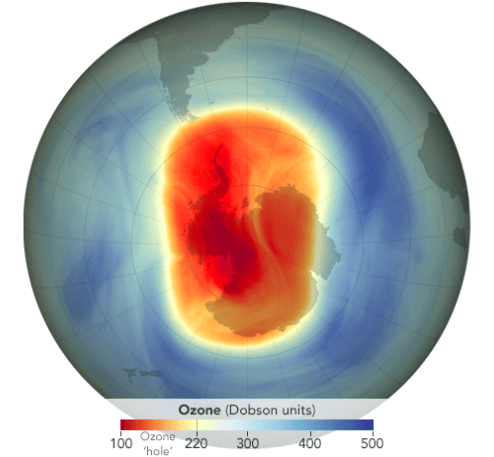
This map shows the size and shape of the ozone hole over the South Pole on September 21, 2023, the day of its maximum extent, as calculated by the NASA Ozone Watch team. Moderate ozone losses (orange) are visible amid widespread areas of more potent ozone losses (red).
Editor’s note: This article has been updated to clarify the ranking of the 2023 ozone hole. It is the 12th largest single-day hole on record and the 16th largest when averaged from Sept 7 to Oct 13.
The 2023 Antarctic ozone hole reached its maximum size on Sept. 21, according to annual satellite and balloon-based measurements made by NASA and NOAA. At 10 million square miles, or 26 million square kilometers, the hole ranked as the 12th largest single-day ozone hole since 1979.
During the peak of the ozone depletion season from Sept. 7 to Oct. 13, the hole this year averaged 8.9 million square miles (23.1 million square kilometers), approximately the size of North America, making it the 16th largest over this period.
“It’s a very modest ozone hole,” said Paul Newman, leader of NASA’s ozone research team and chief scientist for Earth sciences at NASA’s Goddard Space Flight Center in Greenbelt, Maryland. “Declining levels of human-produced chlorine compounds, along with help from active Antarctic stratospheric weather, slightly improved ozone levels this year.”
In what is now “old school Internet” (or web surfing for fogies), I will get a friend request from someone on Facebook/Meta who is in cryptocurrency. I quote myself in the first paragraph of what I refer to as my “public service announcement):
I am not INTERESTED in crypto. As someone who worked with cryptography as a matter of national security, holding a TS/SCI clearance, when you start your message with “let me explain to YOU how crypto works,” expect to get blocked.
Invariably, I still do, which makes me wonder if they read the PSA or think “they will be the one” to sign me. News flash, pilgrim…I now have another pertinent reason to ignore your blockchain solicitations, actually, several good reasons.
Every time we turn on a light in our homes, there is a thermal budget that we are being charged for (that’s how Duke Power makes its money in North Carolina and Perdernales Electric Cooperative in Texas). Bitcoin/Blockchain (I think) caught the imagination because it seemed like a “Federation Credit” from Star Trek, where no one explains fully how a society that is “post-scarcity” somehow feels the need for some type of currency in utopia. It’s kind of like magic carpets: you go with the bit for the story – warp drive, Heisenberg compensators, Federation credits. The story, and if you are thoroughly entertained after the denouement, not the physics, is what matters.
You might not be extracting anything from the planet directly, but Bitcoin mining has a massive impact on the planet’s environment.
Mining resources from our planet can take a devastating toll on the environment, both local and global. Even beyond this, using the resource could cause disastrous effects on our planet, and dependence on a single resource can wreak havoc on a country’s economy. Yet, many of these resources are needed for our daily lives — sometimes as a luxury, sometimes as a necessity. Any responsible country or company should always take pause to consider what impact mining of any kind can have on the planet.
It turns out that these days, one type of mining might be the worst for Earth’s environment: bitcoins. Yes, the “mining” of virtual currency makes its mark on our planet. The unequal distribution of Bitcoin mining across the globe means that some countries are making a much larger dent into the planet’s climate and environment than others … all for a “resource” that is far from necessary for our society.
Bitcoin mining uses a lot of computing power to solve the cryptographic puzzles that lie at the heart of the industry. As of today (October 30, 2023), each Bitcoin is worth over $34,000, and with the multitude of other cryptocoins out there, using computers to unlock more can be a profitable endeavor. Almost half a trillion dollars of the global economy runs on these “virtual currencies.”
Topics: Applied Physics, Astrophysics, Computer Modeling, Einstein, High Energy Physics, Particle Physics, Theoretical Physics
In the search for new physics, a new kind of scientist is bridging the gap between theory and experiment.
Traditionally, many physicists have divided themselves into two tussling camps: the theorists and the experimentalists. Albert Einstein theorized general relativity, and Arthur Eddington observed it in action as “bending” starlight; Murray Gell-Mann and George Zweig thought up the idea of quarks, and Henry Kendall, Richard Taylor, Jerome Freidman and their teams detected them.
In particle physics especially, the divide is stark. Consider the Higgs boson, proposed in 1964 and discovered in 2012. Since then, physicists have sought to scrutinize its properties, but theorists and experimentalists don’t share Higgs data directly, and they’ve spent years arguing over what to share and how to format it. (There’s now some consensus, although the going was rough.)
But there’s a missing player in this dichotomy. Who, exactly, is facilitating the flow of data between theory and experiment?
Traditionally, the experimentalists filled this role, running the machines and looking at the data — but in high-energy physics and many other subfields, there’s too much data for this to be feasible. Researchers can’t just eyeball a few events in the accelerator and come to conclusions; at the Large Hadron Collider, for instance, about a billion particle collisions happen per second, which sensors detect, process, and store in vast computing systems. And it’s not just quantity. All this data is outrageously complex, made more so by simulation.
In other words, these experiments produce more data than anyone could possibly analyze with traditional tools. And those tools are imperfect anyway, requiring researchers to boil down many complex events into just a handful of attributes — say, the number of photons at a given energy. A lot of science gets left out.
In response to this conundrum, a growing movement in high-energy physics and other subfields, like nuclear physics and astrophysics, seeks to analyze data in its full complexity — to let the data speak for itself. Experts in this area are using cutting-edge data science tools to decide which data to keep and which to discard and to sniff out subtle patterns.
I admit I had heard of this before, but I didn’t know the government gave it his name. It figures because Cleve was clever (see what I did there?) amid the Second World War and the secret Manhattan Project, led by Robert J. Oppenheimer and now a popular movie from Christopher Nolan. Cleve honestly thought the story was crap, but I can see why the FBI got so excited. Fiction writers are storytellers, and storytellers recognize patterns in human nature and the logical outcomes of scientific research. Instead of the devices that horribly leveled Hiroshima and Nagasaki (“Little Boy” and “Fat Man”), we very well could have had Philip K. Dick’s predicted “Heisenberg Device” (“The Man in the High Castle,” 1962, also a fascinating alternative history series on Amazon Prime).
The Amazon description (even though they don’t have a copy in print):
WHY DID THE FBI WANT “DEADLINE” CENSORED? Hugo and Nebula Award winner Robert Silverberg says, “Deadline’s publication caus[ed] the FBI to investigate Cartmill, Astounding Science Fiction, John W. Campbell, Isaac Asimov, Robert A. Heinlein, and L. Sprague de Camp.” Author Cleve Cartmill, editor John W. Campbell, publishers Street & Smith, Isaac Asimov, Robert A. Heinlein, and L. Sprague de Camp were only some of those who came under government investigation after security officials learned of the contents of what was to become science fiction’s most controversial brainchild? Why? You will discover the startling answers in Jean Marie Stine’s amazing introduction to this first-ever collection of Golden Age author Cartmill’s work. Included in this mammoth volume are four complete novellas: The Too-close to Reality for the Government, “Deadline,” the noirish outer space mystery, “Some Day We’ll Find You,” the intellectual thriller of an attempted revolution against a future theocracy; “With Flaming Swords,” and the thought-provoking story of a man whose desire to be a normal, patriotic citizen inadvertently lead to his society’s “Overthrow.” But, be warned: Cartmill questioned authority and traditional explanations and told his stories to inspire readers to see and question the shortcomings of their own society. So, if you are completely comfortable with your government, society, and life and never want to doubt what you’re told, put down this book immediately and do not read any further. Cleve Cartmill (1908-1964) was a reporter, radio operator and inventor. He is most famous for “Deadline,” the Murchison And Co., Space Salvagers series, and his short novels for the legendary Unknown magazine. This book’s editor, Jean Marie Stine, is a well-known science fiction author and anthologist. During the late 1960s, she served as a personal assistant to Star Trek creator Gene Roddenberry, and in the 1970s, she wrote the classic The Prisoner: A Day in the Life, based on Patrick McGoohan’s cult television series.
*****
One of my favorite, and most powerful Trek episodes I saw as a youth was “Let That Be Your Last Battlefield.“ Recall the 60s weren’t just “make love, not war”: there was a lot of both. Vietnam overseas, protests of the war, and Civil Rights/Voting Rights marches at home. Suspicions that any deviance from the John Birch Society’s authoritarian “norm” was judged subversive; communists, therefore, were necessarily purged and crushed from existence. Judging from the airing date, its first showing came nine months after the sad assassination of Dr. Martin Luther King.
It also aired during the climate of the Cold War, a period many seemingly LONG to get back to (that madness), where the nuclear “plan” was called MAD: mutually assured destruction. We still possess that insane power, essentially holding humanity hostage, guns to our own heads.
Gene Roddenberry put an interracial, international crew together: Nyota Uhura (literally: “Freedom Star” in Kiswahili); Hikaru Sulu (for the Sulu sea, meant to represent all of Asia, but of fictional Japanese origin); Pavel Andreievich Chekov (a RUSKIE for crying out loud!). In this fictional treatment, Bele and Lokai “stood their ground” until the end. As I’ve commented before, Roddenberry developed his own eschatology, y. Yet, it is positive and relevant that we might just survive our own hubris, essentially stemming from old tribal conflicts and current contemporary displays of breathtaking stupidity and arrogance.
This episode was a stark warning of the inevitable consequences of NOT…
“Let That Be Your Last Battlefield” is the fifteenth episode of the third season of the original science fiction television show Star Trek. It was first broadcast on January 10, 1969, and repeated on August 12, 1969. It was written by Oliver Crawford, based on a story by Gene L. Coon (writing under his pen name “Lee Cronin”) and directed by Jud Taylor. The script evolved from an outline by Barry Trivers for a possible first-season episode called “A Portrait in Black and White.” The script was accepted for the third season following budget cuts. The episode guest-stars Lou Antonio and Frank Gorshin, best known for his role as The Riddler in the Batman live-action television series. Contrary to popular rumors and articles, Gorshin was not Emmy nominated for this role.
In this episode, the Enterprise picks up two survivors of a war-torn planet who are still committed to destroying each other aboard the ship.
Once the Ariannus mission is completed, Bele takes control of the Enterprise again, but this time, he deactivates the auto-destruct in the process and sends the ship to Cheron. Once there, the two aliens find the planet’s population completely wiped out by a global war fueled by insane racial hatred. Both Lokai and Bele stare silently at the destruction on the monitor and realize they are the only ones left of their race (or, as they see it, their “races”).
Instead of calling a truce, the two beings begin to blame each other for the destruction of the planet, and a brawl ensues. As the two aliens fight, their innate powers radiate, cloaking them with an energy aura that threatens to damage the ship. With no other choice, Kirk sadly allows the two aliens to chase each other down to their obliterated world to decide their own fates, consumed by their now self-perpetuating mutual hate. Forlorn, Lt. Uhura asks if their hate is all they ever had. Kirk ruefully says no…but it is all they have left.
Bele and Lokai. Black on one side and white on the other. Mirror images of each other. Cain and Abel. Brahman and Dalit. German and Jewish. Catholic and Protestant. Hutu and Tutsi. Ukrainian and Russian. Ishmael and Isaac, imago alterius. Of the same genome and lands, on the same PLANET, yet hating one another for the most superficial, if you want to call it this, “reasoning.” Which is the more excellent sacrifice? Who is the Abrahamic son of blessing? Though I invoke Biblical struggles, the current crisis started almost with the birth of the modern nation of Israel and the displacement of Palestinians after the Second World War. Vox gives a nice primer on the history. All conflict boils down to a struggle over resources: oil, minerals, rare earth, jewels, water, holy ground, and the faux hierarchies the few use to justify the grand theft of resources from the many.
Let’s be clear: Hamas is a terrorist organization, as the Russian Federation is a terrorist state. Both are not invested in world order (a “Boogie Man” term) because disorder is their only superpower. A coalition between Israel and Saudi Arabia is as disastrous to Hamas as Ukraine is on the border of Russia: they are, ironically, the “threat of a good example” (Noam Chomsky). How do you justify the destruction of a nation when two monotheistic governments cooperate? How do you justify a dictatorship when there is a democracy on your border, that Russians have relatives there, and many have intermarried? “Superpower” is a documentary filmed by the actor Sean Penn at the beginning of the conflict. If you saw Putin’s expression the one time he and Volodymyr Zelinsky were on stage together, and Zelinsky defied Putin’s version of events, I don’t need to study Russian to see when a dictator is incensed. These wars are personal. He and Hamas are Bele.
A planet or a nation in the Near East. The pattern is recognizable, as is its conclusion.
* * * * *
“Our scientific power has outrun our spiritual power. We have guided missiles and misguided men.”
“A nation that continues year after year to spend more money on military defense than on programs of social uplift is approaching spiritual doom.”
“We must learn to live together as brothers or perish together as fools.” “The choice is not between violence and nonviolence but between nonviolence and nonexistence.”
Tao produces one One produces two Two produce three Three produce myriad things Myriad things, backed by yin and embracing yang Achieve harmony by integrating their energy What the people dislike Are alone, bereft, and unworthy But the rulers call themselves these terms
So, with all things Appear to take loss but benefit Or receive benefits but lose What the ancients taught I will also teach The violent one cannot have a natural death I will use this as the principle of all teachings
(Tao te Ching verse 42, translation by Derek Lin, 2006)
If you stir a colloidal solution containing nanoparticles, you might expect the particles to disperse evenly through the liquid. But that’s not what happens. Instead, the particles end up concentrated in a specific region and may even clump together. This unexpected result is an example of Einstein’s tea leaf paradox, and the researchers at Tongji University in China who discovered it – quite by accident – say it could be used to collect particles or molecules for detection in a dilute solution. Importantly, it could also be used to make aerogels for technological applications.
We usually stir a liquid to evenly disperse the substances in it. The phenomenon known as Einstein’s tea leaf paradox describes a reverse effect in which the leaves in a well-stirred cup of tea instead become concentrated in a doughnut-shaped area and gather at the bottom center of the cup once stirring ceases. While this paradox has been known about for more than 100 years and is understood to be caused by a secondary flow effect, there are few studies on how it manifests for nanoparticles in a stirred solution.
Liquid “squeezing”
Researchers led by Ai Du of the School of Physics, Science, and Engineering at Tongji University in Shanghai have now simulated how gold nanoparticle spheres dispersed in water move when the solution is stirred. When they calculated the flow velocity distribution of the fluid, they found that the rate at which the particles moved appeared to follow the fluid’s flow velocity.
“Interestingly, by dividing the whole container into several sectors, we also observed that the high-velocity region driven by the stirrer was also the region in which the particles aggregated,” explains Du. “We think that this phenomenon is probably due to direct ‘squeezing’ of the liquid created by the stirrer and comes from the mass differences between the nanoparticles and the liquid phase.”
Claudia Goldin Harvard University, Cambridge, MA, USA
“for having advanced our understanding of women’s labor market outcomes”
She uncovered key drivers of gender differences in the labor market
This year’s Laureate in the Economic Sciences, Claudia Goldin, provided the first comprehensive account of women’s earnings and labor market participation through the centuries. Her research reveals the causes of change, as well as the main sources of the remaining gender gap.
Women are vastly underrepresented in the global labor market, and when they work, they earn less than men. Claudia Goldin has trawled the archives and collected over 200 years of data from the US, allowing her to demonstrate how and why gender differences in earnings and employment rates have changed over time.
Goldin showed that female participation in the labor market did not have an upward trend over this entire period but instead formed a U-shaped curve. The participation of married women decreased with the transition from an agrarian to an industrial society in the early nineteenth century but then started to increase with the growth of the service sector in the early twentieth century. Goldin explained this pattern as the result of structural change and evolving social norms regarding women’s responsibilities for home and family.
Narges Mohammadi is a woman, a human rights advocate, and a freedom fighter. Her brave struggle for freedom of expression and the right to independence has come with tremendous personal costs. Altogether, the regime in Iran has arrested her 13 times, convicted her five times, and sentenced her to a total of 31 years in prison and 154 lashes.
Narges Mohammadi is still in prison.
Announcement
“Zan – Zendegi – Azadi” “Woman – Life – Freedom”
The Norwegian Nobel Committee has decided to award the Nobel Peace Prize for 2023 to Narges Mohammadi for her fight against the oppression of women in Iran and her fight to promote human rights and freedom for all. Her brave struggle has come with tremendous personal costs. Altogether, the regime has arrested her 13 times, convicted her five times, and sentenced her to a total of 31 years in prison and 154 lashes. Ms Mohammadi is still in prison as I speak.
In September 2022, a young Kurdish woman, Mahsa Jina Amini, was killed while in the custody of the Iranian morality police. Her killing triggered the largest political demonstrations against Iran’s theocratic regime since it came to power in 1979. Under the slogan “Woman – Life – Freedom”, hundreds of thousands of Iranians took part in peaceful protests against the authorities’ brutality and oppression of women. The regime cracked down hard on the protests: more than 500 demonstrators were killed. Thousands were injured, including many who were blinded by rubber bullets fired by the police. At least 20,000 people were arrested and held in regime custody.
The motto adopted by the demonstrators – “Woman – Life – Freedom” – suitably expresses the dedication and work of Narges Mohammadi.
Woman. She fights for women against systematic discrimination and oppression.
Life. She supports women’s struggle for the right to live full and dignified lives. This struggle across Iran has been met with persecution, imprisonment, torture, and even death.
Freedom. She fights for freedom of expression and the right of independence and against rules requiring women to remain out of sight and to cover their bodies. The freedom demands expressed by demonstrators apply not only to women but to the entire population.
In the 1990s, as a young physics student, Narges Mohammadi was already distinguishing herself as an advocate for equality and women’s rights. After concluding her studies, she worked as an engineer as well as a columnist in various reform-minded newspapers. In 2003 she became involved with the Defenders of Human Rights Center in Tehran, an organization founded by Nobel Peace Prize laureate Shirin Ebadi. In 2011, Ms. Mohammadi was arrested for the first time and sentenced to many years of imprisonment for her efforts to assist incarcerated activists and their families.
Two years later, after her release on bail, Ms Mohammadi immersed herself in a campaign against the use of the death penalty. Iran has long been among the countries that execute the highest proportion of their inhabitants annually. Just since January 2022, more than 860 prisoners have been punished by death in Iran.
Her activism against the death penalty led to the re-arrest of Ms Mohammadi in 2015 and to a sentence of additional years behind walls. Upon her return to prison, she began opposing the regime’s systematic use of torture and sexualized violence against political prisoners, especially women, that is practiced in Iranian prisons.
Last year’s wave of protests became known to the political prisoners held inside the notorious Evin prison in Tehran. Once again, Ms Mohammadi assumed leadership. From prison she expressed support for the demonstrators and organized solidarity actions among her fellow inmates. The prison authorities responded by imposing even stricter conditions. Ms Mohammadi was prohibited from receiving calls and visitors. She nevertheless managed to smuggle out an article that the New York Times published on the one-year anniversary of Mahsa Jina Amini’s killing. The message was: “The more of us they lock up, the stronger we become.” From captivity, Ms Mohammadi has helped to ensure that the protests have not ebbed out.
Narges Mohammadi is a woman, a human rights advocate, and a freedom fighter. In awarding her this year’s Nobel Peace Prize, the Norwegian Nobel Committee wishes to honour her courageous fight for human rights, freedom, and democracy in Iran. This year’s Peace Prize also recognizes the hundreds of thousands of people who, in the preceding year, have demonstrated against the theocratic regime’s policies of discrimination and oppression targeting women. Only by embracing equal rights for all can the world achieve the fraternity between nations that Alfred Nobel sought to promote. The award to Narges Mohammadi follows a long tradition in which the Norwegian Nobel Committee has awarded the Peace Prize to those working to advance social justice, human rights, and democracy. These are important preconditions for lasting peace.







 Physics and Nano