"The one exclusive sign of thorough knowledge is the power of teaching." Aristotle | Disclaimer: The views and opinions expressed on this Wordpress website are the views and opinions of the content creator, Dr. Reggie Goodwin, and should not be construed as shared, or sourced from The Environmental Protection Agency, or any organizations with which they have cooperative, or business relationships.
Scientists have developed amorphous silicon carbide, a strong and scalable material with potential uses in microchip sensors, solar cells, and space exploration. This breakthrough promises significant advancements in material science and microchip technology. An artist’s impression of amorphous silicon carbide nanostrings testing to its limit tensile strength. Credit: Science Brush
A new material that doesn’t just rival the strength of diamonds and graphene but boasts a yield strength 10 times greater than Kevlar, renowned for its use in bulletproof vests.
Researchers at Delft University of Technology, led by assistant professor Richard Norte, have unveiled a remarkable new material with the potential to impact the world of material science: amorphous silicon carbide (a-SiC).
Beyond its exceptional strength, this material demonstrates mechanical properties crucial for vibration isolation on a microchip. Amorphous silicon carbide is, therefore, particularly suitable for making ultra-sensitive microchip sensors.
The range of potential applications is vast, from ultra-sensitive microchip sensors and advanced solar cells to pioneering space exploration and DNA sequencing technologies. The advantages of this material’s strength, combined with its scalability, make it exceptionally promising.
Researchers at Delft University of Technology, led by assistant professor Richard Norte, have unveiled a remarkable new material with the potential to impact the world of material science: amorphous silicon carbide (a-SiC).
The researchers adopted an innovative method to test this material’s tensile strength. Instead of traditional methods that might introduce inaccuracies from the way the material is anchored, they turned to microchip technology. By growing the films of amorphous silicon carbide on a silicon substrate and suspending them, they leveraged the geometry of the nanostrings to induce high tensile forces. By fabricating many such structures with increasing tensile forces, they meticulously observed the point of breakage. This microchip-based approach not only ensures unprecedented precision but also paves the way for future material testing.
Why the focus on nanostrings? “Nanostrings are fundamental building blocks, the very foundation that can be used to construct more intricate suspended structures. Demonstrating high yield strength in a nanostring translates to showcasing strength in its most elemental form.”
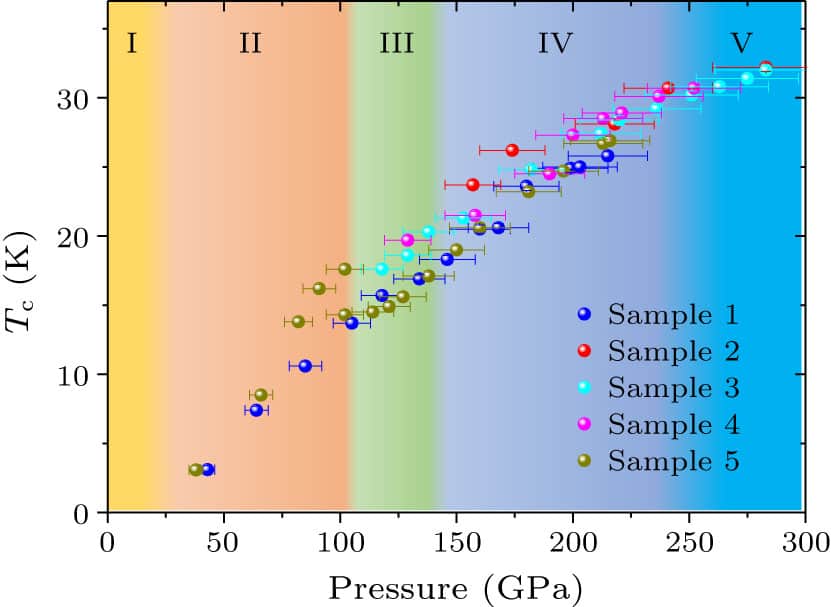
Scandium is the only known elemental superconductor to have a critical temperature in the 30 K range. This phase diagram shows the superconducting transition temperature (Tc) and crystal structure versus pressure for scandium. The measured results on all the five samples studied show consistent trends. (Courtesy: Chinese Phys. Lett.40 107403)
Scandium remains a superconductor at temperatures above 30 K (-243.15Celsius, -405.67 Fahrenheit), making it the first element known to superconduct at such a high temperature. The record-breaking discovery was made by researchers in China, Japan, and Canada, who subjected the element to pressures of up to 283 GPa – around 2.3 million times the atmospheric pressure at sea level.
Many materials become superconductors – that is, they conduct electricity without resistance – when cooled to low temperatures. The first superconductor to be discovered, for example, was solid mercury in 1911, and its transition temperature Tc is only a few degrees above absolute zero. Several other superconductors were discovered shortly afterward with similarly frosty values of Tc.
In the late 1950s, the Bardeen–Cooper–Schrieffer (BCS) theory explained this superconducting transition as the point at which electrons overcome their mutual electrical repulsion to form so-called “Cooper pairs” that then travel unhindered through the material. But beginning in the late 1980s, a new class of “high-temperature” superconductors emerged that could not be explained using BCS theory. These materials have Tc above the boiling point of liquid nitrogen (77 K), and they are not metals. Instead, they are insulators containing copper oxides (cuprates), and their existence suggests it might be possible to achieve superconductivity at even higher temperatures.
The search for room-temperature superconductors has been on ever since, as such materials would considerably improve the efficiency of electrical generators and transmission lines while also making common applications of superconductivity (including superconducting magnets in particle accelerators and medical devices like MRI scanners) simpler and cheaper.
What is lost in the above Facebook meme: 5:00 – 5:30 pm was typically your local news. 6:00 – 6:30 pm, before “Bewitched,” was your international news, the Walter Cronkites, Mike Wallaces, and Harry Reasoner’s time to scare the living crap out of you that the world beyond our borders, during and post-Vietnam, was still going over a cliff. Hence, there is a serial lineup of sitcom talent for an obvious purpose. We also got cut off at midnight, white noise after the anthem, and a nation avoided insomnia because no 24-hour options existed.
Above, you peer a lineup that existed on network television in the early 1970s and continued throughout the Reagan era. It went essentially unchanged until the early 2000s.
Saturday morning cartoons ENDED in September 2014. I can at least see Bugs Bunny on YouTube. Occasionally, Facebook brings up Tom and Jerry, The Roadrunner, etc., on my newsfeed because the algorithms have read my desires and given me what I would most likely wish to see. In this case, nostalgia is free, but now more than ever, I am the product.
“Many decisions about the form and content of news programs are made on the basis of information about the viewer (Internet history), the purpose of which is to keep the viewers watching so that they will be exposed to the commercials” (bots and propaganda).
Neil Postman, Steven Powers, “How to Watch TV News.”
ABC, CBS, and NBC are running game shows and reality shows in prime time where sitcoms, dramas, actors, and writers used to be employed. As “Amusing Ourselves to Death” puts it, the news, 24-7-365 (366 on leap years), has become our entertainment. How did this happen?
In 1972, Richard Milhouse Nixon won a landslide election, winning 49/50 states and 520 electoral votes to his Democratic opponent, George McGovern’s 17. “Other” received 1 electoral vote. Judging from the redness of the map, a lot of African Americans voted for “law and order” or did not bother to show up at the polls. The Vietnam War trudged on, and the body count approached a staggering 282,000 U.S. and allied military deaths.
Two years later, in 1974, Nixon resigned in disgrace after the revelations of the Watergate burglary investigation by Carl Bernstein and Bob Woodward, the subsequent investigations, and the relentless media coverage that swayed a nation from electoral route to, maybe we need to get rid of the president who emphatically stated “I am not a crook” might be a crook. In this case, presidential larceny could not be tolerated.
This was possible because Americans had a shared reality innocently framed by what we viewed for entertainment: as many kids in Rural Hall watched Archie Bunker and Saturday cartoons as my neighbors did in East Winston. Although we were in the throws of forced busing due to the 9-0 Supreme Court Brown vs. Board Decision in 1954 (“all-deliberate speed” came about 20 years later in North Carolina), these shows gave us a framework for conversation, jokes, laughter, and community. The above shows weren’t the bastions of diversity – only “Room 222” had a diverse cast – but a shared entertainment experience made us feel more “united” than we do now.
Roger Ailes was an aide in the Nixon administration. After Nixon’s ouster, Ailes wanted a news network that was friendly to conservatives and biased against liberals. According to a Rolling Stones article, he created a propaganda network and a fear factory. The fear seems to be in the workplace and projected to its audience, absorbing propaganda nightly. After his death, it still runs top-down, like Pravda, not like a news organization. Since it’s profitable, even after the Dominion lawsuit and the upcoming lawsuit with Smartmatics, the network thinks it can absorb the legal losses of billion-dollar settlements and survive. That is frightening power and reach.
I cannot leave their rivals out of this. CNN was the first parent cable news network that “birthed” Fox and MSNBC from “Crossfire” (Paul Begala on the left, and Tucker Carlson on the right). They all follow a framework of “what should you fear of the ‘other.'” Television networks have always competed for viewership through television shows staffed by writers who create content. Shonda Rhimes‘ “Grey’s Anatomy,” “Scandal,” and “How To Get Away With Murder” on the public airwaves are distant memories. You need a streaming subscription now. I pay for several, but it’s not normal, nor should it be seen as normal.
What happens when your “United States” has no framework for a shared reality?
The Republican frontrunner/former reality TV huckster has not debated in the primary and doesn’t need to. He probably won’t in the general election either. He presided over the deaths of 1.13 million Americans due to the botched handling of the Coronavirus that, arguably, his Republican predecessor (43) put the medical professionals in place, and his Democratic successor (44) continued and expanded. 45 pulled them out of China to “own the libs” and found himself and the country flatfooted to identify whether the virus came from a food market or a lab leak. The U.S. had the worst performance of Western nations, exacerbated by not promoting masks and pushing non-cures like hydroxychloroquine and ivermectin.
But, the party and a sizeable amount of the nation want to give him the nuclear codes again because, heck, he’s entertaining, in a perverse, psychotic sense. For example, the fictional Batman is grim, determined, disciplined, and rarely smiles in the comics. His nemesis, Joker, is a murdering psychopath, but Jack Nickelson and Heath Ledger made him “entertaining.” We all watched both versions of Mayhem.
If you can sell soap to 1950s housewives, you can sell racism, sexism, homophobia, and xenophobia to the rubes who can’t, or won’t, afford streaming alternatives. And sell soap.
You “keep the viewers watching” not with clever sitcoms and nighttime dramas like “Dallas” and “Dynasty,” but anger at the “other.” Who is “other?” The people who don’t watch your network share your curated views. One side is “woke,” the other is fascist. No one talks.
We’ve had decades of Civil War reenactments in city parks, and no one died. Therefore, there is no appreciation that in an actual, modern Civil War, the death toll would likely overrun the hospitals more than Sars-CoV-2 did with the alpha through delta variants. The U.S. dollar would cease to be the currency of global trade, and world order would collapse into fiefdoms, dictatorships, and warlords, which would be fine to oligarchs who separated themselves from society generations ago and only come down from Mount Olympus to influence/bribe our politicians. Homo Sapiens (Latin: “wise men”) should then choose another apropos name: Homo Stultus (“stupid men”), and fully own Idiocracy. It didn’t need 500 years.
Humans are storytelling creatures. We need entertainment in the form of books, poetry, well-acted plays, movies, and television shows. We also need knowledge, facts, and accurate history to make a collective assessment of where we’ve been collectively as a nation and a species and where we’re going as a nation – perfecting The Union or over a cliff. Karl Rovian “created realities” nor Neo-Nazi book bans accomplish either necessity.
“Infotainment” is neither news nor entertaining, and Dr. Postman’s warning about the parent of this debacle, Ted Turner’s HBO-inspired infotainment, CNN, rings from his grave:
“What Orwell feared were those who would ban books (well?). What Huxley feared was that there would be no reason to ban a book, for there would be no one who wanted to read one. Orwell feared those who would deprive us of information. Huxley feared those who would give us so much that we would be reduced to passivity and egoism. Orwell feared that the truth would be concealed from us. Huxley feared the truth would be drowned in a sea of irrelevance. Orwell feared we would become a captive culture. Huxley feared we would become a trivial culture, preoccupied with some equivalent of the feelies, the orgy porgy, and the centrifugal bumblepuppy. As Huxley remarked in Brave New World Revisited, the civil libertarians and rationalists who are ever on the alert to oppose tyranny “failed to take into account man’s almost infinite appetite for distractions.” In 1984, Orwell added, people are controlled by inflicting pain. In Brave New World, they are controlled by inflicting pleasure. In short, Orwell feared that what we fear will ruin us. Huxley feared that what we desire will ruin us.
“This book is about the possibility that Huxley, not Orwell, was right.”
A new thermal transistor can control heat as precisely as an electrical transistor can control electricity.
From smartphones to supercomputers, electronics have a heat problem. Modern computer chips suffer from microscopic “hotspots” with power density levels that exceed those of rocket nozzles and even approach that of the sun’s surface. Because of this, more than half the total electricity burned at U.S. data centers isn’t used for computing but for cooling. Many promising new technologies—such as 3-D-stacked chips and renewable energy systems—are blocked from reaching their full potential by errant heat that diminishes a device’s performance, reliability, and longevity.
“Heat is very challenging to manage,” says Yongjie Hu, a physicist and mechanical engineer at the University of California, Los Angeles. “Controlling heat flow has long been a dream for physicists and engineers, yet it’s remained elusive.”
But Hu and his colleagues may have found a solution. As reported last November in Science, his team has developed a new type of transistor that can precisely control heat flow by taking advantage of the basic chemistry of atomic bonding at the single-molecule level. These “thermal transistors” will likely be a central component of future circuits and will work in tandem with electrical transistors. The novel device is already affordable, scalable, and compatible with current industrial manufacturing practices, Hu says, and it could soon be incorporated into the production of lithium-ion batteries, combustion engines, semiconductor systems (such as computer chips), and more.
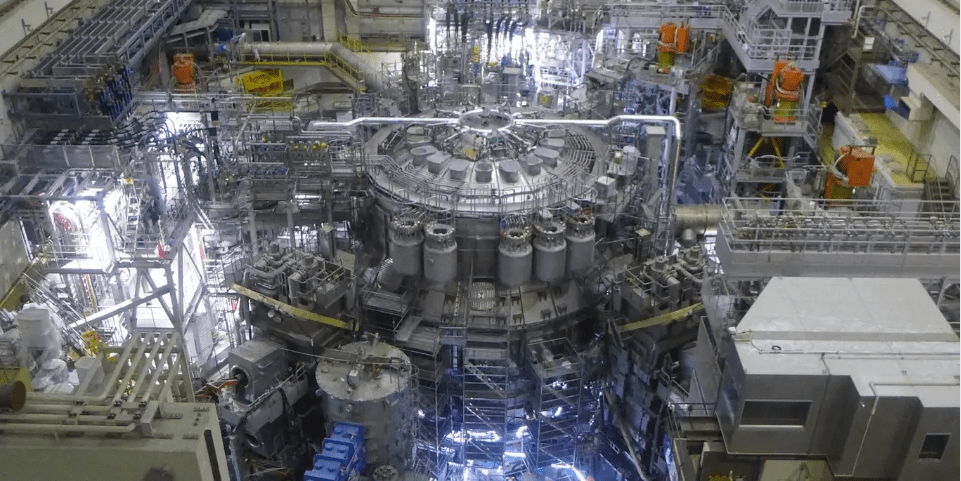
Japan and the European Union have officially inaugurated testing at the world’s largest experimental nuclear fusion plant. Located roughly 85 miles north of Tokyo, the six-story JT-60SA “tokamak” facility heats plasma to 200 million degrees Celsius (around 360 million Fahrenheit) within its circular, magnetically insulated reactor. Although JT-60SA first powered up during a test run back in October, the partner governments’ December 1 announcement marks the official start of operations at the world’s biggest fusion center, reaffirming a “long-standing cooperation in the field of fusion energy.”
The tokamak—an acronym of the Russian-language designation of “toroidal chamber with magnetic coils”—has led researchers’ push towards achieving the “Holy Grail” of sustainable green energy production for decades. Often described as a large hollow donut, a tokamak is filled with gaseous hydrogen fuel that is then spun at immense high speeds using powerful magnetic coil encasements. When all goes as planned, intense force ionizes atoms to form helium plasma, much like how the sun produces its energy.
Speaking at the inauguration event, EU energy commissioner Kadri Simson referred to the JT-60SA as “the most advanced tokamak in the world,” representing “a milestone for fusion history.”
“Fusion has the potential to become a key component for energy mix in the second half of this century,” she continued.
High-dimensional quantum transport enabled by nonlinear detection. In our concept, information is encoded on a coherent source and overlapped with a single photon from an entangled pair in a nonlinear crystal for up-conversion by sum frequency generation, the latter acting as a nonlinear spatial mode detector. The bright source is necessary to achieve the efficiency required for nonlinear detection. Information and photons flow in opposite directions: one of [the] Bob’s entangled photons is sent to Alice and has no information, while a measurement on the other in coincidence with the upconverted photon establishes the transport of information across the quantum link. Alice need not know this information for the process to work, while the nonlinearity allows the state to be arbitrary and unknown dimension and basis. Credit: Nature Communications (2023). DOI: 10.1038/s41467-023-43949-x
Nature Communicationspublished research by an international team from Wits and ICFO- The Institute of Photonic Sciences, which demonstrates the teleportation-like transport of “patterns” of light—this is the first approach that can transport images across a network without physically sending the image and a crucial step towards realizing a quantum network for high-dimensional entangled states.
Quantum communication over long distances is integral to information security and has been demonstrated with two-dimensional states (qubits) over very long distances between satellites. This may seem enough if we compare it with its classical counterpart, i.e., sending bits that can be encoded in 1s (signal) and 0s (no signal), one at a time.
However, quantum optics allow us to increase the alphabet and to securely describe more complex systems in a single shot, such as a unique fingerprint or a face.
“Traditionally, two communicating parties physically send the information from one to the other, even in the quantum realm,” says Prof. Andrew Forbes, the lead PI from Wits University.
“Now, it is possible to teleport information so that it never physically travels across the connection—a ‘Star Trek’ technology made real.” Unfortunately, teleportation has so far only been demonstrated with three-dimensional states (imagine a three-pixel image); therefore, additional entangled photons are needed to reach higher dimensions.
Cate Cox and Brittany Watts: Their last names rhyme, but their circumstances couldn’t be more diametrically different from one another.
Cate Cox is a married suburban mother with two children. She previously lived in a suburb of Dallas, Texas, but due to her condition, she had to flee her state. A complication with her pregnancy put her life at risk and the possibility that she might not be able to conceive again if her pregnancy weren’t ended expeditiously through a procedure now outlawed in Texas.
Brittany Watts, an African American woman, had a stillborn, unfortunately, in the toilet. The fetus was found in the drain, and she was charged with abuse.
Mrs. Cox eventually left Texas for the procedure, having the financial means to leave and get the healthcare that she desired.
Ms. Watts was a frightened young woman who had left the hospital twice before her miscarriage. Yet she’s charged with felony abuse of a corpse in Ohio.
Abstract
The Effects of the Dobbs Decision on Fertility*
The U.S. Supreme Court decision in Dobbs v. Jackson Women’s Health Organization sparked the most profound transformation of the landscape of abortion access in 50 years. We provide the first estimates of the effects of this decision on fertility using a preregistered synthetic difference-in-differences design applied to newly released provisional natality data for the first half of 2023. The results indicate that states with abortion bans experienced an average increase in births of 2.3 percent relative to states where abortion was not restricted.
The Dobbs Decision was a strategic salvo shot at the year 2045:
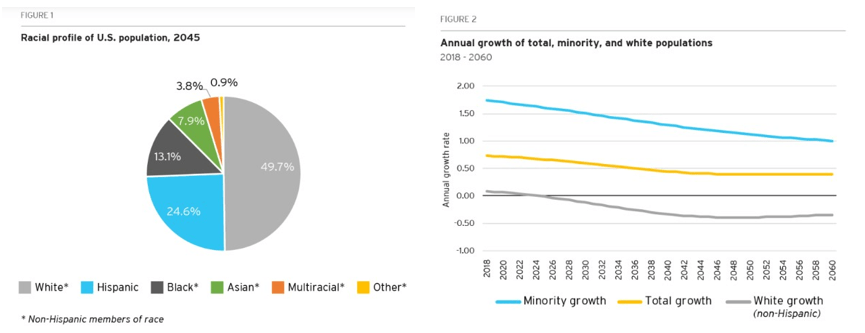
New census population projections confirm the importance of racial minorities as the primary demographic engine of the nation’s future growth, countering an aging, slow-growing, and soon-to-be-declining white population. The new statistics project that the nation will become “minority white” in 2045. During that year, whites will comprise 49.7 percent of the population in contrast to 24.6 percent for Hispanics, 13.1 percent for blacks, 7.9 percent for Asians, and 3.8 percent for multiracial populations (see Figure 1).
The shift is the result of two trends. First, between 2018 and 2060, gains will continue in the combined racial minority populations, growing by 74 percent. Second, during this time frame, the aging white population will see a modest immediate gain through 2024 and then experience a long-term decline through 2060, a consequence of more deaths than births (see Figure 2)
24.6 (Hispanics) + 13.1 (African Americans) + 7.9 (Asians) + 3.8 (Multiracial) + 0.9 (Other) = 50.3%, which is apparently an existential crisis on the right because “white” supremacy is anxiously numerical.
In a democratic society, the numerical majority wins, rules, and decides. The theoretical rights of a minority may or may not be respected, especially if they are a planned minority. Numerical population power is the power that comes to those groups that acquire power through their sheer size. The black population peaked in the 1750s when slaves and free blacks accounted for approximately 33 percent of the total population. The high numerical strength of blacks caused fear and concern among whites. They feared the loss of their own numerical power. Word of black Haitians’ successful slave revolt in the 1790s had spread across America and reportedly ignited several slave revolts in Southern states.
The First U.S. Congress enacted the first naturalization law that declared America to be a nation for “whites only.” The Naturalization Act and other income incentives attracted a mass influx of legal and illegal European ethnicities, followed by Asian and Hispanic immigrants a century later. The immigration quota for blacks remained zero until their total percentage of the population declined to nine percent. By making blacks a planned numerical minority, white society assured its dominance in a democratic society where the majority always wins. Source: Sample chapter
Hence, a national ban is actually what they want. Fifteen weeks will be sold as a “reasonable” compromise, and then it will be paired down to the goose egg that is the actual target. Hence, the hostility towards mixed-race couples and multiracial children from their union: they’re not on the “white” team. Hence, the hostility towards the LGBTQ community and whether or not they conceive by surrogate or artificial insemination, their union does not produce enough “white” babies to maintain a numerical majority for the “white” team. Mrs. Cox and upper-middle-class suburban women like her will always have the means and the money to flee any complications and save future childbearing years. Ms. Watt will have one of two options: either flush her undesired fetus while in a state of shock down a toilet or die from complications that she cannot afford to mitigate.
The American Eugenics Movement, unfortunately, had a boost from prominent scientists who wished to rid the world of the “feebleminded” and the unfit. They did this through forced sterilization and control over who could get married (to procreate in the first place). If you’ve ever used the terms “well-bred” or “good breeding,” those originate from eugenics, now accepted as a pseudoscience, once promoted by one of the founders of the transistor and Nobel laureate in Physics, William Schockley. Coupled with southern Jim Crow, eugenics-on-steroids in the hands of the Nazis led to the Holocaust.
Nazi authorities created the Lebensborn program to increase Germany’s population. Pregnant German women deemed “racially valuable” were encouraged to give birth to their children at Lebensborn homes. During World War II, the program became complicit in the kidnapping of foreign children with physical features considered “Aryan” by the Nazis.
The First U.S. Congress enacted the first naturalization law that declared America to be a nation for “whites only.” The Naturalization Act and other income incentives attracted a mass influx of legal and illegal European ethnicities, followed by Asian and Hispanic immigrants a century later. The immigration quota for blacks remained zero until their total percentage of the population declined to nine percent. By making blacks a planned numerical minority, white society assured its dominance in a democratic society where the majority always wins. Source: Sample chapter
If one is desperate to maintain a majority or “goose your numbers,” you might be capable of anything to achieve those ends.
Very soon in the founding of a new nation, however, White Christians began to establish their well-being by using the resources, bodies, and lives of others. Through their own “witchcraft,” European Christians employed a mysterious and threatening potency that was the practice of using the other for their own gain. In [James W.] Perkinson’s description, through the projects of modern Christian empire “a witchery” of heretofore unimaginable potency ravaged African and aboriginal cultures…For Perkinson, the witchcraft of White supremacy was conjured through racial discourse as an ideological and practical frame that he identifies as the ‘quintessential witchery of modernity.’… In Perkinson’s chilling words, “Whiteness, under the veneer of its ‘heavenly’ pallor, is a great grinding witch tooth, sucking blood and tearing flesh without apology.”
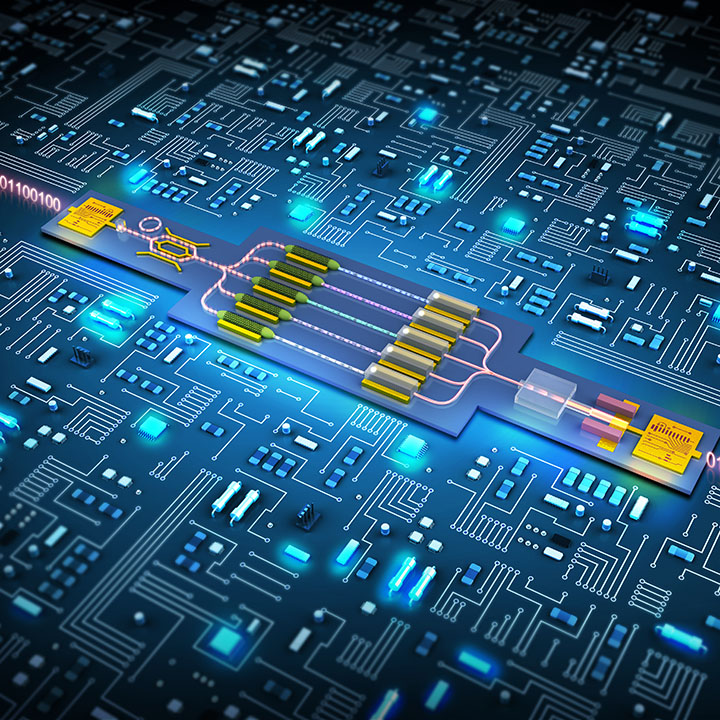
Researchers are working to overcome challenges related to nanoscale optoelectronic interconnects, which use light to transmit signals around an integrated circuit. IMAGE: PROVIDED BY NCNST
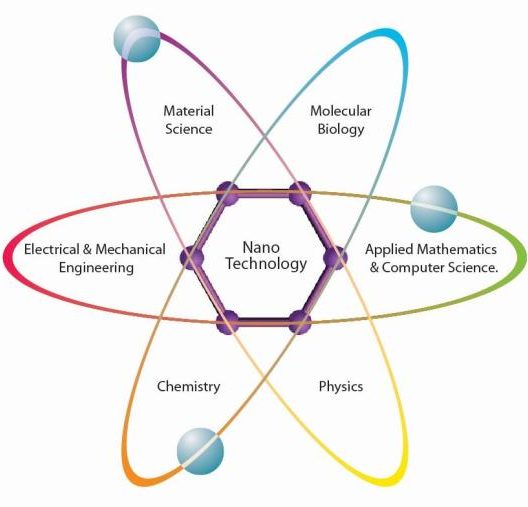
The promise of nanotechnology, the engineering of machines and systems at the nanoscale, is anything but tiny. Over the past decade alone, there has been an explosion in research on how to design and build components that solve problems across almost every sector, and nanotechnology innovations have led to huge advancements in our quest to address humanity’s grand challenges, from healthcare to water to food security.
Like any area of scholarship, there are still so many unknowns. And yet, there are more talented scientists and engineers endeavoring to better comprehend and harness the power of nanotechnology than ever before. The future is bright for nanotechnology and its applications.
In celebration of its 20th anniversary, the National Center for Nanoscience and Technology, China (NCNST), a subsidiary of the prestigious Chinese Academy of Sciences, partnered with Science Custom Publishing to survey nanoscience experts from the journal and across the globe about the most knotty and fascinating questions that still need to be answered if we are to advance nanotechnology in society.
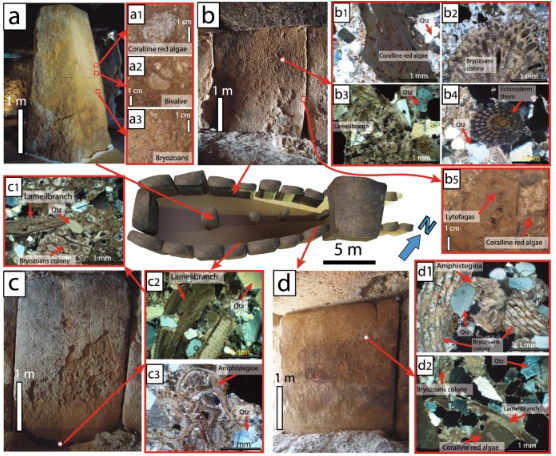
The 3D model of Menga was drawn with AutoCAD, showing the biofacies (microfacies) present in the stones. The fourth pillar, currently missing, has been added, while capstones C-2, C-3, C-4, and C-5 have been removed in order to show the interior of the monument (Lozano Rodríguez et al.25). (a) Pillar P-3 with examples of biofacies (a1–a3 observed in hand specimen). (b) Orthostat O-15 with examples of biofacies (b1–b4 observed petrographically) and in hand specimen (b5). (c) Orthostat O-8 with examples observed petrographically (crossed polars) (c1,c2). (d) Orthostat O-5 with examples observed through the petrographic microscope (d1,d2). The star-shaped symbol indicates the place where a section was made for the petrographic study. Qtz: Quartz (designations after Kretz,49).
Topics: Applied Physics, Archaeology, Dark Humor, History
Abstract
The technical and intellectual capabilities of past societies are reflected in the monuments they were able to build. Tracking the provenance of the stones utilized to build prehistoric megalithic monuments through geological studies is of utmost interest for interpreting ancient architecture as well as contributing to their protection. According to the scarce information available, most stones used in European prehistoric megaliths originate from locations near the construction sites, which would have made transport easier. The Menga dolmen (Antequera, Malaga, Spain), listed in UNESCO World Heritage since July 2016, was designed and built with stones weighing up to nearly 150 tons, thus becoming the most colossal stone monument built in its time in Europe (c. 3800–3600 BC). Our study (based on high-resolution geological mapping as well as petrographic and stratigraphic analyses) reveals key geological and archaeological evidence to establish the precise provenance of the massive stones used in the construction of this monument. These stones are mostly calcarenites, a poorly cemented detrital sedimentary rock comparable to those known as ‘soft stones’ in modern civil engineering. They were quarried from a rocky outcrop located at a distance of approximately 1 km. In this study, it can be inferred the use of soft stone in Menga reveals the human application of new wood and stone technologies, enabling the construction of a monument of unprecedented magnitude and complexity.
José Antonio Lozano Rodríguez, Leonardo García Sanjuán, Antonio M. Álvarez-Valero, Francisco Jiménez-Espejo, Jesús María Arrieta, Eugenio Fraile-Nuez, Raquel Montero Artús, Giuseppe Cultrone, Fernando Alonso Muñoz-Carballeda & Francisco Martínez-Sevilla
In this image, optical pulses (solitons) can be seen circling through conjoined optical tracks. (Image: Yuan, Bowers, Vahala, et al.) An animated gif is at the original link below.
(Nanowerk News) When we last checked in with Caltech’s Kerry Vahala three years ago, his lab had recently reported the development of a new optical device called a turnkey frequency microcomb that has applications in digital communications, precision timekeeping, spectroscopy, and even astronomy.
This device, fabricated on a silicon wafer, takes input laser light of one frequency and converts it into an evenly spaced set of many distinct frequencies that form a train of pulses whose length can be as short as 100 femtoseconds (quadrillionths of a second). (The comb in the name comes from the frequencies being spaced like the teeth of a hair comb.)
Now Vahala, Caltech’s Ted and Ginger Jenkins, Professor of Information Science and Technology and Applied Physics and executive officer for applied physics and materials science, along with members of his research group and the group of John Bowers at UC Santa Barbara, have made a breakthrough in the way the short pulses form in an important new material called ultra-low-loss silicon nitride (ULL nitride), a compound formed of silicon and nitrogen. The silicon nitride is prepared to be extremely pure and deposited in a thin film.
In principle, short-pulse microcomb devices made from this material would require very low power to operate. Unfortunately, short light pulses (called solitons) cannot be properly generated in this material because of a property called dispersion, which causes light or other electromagnetic waves to travel at different speeds, depending on their frequency. ULL has what is known as normal dispersion, and this prevents waveguides made of ULL nitride from supporting the short pulses necessary for microcomb operation.
In a paper appearing in Nature Photonics (“Soliton pulse pairs at multiple colors in normal dispersion microresonators”), the researchers discuss their development of the new micro comb, which overcomes the inherent optical limitations of ULL nitride by generating pulses in pairs. This is a significant development because ULL nitride is created with the same technology used for manufacturing computer chips. This kind of manufacturing technique means that these microcombs could one day be integrated into a wide variety of handheld devices similar in form to smartphones.
The most distinctive feature of an ordinary microcomb is a small optical loop that looks a bit like a tiny racetrack. During operation, the solitons automatically form and circulate around it.
“However, when this loop is made of ULL nitride, the dispersion destabilizes the soliton pulses,” says co-author Zhiquan Yuan (MS ’21), a graduate student in applied physics.
Imagine the loop as a racetrack with cars. If some cars travel faster and some travel slower, then they will spread out as they circle the track instead of staying as a tight pack. Similarly, the normal dispersion of ULL means light pulses spread out in the microcomb waveguides, and the microcomb ceases to work.
The solution devised by the team was to create multiple racetracks, pairing them up so they look a bit like a figure eight. In the middle of that ‘8,’ the two tracks run parallel to each other with only a tiny gap between them.




 Physics and Nano