"The one exclusive sign of thorough knowledge is the power of teaching." Aristotle | Disclaimer: The views and opinions expressed on this Wordpress website are the views and opinions of the content creator, Dr. Reggie Goodwin, and should not be construed as shared, or sourced from The Environmental Protection Agency, or any organizations with which they have cooperative, or business relationships.
Topics: Astronomy, Astrophysics, Philosophy, Planetary Science, Space Exploration
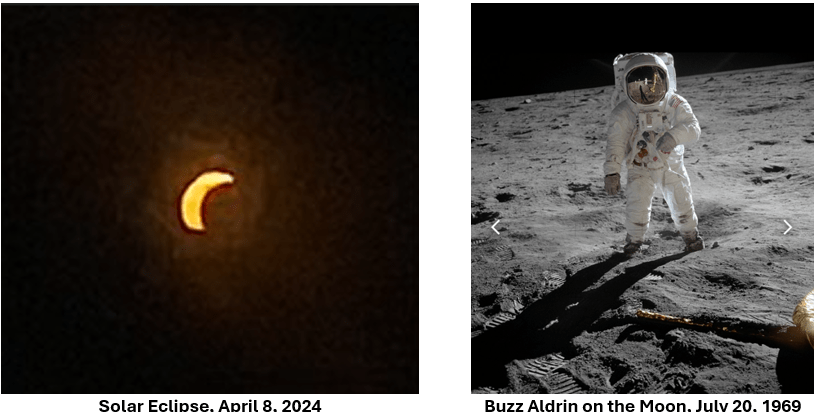
There will be a partial eclipse here in Greensboro. These glasses (6 pair), I purchased in 2017 for ANOTHER partial eclipse that I missed due to working in the lab my first year in grad school. Nano took precedent over astro. The current show starts around 1:56 pm, and ends around 4:28 pm, according to Time and Date dot com.
I will be particularly looking at the reactions of my Texas box turtle, “Speedy,” to see how she reacts when the show starts. Animals tend to go into their shelters (which she has a faux log she likes to go under) during the eclipse because it looks like night. She’s far more accurate than Punxsutawney Phil. I’ve never fully understood the legend and lore, but like many practices that makes the world scratch its heads, this is a “thing” in America.
Oh, and its not a sign of the Apocalypse. Solar, and lunar eclipses are natural occurrences that unfortunately, superstition has promoted for whatever reason to disastrous results. It comes with the territory of having a moon. Venus, an oven that would make Hell blush, as far as we know, doesn’t have a moon, and if we were to colonize Mars: it has two.
(Image: (c) Alan Dyer/VW Pics/UIG Getty Image)
On April 8, 2024, a total solar eclipse will be visible across North America.
Avatar (n) – an electronic image (as in a video game) that represents and may be manipulated by a computer user; the incarnation of a Hindu deity (such as Vishnu); an incarnation in human form; an embodiment (as of a concept or philosophy) often in a person, See: Merriam-Webster/avatar
Stalking Horse (n) – a horse or a figure like a horse behind which a hunter stalks game; something used to mask a purpose; a candidate put forward to divide the opposition or to conceal someone’s real candidacy, See: Merriam-Webster/stalking horse
Trojan Horse (n) – a seemingly useful computer program that contains concealed instructions which when activated perform an illicit or malicious action (such as destroying data files); someone or something intended to defeat or subvert from within usually by deceptive means, See: Merriam-Webster/trojan horse
So far, every republican president post-Eisenhower has been an avatar for agendas crafted for them.
My observation: Post-Eisenhower, they had no real vision of how they wanted to govern. Conservative “think tanks” and corporate interests have performed a political version of “Cliff Notes” so that thinking is irrelevant, and from the candidates themselves, discouraged. Talking points, propaganda, and sloganeering are manufactured, and repeated in an established echo chamber, where repetition replaces reality. What we get aren’t politicians, but actors on a stage who know the buttons to push in their audience.
Governor Ronald Reagan lost the Republican Primary to Vice President Gerald Ford in 1976. Ford injured his chances of a second term by pardoning his former boss, Richard Nixon after the unforced error of Watergate: on paper, he was going to win against his Democratic opponent, George McGovern, after LBJ chose not to run for re-election due to the unpopularity of the Indo China/Vietnam conflict. McGovern only won his state of Minnesota, as Nixon won a landslide frightening the country with “law and order.” However, it may have been that Nixon, neurotically fearful, and abusing alcohol, feared the DNC Headquarters may have had intelligence on his collusion with a foreign power:
“Keep Anna Chennault working on SVN (South Vietnam),” Haldeman wrote, as Nixon barked orders into the phone. They were out to “monkey wrench” Johnson’s election eve initiative, Nixon said. And it worked.
The Nixon campaign’s sabotage of Johnson’s peace process was successful. Nine days later, Thieu’s decision to boycott the talks headlined The New York Times and other U.S. newspapers, reminding American voters of their long-harbored mistrust of the wheeler-dealer LBJ and his “credibility gap” on Vietnam. Humphrey’s momentum faded.
LBJ was furious. His national security adviser, Walt Rostow, urged him to unmask Nixon’s treachery. Humphrey’s aides told their boss to expose the episode and disgrace their Republican foes. But Johnson and Humphrey balked. They didn’t have proof that Nixon had personally directed her actions.
Reagan latched onto a letter: the Lewis Powell memo, head of the U.S. Chamber of Commerce, and Associate Justice of the Supreme Court, appointed by Nixon. This letter was the basis of “Reaganism,” the attacks on education, labor rights, and the “long game” by Corporate America to deregulate the administrative state, and give themselves and the owner class tax cuts, sold by a B-Movie actor that could hit all his lines as “trickledown.” His Vice President, and former primary adversary, George Herbert Walker Bush, aptly described it as “voodoo economics,” that is more like a zombie that won’t die. Similar to his predecessor, both men had been governors of California, the “October Surprise” put the Reagan campaign square in the camp of collusion with a foreign power for political gain. He exploited the brief recession in 1980, no fault of his Democratic incumbent opponent, using the often repeated phrase “Are you better off now than you were four years ago?” Any brief recessions under Reagan, and increases in unemployment were blamed on the Democrats by the B-Movie flimflam artist.
The “Gipper” was the perfect avatar for the Powell Memo.
The scion of the 41st president would go on to win a controversial election in 2000, some say installed by a 5 – 4 vote on the Supreme Court. George W. Bush as the 43rd president glad handed, was, between him and his wooden Democratic opponent, he was the candidate “most Americans would like to have a beer with” (W was a self-described recovering alcoholic, and teetotaler). He prayed in the open like a Pharisee and ran on “compassionate conservatism” from his Christian bona fides, calculated and preying on the premise the country was appalled that his predecessor had consensual sex with an adult intern, a woman other than his wife, and lied about it under oath. W talked down the economy that his predecessor handed him a surplus with, then promptly tax-cut it into oblivion and blamed the Democrats for his incompetence. 2008 was the last year of his administration, and that’s when his “chickens came home to roost” w aith the housing crisis, having to bailout Wall Street for essentially gambling with subprime loans, and the costs of wars in Afghanistan, where he did not get Osama Bin Laden, and Iraq, where he executed Saddam Hussein because of a grudge he felt about Hussein trying to kill his dad, and his need to goose his numbers for the upcoming 2004 elections. He would be the only Republican presidential candidate to win the popular vote, now for nine election cycles.
W’s reign of error was preceded by a 1997 statement of principles from Elliott Abrams, Gary Bauer, William J. Bennett, Jeb Bush, Dick Cheney, Eliot A. Cohen, Midge Decter, Paula Dobriansky, Steve Forbes, Aaron Friedberg, Francis Fukuyama, Frank Gaffney, Fred C. Ikle, Donald Kagan, Zalmay Khalilzad, I. Lewis Libby, Norman Podhoretz, Dan Quayle, Peter W. Rodman, Stephen P. Rosen, Henry S. Rowen, Donald Rumsfeld, Vin Weber, George Weigel, and Paul Wolfowitz for the Project for a New American Century:
American foreign and defense policy is adrift. Conservatives have criticized the incoherent policies of the Clinton Administration. They have also resisted isolationist impulses from within their own ranks. But conservatives have not confidently advanced a strategic vision of America’s role in the world. They have not set forth guiding principles for American foreign policy. They have allowed differences over tactics to obscure potential agreement on strategic objectives. And they have not fought for a defense budget that would maintain American security and advance American interests in the new century. We aim to change this. We aim to make the case and rally support for American global leadership. As the 20th century draws to a close, the United States stands as the world’s preeminent power. Having led the West to victory in the Cold War, America faces an opportunity and a challenge: Does the United States have the vision to build upon the achievements of past decades? Does the United States have the resolve to shape a new century favorable to American principles and interests? We are in danger of squandering the opportunity and failing the challenge. We are living off the capital — both the military investments and the foreign policy achievements — built up by past administrations. Cuts in foreign affairs and defense spending, inattention to the tools of statecraft, and inconstant leadership are making it increasingly difficult to sustain American influence around the world. And the promise of short term commercial benefits threatens to override strategic considerations. As a consequence, we are jeopardizing the nation’s ability to meet present threats and to deal with potentially greater challenges that lie ahead.
The strong military and Pax Americana PNAC advocated didn’t hinder the attacks on the Twin Towers, the Pentagon, and almost the Capitol on 9/11/2001. The New American Century brought us civil liberties violating shoes and laptops in plastic tubs to x-ray, hands-above-head body scans, and pat downs if “something suspicious” was seen in the body scan (they ask you if they can check your groin area). I remember a world more laid back at the airport, and better, real food than chips and biscotti.
He, who everyone wanted to have beers with, was the perfect avatar for PNAC.
The dizzying years between 2017 – 2021 seems like a century, and not an administration. I was in graduate school, keeping my head down, and my mind filled with nanomaterials. The administration at that time was slapstick, stumblebum, the source of memes, late night comedian standups, tweets that drove the news cycle (we were trying to decipher “COVFEFE”). There was a Muslim ban, white nationalists in Charlottesville, Virginia who were “very fine people” (in a bizarre application of “both-sides-ism”), the death of Heather Heyer. There were camouflaged agents harassing protestors after the livestreamed George Floyd lynching. Teargas was used to clear demonstrators in Washington, DC June 1, 2020, to hold a Bible upside down for a prescient photo op. Fun observation: the currently branded $59.99 Holy Writ, if you turn the numbers upside down, the 5 looks like an “S.” Add a few vowels and consonants, you get “66.6Suckers!”
Despite his resemblance to the “Lord of the Flies,” he is the frontrunner of a party he’s only been ostensibly attached to after the first black president was elected, re-elected, and clowned him at the White House Correspondents’ Dinner. He is the frontrunner after having affairs on his first, second, and third pregnant, immigrant wife, then with an adult film star, and a Playboy centerfold, and bragging about sexual assault on video. He is the frontrunner because he is the id of a number of Americans disturbed that a black man won the presidency not once, but twice, so he is their anger, their rage, their “retribution.” He is “chosen by God,” despite the fact that he was a Democrat most of his life until he latched onto the birther conspiracy theory. He is the frontrunner despite four years ago, we had refrigerated 18 wheelers as morgues for a death toll of 1.13 million Americans during the pandemic, the stock market a quarter of its trading now, and told to inject ourselves with bleach, hydroxychloroquine and ivermectin (horse wormer), and politicizing masks. He’s the frontrunner encouraging an attack on the Capitol after a “call-and-response” sermon to keep himself in power after the votes were counted not in his favor. He’s the frontrunner using stochastic terrorism to attack his “enemies” by proxy that can result in actual deaths.
As strange as he is, he is the perfect avatar for Project 2025.
“Think tanks” are populated by eggheads that are funded by grants, corporate interests, or billionaires. Dystopian nightmares like “The Hunger Games” and “The Handmaid’s Tale” have behind them a wealthy elite that funds the chaos, because in chaos, they can seize and hoard resources to themselves, and since they’re self-isolated from the rest of humanity, what would it matter to them if society cratered?
The conservative project since the 1954 Brown vs. Board of Education Decision, the 1964 Civil Rights Act, the 1965 Voting Rights Act, the 1968 Fair Housing Act, and the 1973 Roe vs. Wade Decision is to repeal the gains of the 20th Century. They are working on contraception and same sex marriage. “Great again” doesn’t take us back to the Ozzie and Harriet 1950s: I’m seeing a return to the 1850s.
In a paraphrase of a text message with a good friend, my wife and I plan to vote early, order groceries online to pick up early in the morning, and make sure we have ammo for our guns. We’ve discussed siege scenarios, where she should shelter, as I engage, most likely, our neighbors dedicated to a pathological liar.
In the second season of “The Handmaid’s Tale” on Hulu, the “Sons of Jacob” storm the Capitol (familiar?), assassinating the Congress, setting up the “Republic of Gilead,” an act that can only appeal to sociopaths. As we watched the well-acted, horrific scene, I looked at my wife and said spontaneously, “They look like they LOST an election.”
Win, or lose, my fear is they will do violence because they WANT to do violence. The party promoting this violence is nihilistic: they are the dogs who if they “caught the car,” they wouldn’t care about it because dogs normally don’t drive cars.
Major General Smedley Butler, WWI two-times recipient of the Congressional Medal of Honor, revealed the conspiracy to overthrow the first administration of FDR because wealthy corporate interests thought fascism was easier to make money and manage than democracy. Butler, a Republican, revealed the plot, despite he wasn’t a Democrat. It wasn’t a matter of tribal affiliation, or nihilistic tendencies.
Smedley Butler was a patriot, and patriots swear oaths to The Constitution, not to parties, not to men, not to demagogues.
“Laser” is an acronym for Light Amplification by the Stimulated Emission of Radiation. As the article alludes to, the concept existed before the actual device. We have Charles Hard Townes to thank for his work on the Maser (Microwave Amplification by the Stimulated Emission of Radiation) and the Laser. He won the Nobel Prize for his work in 1964. In a spirit of cooperation remarkable for the Cold War era, he was awarded the Nobel with two Soviet physicists, Aleksandr M. Prokhorov and Nikolay Gennadiyevich Basov. He lived from 1915 – 2015. The Doomsday Clock was only a teenager, born two years after the end of the Second World War. As it was in 2023, it is still 90 seconds to midnight. I’m not sure going “Buck Rogers” on the battlefield will dial it back from the stroke of twelve. Infrared lasers are likely going to be deployed in any future battle space, but infrared is invisible to the human eye, a weapon for which you only need a power supply and not an armory; it might appeal not only to knock drones out of the sky, but to assassins, contracted by governments who can afford such a powerful device, that will not leave a ballistic fingerprint, or depending on the laser’s power: DNA evidence.
Nations around the world are rapidly developing high-energy laser weapons for military missions on land and sea, and in the air and space. Visions of swarms of small, inexpensive drones filling the skies or skimming across the waves are motivating militaries to develop and deploy laser weapons as an alternative to costly and potentially overwhelmed missile-based defenses.
Laser weapons have been a staple of science fiction since long before lasers were even invented. More recently, they have also featured prominently in some conspiracy theories. Both types of fiction highlight the need to understand how laser weapons actually work and what they are used for.
A laser uses electricity to generate photons, or light particles. The photons pass through a gain medium, a material that creates a cascade of additional photons, which rapidly increases the number of photons. All these photons are then focused into a narrow beam by a beam director.
In the decades since the first laser was unveiled in 1960, engineers have developed a variety of lasers that generate photons at different wavelengths in the electromagnetic spectrum, from infrared to ultraviolet. The high-energy laser systems that are finding military applications are based on solid-state lasers that use special crystals to convert the input electrical energy into photons. A key aspect of high-power solid-state lasers is that the photons are created in the infrared portion of the electromagnetic spectrum and so cannot be seen by the human eye.
Based in part on the progress made in high-power industrial lasers, militaries are finding an increasing number of uses for high-energy lasers. One key advantage for high-energy laser weapons is that they provide an “infinite magazine.” Unlike traditional weapons such as guns and cannons that have a finite amount of ammunition, a high-energy laser can keep firing as long as it has electrical power.
The U.S. Army is deploying a truck-based high-energy laser to shoot down a range of targets, including drones, helicopters, mortar shells and rockets. The 50-kilowatt laser is mounted on the Stryker infantry fighting vehicle, and the Army deployed four of the systems for battlefield testing in the Middle East in February 2024.
A new image from the Event Horizon Telescope has revealed powerful magnetic fields spiraling from the edge of a supermassive black hole at the center of the Milky Way, Sagittarius A*.
Topics: Astrophysics, Black Holes, Cosmology, Einstein, General Relativity
Physicists have been confident since the 1980s that there is a supermassive black hole at the center of the Milky Way galaxy, similar to those thought to be at the center of most spiral and elliptical galaxies. It has since been dubbed Sagittarius A* (pronounced A-star), or SgrA* for short. The Event Horizon Telescope (EHT) captured the first image of SgrA* two years ago. Now the collaboration has revealed a new polarized image (above) showcasing the black hole’s swirling magnetic fields. The technical details appear in two new papers published in The Astrophysical Journal Letters.
“The new picture of Sgr A* compared to the old one shows the advantages of using a paintbrush rather than a crayon,” Maynooth University cosmologist Peter Coles said on BlueSky. The new image is also strikingly similar to another EHT polarized image of a larger supermassive black hole, M87*, so this might be something that all such black holes share.
The only way to “see” a black hole is to image the shadow created by light as it bends in response to the object’s powerful gravitational field. As Ars Science Editor John Timmer reported in 2019, the EHT isn’t a telescope in the traditional sense. Instead, it’s a collection of telescopes scattered around the globe. The EHT is created by interferometry, which uses light in the microwave regime of the electromagnetic spectrum captured at different locations. These recorded images are combined and processed to build an image with a resolution similar to that of a telescope the size of the most distant locations. Interferometry has been used at facilities like ALMA (the Atacama Large Millimeter/submillimeter Array) in northern Chile, where telescopes can be spread across 16 km of desert.
Avi Loeb, a Harvard University astrophysicist, displays a small vial of material recovered from the floor of the Pacific Ocean. The material, Loeb says, includes fragments of a meteorite that he claims came from another star system—and perhaps even from an alien spacecraft. Credit: Anibal Martel/Anadolu Agency via Getty Images
Reanalysis of a meteor that fell to Earth has cast some doubt on its origin—and its final destination.
This much is certain: on January 8, 2014, an object now catalogued as CNEOS 2014-01-08 entered Earth’s atmosphere somewhere overhead off the northern coast of Papua New Guinea in the South Pacific, heating to become a blazing, shockwave-generating fireball during its plunge from space. Such events are not rare; meteors enter our atmosphere all the time. But estimates of the object’s speed, touted at some 45 kilometers per second, led to suggestions that it might be interstellar in origin—a space rock from some alien and distant planetary system. While we have seen interstellar objects passing through our solar system before, no such objects were known to have ever made planetfall on Earth. So interest in CNEOS 2014-01-08 was piqued, given that its fragments could potentially offer a first direct sample of material sourced from another star.
In June 2023 Avi Loeb—a theoretical physicist at Harvard University—mounted a $1.5-million expedition to find pieces of the meteor. Loeb has been the leading proponent of the notion that this meteor was indeed interstellar in origin—and has even speculated that it may be linked to putative alien spacecraft. His recovery expedition—which was part of his UFO-studying Galileo Project—became a public sensation, further padding Loeb’s already long list of high-profile media spots, which included interviews on prime-time national television shows and with the easily enraptured podcast host Joe Rogan. Loeb has written countless blog posts and a bestselling book on his unorthodox approach to studying extraterrestrial life and intelligence. He has even gone so far as to appear on a giant billboard in Times Square promoting the Galileo Project’s efforts to find the interstellar meteor fragments.
His approach to the topic has, at times, been abrasive, and many other astrobiology-inclined researchers have found his sensational claims too difficult to parse and potentially damaging to their field. But as with any scientific investigation, particularly with findings as provocative as those suggested by Loeb, there is invariably interest in trying to find flaws in the methodology and to offer alternative, more plausible solutions. This latest episode is no exception; it focuses on one very specific data point from this purported interstellar object.
Loeb’s recovery expedition used a boat-dragged magnetic “sled” to scrape samples of sediments from strips of seafloor in an 11-kilometer-wide square where the team believed the meteor had fallen. That zone of inquiry primarily emerged from triangulating the meteor’s presumptive debris field using sensor data from a classified network of U.S. military satellites that were scrubbed of sensitive details and made public as part of NASA’s Center for Near Earth Object Studies (CNEOS). Loeb’s pinpointing also used a local seismometer on Manus Island, Papua New Guinea, which recorded vibrations from an event around the time the meteor supposedly entered the atmosphere to reduce the search area to a strip that was one-kilometer wide.
After studying those seismometer data, however, Benjamin Fernando, a planetary scientist at Johns Hopkins University, has concluded that Loeb’s analysis was flawed. The seismometer, Fernando says, recorded not a celestial object but something much more mundane and closer to home—a passing heavy truck—meaning that the location Loeb and his team searched would not have been in the path of the falling object. “We think that what they picked up from the seafloor is nothing to do with this meteor at all,” says Fernando, who posted the research on the preprint server arXiv.org and presented it at the Lunar and Planetary Science Conference (LPSC) in Texas on Tuesday, March 12.
Fernando and his colleagues maintain that the seismic spike used by Loeb’s team was decidedly similar to other signals likely caused by “cultural noise”—that is, vibrations from vehicles and other hefty, human-made sources. A signal’s polarization can be used to estimate the direction of the source, and in this case, it suggested a movement from “southwest to north over about 100 seconds,” Fernando says. That matches the orientation of a road near the seismometer that runs to a local hospital and aligns with another matching signal that perhaps came from the same vehicular source that was detected earlier in the day (when no known fireballs were overhead). “It’s actually just a truck driving by,” he says. Using information from a separate network of infrasound sensors meant to look for clandestine atomic explosions as part of the Comprehensive Nuclear-Test-Ban Treaty, Fernando and his team provide a different entry point for the meteor some 170 kilometers from where Loeb’s group searched. They also argue that the meteor mostly burned up in the atmosphere anyway, scattering few, if any, notable pieces onto the land or sea below. “You wouldn’t go looking for bits of a firework,” Fernando says.
In the list of logical fallacies, I found unfortunately two (depending on the source, the total list can number 20, 24, more, etc.), that I reflected on as I read this article: “Hasty Generalization,” and “Ought-Is.”
Hasty Generalization means what this looks like: drawing some really spectacular conclusions on what appears to be limited evidence. The second, “Ought-Is,” along with the recent scandal of 10,000 papers retracted in 2023 due to (I think) the pressure to “see your name(s)” in high-impact journals has taken on the similitude of getting “likes” on social media, and has put the scientific enterprise, the hallmark of the Enlightenment, in crisis. “Ought-Is” fallacies are another word for wishful thinking. At that point, scientific progress grinds to a halt, and we slowly start limping back to the dark ages.
Topics: Applied Physics, Chemistry, Energy, Green Tech, Materials Science, Photovoltaics
The energy transition is progressing, and photovoltaics (PV) is playing a key role in this. Enormous capacities are to be added over the next few decades. Experts expect several tens of terawatts by the middle of the century. That’s 10 to 25 solar modules for every person. The boom will provide clean, green energy. But this growth also has its downsides.
Several million tons of waste from old modules are expected by 2050—and that’s just for the European market. Even if today’s PV modules are designed to last as long as possible, they will end up in landfill at the end of their life, and with them some valuable materials.
“Circular economy recycling in photovoltaics will be crucial to avoiding waste streams on a scale roughly equivalent to today’s global electronic waste,” explains physicist Dr. Marius Peters from the Helmholtz Institute Erlangen-Nürnberg for Renewable Energies (HI ERN), a branch of Forschungszentrum Jülich.
Today’s solar modules are only suitable for this to a limited extent. The reason for this is the integrated—i.e., hardly separable—structure of the modules, which is a prerequisite for their long service life. Even though recycling is mandatory in the European Union, PV modules are, therefore, difficult to reuse in a circular way.
The current study by Dr. Ian Marius Peters, Dr. Jens Hauch, and Prof Christoph Brabec from HI ERN shows how important it is for the rapid growth of the PV industry to recycle these materials. “Our vision is to move away from a design for eternity towards a design for the eternal cycle,” says Peters “This will make renewable energy more sustainable than any energy technology before.
Plastic chokes a canal in Chennai, India. Credit: R. Satish Babu/AFP via Getty
Topics: Applied Physics, Biology, Chemistry, Environment, Medicine
People who had tiny plastic particles lodged in a key blood vessel were more likely to experience heart attack, stroke or death during a three-year study.
Now the first data of their kind show a link between these microplastics and human health. A study of more than 200 people undergoing surgery found that nearly 60% had microplastics or even smaller nanoplastics in a main artery1. Those who did were 4.5 times more likely to experience a heart attack, a stroke or death in the approximately 34 months after the surgery than were those whose arteries were plastic-free.
“This is a landmark trial,” says Robert Brook, a physician-scientist at Wayne State University in Detroit, Michigan, who studies the environmental effects on cardiovascular health and was not involved with the study. “This will be the launching pad for further studies across the world to corroborate, extend and delve into the degree of the risk that micro- and nanoplastics pose.”
But Brook, other researchers and the authors themselves caution that this study, published in The New England Journal of Medicine on 6 March, does not show that the tiny pieces caused poor health. Other factors that the researchers did not study, such as socio-economic status, could be driving ill health rather than the plastics themselves, they say.
― Gaylord Nelson, former Republican Governor and Senator of Wisconsin, Founder of Earth Day, April 20, 1970, which led to the formation of the U.S. EPA, December 2, 1970. Image: Nelson Institute of Environmental Science, University of Wisconsin-Madison
Robert Mueller was the subject of Internet memes as a 21st-century version of Joe Friday in “Dragnet.” There was going to be an arrest. The 45th Oval Office occupant was going to be put in handcuffs and “perp-walked” in full view and total embarrassment of the Troll-in-Chief who tormented them with his itchy, psychotic Twitter fingers.
Robert Mueller did not save us.
Jack Smith was appointed late in the game of criminality. He joined Alvin Bragg, Fani Willis, Letitia James, Shawn Crawley, and Roberta Kaplan after two impeachments and 91 federal indictments, trying to do justice, stymied by wealth and privilege that most of us will never have. He has been convicted twice in the E. Jean Carroll: the second time because he couldn’t keep his mouth shut. He owes over half a billion dollars between the two. But these are civil lawsuits. He owes money that he actually doesn’t have, so he has to go hat in hand to the faux Tony Stark to get a bailout, I guess because a check in Rubles would be to hard to gaslight, even for him.
Jack Smith will not save us.
Meme posting on Facebook, tweeting (or “X”), Threading, Snapchatting, Reddit posts with pithy commentary, and real clever zingers will not change anything. Hiding behind your laptop as a “keyboard warrior” is no different and no less cowardly than the trolls you get your blood pressure up over in their mom’s basements. Our democratic republic is “hanging by a thread.” We need your bodies, we need your commitment.
Focus your anger into action.
Out of circumstances due to a lot going on at work, I ended up voting on Super Tuesday. I did not encounter any resistance. The tape in the machine had to be replaced, so my ballot was counted some time later. I came back when my wife voted to get my sticker.
The candidates I voted for won in the primaries. I plan to volunteer for the campaigns that I want to be successful.
If you’re angry about the state of the world and your country, I quote the Honorable John Lewis, who joined the ancestors: “Get in good trouble, necessary trouble.”
It’s not just Civil Rights anymore. It’s Women’s Rights. It’s LGBTQ Rights. It’s Immigrant’s Rights. It’s the rights to just BE yourselves.
The Danger of Echo Chambers
The State of the Union started in the same pomp and circumstance of the Joint Chambers of Congress that is still post a crime scene. The current Speaker filed the Amicus Brief to overturn the results of the 2020 election. I am reminded however, of the 2012 election.
I see Senator Romney gladhanding everyone on the floor. I recall him so confident that he had won the 2012 election, he launched his transition website. It was because he consumed a lot of Fox (not) News, and they projected he would win, until he didn’t.
I recall Karl Rove making Meghan Kelly walk to the statisticians’ office at Fox (not) News, totally apoplectic that Obama/Biden had won re-election. The other persons utterly stunned were Mitt and Ann Romney. As Karl and Fox (not) News viewers, they absorbed a medium that made them feel better, but it did not, in fact, inform them, and still doesn’t.
The danger of echo chambers is like Narcissus, it only gives you the last thing that you might hear:
One day while hunting, Narcissus comes across an untouched, glassy spring. He is drawn to its beauty and lies down to take a drink, but what he sees in the still water enchants him. He is in love with what he sees and is inflamed by the features of the vision: the hair, his eyes, porcelain skin, and rosy cheeks. Attempts to kiss and hold the reflection are in vain, and Narcissus is only frustrated by the teasing reactions of the image. When Narcissus winks, the image winks back, when Narcissus waves, the image waves, and when he cries tears, he sees that the image also cries. Narcissus cannot understand why he cannot reach what he so desperately desires.
The tormented boy agonizes over his unrequited love. He cannot leave the spring and is trapped in his frozen gaze at his reflection, pining away for the boy in the water who rejects all advances. Then Narcissus realizes that the image is his, but it’s too late, as he has already fallen tragically in love with himself. Knowing that he can never have what he desires, his body withers away in despair. When Narcissus says “Goodbye” to the reflection, Echo’s voice says “Goodbye.” At that moment, Narcissus dies while peering into the spring.Historic Mysteries
The danger of echo chambers is adherence to narratives that do not exist in the real world. It is allegiance to “alternative facts,” crackpot conspiracy theories, Big Lies, horse manure, hoopla, and hogwash. It says climate change doesn’t exist in a deluge of evidence on a warming globe annually breaking its previous records. It is saying the Affordable Care Act was destined to “kill grandma,” when four years ago, we had refrigerator trucks as mobile morgues by ignoring a pandemic and promoting quackery like drinking bleach, shining lights up our rectums, ivermectin and hydroxychloroquine. It is putting on a Batman suit and thinking yourself an undefeatable martial artist, or a Superman suit and thinking you can fly. “Try that in Gotham,” or leap from the roof of a short house: the acceleration due to gravity is still 9.81 m/s2. Physics is reality, and it cannot be gaslighted.
Things like the Orwellian Citizen’s United have guaranteed that every election until capitalism itself is reformed is the “election of our lifetimes.” The American oligarchs today are the spiritual descendants of the fascists who tried to prop up Smedley Butler as their dictator. He balked, realizing that he was a “gangster for capitalism” and that “war is a racket.”
Time travel is a popular sci-fi trope, but backward travel is impossible due to the Second Law of Thermodynamics. But it is possible to shape the future we want to see for our children. To do that, we can’t listen to nymphs reflecting echoes.
“Our goal is not just an environment of clean air, water, and scenic beauty. The objective is an environment of decency, quality, and mutual respect for all other human beings and living creatures.”
“The ultimate test of man’s conscience may be his willingness to sacrifice something today for future generations whose words of thanks will not be heard.” ― Gaylord Nelson, former Republican Governor and Senator of Wisconsin, Founder of Earth Day, April 20, 1970, which led to the formation of the U.S. EPA, December 2, 1970.
A sample of the new titanium lattice structure 3D printed in cube form. Credit: RMIT. New titanium lattice structure 3D printed in cube form. Credit: RMIT
Topics: 3D Printing, Additive Manufacturing, Materials Science, Metamaterials
A 3D printed ‘metamaterial’ boasting levels of strength for weight not normally seen in nature or manufacturing could change how we make everything from medical implants to aircraft or rocket parts.
RMIT University researchers created the new metamaterial – a term used to describe an artificial material with unique properties not observed in nature – from common titanium alloy.
But it’s the material’s unique lattice structure design, recently revealed in the journal Advanced Materials, that makes it anything but common: tests show it’s 50% stronger than the next strongest alloy of similar density used in aerospace applications.
Nature-Inspired Designs and Innovations
Lattice structures made of hollow struts were originally inspired by nature: strong hollow-stemmed plants like the Victoria water lily or the hardy organ pipe coral (Tubipora musica) showed us the way to combine lightness and strength.
Scientists used samples from sclerosponges off the coast of Puerto Rico to calculate ocean surface temperatures going back 300 years. Douglas Rissing/iStockphoto/Getty Images
Topics: Climate Change, Existentialism, Global Warming, Research, Thermodynamics
CNN— Using sponges collected off the coast of Puerto Rico in the eastern Caribbean, scientists have calculated 300 years of ocean temperatures and concluded the world has already overshot one crucial global warming limit and is speeding toward another.
These findings, published Monday in the journal Nature Climate Change, are alarming but also controversial. Other scientists say the study contains too many uncertainties and limitations to draw such firm conclusions and could end up confusing public understanding of climate change.
Sponges — which grow slowly, layer by layer — can act like data time capsules, allowing a glimpse into what the ocean was like hundreds of years ago, long before the existence of modern data.
Using samples from sclerosponges, which live for centuries, the team of international scientists was able to calculate ocean surface temperatures going back 300 years.
They found human-caused warming may have started earlier than currently assumed and, as a result, global average temperature may have already warmed more than 1.5 degrees Celsius above pre-industrial levels. Researchers say the results also suggest global temperature could overshoot 2 degrees of warming by the end of the decade.
Under the 2015 Paris Agreement, countries pledged to restrict global warming to less than 2 degrees above pre-industrial levels, with an ambition to limit it to 1.5 degrees. The pre-industrial era — or the state of the climate before humans started burning large amounts of fossil fuels and warming the planet — is commonly defined as 1850-1900.