"The one exclusive sign of thorough knowledge is the power of teaching." Aristotle | Disclaimer: The views and opinions expressed on this Wordpress website are the views and opinions of the content creator, Dr. Reggie Goodwin, and should not be construed as shared, or sourced from The Environmental Protection Agency, or any organizations with which they have cooperative, or business relationships.
Realize that Moore’s “law” isn’t like Newton’s Laws of Gravity or the three laws of Thermodynamics. It’s simply an observation based on experience with manufacturing silicon processors and the desire to continually make money from the endeavor.
As a device engineer, I had heard “7 nm, and that’s it” so often that it became colloquial folklore. TSMC has proven itself a powerhouse once again and, in our faltering geopolitical climate, made itself even more desirable to mainland China in its quest to annex the island, sadly by force if necessary.
Apple will be the first electronic manufacturer to receive chips built by Taiwan Semiconductor Manufacturing Company (TSMC) using a two-nanometer process. According to Korea’s DigiTimes Asia, inside sources said that Apple is “widely believed to be the initial client to utilize the process.” The report noted that TSMC has been increasing its production capacity in response to “significant customer orders.” Moreover, the report added that the company has recently established a production expansion strategy aimed at producing 2nm chipsets based on the Gate-all-around (GAA) manufacturing process.
The GAA process, also known as gate-all-around field-effect transistor (GAA-FET) technology, defies the performance limitations of other chip manufacturing processes by allowing the transistors to carry more current while staying relatively small in size.
Topics: Applied Physics, Education, History, Materials Science, Philosophy, Radiation, Research
We take for granted that Earth is very old, almost incomprehensibly so. But for much of human history, estimates of Earth’s age were scattershot at best. In February 1907, a chemist named Bertram Boltwood published a paper in the American Journal of Science detailing a novel method of dating rocks that would radically change these estimates. In mineral samples gathered from around the globe, he compared lead and uranium levels to determine the minerals’ ages. One was a bombshell: A sample of the mineral thorianite from Sri Lanka (known in Boltwood’s day as Ceylon) yielded an age of 2.2 billion years, suggesting that Earth must be at least that old as well. While Boltwood was off by more than 2 billion years (Earth is now estimated to be about 4.5 billion years old), his method undergirds one of today’s best-known radiometric dating techniques.
In the Christian world, Biblical cosmology placed Earth’s age at around 6,000 years, but fossil and geology discoveries began to upend this idea in the 1700s. In 1862, physicist William Thomson, better known as Lord Kelvin, used Earth’s supposed rate of cooling and the assumption that it had started out hot and molten to estimate that it had formed between 20 and 400 million years ago. He later whittled that down to 20-40 million years, an estimate that rankled Charles Darwin and other “natural philosophers” who believed life’s evolutionary history must be much longer. “Many philosophers are not yet willing to admit that we know enough of the constitution of the universe and of the interior of our globe to speculate with safety on its past duration,” Darwin wrote. Geologists also saw this timeframe as much too short to have shaped Earth’s many layers.
Lord Kelvin and other physicists continued studies of Earth’s heat, but a new concept — radioactivity — was about to topple these pursuits. In the 1890s, Henri Becquerel discovered radioactivity, and the Curies discovered the radioactive elements radium and polonium. Still, wrote physicist Alois F. Kovarik in a 1929 biographical sketch of Boltwood, “Radioactivity at that time was not a science as yet, but merely represented a collection of new facts which showed only little connection with each other.”
Climate of fear Anti-science protestors led to the closure of the High Flux Beam Reactor at the Brookhaven National Laboratory in the US 25 years ago using tactics that are widespread today. (Courtesy: iStock/DanielVilleneuve)
Topics: Biology, Cancer, Carl Sagan, Civilization, Climate Change, Philosophy, Physics
I typically don’t comment on articles, but this one resonated with my memories of Carl Sagan desperately trying to raise the critical thinking skills of an entire essential nation with “The Demon-Haunted World: Science as a Candle in the Dark.” The host of Cosmos would succumb to pneumonia as a consequence of bone marrow disease. I will be the age Carl was when he passed away this year, 62, but not as accomplished as he did in the six decades we all had access to him.
The framework of our current duress was already here in the form of celebrity worship, gossip columns, and talk shows where sensationalism equaled eyeballs, just as the Internet rouses the primitive lizard portion of our brains to be afraid, get angry, and “buy-purchase-consume” products (a friend who’s a sound engineer likes to say that a lot).
Underhand tactics by environmental activists led to the closure of a famous physics facility 25 years ago. There is much we can still learn from the incident, says Robert P Crease.
Fake facts, conspiracy theories, nuclear fear, science denial, baseless charges of corruption, and the shouting down of reputable health officials. All these things happened 25 years ago, long before the days of social media, in a bipartisan, celebrity-driven episode of science denial. Yet the story offers valuable lessons for what works and what does not (mostly the latter) for anyone wanting to head off such incidents.
The episode in question concerned one of the more valuable scientific facilities in the US, the High Flux Beam Reactor (HFBR) at the Brookhaven National Laboratory. As I mentioned in a previous column and in my book The Leak, the HFBR was a successful research instrument that was used to make medical isotopes and study everything from superconductors to proteins and metals. “Experimentalists saw the reactor as the place to go,” recalls the physicist William Magwood IV, then at the US Department of Energy.
But in 1997, lab scientists discovered a leak of water from a pool located in the same building as the reactor, where its spent fuel was stored. The leak contained tritium, a radioactive isotope of hydrogen that decays with a half-life of about 12 years, releasing low-energy electrons that can be stopped by a few sheets of paper. The total amount of tritium in the leak was about that in typical self-illuminating “EXIT” signs.
The protestors’ tactics are a familiar part of today’s political environment: tell people they are in danger and insist that anyone who says otherwise is lying.
The article goes on to recount the actor Alec Baldwin using his celebrity to put a ten-year-old child on the Montell Williams Show to claim that the tritium and the research facility caused his cancer. It wasn’t true, but it was LOUD, drowning out the experts who are used to spirited peer review and erudite discussions of research, not tears and gnashing of teeth.
Montell Williams ended his talk show after announcing that he had multiple sclerosis. Alec Baldwin, though I enjoyed his SNL skits, has other pressing issues.
I have a physicist friend who’s using tritium in his research with optical tweezers, separating isotopes to detect and treat cancers, among other applications. I am opting not to give his website as those same elements described in the article about Brookhaven National Labs have metastasized into our current societal mass psychosis. If his research leads to your cancer cure, you can thank him later.
Twenty-five years ago, we weren’t as far along in climate disruption as we are now. Twenty-five years ago, CNN was 19 years old, and its clones, Fox and MSNBC, were 3 years old. Five years after the Y2K scare (exquisitely setting us up for election 2000 and 9/11), humanity further siloed itself into warring tribes, first posting on Internet bulletin boards, MySpace. Then, the logical progression was to Facebook, Twitter (now X), and its myriad progeny.
A side note: CERN would go on to discover the Higgs Boson because we, in the spirit of fiscal stewardship, closed the superconducting collider in Waxahachie, Texas, 48 kilometers south of Dallas. Peter Higgs and François Englert owe their 2013 Physics Nobel Prize to Switzerland. U-S-A. U-S-A.
How much further along in cancer research and nuclear energy as an alternative to fossil fuels would we be if, prior to Facebook and the former Twitter, we exercised a little critical thinking and common sense? I’m not talking about tritium, but fission reactors, which we know how to build (fusion, though cleaner and less radioactive, is still far off), but the environmental activists have terrorized anyone from building newer and safer facilities that might have had some positive impact on our warming climate. To paraphrase a famous saying, “Don’t let the perfect be the enemy of the good.” Our air quality improved during the pandemic, so the logic leads to upgrading public transportation to something matching other countries that rely on it more than we do, or within our borders, the subway systems in New York, New Jersey, Philadelphia, or Washington, DC. You end up doing nothing of any importance. We could replace the fission reactors one by one as fusion comes online.
A team of physicists has discovered a new superconducting material with unique tunability for external stimuli, promising advancements in energy-efficient computing and quantum technology. This breakthrough, achieved through advanced research techniques, enables unprecedented control over superconducting properties, potentially revolutionizing large-scale industrial applications.
Researchers used the Advanced Photon Source to verify the rare characteristics of this material, potentially paving the way for more efficient large-scale computing.
As industrial computing needs grow, the size and energy consumption of the hardware needed to keep up with those needs grows as well. A possible solution to this dilemma could be found in superconducting materials, which can reduce energy consumption exponentially. Imagine cooling a giant data center full of constantly running servers down to nearly absolute zero, enabling large-scale computation with incredible energy efficiency.
Breakthrough in Superconductivity Research
Physicists at the University of Washington and the U.S. Department of Energy’s (DOE)Argonne National Laboratory have made a discovery that could help enable this more efficient future. Researchers have found a superconducting material that is uniquely sensitive to outside stimuli, enabling the superconducting properties to be enhanced or suppressed at will. This enables new opportunities for energy-efficient switchable superconducting circuits. The paper was published in Science Advances.
Superconductivity is a quantum mechanical phase of matter in which an electrical current can flow through a material with zero resistance. This leads to perfect electronic transport efficiency. Superconductors are used in the most powerful electromagnets for advanced technologies such as magnetic resonance imaging, particle accelerators, fusion reactors, and even levitating trains. Superconductors have also found uses in quantum computing.
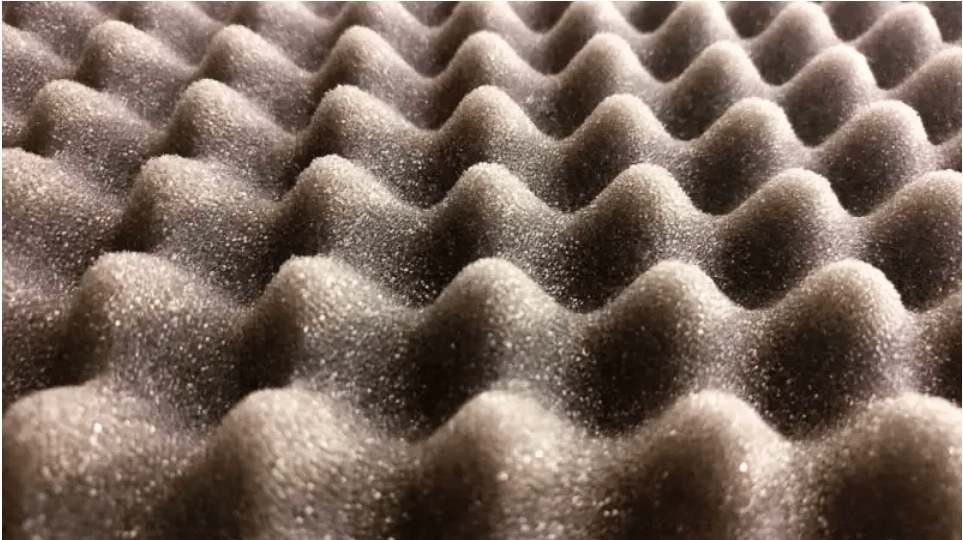
Fluorine gas etches the surface of silicon into a series of angular peaks that, when viewed with a powerful microscope, look much like the pyramid pattern in the sound-proofing foam shown above. Researchers at PPPL have now modeled how these peaks form in silicon, creating a material that is highly light absorbent. Credit: Pixabay/CC0 Public Domain
Topics: Energy, Environment, Materials Science, Nanomaterials, Solar Power
Researchers at the U.S. Department of Energy’s Princeton Plasma Physics Laboratory (PPPL) have developed a new theoretical model explaining one way to make black silicon, an important material used in solar cells, light sensors, antibacterial surfaces, and many other applications.
Black silicon is made when the surface of regular silicon is etched to produce tiny nanoscale pits on the surface. These pits change the color of the silicon from gray to black and, critically, trap more light, an essential feature of efficient solar cells.
While there are many ways to make black silicon, including some that use the charged, fourth state of matter known as plasma, the new model focuses on a process that uses only fluorine gas. PPPL Postdoctoral Research Associate Yuri Barsukov said the choice to focus on fluorine was intentional: The team at PPPL wanted to fill a gap in publicly available research. While some papers have been published about the role of charged particles called ions in the production of black silicon, not much has been published about the role of neutral substances, such as fluorine gas.
“We now know—with great specificity—the mechanisms that cause these pits to form when fluorine gas is used,” said Barsukov, one of the authors of a new paper about the work, appearing in the Journal of Vacuum Science & Technology A.
“This kind of information, published publicly and openly available, benefits us all, whether we pursue further knowledge into the basic knowledge that underlines such processes or we seek to improve manufacturing processes,” Barsukov added.
Significant Li plating capacity from Si anode. a, Li discharge profile in a battery of Li/graphite–Li5.5PS4.5Cl1.5 (LPSCl1.5)–LGPS–LPSCl1.5–SiG at current density 0.2 mA cm–2 at room temperature. Note that SiG was made by mixing Si and graphite in one composite layer. Inset shows the schematic illustration of stages 1–3 based on SEM and EDS mapping, which illustrate the unique Li–Si anode evolution in solid-state batteries observed experimentally in Figs. 1 and 2. b, FIB–SEM images of the SiG anode at different discharge states (i), (ii), and (iii) corresponding to points 1–3 in a, respectively. c, SEM–EDS mapping of (i), (ii), and (iii), corresponding to SEM images in b, where carbon signal (C) is derived from graphite, oxygen (O) and nitrogen (N) signals are from Li metal reaction with air and fluorine (F) is from the PTFE binder. d, Discharge profile of battery with cell construction Li-1M LiPF6 in EC/DMC–SiG. Schematics illustrate typical Si anode evolution in liquid-electrolyte batteries. e, FIB–SEM image (i) of SiG anode following discharge in the liquid-electrolyte battery shown in d; zoomed-in image (ii). Credit: Nature Materials (2024). DOI: 10.1038/s41563-023-01722-x
Researchers from the Harvard John A. Paulson School of Engineering and Applied Sciences (SEAS) have developed a new lithium metal battery that can be charged and discharged at least 6,000 times—more than any other pouch battery cell—and can be recharged in a matter of minutes.
The research not only describes a new way to make solid-state batteries with a lithium metal anode but also offers a new understanding of the materials used for these potentially revolutionary batteries.
“Lithium metal anode batteries are considered the holy grail of batteries because they have ten times the capacity of commercial graphite anodes and could drastically increase the driving distance of electric vehicles,” said Xin Li, Associate Professor of Materials Science at SEAS and senior author of the paper. “Our research is an important step toward more practical solid-state batteries for industrial and commercial applications.”
One of the biggest challenges in the design of these batteries is the formation of dendrites on the surface of the anode. These structures grow like roots into the electrolyte and pierce the barrier separating the anode and cathode, causing the battery to short or even catch fire.
These dendrites form when lithium ions move from the cathode to the anode during charging, attaching to the surface of the anode in a process called plating. Plating on the anode creates an uneven, non-homogeneous surface, like plaque on teeth, and allows dendrites to take root. When discharged, that plaque-like coating needs to be stripped from the anode, and when plating is uneven, the stripping process can be slow and result in potholes that induce even more uneven plating in the next charge.
Bedlam is a scene of madness, chaos, or great confusion. The term bedlam comes from the name of a hospital in London, “Saint Mary of Bethlehem,” which was devoted to treating the mentally ill in the 1400s. Over time, the pronunciation of “Bethlehem” morphed into bedlam, and the term came to be applied to any situation where pandemonium prevails. Source: Vocabulary.com
Swatting is a criminal act that involves making hoax phone calls to emergency services to trick them into sending a response team to a person’s address. The goal is to trick the emergency services into sending a Special Weapons and Tactics (SWAT) team to a supposed emergency, such as a shooting or hostage situation. Source: Google generative AI
According to Dictionary.com, terrorism is the use of violence or threats to intimidate or coerce a government or civilian population. The goal of terrorism is to achieve political, social, or ideological objectives.
International terrorism: Violent, criminal acts committed by individuals and/or groups who are inspired by, or associated with, designated foreign terrorist organizations or nations (state-sponsored). Source: FBI.gov
Domestic terrorism: Violent, criminal acts committed by individuals and/or groups to further ideological goals stemming from domestic influences, such as those of a political, religious, social, racial, or environmental nature. Source: FBI.gov
I grew up in an era of possibilities, of the struggle for rights by African Americans through Medgar Evers, Malcolm X, and Dr. Martin Luther King, Hispanic Americans through Casar Chavez, the LGBT community after the attack on Stonewall Inn in Greenwich Village, New York. The year after the assassination of three black Civil Rights leaders, we did what John F. Kennedy inspired us to do one year later, and Dr. King, the Star Trek fan who talked Nichele Nichols out of quitting the show, never lived to see.
But we live in now, where in the early 2000s, a younger man who wasn’t on the planet tried to convince me that my Saturday morning cartoons the day before hadn’t been interrupted by an important event: the Moon Landing of Apollo 11 on July 20, 1969 (Sunday). His evidence was, of course, a grainy video on YouTube. I’m certain that the conspiracy theorists are already gearing up for Artemis. “Deep fake” has probably improved the tech for denial.
The president who inspired the mission, John F. Kennedy, led the sad cavalcade of assassinations rash in the 1960s. The president who spoke to the astronauts was Richard Nixon, the same who ran on a “law and order” platform, scaring the bejesus out of citizens he wanted to govern because of the bedlam, the chaos, the great confusion on college campuses like Kent State and NC A&T as students protested the Vietnam conflict that nobody understood, and no one wanted, and for the words in our founding documents that stated, “all men are created equal.” The president who saluted astronauts would win reelection in a landslide and lose his job due to Watergate larceny.
The revered founders were, of course, referencing only themselves and their progeny. They had no concept of descendants of their chattel workforce becoming lawyers, engineers, educators, scientists, astronauts, mayors of towns, governors, state representatives, congressional representatives, senators, presidents of universities that directly benefited from slavery, or President or Vice President of the United States. Some of their jurists would obfuscate this possibility and give the interpretation of The Constitution by grammatically spitballing the pious-sounding, pseudo-academic name of “originalism.”
We are here now, at the dawn of the second quarter of the 21st century. Nothing like September 11, 2001, was conceivable to a child in 1969 in the last year of a novel science fiction series called “Star Trek” where it seemed, 200 years into the future, we had “figured it out,” we had put down the rocks of racism, sexism, silliness and decided to work together towards a common goal of survival on Earth and among the stars. Superluminal speeds and Heisenberg-defying transporters were plot devices, and everyone was in on the joke.
Nothing like January 6, 2021, twenty years from an international terrorist assault on our shores that domestic terrorism would bring bedlam to the U.S. Capitol, medieval jousting and bludgeoning Capitol and Metro Police officers, tasing them, bear-spraying them, killing them, urinating and spreading feces, which in and of itself is a sign of mental illness Saint Mary of Bethlehem was constructed to mitigate. Then, poof! It would go away, redefined from insurrection to tourists gone bad (when no tours were scheduled during the pandemic), Antifa (ahem: anti-fascists) to finally “a beautiful day, full of love.”
Towards the end of the second quarter of the 21st Century, we are likely to see climate disruption at an irreversible, unpredictable pace. The world population will be increased to ~9.7 billion, and by 2100, ~10.4 billion. There are a few new posts in 2023, but a lot of inoperable links on the 100-year starship website (like “mailing lists” and “contact us”). From here until 2100, it doesn’t give us a century to construct a generation’s vessel or to solicit and train a crew for a one-way trip on the culturally narcissistic need for humans to survive their hubris expressed on this planet since the dinosaurs were too dumb to have scientists.
It would seem, though, even with the scientists and experts, we have allowed the know-it-alls, who actually know nothing, primacy because they’re so loud. They demand attention to feed a narcissistic ego, blustering and ever-terrified that we will realize that they are nincompoops with no applicable skillsets. Conspiracy theories are tailor-made for people who won’t read, study, or take the time to comprehend hard subjects and are rewarded lucratively for slavish devotion to bull crap. We have allowed our lizard brains to lead and the blowhard simpletons to rule us to ruin. They alone cannot fix or build a starship.
We are here now as the “rule of law” is being tested as it never has been before, to the point that we’re being gaslit to ask if such a thing ever existed and if we can just get by with WHATABOUTISM instead of democracy, tyranny instead of freedom.
Judges, Special Councils, Clerks, and politicians are being swatted and doxxed, and elected officials are receiving death threats because misinformation is being spread on social media like feces to infect the lizard portion of our brains, where fear and anger dwells, exploited for ratings, votes, and to sell products online and between archaic commercials. The only thing on the other side of bedlam is anarchy. That is a poor substitute for a federal republic that has existed for over 246 years and could easily be gone in a fortnight.
June: We have to run. Luke: What? June: We waited last time. We waited too long, and we didn’t see how much they hated us. I lost you, and then we lost Hannah. Luke: Are we just gonna forget about her now? June: We will never ever forget about her, but we cannot help her if we are dead. It’s changing, Luke. This country is changing. Luke: No, Canada’s not Gilead. June: America wasn’t Gilead until it was, and then it was too fuckin’ late. Luke, we have to go. We have to run. Now.
Source: TV fanatic, “The Handmaid’s Tale,” by Margaret Atwood on Hulu
PAC1R-expressing dorsal raphe neurons in the mouse brain (red) serve as the projection targets for PACAP parabrachial neurons to mediate panic-like behavioral and physical symptoms. Credit: Salk Institute
Topics: Biology, Medicine, Research, Science
Overwhelming fear, sweaty palms, shortness of breath, rapid heart rate—these are the symptoms of a panic attack, which people with panic disorder have frequently and unexpectedly. Creating a map of the regions, neurons, and connections in the brain that mediate these panic attacks can provide guidance for developing more effective panic disorder therapeutics.
Now, Salk researchers have begun to construct that map by discovering a brain circuit that mediates panic disorder. This circuit consists of specialized neurons that send and receive a neuropeptide—a small protein that sends messages throughout the brain—called PACAP. What’s more, they determined that PACAP and the neurons that produce its receptor are possible druggable targets for new panic disorder treatments.
The findings were published in Nature Neuroscience.
“We’ve been exploring different areas of the brain to understand where panic attacks start,” says senior author Sung Han, associate professor at Salk.
“Previously, we thought the amygdala, known as the brain’s fear center, was mainly responsible—but even people who have damage to their amygdala can still experience panic attacks, so we knew we needed to look elsewhere. Now, we’ve found a specific brain circuit outside of the amygdala that is linked to panic attacks and could inspire new panic disorder treatments that differ from currently available panic disorder medications that typically target the brain’s serotonin system.”
Scientists have developed amorphous silicon carbide, a strong and scalable material with potential uses in microchip sensors, solar cells, and space exploration. This breakthrough promises significant advancements in material science and microchip technology. An artist’s impression of amorphous silicon carbide nanostrings testing to its limit tensile strength. Credit: Science Brush
A new material that doesn’t just rival the strength of diamonds and graphene but boasts a yield strength 10 times greater than Kevlar, renowned for its use in bulletproof vests.
Researchers at Delft University of Technology, led by assistant professor Richard Norte, have unveiled a remarkable new material with the potential to impact the world of material science: amorphous silicon carbide (a-SiC).
Beyond its exceptional strength, this material demonstrates mechanical properties crucial for vibration isolation on a microchip. Amorphous silicon carbide is, therefore, particularly suitable for making ultra-sensitive microchip sensors.
The range of potential applications is vast, from ultra-sensitive microchip sensors and advanced solar cells to pioneering space exploration and DNA sequencing technologies. The advantages of this material’s strength, combined with its scalability, make it exceptionally promising.
Researchers at Delft University of Technology, led by assistant professor Richard Norte, have unveiled a remarkable new material with the potential to impact the world of material science: amorphous silicon carbide (a-SiC).
The researchers adopted an innovative method to test this material’s tensile strength. Instead of traditional methods that might introduce inaccuracies from the way the material is anchored, they turned to microchip technology. By growing the films of amorphous silicon carbide on a silicon substrate and suspending them, they leveraged the geometry of the nanostrings to induce high tensile forces. By fabricating many such structures with increasing tensile forces, they meticulously observed the point of breakage. This microchip-based approach not only ensures unprecedented precision but also paves the way for future material testing.
Why the focus on nanostrings? “Nanostrings are fundamental building blocks, the very foundation that can be used to construct more intricate suspended structures. Demonstrating high yield strength in a nanostring translates to showcasing strength in its most elemental form.”
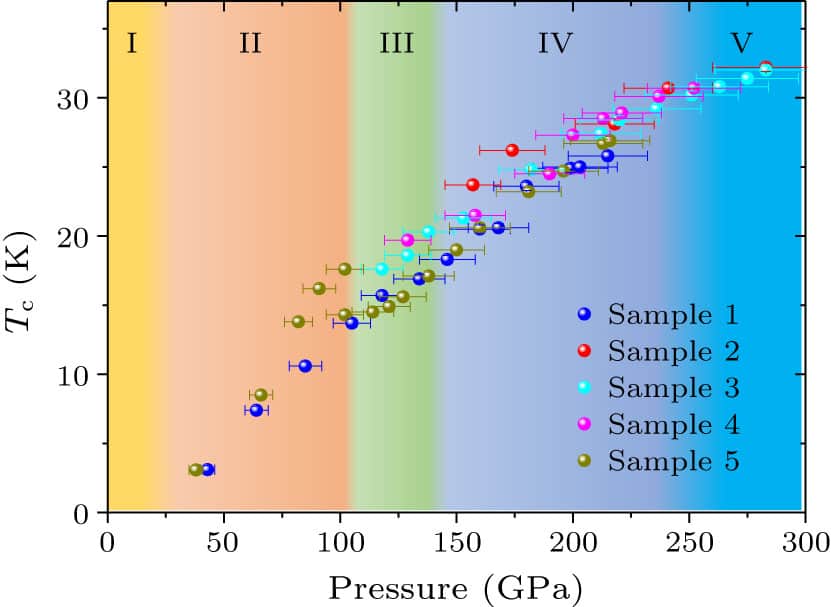
Scandium is the only known elemental superconductor to have a critical temperature in the 30 K range. This phase diagram shows the superconducting transition temperature (Tc) and crystal structure versus pressure for scandium. The measured results on all the five samples studied show consistent trends. (Courtesy: Chinese Phys. Lett.40 107403)
Scandium remains a superconductor at temperatures above 30 K (-243.15Celsius, -405.67 Fahrenheit), making it the first element known to superconduct at such a high temperature. The record-breaking discovery was made by researchers in China, Japan, and Canada, who subjected the element to pressures of up to 283 GPa – around 2.3 million times the atmospheric pressure at sea level.
Many materials become superconductors – that is, they conduct electricity without resistance – when cooled to low temperatures. The first superconductor to be discovered, for example, was solid mercury in 1911, and its transition temperature Tc is only a few degrees above absolute zero. Several other superconductors were discovered shortly afterward with similarly frosty values of Tc.
In the late 1950s, the Bardeen–Cooper–Schrieffer (BCS) theory explained this superconducting transition as the point at which electrons overcome their mutual electrical repulsion to form so-called “Cooper pairs” that then travel unhindered through the material. But beginning in the late 1980s, a new class of “high-temperature” superconductors emerged that could not be explained using BCS theory. These materials have Tc above the boiling point of liquid nitrogen (77 K), and they are not metals. Instead, they are insulators containing copper oxides (cuprates), and their existence suggests it might be possible to achieve superconductivity at even higher temperatures.
The search for room-temperature superconductors has been on ever since, as such materials would considerably improve the efficiency of electrical generators and transmission lines while also making common applications of superconductivity (including superconducting magnets in particle accelerators and medical devices like MRI scanners) simpler and cheaper.





 Physics and Nano