Black Holes and Dark Matter…

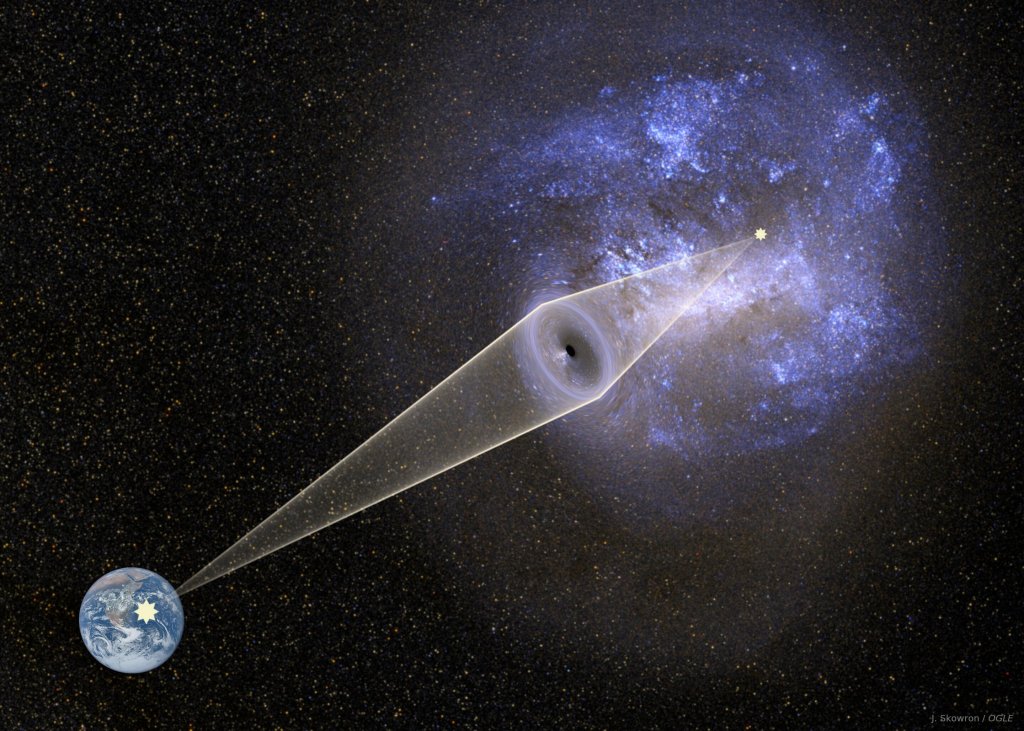
Artist’s impression of a microlensing event caused by a black hole observed from Earth toward the Large Magellanic Cloud. The light of a background star located in the LMC is bent by a putative primordial black hole (lens) in the Galactic halo and magnified when observed from the Earth. Microlensing causes very characteristic variation of brightness of the background star, enabling the determination of the lens’s mass and distance. Credit: J. Skowron / OGLE. Background image of the Large Magellanic Cloud: generated with bsrender written by Kevin Loch, using the ESA/Gaia database

Topics: Astronomy, Astrophysics, Black Holes, Dark Matter

The gravitational wave detectors LIGO and Virgo have detected a population of massive black holes whose origin is one of the biggest mysteries in modern astronomy. According to one hypothesis, these objects may have formed in the very early universe and may include dark matter, a mysterious substance filling the universe.

A team of scientists from the OGLE (Optical Gravitational Lensing Experiment) survey from the Astronomical Observatory of the University of Warsaw have announced the results of nearly 20-year-long observations indicating that such massive black holes may comprise at most a few percent of dark matter. Another explanation, therefore, is needed for gravitational wave sources. The results of the research were published in a study in Nature and a study in The Astrophysical Journal Supplement Series.

Various astronomical observations indicate that ordinary matter, which we can see or touch, comprises only 5% of the total mass and energy budget of the universe. In the Milky Way, for every 1 kg of ordinary matter in stars, there is 15 kg of dark matter, which does not emit any light and interacts only by means of its gravitational pull.

“The nature of dark matter remains a mystery. Most scientists think it is composed of unknown elementary particles,” says Dr. Przemek Mr.óz from the Astronomical Observatory, University of Warsaw, the lead author of both articles. “Unfortunately, despite decades of efforts, no experiment (including experiments carried out with the Large Hadron Collider) has found new particles that could be responsible for dark matter.”

New research challenges black holes as dark matter explanation, University of Warsaw, Phys.org.

Dolphins and Mercury…

Scientists have found elevated mercury levels in dolphins throughout the Southeast since 2007. Sources: BryanDamseauxGriffinStavrosWoshner. Credit: N. Hanacek/NIST

Topics: Biology, Chemistry, Civilization, Environment

In a study with potential implications for the oceans and human health, scientists reported elevated mercury levels in dolphins in the U.S. Southeast, with the greatest levels found in dolphins in Florida’s St. Joseph and Choctawhatchee Bays.

Dolphins are considered a “sentinel species” for oceans and human health because, like us, they are high up in the food chain, live long lives, and share certain physiological traits with humans. Some staples of their diet, such as spot, croaker, weakfish and other small fish, are most vulnerable to mercury pollution and are also eaten by people.  

The study, which appeared in the journal Toxics, drew no conclusions about Florida and Georgia residents’ mercury levels or the potential health risks to humans. It did, however, cite previous research by a different group of researchers that found a correlation between high mercury levels in dolphins in Florida’s Indian River Lagoon and humans living in the area.

“As a sentinel species, the bottlenose dolphin data presented here can direct future studies to evaluate mercury exposure to human residents” in the Southeast and other potentially affected areas in the United States, the authors of the study in Toxics wrote.

Research Finds Dolphins With Elevated Mercury Levels in Florida and Georgia, National Institute of Standards and Technology (NIST)

B Boys & Girls, Physics & Olympics…

AP Photo/Andres Kudacki

Topics: Applied Physics, Diversity in Science, Physics, Physiology

“B-boys and B-girls wield physics to pull off gravity-defying dance moves.”

Okay, “gravity-defying” is a bit of hyperbole. Break dancing, as the article alludes, started in New York, and the movements can be found in martial arts like Brazilian Capoeira. It’s more centrifugal force and torque, but I get that “gravity-defying” will get more clicks. I wish it didn’t and the science behind it got more attention.

Two athletes square off for an intense dance battle. The DJ starts spinning tunes, and the athletes begin twisting, spinning and seemingly defying gravity, respectfully watching each other and taking turns showing off their skill.

The athletes converse through their movements, speaking through a dance that celebrates both athleticism and creativity. While the athletes probably aren’t consciously thinking about the physics behind their movements, these complex and mesmerizing dances demonstrate a variety of different scientific principles.

Breaking, also known as breakdancing, originated in the late 1970s in the New York City borough of the Bronx. Debuting as an Olympic sport in the 2024 Summer Olympics, breaking will showcase its dynamic moves on a global stage. This urban dance style combines hip-hop culture, acrobatic moves and expressive footwork.

Physics In Action: Paris 2024 Olympics To Debut High-Level Breakdancing, Amy Pope, Clemson University

Comstockery…

Image source: Wikipedia/Pine_Tree_Flag

Since its creation during the American Revolution, the flag has carried a message of defiance: The phrase “appeal to heaven” comes from the 17th-century philosopher John Locke, who wrote of a responsibility to rebel, even use violence, to overthrow unjust rule.

Another Provocative Flag Was Flown at Another Alito Home

Topics: Civics, Civil Rights, Civilization, Democracy, Existentialism, Fascism

So what is the Comstock Act? Many of us have heard of it, if only vaguely. We may also have heard the term “Comstockery,” defined as the “strict censorship of materials considered obscene” and “censorious opposition to alleged immorality,” and know that it was coined by playwright George Bernard Shaw.

The occasion was the removal of Shaw’s Man and Superman from the shelves of the New York Public Library in 1905. Taking umbrage and spotting an opportunity, Shaw fired back, announcing his intention to bring “Mrs. Warren’s Profession”—a play that had been banned in London for its frank discussion of prostitution—to New York, telling the city’s papers, “Comstockery is the world’s standing joke at the expense of the United States. It confirms the deep-seated conviction of the Old World that America is a provincial place, a second-rate country-town civilization after all.”

Anthony Comstock, by then America’s leading moralist, hadn’t heard of Shaw until the playwright’s words were published in the papers. He did a little quick brushing up and fired back, calling Shaw an “Irish smut peddler” and alerting the New York police to the dangerous content of Shaw’s play. He also wrote a huffy letter to Shaw’s producer Arnold Daly, calling “Mrs. Warren’s Profession” “filthy” and quoting, with an ominous tone of warning, recent court decisions in obscenity cases. Daly, a savvy publicity man, did not let the opportunity go by. He sent Comstock’s letter to all the papers, along with an exquisitely civil response inviting Comstock to come to a rehearsal. 

The result? Ticket sales went through the roof, and the play was sold out weeks before the curtain went up. The police were called forth on opening night—not to raid the play, but to dispel the overflow mob in the streets clamoring to get in. Score one for GBS.

A Nationwide Abortion Ban Could Really Happen. You Can Thank Anthony Comstock’s Suitcase Full of Dildos. Eleanor Clooney, Mother Jones

George Bernard Shaw in The Guardian article from 1997 is lauded as one of the “founding fathers of British socialism,” which also meant at the time that he was an avowed eugenicist. (The title of the play was a dead giveaway.) The author of “The Handmaid’s Tale,” Margaret Atwood, has said in interviews that she’s not keen on the term “progressive,” since it was born in the era of trying to breed “better humans” and sterilize underserving others.

However, Comstock managed to model for conservatives yet born, the extremism that we are now witness to in the 21st Century. He’s noted in her research for “setting up stings” and physically fighting against those who he SET UP in the sting, because only he was the “righteous one.” He was also known for pouring out his ration of whiskey as pious as any of the Pharisees, so he wasn’t particularly the “life of the party” as the Continental Army fought the War of Independence for “religious freedom” and to skip out on the taxes the colonists owed King George of England.

I do agree with Clooney’s article on one thing: this puritanism is inherent in human culture. It’s been with us since metaphorically, Eden.

I do appreciate from her that we have had, and probably always will have puritanism: “behavior or beliefs that are based on strict moral or religious principles, especially the principle that people should avoid physical pleasures.” Collins Dictionary In that respect, Osama Bin Laden was a Muslim puritan, influenced still by the author Sayyid Qutb (1906—1966). “As an Islamist, he held that all aspects of society should be conducted according to the Shari’a, that is, laws of God as derived from the Qur’an and the practice (sunna) of the Prophet Muhammad. Probably his best known and most distinctive doctrine is his interpretation of jahiliyya (pre-Islamic ignorance) as characterizing all of the societies of his time, including the Muslim ones.” Internet Encyclopedia of Philosophy/Sayyid Qutb

*****

The Louisiana House approved a bill Tuesday that would add two medications commonly used to induce abortions to the state’s list of controlled dangerous substances, making possession of the drugs without valid prescriptions a crime punishable by fines, jail time or both.

The measure, which has drawn support from anti-abortion groups and alarm from medical professionals and reproductive rights advocates, would add the medications mifepristone and misoprostol to Schedule IV of the state’s Uniform Controlled Dangerous Substances Law. Abortion — both medical and surgical — is illegal in Louisiana, so it is already illegal to prescribe the medications to terminate pregnancies, except in very limited circumstances.

Medication abortions accounted for 63% of all abortions last year, according to the reproductive rights think tank the Guttmacher Institute.

The bill passed 64-29 in the GOP-controlled House of Representatives. It will now go back to the Senate, and if it is approved, it would then be sent to the governor to sign into law.

Louisiana House passes bill to make abortion pills a controlled dangerous substance, Daniella Silva, Marissa Parra and Natalie Obregon, NBC News

There is a desperation in these actions at the oxymoronically-named Supreme Court and local levels: “demographics is destiny” is being fought tooth-and-nail.

I think it is instructive that white evangelicals became a numerical minority in 2017. In 2045 or sooner, white Americans are projected to be 49.7% of the population (Brookings) versus 50.3% of all ethnic groups combined (African Americans projected to remain around 13%). It’s slight, it’s petty, but it does explain a lot about them, even the repeal of Roe v Wade: Kate Cox in Dallas wasn’t arrested for seeking an abortion outside of Texas. Brittany Watts in Ohio was criminally charged with a miscarriage in a toilet that could have been avoided had the state not banned the procedure and threatened doctors with arrest. Thankfully, the grand jury overturned it.

White woman: A mulligan. No arrest, but instructive that authorities will look the other way, because she will “help” in the anxious arithmetic of white supremacy.
Black woman: A prison sentence (if they could), and a toilet for her fetus.

We may never see a national abortion ban, but that may be unnecessary if the spirit of Anthony Comstock is invoked in these draconian measures NATIONWIDE.

The phrase “appeal to heaven” comes from the 17th-century philosopher John Locke, who wrote of a responsibility to rebel, even use violence, to overthrow unjust rule.

It’s the formula for the Republic of Gilead in “The Handmaid’s Tale.” Like the fictional “Sons of Jacob” before the hierarchy of the Commanders, they are willing to do violence to bring about their fever dreams of of a “united Reich” dictatorship.

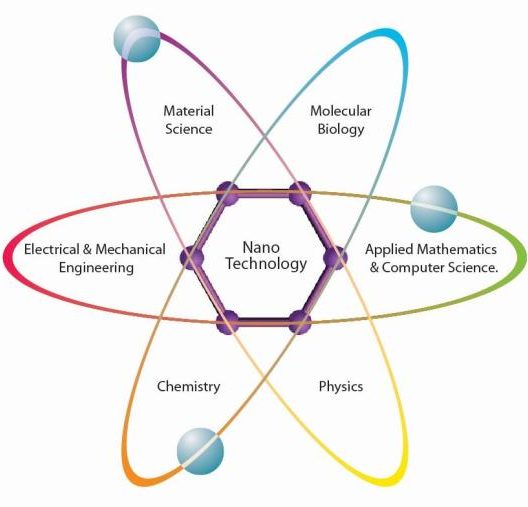
Perhaps we humans are simply the ultimate expression of Comstockery, cognitive dissonance allowing us to gaslight collectively into thinking of ourselves as “blessed,” the “Promised Land,” “Manifest Destiny,” Homo Sapiens (“wise men”): we have created works of artistry, delved into the mysteries of quantum mechanics, split the atom, created technologies at nanoscales and have the ability to launch objects into near orbit or, for interplanetary and interstellar journeys, and simultaneously created several means to end our existence, and all life on the planet. Instead, the more apt description, Homo Stultus (“stupid men”) is apropos, because intelligence applied without thought of the consequences beyond a business quarter is active, abject stupidity! It does however, resolve the Fermi Paradox: Intelligence might well be its own Entropy. The aliens that we seem to have not yet communicated with, or made contact might have killed themselves. This is hopefully instructive. Humanity needs to pass through its “great filter” to build starships.

Climate CERN…

Worrying trend Reliable climate models are needed so that societies can adapt to the impact of climate change. (Courtesy: Shutterstock/Migel)

Topics: Applied Physics, Atmospheric Science, CERN, Civilization, Climate Change

It was a scorcher last year. Land and sea temperatures were up to 0.2 °C (32.36 °F) higher every single month in the second half of 2023, with these warm anomalies continuing into 2024. We know the world is warming, but the sudden heat spike had not been predicted. As NASA climate scientist Gavin Schmidt wrote in Nature recently: “It’s humbling and a bit worrying to admit that no year has confounded climate scientists’ predictive capabilities more than 2023 has.”

As Schmidt went on to explain, a spell of record-breaking warmth had been deemed “unlikely” despite 2023 being an El Niño year, where the relatively cool waters in the central and eastern equatorial Pacific Ocean are replaced with warmer waters. Trouble is, the complex interactions between atmospheric deep convection and equatorial modes of ocean variability, which lie behind El Niño, are poorly resolved in conventional climate models.

Our inability to simulate El Niño properly with current climate models (J. Climate 10.1175/JCLI-D-21-0648.1) is symptomatic of a much bigger problem. In 2011 I argued that contemporary climate models were not good enough to simulate the changing nature of weather extremes such as droughts, heat waves and floods (see “A CERN for climate change” March 2011 p13). With grid-point spacings typically around 100 km, these models provide a blurred, distorted vision of the future climate. For variables like rainfall, the systematic errors associated with such low spatial resolution are larger than the climate-change signals that the models attempt to predict.

Reliable climate models are vitally required so that societies can adapt to climate change, assess the urgency of reaching net-zero or implement geoengineering solutions if things get really bad. Yet how is it possible to adapt if we don’t know whether droughts, heat waves, storms or floods cause the greater threat? How do we assess the urgency of net-zero if models cannot simulate “tipping” points? How is it possible to agree on potential geoengineering solutions if it is not possible to reliably assess whether spraying aerosols in the stratosphere will weaken the monsoons or reduce the moisture supply to the tropical rainforests? Climate modelers have to take the issue of model inadequacy much more seriously if they wish to provide society with reliable actionable information about climate change.

I concluded in 2011 that we needed to develop global climate models with spatial resolution of around 1 km (with compatible temporal resolution) and the only way to achieve this is to pool human and computer resources to create one or more internationally federated institutes. In other words, we need a “CERN for climate change” – an effort inspired by the particle-physics facility near Geneva, which has become an emblem for international collaboration and progress.

Why we still need a CERN for climate change, Tim Palmer, Physics World

Methane on Mars…

Filled with briny lakes, the Quisquiro salt flat in South America’s Altiplano region represents the kind of landscape that scientists think may have existed in Gale Crater on Mars, which NASA’s Curiosity Rover is exploring. Credit: Maksym Bocharov

Topics: Astrobiology, Astrophysics, Atmospheric Science, Mars, NASA, Planetary Science

The most surprising revelation from NASA’s Curiosity Mars Rover—that methane is seeping from the surface of Gale Crater—has scientists scratching their heads.

Living creatures produce most of the methane on Earth. But scientists haven’t found convincing signs of current or ancient life on Mars, and thus didn’t expect to find methane there. Yet, the portable chemistry lab aboard Curiosity, known as SAM, or Sample Analysis at Mars, has continually sniffed out traces of the gas near the surface of Gale Crater, the only place on the surface of Mars where methane has been detected thus far. Its likely source, scientists assume, are geological mechanisms that involve water and rocks deep underground.

If that were the whole story, things would be easy. However, SAM has found that methane behaves in unexpected ways in Gale Crater. It appears at night and disappears during the day. It fluctuates seasonally, and sometimes spikes to levels 40 times higher than usual. Surprisingly, the methane also isn’t accumulating in the atmosphere: ESA’s (the European Space Agency) ExoMars Trace Gas Orbiter, sent to Mars specifically to study the gas in the atmosphere, has detected no methane.

Why is methane seeping on Mars? NASA scientists have new ideas, Lonnie Shekhtman, NASA, Phys.org.

AI and the Great Filter…

Two researchers have revised the Drake equation, a mathematical formula for the probability of finding life or advanced civilizations in the universe.

University of Rochester. Are We Alone in the Universe? Revisiting the Drake Equation, NASA

Topics: Astrobiology, Astrophysics, Artificial Intelligence, Civilization, SETI

See: Britannica.com/The-Fermi-Paradox/Where-Are-All-The-Aliens

Abstract
This study examines the hypothesis that the rapid development of Artificial Intelligence (AI), culminating in the emergence of Artificial Superintelligence (ASI), could act as a “Great Filter” that is responsible for the scarcity of advanced technological civilizations in the universe. It is proposed that such a filter emerges before these civilizations can develop a stable, multiplanetary existence, suggesting the typical longevity (L) of a technical civilization is less than 200 years. Such estimates for L, when applied to optimistic versions of the Drake equation, are consistent with the null results obtained by recent SETI surveys, and other efforts to detect various techno-signatures across the electromagnetic spectrum. Through the lens of SETI, we reflect on humanity’s current technological trajectory – the modest projections for L suggested here, underscore the critical need to quickly establish regulatory frameworks for AI development on Earth and the advancement of a multiplanetary society to mitigate against such existential threats. The persistence of intelligent and conscious life in the universe could hinge on the timely and effective implementation of such international regulatory measures and technological endeavors.

Is artificial intelligence the great filter that makes advanced technical civilizations rare in the universe? Michael A. Garrett, Acta Astronautica, Volume 219, June 2024, Pages 731-735

Seventy Years Ago…

Topics: Civics, Civil Rights, Civilization, Existentialism, Fascism, History

“On **May 17, 1954**, U.S. Supreme Court Justice Earl Warren delivered the unanimous ruling in the landmark civil rights case Brown v. Board of Education of Topeka, Kansas. State-sanctioned segregation of public schools was a violation of the 14th Amendment and was, therefore, unconstitutional. This historic decision marked the end of the “separate but equal” precedent set by the Supreme Court nearly 60 years earlier in Plessy v. Ferguson. It served as a catalyst for the expanding civil rights movement during the decade of the 1950s.”

Source: https://www.archives.gov/milestone-documents/brown-v-board-of-education

Dr. Martin Luther King Jr was assassinated on April 4, 1968, a Thursday. My graduating kindergarten class at Bethlehem Community Center in Winston-Salem, North Carolina, was told by our teachers on Friday, who cried with us and reassured us that the men outside with Confederate flags, shooting in the air, reveling “that n—-r’s dead” would not harm us, or prevent our celebration. We slept as well as we could through nap time and dressed for our day and our parents. Not one child in my photo of the event is smiling. Not one.

I attended segregated schools in Winston-Salem, NC, until my fourth grade year in 1971. “All deliberate speed” had some considerable foot-dragging.

I was bused across town for 4th grade only to Rural Hall, and their kids were bused across town to Fairview Elementary for 5th and 6th grade. I was bused to Mineral Springs Middle School for 7th -8th grade. ALL the former Black High Schools, like Atkins, Carver, Hanes, and Paisley, had to be “9th and 10th grades only,” as North, East, Parkland, and West were reserved for the higher grades for high school graduation.

“We have fought hard and long for integration, as I believe we should have, and I believe that we will win, but I have come to believe that we are integrating into a burning house. I’m afraid that America has lost the moral vision she may have had,” as the nation is not deeply concerned “with the plight of the poor and disenfranchised.” This failure, King argued, would only further stoke “the anger and violence that tears the soul of this nation. I fear I am integrating my people into a burning house.” Dr. King confessed to his friend, the Civil Rights activist and entertainer Harry Belafonte.

I am sixty-one years old, a grandfather, and a late entrant to the ranks of a Ph.D. I am sad to say that despite the optimism of the movement, NOTHING has changed.

Ecclesiastes 1:9 “The thing that hath been, it is that which shall be and that which is done is that which shall be done: and there is no new thing under the sun.

“What’s past is prologue.” William Shakespeare, The Tempest.

Matrix…

(a) Schematics of the word INFORMATION is written on a material in binary code using magnetic recording. Red denotes magnetization pointing out of the plane and blue is magnetization pointing into the plane. (b)–(d) Time evolution of the digital magnetic recording information states simulated using micromagnetic Monte Carlo. (b) Initial random state. (c) INFORMATION is written (t = 0 s). (d) Iteration 930 (t = 1395 s) showing the degradation of information states. Reproduced with permission from M. M. Vopson and S. Lepadatu, AIP Adv. 12, 075310 (2022). Copyright 2022 AIP Publishing.

Topics: Chemistry, DNA, General Relativity, Genetics, Nucleotides, Thermodynamics

Reference: Electronic Orbitals, Chem Libre Text dot org

As Morpheus describes, “You take the blue pill, the story ends. You wake up in your bed and believe whatever you want to believe. You take the red pill, you stay in Wonderland. And I show you how deep the rabbit hole goes.” Neo takes the red pill and wakes up in the real world. Source: Britannica Online: Red Pill and Blue Pill Symbolism

The simulation hypothesis is a philosophical theory, in which the entire universe and our objective reality are just simulated constructs. Despite the lack of evidence, this idea is gaining traction in scientific circles as well as in the entertainment industry. Recent scientific developments in the field of information physics, such as the publication of the mass-energy-information equivalence principle, appear to support this possibility. In particular, the 2022 discovery of the second law of information dynamics (infodynamics) facilitates new and interesting research tools at the intersection between physics and information. In this article, we re-examine the second law of infodynamics and its applicability to digital information, genetic information, atomic physics, mathematical symmetries, and cosmology, and we provide scientific evidence that appears to underpin the simulated universe hypothesis.

Introduction

In 2022, a new fundamental law of physics has been proposed and demonstrated, called the second law of information dynamics, or simply the second law of infodynamics.1 Its name is an analogy to the second law of thermodynamics, which describes the time evolution of the physical entropy of an isolated system, which requires the entropy to remain constant or to increase over time. In contrast to the second law of thermodynamics, the second law of infodynamics states that the information entropy of systems containing information states must remain constant or decrease over time, reaching a certain minimum value at equilibrium. This surprising observation has massive implications for all branches of science and technology. With the ever-increasing importance of information systems such as digital information storage or biological information stored in DNA/RNA genetic sequences, this new powerful physics law offers an additional tool for examining these systems and their time evolution.2 

The second law of infodynamics and its implications for the simulated universe hypothesis, Melvin M. Vopson, AIP Advances

The Checkbook of Space Travel…

An illustration of NASA’s Orion spacecraft in orbit around the moon. (Image credit: Lockheed Martin)

Topics: Astronautics, History, NASA, Space Exploration, Spaceflight

Between 1969 and 1972, the Apollo missions sent a total of a dozen astronauts to the surface of the moon — and that was before the explosion of modern technology. So why does it seem like our current efforts, as embodied by NASA’s Artemis program, are so slow, halting and complex? 

There isn’t one easy answer, but it comes down to money, politics and priorities.

Let’s start with the money. Yes, the Apollo missions were enormously successful — and enormously expensive. At its peak, NASA was consuming around 5% of the entire federal budget, and more than half of that was devoted to the Apollo program. Accounting for inflation, the entire Apollo program would cost over $260 billion in today’s dollars. If you include project Gemini and the robotic lunar program, which were necessary precursors to Apollo, that figure reaches over $280 billion.

In comparison, today NASA commands less than half a percent of the total federal budget, with a much broader range of priorities and directives. Over the past decade, NASA has spent roughly $90 billion on the Artemis program. Naturally, with less money going to a new moon landing, we’re likely to make slower progress, even with advancements in technology.

Why is it so hard to send humans back to the moon? Paul Sutter, Space.com.