"The one exclusive sign of thorough knowledge is the power of teaching." Aristotle | Disclaimer: The views and opinions expressed on this Wordpress website are the views and opinions of the content creator, Dr. Reggie Goodwin, and should not be construed as shared, or sourced from The Environmental Protection Agency, or any organizations with which they have cooperative, or business relationships.
Topics: Astrophysics, Black Holes, Cosmology, Einstein, General Relativity
Note: From comments on a previous post, maybe science writers need to work on their chosen list of metaphors?
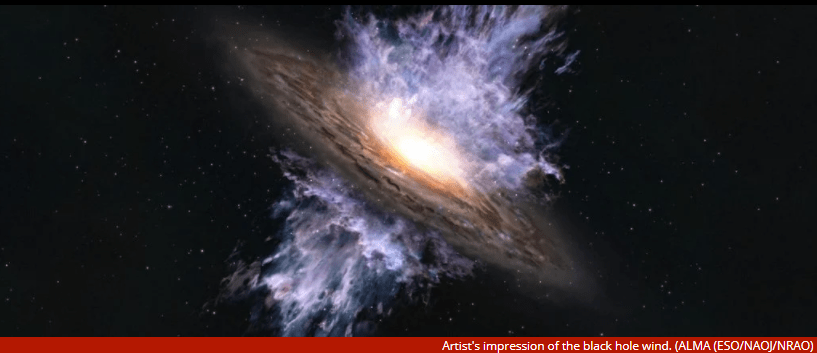
In the far reaches of the Universe, a supermassive black hole is throwing a tantrum.
It’s blowing a tremendous wind into intergalactic space, and we’re seeing the storm light from 13.1 billion years ago when the Universe was less than 10 percent of its current age. It’s the most distant such tempest we’ve ever identified, and its discovery is a clue that could help astronomers unravel the history of galaxy formation.
“The question is when did galactic winds come into existence in the Universe?” said astronomer Takuma Izumi of the National Astronomical Observatory of Japan (NAOJ).
“This is an important question because it is related to an important problem in astronomy: How did galaxies and supermassive black holes coevolve?”
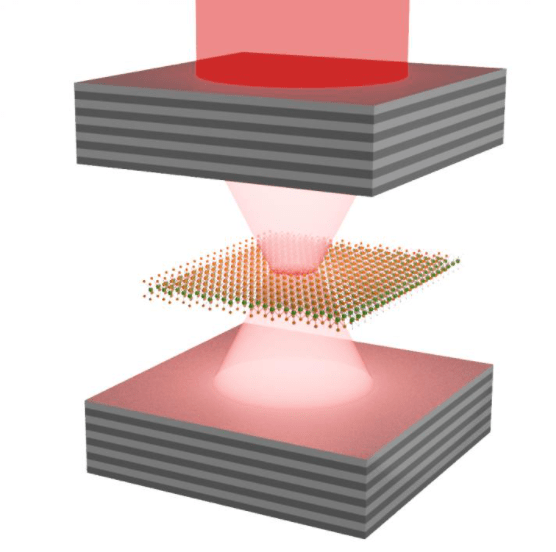
In their experiments, the researchers used ultrathin crystals consisting of a single layer of atoms. These sheet was sandwiched between two layers of mirror-like materials. The whole structure acts like a cage for light and is called a microcavity.
Physicists have taken a step towards realizing the smallest-ever solid-state laser by generating an exotic quantum state known as a Bose-Einstein condensate (BEC) in quasiparticles consisting of both matter and light. Although the effect has so far only been observed at ultracold temperatures in atomically thin crystals of molybdenum diselenide (MoSe2), it might also be produced at room temperature in other materials.
When particles are cooled down to temperatures just above absolute zero, they form a BEC – a state of matter in which all the particles occupy the same quantum state and thus act in unison, like a superfluid. A BEC made up of tens of thousands of particles therefore behaves as if it were just one single giant quantum particle.
“Devices that can control these novel light-matter states hold the promise of a technological leap in comparison with current electronic circuits,” explains Anton-Solanas, who is in the quantum materials group at Oldenburg’s Institute of Physics. “Such optoelectronic circuits, which operate using light instead of electric current, could be better and faster at processing information than today’s processors.”
Anton-Solanas, Schneider and colleagues studied crystals of MoSe2 that were just a single atomic layer thick. MoSe2belongs to a family of materials known as transition-metal dichalcogenides (TMDCs). In their bulk form, these materials act as indirect band-gap semiconductors, but when scaled down to a monolayer thickness, they behave as direct band-gap semiconductors, capable of efficiently absorbing and emitting light.
In their experiments, the researchers assembled sheets of MoSe2 less than a nanometer thick and sandwiched them between alternating layers of silicon dioxide and titanium dioxide (SiO2/TiO2), which reflect light like a mirror. The resulting structure is known as a microcavity and acts like a cage for light. “It’s like trapping the light-emitting material in a room filled with mirrors and mirrors only,” Tongay tells Physics World. “The light gets reflected these mirrors and is absorbed by the material back and forth.”
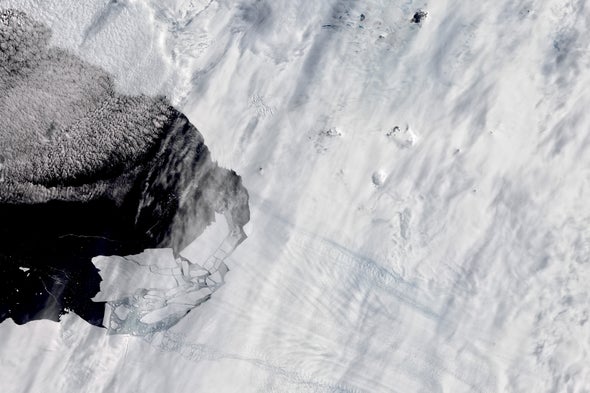
Icebergs break away from Pine Island Glacier in Antarctica last year. Credit: NASA Earth Observatory
Topics: Climate Change, Existentialism, Global Warming
Antarctica’s monster Pine Island Glacier—one of the fastest melting glaciers on the continent—is giving climate scientists new reasons to worry.
The trouble has to do with its ice shelf, a frozen ledge at the edge of the Pine Island Glacier. The ice shelf helps stabilize and contain the vast flow of ice behind it.
But now it’s crumbling into pieces.
In the last five years alone, more than a fifth of the ice shelf has broken away in the form of gigantic icebergs, which fall into the ocean and drift away.
At the same time, the glacier has begun losing ice at a faster rate. Since 2017, the speed of the ice flowing from the glacier into the sea has accelerated by 12%.
These losses are summarized in a new study, published Friday in the journal Science Advances.
The big question is what will happen next, according to lead study author Ian Joughin, a glaciologist at the University of Washington. There’s a chance the ice shelf may stabilize and the flow of ice will slow down, or at least stop speeding up.
Then again, “the other scenario is this process will continue and the shelf will fall apart far more quickly than we expected,” he told E&E News.
In a major scientific leap, University of Queensland researchers have created a quantum microscope that can reveal biological structures that would otherwise be impossible to see.
This paves the way for applications in biotechnology, and could extend far beyond this into areas ranging from navigation to medical imaging.
The microscope is powered by the science of quantum entanglement, an effect Einstein described as “spooky interactions at a distance.”
Professor Warwick Bowen, from UQ’s Quantum Optics Lab and the ARC Centre of Excellence for Engineered Quantum Systems (EQUS), said it was the first entanglement-based sensor with performance beyond the best possible existing technology.
“This breakthrough will spark all sorts of new technologies — from better navigation systems to better MRI machines, you name it,” Professor Bowen said.
“Entanglement is thought to lie at the heart of a quantum revolution. We’ve finally demonstrated that sensors that use it can supersede existing, non-quantum technology.
“This is exciting — it’s the first proof of the paradigm-changing potential of entanglement for sensing.”
Topics: Civics, Civil Rights, Existentialism, History, Human Rights
Note: This post meant for Friday was delayed by a crashing hard drive. I now have a brand NEW solid state version thanks to Best Buy and the Geek Squad (shameless plug). I now have the dubious and quaint job of finding all of my files on this newer, faster drive.
At a time when statues that honor our past often whitewash that history or honor traitors, Paine’s is a legacy all Americans can be proud of today and which our nation should honor. Paine was a thinker far ahead of his time. Almost uniquely among the Founding Fathers he opposed slavery and favored abolition, called for a progressive income tax to pay for universal education (including for both sexes), a welfare system for poor relief, pensions, women’s rights, and more. He was an eloquent advocate for equality and representative government, writing, “The true and only true basis of representative government is equality of rights.” He added, “the danger arises from exclusions.”
Thomas Paine was one the greatest political writers and philosophers of his time; his best-selling works, Common Sense, The American Crisis, Rights of Man, and The Age of Reason fundamentally altered the political and social landscape of the 18th and 19th centuries and helped forge the United States of America.
Thomas Paine embodies the American Dream in a selfless way, rising from humble origins and penury to become a foremost political figure of his time, a friend to humanity and a foe to tyrants. He never sought personal power or wealth; instead, he championed the rights of the “common” people and believed emphatically in the dignity and rights of humans, which drove him to challenge the traditional authority of kings and dogmas of established churches, forever changing the course of human history.
Thomas Paine helped create America. It’s time America honored his legacy.
We saw to our horror a modern insurrection on January 6, 2021. As the battle ensign of Robert E. Lee’s North Virginia Regiment paraded the halls of the Capitol during the siege, we discovered later the number of confederate figures venerated at the “Temple of Democracy” as well as state Capitols and cities that were guilty of the first insurrection.
Thomas Paine was as much a Founding Father to the United States of America as any other whose histories have been whitewashed, and mythologized to the point of unrealistic apotheosis. He apparently named the United States (lately, an oxymoron), and penned the lines you’ve probably heard in one form, or another:
“These are the times that try men’s souls. The summer soldier and the sunshine patriot will, in this crisis, shrink from the service of their country; but he that stands by it now, deserves the love and thanks of man and woman. Tyranny, like hell, is not easily conquered; yet we have this consolation with us, that the harder the conflict, the more glorious the triumph. When we obtain too cheap, we esteem too lightly; it is dearness only that gives everything its value. Heaven knows how to put a proper price on its goods; and it would be strange indeed if so celestial an article as FREEDOM should not be highly rated.”
He was a scientist, poet, philosopher, scholar, and best-selling author. He was a deist, as were most of the Founding Fathers, meaning they believed in a God, just not a sovereign one intimately tied into, or interested in human affairs. There is such a thing as the Jeffersonian Bible, where Thomas Jefferson took scissors to every miraculous occurrence in the tome. Yet like the Tulsa Massacre and other vile atrocities masked by state propaganda, Paine’s history is deliberately hidden: unknown except to atheists, agnostics, freethinking societies, historians and theologians who study him, and humanists who revere him.
Despite the artistic flow of his prose that inspired a revolution against the British Empire and birth of its American analogue, there are no statues of him at our Capitol, the seat of our power. It is ironic the vitriol against the District of Columbia becoming the 51st state, existing as the last visible example of literal taxation without representation. “It would be strange indeed if so celestial an article as FREEDOM should not be highly rated.”
History is best defined as a study of past events, particularly human events, to learn important lessons from them. History gains insights from the past; science make hypotheses, design experiments, looking for patterns to make predictions that can hopefully improve our futures, extend our lives, and maybe, our civilization.
Thomas Paine, and the Tulsa Massacre: both are sins of omission, both leave a citizenry of a federal republic uninformed. Uninformed citizens don’t make decisions using faculties of critical thinking skills, since that part of the brain is unused, if not atrophied. Uninformed citizens cannot manage the responsibilities of a democratic republic. Uninformed citizens are anathema to a democracy. Such citizens are open to conspiracy theories, as nature abhors a vacuum. What would our country be if we faced our past, and planned logically for our futures? Gaslighting history and ignoring science is a disastrous combination that limits our survival runway as a species. Without global cooperation, management of resources, addressing income inequality that exacerbated our response to the pandemic, systemic racism that impoverishes not just BIPOC, but nations, we will crumble, as other empires have. The Mayas sacrificed fellow tribesmen and women to a water god to eliminate drought. New flash: it didn’t work out too well for them.
Tyranny, like hell, is not easily conquered; yet we have this consolation with us, that the harder the conflict, the more glorious the triumph. When we obtain too cheap, we esteem too lightly; it is dearness only that gives everything its value.
It is not the time to tire. We must defeat this evil, or witness the death of democracy.
Our next actions will either save, or doom the republic.
Our next actions will be guided either by apathy, or common sense.
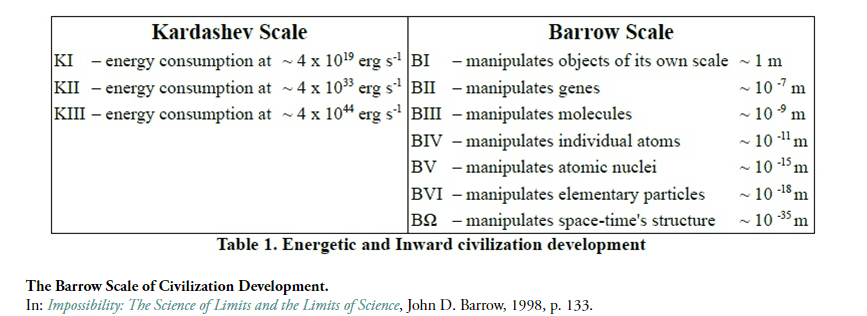
The Kardashev Scale is a discussion, and ranking of civilizations based on energy output:
Type I: able to marshal energy resources for communications on a planet-wide scale, equivalent to the entire present power consumption of the human race, or about 1016 watts. Here, Carl Sagan begged to differ, due to power gradation, we’re more like (on his measure) a 0.7 civilization, or 7 x 10¹⁵ watts. We have pockets of deployed resources, but definitely not “planet-wide,” else there would be no economic distinctions: east/south side to west side; 1st and 3rd worlds. Perhaps we could edge up our score with renewable alternatives? Type II: surpasses this by a factor of approximately ten billion, making available 1026 watts, by exploiting the total energy output of its central star, using a Dyson sphere. Type III: evolved enough to tap the energy resources of an entire galaxy, ~ 1036 watts. Type IV and V here.
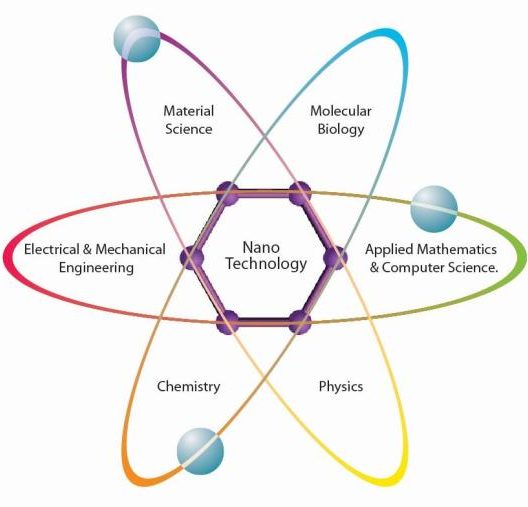
Professor John D. Barrow is an astrophysicist and mathematician at Cambridge. His take is going not from the aspect of starships, instead of from ever-shrinking technology to make advanced control of energy, and technology possible.
On the Barrow Scale, we’re clearly in the Barrow Three minus or nanotechnology. Arthur C. Clarke said “any sufficiently advanced technology is indistinguishable from magic,” and kind of gives a runway that is the impossible-to-design Trek technobabble.
Could we go further?
Well, that depends on whether the purveyors of this technological node haven’t blown ourselves to smithereens, [climate] changed ourselves to death, or ignored another zoonotic virus and comforted ourselves with throwing caution to the winds, taking vitamins, and jogging to the self-made apocalypse. Sorry for being cynical.
Also, each technological node is driven by industry, and at the top of that are apex predators also known as CEOs/billionaires who have a propensity to not share the resources they plunder. Also after seeing the Netflix documentary: “The Social Dilemma,” I wonder what an AI-enabled-Planck-technology Internet, or economy would LOOK like, and who would it ultimately favor? Billionaires don’t occur naturally, and trillionaires, quadrillion, or quintillion-empowered varieties would likely be tyrannical, and obscene.
Though this tech through-line is ambitious, bold, imaginative, it has a Pollyannaish feel to it, dependent on the benevolence of our fellow human beings, and a shared vision of humanity’s progress.
Then, there are those apex predators that won’t pay taxes, give a damn, or build starships so they can first ride on for their three minutes of narcissistic pleasure. Star Trek and a United Federation of Planets post-scarcity is still a Gene Roddenberry dream.
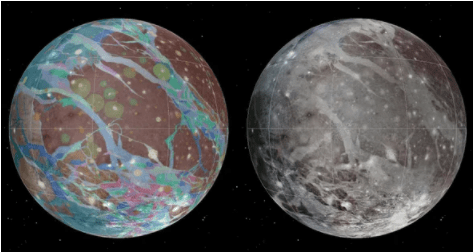
No probe has gotten a good view of Jupiter’s largest moon since 2000, when NASA’s Galileo spacecraft swung past the strange world, which is the largest moon in the whole solar system. But on Monday (June 7), at 1:35 p.m. EDT (1735 GMT), NASA’s Juno spacecraft will skim just 645 miles (1,038 kilometers) above Ganymede’s surface, gathering a host of observations as it does so.
“Juno carries a suite of sensitive instruments capable of seeing Ganymede in ways never before possible,” principal investigator Scott Bolton, a space scientist at the Southwest Research Institute in San Antonio, said in a NASA statement. “By flying so close, we will bring the exploration of Ganymede into the 21st century.”
Ganymede is a fascinating world for scientists. Despite its status as a moon, it’s larger than the tiny planet Mercury and is the only moon to sport a magnetic field, a bubble of charged particles dubbed a magnetosphere. Until now, the only spacecraft to get a good look at Ganymede were NASA’s twin Voyager probes in 1979 and the Galileo spacecraft, which flew past the moon in 2000.
A major challenge in cell biology remains unraveling how cells control their biochemical reaction cycles. For instance, how do they regulate gene expression in response to stress? How does their metabolism change when resources are scarce? Control theory has proven useful in understanding how networks of chemical reactions can robustly tackle those and other tasks.1 The essential ingredients in such approaches are chemical feedback loops that create control mechanisms similar to the circuits that regulate, for example, the temperature of a heating system, the humidity of an archive, or the pH of a fermentation tank.
Theories for the control of biochemical reactions have largely focused on homogeneous, well-stirred environments. However, macromolecules inside cells are often highly organized in space by specialized subunits called organelles. Some organelles, such as the cell nucleus, are bound by a membrane. By contrast, another class of organelles—biomolecular condensates—show the hallmark physical properties of liquid-like droplets, and they provide chemically distinct environments for biochemical reactions.2–4
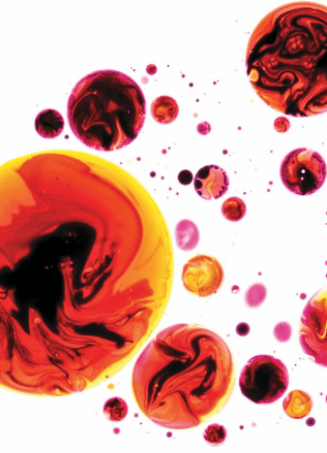
Such droplets can act as microreactors for biochemical reactions in a living cell (see figure 1). Their liquid nature sustains the fast diffusion of reactants while their specific composition gives rise to the partitioning of reactants in or out of the droplets. In general, the concentrations of reactants inside condensates differ from the concentrations outside. Those differences modify reaction fluxes, which, in turn, can dramatically affect reaction yield and other properties of chemical reactions. Just how such modified fluxes govern the biochemistry inside cells remains poorly understood.
Drops in Cells, Christoph Weber, Christoph Zechner, Physics Today
New territory Two candidate collider-neutrino events from the FASERν pilot detector in the plane longitudinal to (top) and transverse to (bottom) the beam direction. The different lines in each event show charged-particle tracks originating from the neutrino interaction point. Credit: FASER Collaboration.
Topics: CERN, High Energy Physics, Particle Physics, Research
Think “neutrino detector” and images of giant installations come to mind, necessary to compensate for the vanishingly small interaction probability of neutrinos with matter. The extreme luminosity of proton-proton collisions at the LHC, however, produces a large neutrino flux in the forward direction, with energies leading to cross-sections high enough for neutrinos to be detected using a much more compact apparatus.
In March, the CERN research board approved the Scattering and Neutrino Detector (SND@LHC) for installation in an unused tunnel that links the LHC to the SPS, 480 m downstream from the ATLAS experiment. Designed to detect neutrinos produced in a hitherto unexplored pseudo-rapidity range (7.2 < 𝜂 < 8.6), the experiment will complement and extend the physics reach of the other LHC experiments — in particular FASERν, which was approved last year. Construction of FASERν, which is located in an unused service tunnel on the opposite side of ATLAS along the LHC beamline (covering |𝜂|>9.1), was completed in March, while installation of SND@LHC is about to begin.
Both experiments will be able to detect neutrinos of all types, with SND@LHC positioned off the beamline to detect neutrinos produced at slightly larger angles. Expected to commence data-taking during LHC Run 3 in spring 2022, these latest additions to the LHC-experiment family are poised to make the first observations of collider neutrinos while opening new searches for feebly interacting particles and other new physics.
Topics: Civics, Civil Rights, Existentialism, Fascism, Human Rights
Even presidents who don’t believe in history need a historian to rely on. When asked, in 2014, by a delegation of students and history teachers for his chosen chronicler of Russia’s past, Vladimir Putin came up with a single name: Ivan Ilyin.
Ilyin is a figure who might have been easily lost to history were it not for the posthumous patronage of Russia’s leader. Putin first drew attention to him – Ilyin was a philosopher, not a historian, a Russian who died in exile in Switzerland in 1954 – when he organized the repatriation of Ilyin’s remains for reburial in Moscow in 2005. Ilyin’s personal papers, held in a library in Michigan, were also brought “home” at the president’s request. New editions of Ilyin’s dense books of political philosophy became popular in Kremlin circles – and all of Russia’s civil servants reportedly received a collection of his essays in 2014. And when Putin explained Russia’s need to combat the expansion of the European Union, and laid out the argument to invade Ukraine, it was Ilyin’s arguments on which the president relied.
Timothy Snyder begins his pattern-making deconstruction of recent Russian history – which by design, he argues, is indistinguishable from recent British and American history – with a comprehensive account of Putin’s reverence for the work of Ilyin. Like much of Snyder’s analysis in this un-ignorable book, the framing offers both a disturbing and persuasive insight.
Ilyin, an early critic of Bolshevism, had been expelled by the Soviets in 1922. In Germany, where he wrote favorably of the rise of Hitler and the example of Mussolini, he developed ideas for a Russian fascism, which could counter the effects of the 1917 revolution. As a thread through his nationalist rhetoric, he proposed a lost “Russian spirit”, which in its essence reflected a Christian God’s original creation before the fall and drew on a strongly masculine “pure” sexual energy (he had been psychoanalyzed by Freud). A new Russian nation should be established, Ilyin argued, to defend and promote that ineffable spirit against all external threats – not only communism but also individualism. To achieve that end, Ilyin outlined a “simulacrum” of democracy in which the Russian people would speak “naturally” with one voice, dependent on a leader who was cast as “redeemer” for returning true Russian culture to its people. (My insert: Make Russia Great Again?) Elections would be “rituals” designed to endorse that power, periodically “uniting the nation in a gesture of subjugation.”
Black Wall Street was razed in 1921, the bombing by air dramatized in the sequel to Watchmen on HBO. Rosewood was massacred in 1923. The steamroller of violence began in 1919 after “The Great War,” we know as World War I as African American soldiers returned from the war and filled factory jobs that whites found themselves competing for. The struggle for resources fosters violence. Standardized testing, De Jure redlining, and structural racism are all bloodless coups of violence. It is Pontius Pilate washing his hands before the crucifixion, but the aims and the ends are absolutely congruent.
In our country, one of the two major parties is actively practicing un-democracy: they are obviously not interested in “bipartisanship,” except as a political cudgel on the democrats; there are 47 states logging hundreds of legislative maneuvers to make it harder for black and indigenous people of color (BIPOC) to VOTE. Armed “poll watchers” can intimidate, film, potential voters. This precedent is ominous now that you don’t need a permit, or training to “open carry” in Texas: just a brain, no matter the state (or, damage) of an individual mind, and a functioning trigger finger. The ongoing, dystopian Arizona “fraud-it” is as much a template as January 6, 2021. If not challenged, we will see both again. In a two-party system, both have to accept that if your party lost the election, it’s your job to come with better arguments the next time. Now, the equivalent of a tantrum is being constructed, modeled after the commander of covfefe Pablum, just one where votes are suppressed, gallows might be built, bullets likely fly, and blood from BIPOC bodies runs red.
“Not having a January 6 Commission to look into exactly what occurred is a slap in the faces of all the officers who did their jobs that day,” Gladys Sicknick said in a statement provided to POLITICO. “I suggest that all Congressmen and Senators who are against this Bill visit my son’s grave in Arlington National Cemetery and, while there, think about what their hurtful decisions will do to those officers who will be there for them going forward.”
“Putting politics aside, wouldn’t they want to know the truth of what happened on January 6? If not, they do not deserve to have the jobs they were elected to do,” she added.
Among the Republican senators who agreed to meet with the group, according to a source with knowledge of the schedule: Sens. Mitt Romney (Utah), Rob Portman (Ohio), Pat Toomey (Pa.), Susan Collins (Maine), Roger Marshall (Kansas), John Barrasso (Wyo.), Bill Cassidy (La.), Ted Cruz (Texas), Mike Crapo (Idaho), Mike Lee (Utah), Ron Johnson (Wis.) and Lindsey Graham (S.C.).
The army hired Boston lawyer Joseph Welch to make its case. At a session on June 9, 1954, McCarthy charged that one of Welch’s attorneys had ties to a Communist organization. As an amazed television audience looked on, Welch responded with the immortal lines that ultimately ended McCarthy’s career: “Until this moment, Senator, I think I never really gauged your cruelty or your recklessness.” When McCarthy tried to continue his attack, Welch angrily interrupted, “Let us not assassinate this lad further, senator. You have done enough. Have you no sense of decency?”
Overnight, McCarthy’s immense national popularity evaporated. Censured by his Senate colleagues, ostracized by his party, and ignored by the press, McCarthy died three years later, 48 years old and a broken man.