"The one exclusive sign of thorough knowledge is the power of teaching." Aristotle | Disclaimer: The views and opinions expressed on this Wordpress website are the views and opinions of the content creator, Dr. Reggie Goodwin, and should not be construed as shared, or sourced from The Environmental Protection Agency, or any organizations with which they have cooperative, or business relationships.
Argonne researchers have developed a cutting-edge technique to study atomic vibrations near material interfaces, opening doors to new quantum applications in computing and sensing.
Scientists are racing to develop new materials for quantum technologies in computing and sensing for ultraprecise measurements. For these future technologies to transition from the laboratory to real-world applications, a much deeper understanding is needed of the behavior near surfaces, especially those at interfaces between materials.
Scientists at the U.S. Department of Energy’s (DOE) Argonne National Laboratory have unveiled a new technique that could help advance the development of quantum technology. Their innovation, surface-sensitive spintronic terahertz spectroscopy (SSTS), provides an unprecedented look at how quantum materials behave at interfaces.
“This technique allows us to study surface phonons — the collective vibrations of atoms at a material’s surface or interface between materials,” said Zhaodong Chu, a postdoctoral researcher at Argonne and first author of the study. “Our findings reveal striking differences between surface phonons and those in the bulk material, opening new avenues for research and applications.”
In materials such as crystals, atoms form repeating patterns called lattices, which can vibrate in waves known as phonons. While much is understood about phonons in the bulk material, little is known about surface phonons — those occurring within nanometers of an interface. The team’s research reveals that surface phonons behave differently, enabling unique quantum behaviors such as interfacial superconductivity.
The “woolly mouse” was developed by Colossal Biosciences by editing genes to give the mouse a bushier, thicker coat, akin to that of the extinct woolly mammoth. Colossal
Topics: Biology, Biotechnology, Research
Note: I had a pet hamster named “Woolly,” that looked remarkably like this one. I’m sure cloning wasn’t at this point decades ago. He sadly only lasted a little over a year.
The biotech company Colossal Biosciences has long aspired to bring back the extinct woolly mammoth, which roamed the Northern Hemisphere thousands of years ago, during the last ice age. But for now, as a step along the way, the company has come up with something decidedly less mammoth: meet the woolly mouse.
On Tuesday Colossal announced this lab-born animal, which features shaggy, mammothlike fur and has cold-adapted traits such as the way in which it stores and burns fat. Researchers retrieved and sequenced ancient mammoth DNA from preserved skin, bone and hair to learn which genes controlled traits such as coat color and cold tolerance. They altered the corresponding genes in lab mice and made other alterations in the rodents’ genome.
What was the purpose of this feat of genetic engineering? Colossal’s pitch is that, with biodiversity going the way of the dodo (which the company also hopes to resurrect), saving existing species will require tweaking their DNA to make them more resilient. The researchers at the company also claim that bringing back extinct species can help the environment. For example, they say mammoths can help fight climate change by tamping down Arctic permafrost, reducing how much of it is thawing and releasing methane into the atmosphere. Company co-founder and CEO Ben Lamm puts the approach in startling terms: “Why leave nature to chance?” In pursuit of such “de-extinction” goals, Colossal has raised hundreds of millions of dollars from celebrities to the CIA.
Climeworks’ Mammoth plant in Iceland, which began operations in May 2024. The plant removes carbon dioxide with direct air capture — one of the methods examined in APS’ latest report.
Topics: Applied Physics, Climate Change, Global Warming, Green Tech
Anthropologists believe our ancestors first used fire as a tool nearly two million years ago. Eventually, fire became a necessity for cooking and warmth. Then, 4,000 years ago, dwellers in modern-day northern China discovered a black rock that burned better than wood: coal.
Today, we mine and consume an estimated 8.8 billion metric tons (tons) of coal every year, among other fossil fuels, releasing into Earth’s atmosphere billions of tons of carbon that had been locked away in Earth’s crust for hundreds of millions of years. That carbon dioxide, we now know, is blanketing our planet — trapping heat, supercharging hurricanes and heat waves, and melting vast expanses of sea ice and glaciers.
As countries race to drive their annual greenhouse gas emissions to net zero by 2050, some are contemplating a different question: What can we do about the 1.5 trillion tons of carbon dioxide we’ve already added to our atmosphere?
On Jan. 27, APS released a new report, “Atmospheric Carbon Dioxide Removal: A Physical Science Perspective,” that aims to answer this question. The four authors of the report — which was commissioned by the APS Panel on Public Affairs — are Washington Taylor of the Massachusetts Institute of Technology, Jonathan Wurtele of the University of California, Berkeley, APS Past President Bob Rosner of the University of Chicago, and APS President-elect Brad Marston of Brown University.
The report summarizes the current state of available carbon dioxide removal (CDR) technologies and outlines recommendations for policymakers. Above all, the report emphasizes that in most cases, cutting current carbon emissions is easier and less costly than large-scale, engineered carbon dioxide removal efforts may ever be.
Topics: African Americans, Black History Month, Carl Sagan, Carter G. Woodson, Democracy, Diversity in Science, Existentialism, Women in Science
“If you can control a man’s thinking you do not have to worry about his action. When you determine what a man shall think you do not have to concern yourself about what he will do. If you make a man feel that he is inferior, you do not have to compel him to accept an inferior status, for he will seek it himself. If you make a man think that he is justly an outcast, you do not have to order him to the back door. He will go without being told; and if there is no back door, his very nature will demand one.” ― Carter G. Woodson, The Mis-Education of the Negro
A complimentary quote:
Years later, I thought about this when I left Nigeria to go to university in the United States. I was 19. My American roommate was shocked by me. She asked where I had learned to speak English so well, and was confused when I said that Nigeria happened to have English as its official language. She asked if she could listen to what she called my “tribal music,” and was consequently very disappointed when I produced my tape of Mariah Carey. She assumed that I did not know how to use a stove.
What struck me was this: She had felt sorry for me even before she saw me. Her default position toward me, as an African, was a kind of patronizing, well-meaning pity. My roommate had a single story of Africa: a single story of catastrophe. In this single story, there was no possibility of Africans being similar to her in any way, no possibility of feelings more complex than pity, and no possibility of a connection as human equals.
So, after I had spent some years in the U.S. as an African, I began to understand my roommate’s response to me. If I had not grown up in Nigeria, and if all I knew about Africa were from popular images, I too would think that Africa was a place of beautiful landscapes, beautiful animals, and incomprehensible people, fighting senseless wars, dying of poverty and AIDS, unable to speak for themselves and waiting to be saved by a kind, white foreigner. I would see Africans in the same way that I, as a child, had seen Fide’s family.
This single story of Africa ultimately comes, I think, from Western literature. Now, here is a quote from the writing of a London merchant called John Lok, who sailed to West Africa in 1561 and kept a fascinating account of his voyage. After referring to the black Africans as “beasts who have no houses,” he writes, “They are also people without heads, having their mouth and eyes in their breasts.”
Dr. Woodson was a historian and founded Negro History Week which became what we now celebrate as Black or African American History Month, and the subsequent clone celebrations: “Imitation is the best form of flattery.” I offer Chimamanda Ngozi Adichie as a compliment to the statement that I am about to make:
In oppressive systems, History Months are not designed to appease the oppressors.
Understand Dr. Woodson wrote The Mis-Education of the Negro five years before the British Play Gas Light, followed by the 1944 film Gaslight.
Gaslighting, an elaborate and insidious technique of deception and psychological manipulation, is usually practiced by a single deceiver, or “gaslighter,” on a single victim over an extended period. Its effect is to gradually undermine the victims’ confidence in their own ability to distinguish truth from falsehood, right from wrong, or reality from appearance, thereby rendering them pathologically dependent on the gaslighters in their thinking or feelings.
As part of the process, the victims’ self-esteem is severely damaged, and they become additionally dependent on the gaslighters for emotional support and validation. In some cases the intended (and achieved) result is to rob the victims of their sanity. The phenomenon is attested in the clinical literature as a form of narcissistic abuse whereby extreme narcissists attempt to satisfy their pathological need for constant affirmation and esteem (for “narcissistic supply”) by converting vulnerable people into intellectual and emotional slaves whom the narcissists paradoxically despise for their victimhood. Because gaslighters themselves are typically psychologically disordered, they are often not fully aware of what they are doing or why they are doing it.
The word did not exist, but the behavior was definitely apparent in the country Dr. Woodson lived in, and the people who he was trying to educate so that they would have a sense of self, a sense of their power and agency, in other words: hope.
“In oppressive systems, History Months are not designed to appease the oppressors,” they are designed to empower the oppressed. We lulled ourselves into thinking that the oppressors just needed knowledge of our history, hence the clone months for other ethnic groups and gender identities. The oppressed were “appealing to the better angels,” of the oppressor class when they revealed that they never read the books printed, they never meant to read the books printed, and they sure didn’t want the targets of their oppression reading the books printed, hence, the outright banning. In 2008, America elected its one, and so far only, black president, re-elected him in 2012, and to paraphrase professor Henry Louis Gates Jr., some so-called “white” people collectively lost their minds.
Bill Clinton, Toni Morrison’s de facto black president before Barack Obama, birthed Newt Gingrich, “Contracts ON America,” and government shutdowns, then, and every time the Republican Party has the Speaker’s gavel. The current party took Reagan’s throwaway line: “government IS the problem” and used it as marching orders, such that every elected member of the party – Tea Party, Freedom Caucus, or any other Orwellian self-title, is a de facto political terrorist. They took Lyndon Johnson’s observation, and used it as a blueprint:
“If you can convince the lowest white man he’s better than the best-colored man, he won’t notice you’re picking his pocket. [Hell], give him somebody to look down on, and he’ll empty his pockets for you.“ Why would an oppressive system divorce itself from such a successful strategy?
Black people didn’t take your place in Ivy League Universities; the LGBT, Hispanic/Latinos and immigrants didn’t “take your positions” guaranteed in previous iterations of whiteness: it was your lack of preparation, lack of desire to work in arduous conditions parallel to chattel enslavement on factory farms and meat packing plants, and neoliberal policies, by both major parties that shipped jobs overseas that could have been filled by American workers that for their reasons, were never interested in college. I possess a Doctorate of Philosophy in Nanoengineering, but I was raised by a mother who’s highest formal education was an Associate Degree in Practical Nursing, and a father who on paper had a sixth-grade education, though a ninth-grade and higher reading comprehension. They managed to purchase a house that they burned the mortgage around my twelfth birthday because they owned it. They lived the “American dream” when it was affordable.
The decision to ship jobs overseas, not allowing others to live that American dream, was accomplished in corporate boardrooms lacking a considerable amount of diversity, and minimal amounts of Melanin. Those same homogeneous corporate boardrooms have invested enough dark money to write laws in their favor, and sway elections, here, and abroad. There may be a small number in that boardroom not of European ancestry, but that is for optics, and you don’t have to be “white” to support white supremacy. Proximity is not itself a protection or a balm to the intimation of violence.
Barack Hussein Obama – by merely existing, and the audacity of winning – inadvertently birthed the Tea Party cum Freedom Caucus cum QAnon cum the Oval Office occupant who rode birtherism to power; Lauren Boubert and Marjorie Taylor Greene, neither of whom are with the husbands they started their congressional careers with, are part of the 53% in 2016 and 2024 who voted for someone they would never let their daughters date, or bring into their homes. To white women: proximity to white male supremacy has never been a shield from its brutality. 2016 proved this country is misogynist; 2024 proved it is that and racist, because it only wants “a single story,” albeit dangerous, where Abe is honest, George could not tell a lie, and the Founding Fathers gave enough wiggle-room for a lanky politician with a funny name from Illinois, like Lincoln, to rise to the presidency. As slave owners, there was no concept of their African property having citizenship, agency, or their women being other than helpless ornaments to their prestige, and power.
“In oppressive systems, History Months are not designed to appease the oppressors,” they are designed to empower the oppressed.
Q: “Why don’t we have ‘White History Month?'”
A: Show me where the marginalized have oppressed you.
Better yet: If you want an end to all the History Months, end the oppressive systems that require their existence. Accept history for what it is, a chronicle of the triumphs and flaws of human civilization. Humans have existed on the Earth for about 300,000 years in its many iterations, and human civilization about 6,000 years, building on its understanding of the Cosmos, from philosophy, to mathematics, to physics, chemistry, and engineering. Humans who migrated from the African continent adapted to their environments, which is why the concept of “race” could not be corroborated by the Human Genome Diversity Project (which I assume under the current climate will be renamed now), and it is rightly referred to as a social construction. The Earth has existed for 4.5 billion years, so in ratio: hominids have existed for 0.01% of that period, and civilization 1.3E-4% = 0.00013%. The Earth does not need us: We need the Earth. Migration to the stars cannot happen until we evolve here.
Look again at that dot. That’s here. That’s home. That’s us. On it everyone you love, everyone you know, everyone you ever heard of, every human being who ever was, lived out their lives. The aggregate of our joy and suffering, thousands of confident religions, ideologies, and economic doctrines, every hunter and forager, every hero and coward, every creator and destroyer of civilization, every king and peasant, every young couple in love, every mother and father, hopeful child, inventor and explorer, every teacher of morals, every corrupt politician, every “superstar,” every “supreme leader,” every saint and sinner in the history of our species lived there–on a mote of dust suspended in a sunbeam.
The Earth is a very small stage in a vast cosmic arena. Think of the rivers of blood spilled by all those generals and emperors so that, in glory and triumph, they could become the momentary masters of a fraction of a dot. Think of the endless cruelties visited by the inhabitants of one corner of this pixel on the scarcely distinguishable inhabitants of some other corner, how frequent their misunderstandings, how eager they are to kill one another, how fervent their hatreds.
Our posturing, our imagined self-importance, the delusion that we have some privileged position in the Universe, are challenged by this point of pale light. Our planet is a lonely speck in the great enveloping cosmic dark. In our obscurity, in all this vastness, there is no hint that help will come from elsewhere to save us from ourselves.
The Earth is the only world known so far to harbor life. There is nowhere else, at least in the near future, to which our species could migrate. Visit, yes. Settle, not yet. Like it or not, for the moment the Earth is where we make our stand.
It has been said that astronomy is a humbling and character-building experience. There is perhaps no better demonstration of the folly of human conceits than this distant image of our tiny world. To me, it underscores our responsibility to deal more kindly with one another, and to preserve and cherish the pale blue dot, the only home we’ve ever known.
Lonnie Johnson holds his patent for the pump-action water gun he developed, now known as the Super Soaker
Topics: African Americans, Black History Month, Diversity in Science, Mechanical Engineering, NASA, Nuclear Engineering, STEM
Engineer Lonnie Johnson invented the massively popular Super Soaker water gun and is developing a thermoelectric device to convert solar energy into sustainable power.
Lonnie Johnson invented the Super Soaker in 1989 and has since dedicated his engineering skills to creating more efficient rechargeable batteries and sustainable solar power. As a child, Johnson learned to build toys from his father and was later inspired to make a career of his early talent by fellow Black inventorGeorge Washington Carver. Since the debut of Johnson’s famous toy, hundreds of millions of Super Soakers have been sold, and the water gun was added to the National Toy Hall of Fame in 2015. Seven years later, Johnson was inducted into the National Inventors Hall of Fame. Today, in addition to working on batteries, the inventor and his team are developing the Johnson Thermoelectric Energy Converter (JTEC), an engine that converts heat from solar energy into electricity more effectively than current technology.
Lonnie George Johnson was born on October 6, 1949, in Mobile, Alabama. His father was a World War II veteran who worked as a civilian driver at nearby Air Force bases, while his mother worked in a laundry and as a nurse’s aid. During the summers, both of Johnson’s parents also picked cotton on his grandfather’s farm.
Out of both interest and economic necessity, Johnson’s father was a skilled handyman who taught his six children to build their own toys. When Johnson was still a small boy, he and his dad built a pressurized chinaberry shooter out of bamboo shoots. At age 13, Johnson attached a lawnmower engine to a go-kart he built from junkyard scraps and raced it along the highway until the police pulled him over.
Out of both interest and economic necessity, Johnson’s father was a skilled handyman who taught his six children to build their own toys. When Johnson was still a small boy, he and his dad built a pressurized chinaberry shooter out of bamboo shoots. At age 13, Johnson attached a lawnmower engine to a go-kart he built from junkyard scraps and raced it along the highway until the police pulled him over.
Growing up in Mobile in the days of legal segregation, Johnson attended Williamson High School, an all-Black facility, where he was told not to aspire beyond a career as a technician despite his precocious intelligence and creativity. Nevertheless, inspired by the story of famed African American inventor George Washington Carver, Johnson persevered in his dream of becoming an inventor.
Nicknamed “The Professor” by his high school buddies, Johnson represented his school at a 1968 science fair sponsored by the Junior Engineering Technical Society (JETS). The fair took place at the University of Alabama at Tuscaloosa, where, just five years earlier, Governor George Wallace had tried to prevent two Black students from enrolling at the school by standing in the doorway of the auditorium.
The only Black student in the competition, Johnson debuted a compressed-air-powered robot, called “the Linex,” which he had painstakingly built from junkyard scraps over a year. Much to the chagrin of the university officials, Johnson won first prize. “The only thing anybody from the university said to us during the entire competition,” Johnson later recalled, “was ‘Goodbye’ and ‘Y’all drive safe, now.’”
After graduating with Williamson’s last segregated class in 1969, Johnson attended Tuskegee Institute (today Tuskegee University) on a scholarship. He earned a bachelor’s degree in mechanical engineering in 1973, and two years later, he received a master’s degree in nuclear engineering from the school.
After Johnson received his degrees, he joined the U.S. Air Force and became an important member of the government’s scientific establishment. He was assigned to the Strategic Air Command, where he helped develop the stealth bomber program. Johnson moved on to NASA’s Jet Propulsion Laboratory in 1979, working as a systems engineer for the Galileo mission to Jupiter and the Cassini mission to Saturn, before returning to the Air Force in 1982.
Despite his busy days, Johnson continued to pursue his own inventions in his spare time. One of his longtime pet projects was an environmentally friendly heat pump that used water instead of Freon. Johnson finally completed a prototype one night in 1982 and decided to test it in his bathroom. He aimed the nozzle into his bathtub, pulled the lever and blasted a powerful stream of water straight into the tub. Johnson’s instantaneous and instinctive reaction, since shared by millions of kids around the world, was pure delight.
In 1989, after another seven years of tinkering and tireless sales-pitching, during which he left the Air Force to go into business for himself, Johnson finally sold his device to the Larami Corporation. The “Power Drencher” initially failed to make much of a commercial impact, but after additional marketing efforts and a name change, the “Super Soaker” became a massively successful item. It topped $200 million in sales in 1991 and went on to annually rank among the world’s top 20 best-selling toys.
Topics: African Americans, Black History Month, Computer Engineering, Diversity in Science, Electrical Engineering, NASA, Robotics, STEM, Women in Science
Accomplished roboticist, entrepreneur, and educator Ayanna Howard, PhD, became dean of The Ohio State University College of Engineering on March 1, 2021. Previously she was chair of the Georgia Institute of Technology School of Interactive Computing in the College of Computing, as well as founder and director of the Human-Automation Systems Lab (HumAnS).
Her career spans higher education, NASA’s Jet Propulsion Laboratory, and the private sector. Dr. Howard is the founder and president of the board of directors of Zyrobotics, a Georgia Tech spin-off company that develops mobile therapy and educational products for children with special needs. Zyrobotics products are based on Dr. Howard’s research.
Among many accolades, Forbes named Dr. Howard to its America’s Top 50 Women In Tech list. In 2021, the Association for Computing Machinery named her the ACM Athena Lecturer in recognition of her fundamental contributions to the development of accessible human-robotic systems and artificial intelligence, along with forging new paths to broaden participation in computing. In 2022, she was elected Fellow of the American Association for the Advancement of Science (AAAS) and the National Academy of Inventors (NAI), and was appointed to the National Artificial Intelligence Advisory Committee (NAIAC).
Dr. Howard also is a tenured professor in the college’s Department of Electrical and Computer Engineering with a joint appointment in Computer Science and Engineering. As dean, she holds the Monte Ahuja Endowed Dean’s Chair, which was established in 2013 through a generous gift from Distinguished Alumnus Monte Ahuja ’70. [View Dean Howard’s full CV]
She is the first woman to lead the College of Engineering. Nationally, only 17% of engineering deans or directors across the country are female, according to the Society of Women Engineers. She also is the college’s second Black dean. George Mason University President Gregory Washington served as interim dean from 2008 to 2011. Throughout her career, Dr. Howard has been active in helping to diversify the engineering profession for women, underrepresented minorities, and individuals with disabilities.
Dr. Howard earned her bachelor’s degree in computer engineering from Brown University, her master’s degree and PhD in electrical engineering from the University of Southern California, and her MBA from Claremont Graduate University.
Born: Aug. 26, 1918 Died: Feb. 24, 2020 Hometown: White Sulphur Springs, WV Education: B.S., Mathematics and French, West Virginia State College, 1937 Hired by NACA: June 1953 Retired from NASA: 1986 Actress Playing Role in Hidden Figures: Taraji P. Henson
Topics: African Americans, Black History Month, Diversity in Science, Mathematics, NASA, Spaceflight, STEM, Women in Science
Being handpicked to be one of three black students to integrate West Virginia’s graduate schools is something that many people consider one of their life’s most notable moments. Still, it’s just one of several breakthroughs that have marked Katherine Johnson’s long and remarkable life. Born in White Sulphur Springs, West Virginia, in 1918, her intense curiosity and brilliance with numbers vaulted her ahead several grades in school. By 13, she was attending the high school on the campus of historically black West Virginia State College. At 18, she enrolled in the college itself, where she made quick work of the school’s math curriculum and found a mentor in math professor W. W. Schieffelin Claytor, the third African American to earn a PhD in mathematics. She graduated with highest honors in 1937 and took a job teaching at a black public school in Virginia.
When West Virginia decided to quietly integrate its graduate schools in 1939, West Virginia State’s president, Dr. John W. Davis, selected her and two men to be the first black students offered spots at the state’s flagship school, West Virginia University. She left her teaching job and enrolled in the graduate math program. At the end of the first session, however, she decided to leave school to start a family with her first husband, James Goble. She returned to teaching when her three daughters got older, but it wasn’t until 1952 that a relative told her about open positions at the all-black West Area Computing section at the National Advisory Committee for Aeronautics’ (NACA’s) Langley laboratory, headed by fellow West Virginian Dorothy Vaughan. Katherine and her husband decided to move the family to Newport News, Virginia, to pursue the opportunity, and Katherine began work at Langley in the summer of 1953. Just two weeks into her tenure in the office, Dorothy Vaughan assigned her to a project in the Maneuver Loads Branch of the Flight Research Division, and Katherine’s temporary position soon became permanent. She spent the next four years analyzing data from flight tests and worked on the investigation of a plane crash caused by wake turbulence. As she was wrapping up this work her husband died of cancer in December 1956.
The 1957 launch of the Soviet satellite Sputnik changed history—and Johnson’s life. In 1957, she provided some of the math for the 1958 document Notes on Space Technology, a compendium of a series of 1958 lectures given by engineers in the Flight Research Division and the Pilotless Aircraft Research Division (PARD). Engineers from those groups formed the core of the Space Task Group, the NACA’s first official foray into space travel. Johnson, who had worked with many of them since coming to Langley, “came along with the program” as the NACA became NASA later that year. She did trajectory analysis for Alan Shepard’s May 1961 mission Freedom 7, America’s first human spaceflight. In 1960, she and engineer Ted Skopinski coauthored Determination of Azimuth Angle at Burnout for Placing a Satellite Over a Selected Earth Position, a report laying out the equations describing an orbital spaceflight in which the landing position of the spacecraft is specified. It was the first time a woman in the Flight Research Division had received credit as an author of a research report.
In 1962, as NASA prepared for the orbital mission of John Glenn, Johnson was called upon to do the work that she would become most known for. The complexity of the orbital flight required the construction of a worldwide communications network, linking tracking stations around the world to IBM computers in Washington, Cape Canaveral in Florida, and Bermuda. The computers had been programmed with the orbital equations that would control the trajectory of the capsule in Glenn’s Friendship 7 mission from liftoff to splashdown, but the astronauts were wary of putting their lives in the care of the electronic calculating machines, which were prone to hiccups and blackouts. As a part of the preflight checklist, Glenn asked engineers to “get the girl”—Johnson—to run the same numbers through the same equations that had been programmed into the computer, but by hand, on her desktop mechanical calculating machine. “If she says they’re good,’” Katherine Johnson remembers the astronaut saying, “then I’m ready to go.” Glenn’s flight was a success and marked a turning point in the competition between the United States and the Soviet Union in space.
Topics: African Americans, Black History Month, Diversity in Science, Particle Physics, STEM, Theoretical Physics, Women in Science
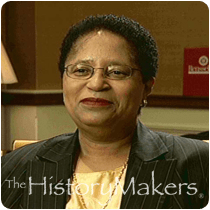
Renowned physicist and university president Shirley Ann Jackson was born on August 5, 1946, in Washington, D.C., to George Hiter Jackson and Beatrice Cosby Jackson. When Jackson was a child, her mother read her the biography of Benjamin Banneker, an African American scientist and mathematician who helped build Washington, D.C., and her father encouraged her interest in science by assisting her with projects for school. The Space Race of the late-1950s would also have an impact on Jackson as a child, spurring her interest in scientific investigation.
Jackson attended Roosevelt High School in Washington, D.C., where she took accelerated math and science classes. Jackson graduated as valedictorian in 1964 and encouraged by the assistant principal for boys at her high school, she applied to the Massachusetts Institute of Technology (MIT). Jackson was among the first African American students to attend MIT and undergraduate, she was one of only two women.
In 1973, Jackson graduated from MIT with her Ph.D. in theoretical elementary particle physics, the first woman to receive a Ph.D. in physics in MIT’s history. Jackson worked on her thesis, entitled The Study of a Multiperipheral Model with Continued Cross-Channel Unitarity, under the direction of James Young, the first African American tenured full professor in the physics department at MIT. In 1975, the thesis was published in Annals of Physics.
After receiving her degree, Jackson was hired as a research associate in theoretical physics at the Fermi National Accelerator Laboratory or Fermilab. While at Fermilab, Jackson studied medium to large subatomic particles, specifically hadrons, a subatomic particle with a strong nuclear force. Throughout the 1970s, Jackson worked in this area on Landau’s theories of charge density waves in one, and two dimensions, as well as Tang-Mills gauge theories and neutrino reactions.
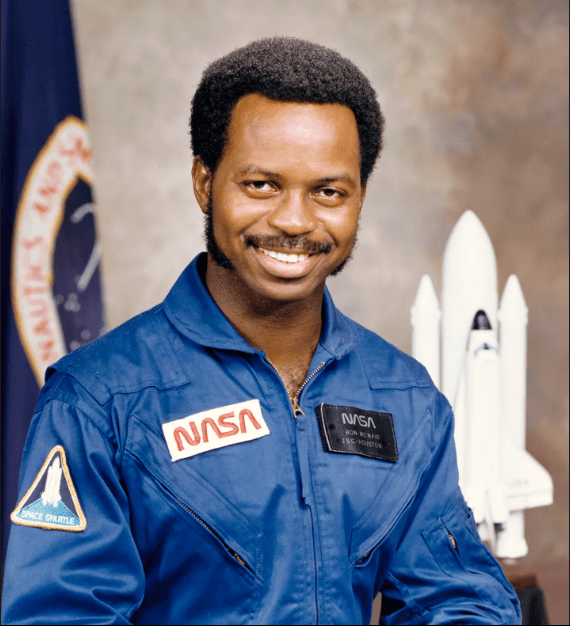
In 1978 McNair was selected as a mission specialist astronaut by the National Aeronautics and Space Administration (NASA). He, along with Guion S. Bluford, Jr., and Frederick Gregory, were the first African Americans selected as astronauts. His first spaceflight was on the STS-41B mission of the space shuttle Challenger (February 3–11, 1984). During that flight astronaut Bruce McCandless became the first person to perform a space walk without being tethered to a spacecraft. McNair operated the shuttle’s robotic arm to move a platform on which an astronaut could stand. This method of placing an astronaut in a specified position using the robotic arm was used on subsequent shuttle missions to repair satellites and assemble the International Space Station.
Ronald McNair, Guion Bluford, and Frederick Gregory, NASA’s first Black astronauts, from the 1978 astronaut class.
Topics: African Americans, Astronautics, Black History Month, Diversity in Science, NASA, Space Shuttle, Spaceflight
Frederick Drew Gregory is the first astronaut born, reared, and educated in the nation’s capital, Washington, DC, which is also home to the Smithsonian’s National Air and Space Museum. He is a veteran of three space shuttle missions and the first African American to pilot and command a mission in space. He is also the first African American to rise to the second-highest NASA leadership position, Deputy Administrator.
Gregory’s story is generationally entwined with the history of the District of Columbia (DC). In an era of profound racism and segregation, Gregory’s family were respected members of Washington’s influential Black community. When he was born in 1941, his family members were already making history, and Gregory followed suit in his own time.
Gregory’s uncle, Dr. Charles R. Drew, became famous for his medical research and innovation during World War II. His father, Francis Anderson Gregory, was locally prominent as assistant superintendent of DC Public Schools for many years and served as the first Black president of the Public Library’s Board of Trustees; the branch library in the Fort Davis neighborhood where the Gregory family lived is named in his honor. His mother, Nora Drew Gregory, a graduate of Dunbar High School, had a thirty-year career as a teacher in Washington’s elementary schools and led the library board after her husband. Her niece—Gregory’s cousin—Charlene Drew Jarvis served on the DC Council for more than two decades.
Gregory remembers his father taking him to Andrews Air Force Base for air shows and car races when he was a child; that was his earliest exposure to aviation. He also knew several Tuskegee Airmen who were friends of his father and often visited the Gregory’s home, when he was too young to understand their historical significance but enjoyed their tales of flying. As a teenager, he made the connection between flying and the military and decided he wanted to be an aeronautical engineer and military aviator.
Gregory’s life became illustrious after he graduated from Anacostia High School—Washington’s schools were not yet integrated, but Gregory was active in an integrated Boy Scout troop. Nominated by civil rights activist and member of Congress Adam Clayton Powell Jr., Gregory attended the United States Air Force Academy, where he was the only Black cadet in his class and one of very few African Americans at the academy. He graduated with distinction and a degree in military engineering in 1964 and was commissioned as an officer into the Air Force.
When Gregory joined the Air Force, he first flew helicopters and then fighter aircraft, including the F-4 Phantom. He served in Vietnam, where he flew 550 combat rescue missions, and returned to enter the Naval Test Pilot School in Patuxent, Maryland. While serving as an engineering and research test pilot for the Air Force and NASA, he earned a master’s degree in information systems from George Washington University, in his hometown. During his career, he logged 7,000 hours in more than 50 aircraft.
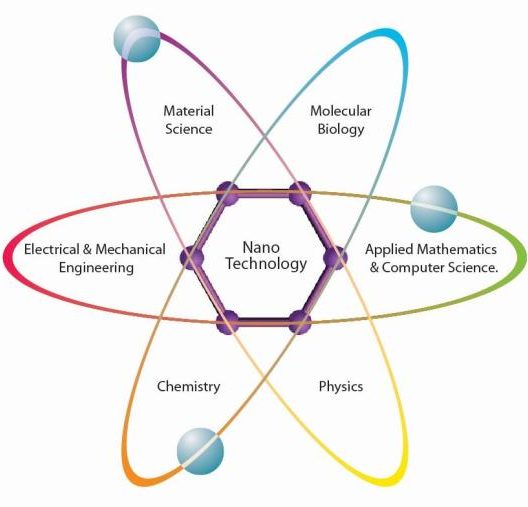








 Physics and Nano