"The one exclusive sign of thorough knowledge is the power of teaching." Aristotle | Disclaimer: The views and opinions expressed on this Wordpress website are the views and opinions of the content creator, Dr. Reggie Goodwin, and should not be construed as shared, or sourced from The Environmental Protection Agency, or any organizations with which they have cooperative, or business relationships.
Topics: Astronomy, Astrophysics, Exoplanets, Space Exploration
In 2008, HR8799 was the first extrasolar planetary system ever directly imaged. Now, the famed system stars in its very own video.
Using observations collected over the past 12 years, Northwestern University astrophysicist Jason Wang has assembled a stunning time-lapse video of the family of four planets — each more massive than Jupiter — orbiting their star. The video gives viewers an unprecedented glimpse into planetary motion.
“It’s usually difficult to see planets in orbit,” Wang said. “For example, it isn’t apparent that Jupiter or Mars orbit our sun because we live in the same system and don’t have a top-down view. Astronomical events either happen too quickly or too slowly to capture in a movie. But this video shows planets moving on a human time scale. I hope it enables people to enjoy something wondrous.”
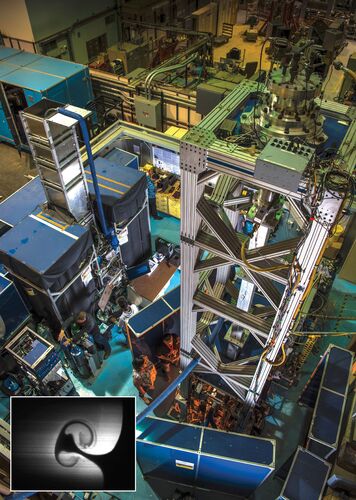
A vertical shock tube at Los Alamos National Laboratory is used for turbulence studies. Sulfur hexafluoride is injected at the top of the 5.3-meter tube and allowed to mix with air. The waste is ejected into the environment through the blue hose at the tube tower’s lower left; in the fiscal year 2021, such emissions made up some 16% of the lab’s total greenhouse gas emissions. The inset shows a snapshot of the mixing after a shock has crossed the gas interface; the darker gas is SF6, and the lighter one is air. The intensities yield density values.
Topics: Civilization, Climate Change, Global Warming, Research
Reducing air travel, improving energy efficiency in infrastructure, and installing solar panels are among the obvious actions that individual researchers and their institutions can implement to reduce their carbon footprint. But they can take many other small and large steps, too, from reducing the use of single-use plastics and other consumables and turning off unused instruments to exploiting waste heat and siting computing facilities where they are powered by renewable energy. On a systemic level, measures can encourage behaviors to reduce carbon emissions; for example, valuing in-person invited job talks and remote ones equally could lead to less air travel by scientists.
So far, the steps that scientists are taking to reduce their carbon footprint are largely grassroots, notes Hannah Johnson, a technician in the imaging group at the Princess Máxima Center for Pediatric Oncology in Utrecht and a member of Green Labs Netherlands, a volunteer organization that promotes sustainable science practices. The same goes for the time and effort they put in for the cause. One of the challenges, she says, is to get top-down support from institutions, funding agencies, and other national and international scientific bodies.
At some point, governments are likely to make laws that support climate sustainability, says Astrid Eichhorn, a professor at the University of Southern Denmark whose research is in quantum gravity and who is active on the European Federation of Academies of Sciences and Humanities committee for climate sustainability. “We are in a situation to be proactive and change in ways that do not compromise the quality of our research or our collaborations,” she says. “We should take that opportunity now and not wait for external regulations.”
Suppose humanity manages to limit emissions worldwide to 300 gigatons of carbon dioxide equivalent (CO2e). In that case, there is an 83% chance of not exceeding the 1.5 °C temperature rise above preindustrial levels set in the 2015 Paris Agreement, according to a 2021 Intergovernmental Panel on Climate Change special report. That emissions cap translates to a budget of 1.2 tons of CO2e per person annually through 2050. Estimates for the average emissions by researchers across scientific fields are much higher and range widely in part because of differing and incomplete accounting approaches, says Eichhorn. She cites values from 7 to 18 tons a year for European scientists.
Life on other planets might not look like any beings we’re used to on Earth. It may even be unrecognizable at first to scientists searching for it. Credit: William Hand
Topics: Astrobiology, Astronomy, Astrophysics, Planetary Science, SETI, Space Exploration
Sarah Stewart Johnson was a college sophomore when she first stood atop Hawaii’s Mauna Kea volcano. Its dried lava surface differed from the eroded, tree-draped mountains of her home state of Kentucky. Johnson wandered away from the other young researchers she was with and toward a distant ridge of the 13,800-foot summit. Looking down, she turned over a rock with the toe of her boot. To her surprise, a tiny fern lived underneath it, sprouting from ash and cinder cones. “It felt like it stood for all of us, huddled under that rock, existing against the odds,” Johnson says.
Her true epiphany, though, wasn’t about the hardiness of life on Earth or the hardships of being human: It was about aliens. Even if a landscape seemed strange and harsh from a human perspective, other kinds of life might find it quite comfortable. The thought opened up the cosmic real estate and the variety of life she imagined might be beyond Earth’s atmosphere. “It was on that trip that the idea of looking for life in the universe began to make sense to me,” Johnson says.
Later, Johnson became a professional at looking. As an astronomy postdoc at Harvard University in the late 2000s and early 2010s, she investigated how astronomers might use genetic sequencing—detecting and identifying DNA and RNA—to find evidence of aliens. Johnson found the work exciting (the future alien genome project!), but it also made her wonder: What if extraterrestrial life didn’t have DNA or RNA or other nucleic acids? What if their cells got instructions in some other biochemical way?
As an outlet for heretical thoughts like this, Johnson started writing in style too lyrical and philosophical for scientific journals. Her typed musings would later turn into the 2020 popular science book The Sirens of Mars. Inside its pages, she probed the idea that other planets were truly other. So their inhabitants might be very different, at a fundamental and chemical level, from anything in this world. “Even places that seem familiar—like Mars, a place that we think we know intimately—can completely throw us for a loop,” she says. “What if that’s the life case?”
Climate change is already disrupting the lives of billions of people. What was once considered a problem for the future is raging all around us right now. This reality has helped convince a majority of the public that we must act to limit suffering. In an August 2022 survey by the Pew Research Center, 71 percent of Americans said they had experienced at least one heat wave, flood, drought, or wildfire in the past year. Among those people, more than 80 percent said climate change had contributed. In another 2022 poll, 77 percent of Americans who said they had been affected by extreme weather in the past five years saw climate change as a major crisis.
Yet the response is not meeting the urgency of the crisis. A transition to clean energy is underway, but it is happening too slowly to avoid the worst effects of climate change. The U.S. government finally took long-delayed action by passing the Inflation Reduction Act in August 2022, much more progress is needed, and it is hampered by entrenched politics. The partisan divide largely stems from conservatives’ perception that climate change solutions will involve big government controlling people’s choices and imposing sacrifices. Research shows that Republicans’ skepticism about climate change is largely attributable to a conflict between ideological values and often-discussed solutions, particularly government regulations. A 2019 study on Climatic Change found that political and ideological polarization on climate change is particularly acute in the U.S. and other English-speaking countries.
One thing we can all do to ease this gridlock is to alter the language and messages we use about climate change. The words we use and the stories we tell matter. Transforming the way we talk about climate change can engage people and build the political will needed to implement policies strong enough to confront the crisis with the urgency required.
To inspire people, we need to tell a story not of sacrifice and deprivation but of opportunity and improvement in our lives, health, and well-being—a story of humans flourishing in a post-fossil-fuel age.
The debt limit does not authorize new spending commitments. It simply allows the government to finance existing legal obligations that Congresses and presidents of both parties have made in the past.
Failing to increase the debt limit would have catastrophic economic consequences. It would cause the government to default on its legal obligations – an unprecedented event in American history. That would precipitate another financial crisis and threaten the jobs and savings of everyday Americans – putting the United States right back in a deep economic hole, just as the country is recovering from the recent recession.
Congress has always acted when called upon to raise the debt limit. Since 1960, Congress has acted 78 separate times to permanently raise, temporarily extend, or revise the definition of the debt limit – 49 times under Republican presidents and 29 times under Democratic presidents. Congressional leaders in both parties have recognized that this is necessary.
Elected to the Senate in 1946, Joseph McCarthy (1908-1957) did not draw major national attention until 1950. On February 9th of that year, he delivered a Lincoln Day address in Wheeling, West Virginia, blaming failures in American foreign policy on Communist infiltration of the U.S. government. The Wisconsin Republican claimed to have a list of known Communists still working in the Department of State. A special subcommittee investigated McCarthy’s charges and rejected them as “a fraud and a hoax,” but the outbreak of the Korean War and the highly publicized conviction of Alger Hiss lent credibility to the charges. When McCarthy became chairman of the Permanent Subcommittee on Investigations in 1953, he launched a series of investigations into alleged subversion and espionage. In 1954 a confrontation with the army led to the nationally televised Army-McCarthy hearings, which tarnished McCarthy’s public image, undermined his charges, and prompted his censure by the U.S. Senate.
The New McCarthyism, or the New Testament of the Soulless
“If you tell a lie big enough and keep repeating it, people will eventually come to believe it. The lie can be maintained only for such time as the State can shield the people from the political, economic and/or military consequences of the lie. It thus becomes vitally important for the State to use all of its powers to repress dissent, for the truth is the mortal enemy of the lie, and thus by extension, the truth is the greatest enemy of the State.”
This is an excellent definition of the “Big lie,” however, there seems to be no evidence that it was used by Nazi propaganda chief Joseph Goebbels, though it is often attributed to him.
His primary rules were: never allow the public to cool off; never admit a fault or wrong; never concede that there may be some good in your enemy; never leave room for alternatives; never accept blame; concentrate on one enemy at a time and blame him for everything that goes wrong; people will believe a big lie sooner than a little one; and if you repeat it frequently enough people will sooner or later believe it.
“Then if anyone at all is to have the privilege of lying, the rulers of the State should be the persons; and they, in their dealings either with enemies or with their [own] citizens, may be allowed to lie for the public good. But nobody else should meddle with anything of the kind.” Plato, The Republic
We tell ourselves lies: E Pluribus Unum – out of many, one, or the “melting pot,” Emma Lazarus’s poem at the Statue of Liberty, whitewashing the kidnapping of Africans, the indentured servitude of poor whites and Native Americans, the disdain our immigration laws treated immigrants from the Chinese Exclusion Act, Catholics, Italians, Czecholovacians, Russians, to the recently attempted Muslim Ban.
One lie a sizable number of citizens are telling themselves: a demographic shift either isn’t happening or can be mitigated by either denying electoral losses, or keeping certain people from voting.
America Looks Different
The nation’s demographic changes add to the urgency of recognizing how precarious our position has become.
America is changing demographically, and unless Republicans are able to grow our appeal the way GOP governors have done, the changes tilt the playing field even more in the Democratic direction.
In 1980, exit polls tell us that the electorate was 88 percent white. In 2012, it was 72 percent white. Hispanics made up 7 percent of the electorate in 2000, 8 percent in 2004, 9 percent in 2008 and 10 percent in 2012. According to the Pew Hispanic Center, in 2050, whites will be 47 percent of the country while Hispanics will grow to 29 percent and Asians to 9 percent.
If we want ethnic minority voters to support Republicans, we have to engage them and show our sincerity.
A functional party would look at this and disseminate it. They might hire consultants to form focus groups. The message would be broadcast from radio stations, television, and the Internet: Republicans want to be a “big tent” party. We (republicans) want to expand to minorities, women, youth. A function party acting on these practical, fact-based conclusions would look completely different than the fiasco we are currently witnessing. They have shown since this report to be racing in the opposite direction, heading over the proverbial lemming cliff. Maybe they tried, but the majority of their electorate wasn’t receptive to “others” being under their red tent.
Rural Americans reliably votes republican, and guaranteed the re-elections of Greg Abbott and Ron DeSantis, miniatures of Trump showing after higher infection rates and deaths from Covid, gun massacres, faux crusades against asylum seekers, undocumented immigrants – usually coming for construction jobs at American companies paying them cash under the table, and wars against Critical Race Theory (i.e. accurately taught American history), Nazi book bans, and assaulting the beach of Drag Queen story hour with AR15s – all it takes to win elections is the scare and make angry the right number of white people.
The New McCarthyism is based on Goebbels’s “Big Lie,” the current one given by a septuagenarian that could not accept another septuagenarian who beat him in the 2020 election. So narcissistic and pathological was the loser he fomented a coup in the 21st Century, 20 years after 9-11. Osama Bin Laden is gone, a casualty of Seal Team Six, but his chief aim of destabilizing the west of showing the “Great Satan” to be a paper tiger. To show that the ideals we espoused overseas couldn’t even be maintained at home. The Civil Rights Movement, the killing of African Americans: all of this has been televised and broadcast. Osama and Vladimir Putin only pushed on an open sore and poured in salt. The culmination of Osama and Vladimir’s wildest dreams was the election of a mop-headed, fake billionaire that has lost more money than he’s ever earned. The book I believe he read from cover to cover and emulated in his rallies was “My New Order,” a collection of speeches by Adolf Hitler. It is in its original form 1,008 pages long. He did at one time have an attention span beyond that of a gnat. He seems to have committed it to memory. The only person who would know for sure, Ivana, is buried surreptitiously on his golf course in New Jersey.
Concealed carry devolved to open carry, in many states requiring no registration or training, studies showing the threats to African Americans getting shot elevated by such conditions. The goal of the New McCarthyism is the same as old time American Klan-robed fascism: it is to frighten, first African Americans, then the general public. Where does anyone feel safe now, when schools, the malls, places of worship have become killing fields? The government dysfunction we’ve seen since the Speaker vote debacle, and the threat not to raise the debt ceiling (25% of which were accrued during the previous administration) is by design. It is to “wear out” the electorate, it is the proverbial “pox on both houses”; and the convenient discovery of classified documents with former Vice Presidents Biden and Pence is both-sides-ism on steroids, and textbook gaslighting. It is to give us no reason to believe voting will change anything. It is voter suppresion by gaslighting, because the Growth and Opportunity Project would take too much work. and change. They are not a serious governing party: they are the comments section on Facebook reading “Green Eggs and Ham.”
The Republic is a repudiation of the rights of kings to rule over a country, the lives of peasants, and hoard wealth for themselves. The new world kings/billionaires/oligarchs are trying to reestablish that through means of fear, violence, and terror.
Kevin McCarthy will cement his legacy as this nation’s weakest (and likely, short-lived) Speaker of the House. He’s given away his power, and threatening default of the full faith and credit of the United States. Which would defund the Ukraine war, on both Ukraine, and Russia’s side. It would raise U.S. unemployment from record lows, to third world levels. It would pitch the world over that same lemmings cliff into the Greatest Depression, possibly the last one. It would guarantee an electoral loss for the Grand Old Party that rejected the price of growth and opportunity: diversity, equity, and inclusion.
Currently authorized bivalent COVID-19 boosters demonstrated similar protection against symptomatic illness from the XBB/XBB.1.5 Omicron subvariants as from BA.5-related subvariants, according to a CDC study.
From December 2022 to January 2023, the bivalent boosters’ vaccine effectiveness (VE) against symptomatic infection was a similar 48% versus XBB/XBB.1.5-related strains and 52% versus BA.5-related sublineages, reported Ruth Link-Gelles, Ph.D., of the CDC’s National Center for Immunization and Respiratory Diseases, and colleagues in Morbidity and Mortality Weekly Report (MMWR).
Meanwhile, Pfizer’s updated booster demonstrated superior neutralizing antibody activity compared with the company’s original product against all the latest Omicron subvariants, including XBB.1, according to Kena Swanson, Ph.D., of Pfizer Vaccine Research and Development in Pearl River, New York and colleagues, writing in the New England Journal of Medicine. Their findings contradict earlier research from other labs that found no significant difference in neutralizing activity with the bivalent over the monovalent vaccine.
According to the latest estimates from the CDC, XBB.1.5 is responsible for 49.1% of new COVID-19 cases in the U.S., while XBB is responsible for another 3.3%.
On target: Water is fanned out through a specially developed nozzle, and then a laser pulse is passed through it to create a switch. (Courtesy: Adrian Buchmann)
A laser-controlled water-based switch that operates twice as fast as existing semiconductor switches has been developed by a trio of physicists in Germany. Adrian Buchmann, Claudius Hoberg, and Fabio Novelli at Ruhr University Bochum used an ultrashort laser pulse to create a temporary metal-like state in a jet of liquid water. This altered the transmission of terahertz pulses over timescales of just tens of femtoseconds.
With the latest semiconductor-based switches approaching fundamental upper limits on how fast they can operate, researchers are searching for faster ways of switching signals. One unexpected place to look for inspiration is the curious behavior of water under extreme conditions – like those deep within ice-giant planets or created by powerful lasers.
Molecular dynamics simulations suggest water enters a metallic state at pressures of 300 GPa and temperatures of 7000 K. While such conditions do not occur on Earth, it is possible that this state contributes to the magnetic fields of Uranus and Neptune. To study this effect closer to home, recent experiments have used powerful, ultrashort laser pulses to trigger photo-ionization in water-based solutions – creating fleeting, metal-like states.
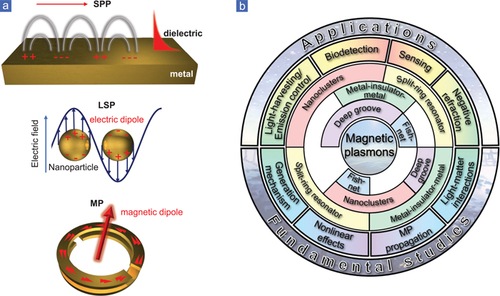
FIG. 1. (a) Sketches of the excitations of surface plasmons polaritons – SPP (top), localized surface plasmons – LSP (middle), and magnetic plasmons – MP (bottom). All these excitations are associated with a collective motion of surface charges under light illumination. (b) Diagram of MP-based plasmonic nanostructures that are used for both fundamental studies and their applications in various research fields.
The magnetic response of most natural materials, characterized by magnetic permeability, is generally weak. Particularly in the optical range, the weakness of magnetic effects is directly related to the asymmetry between electric and magnetic charges. Harnessing artificial magnetism started with a pursuit of metamaterial design exhibiting magnetic properties. The first demonstration of artificial magnetism was given by a plasmonic nanostructure called split-ring resonators. Engineered circulating currents form magnetic plasmons, acting as the source of artificial magnetism in response to external electromagnetic excitation. In the past two decades, magnetic plasmons supported by plasmonic nanostructures have become an active topic of study. This Perspective reviews the latest studies on magnetic plasmons in plasmonic nanostructures. A comprehensive summary of various plasmonic nanostructures supporting magnetic plasmons, including split-ring resonators, metal–insulator–metal structures, metallic deep groove arrays, and plasmonic nanoclusters, is presented. Fundamental studies and applications based on magnetic plasmons are discussed. The formidable challenges and the prospects of the future study directions on developing magnetic plasmonic nanostructures are proposed.
Numerical simulation of the neutron stars merging to form a black hole, with their accretion disks interacting to produce electromagnetic waves. Credit: L. Rezolla (AEI) & M. Koppitz (AEI & Zuse-Institut Berlin)
Topics: Black Holes, Cosmology, General Relativity, Gravity, Research
Scientists have advanced in discovering how to use ripples in space-time known as gravitational waves to peer back to the beginning of everything we know. The researchers say they can better understand the state of the cosmos shortly after the Big Bang by learning how these ripples in the fabric of the universe flow through planets and the gas between the galaxies.
“We can’t see the early universe directly, but maybe we can see it indirectly if we look at how gravitational waves from that time have affected matter and radiation that we can observe today,” said Deepen Garg, lead author of a paper reporting the results in the Journal of Cosmology and Astroparticle Physics. Garg is a graduate student in the Princeton Program in Plasma Physics, which is based at the U.S. Department of Energy’s (DOE) Princeton Plasma Physics Laboratory (PPPL).
Garg and his advisor Ilya Dodin, who is affiliated with both Princeton University and PPPL, adapted this technique from their research into fusion energy, the process powering the sun and stars that scientists are developing to create electricity on Earth without emitting greenhouse gases or producing long-lived radioactive waste. Fusion scientists calculate how electromagnetic waves move through plasma, the soup of electrons and atomic nuclei that fuels fusion facilities known as tokamaks and stellarators.
The modern martial arts belt ranking system started emerging in 1907 when the creator of Judo, Jigoro Kano, introduced the iconic Judo uniform and belt. Before that, his students practiced traditional Japanese kimonos. However, only two belt colors existed back then: white and black. White belts were those learning the fundamentals, while black belts were students who mastered the basics, knew how to use them functionally, and were ready to pursue Judo on a more serious and advanced level. The white coloring represented purity, avoidance of ego, and simplicity, while the black symbolized a fuller repertoire of knowledge.
A popular belief within the martial arts community is that every student started off with a white belt, then gradually, it darkened in color from all the blood, sweat, and tears of training. However, no real historical evidence exists of this practice, and it is generally regarded as little more than a myth. Source: https://stouttrainpitt.com/
Hierarchy (noun): a system in which people or things are arranged according to their importance. Cambridge Dictionary
Every nation has an arrangement of those who are deemed “important.” In the United Kingdom, since Charles ascended after the death of his mother, Elizabeth, they are apparently the beneficiaries of the Norman invasion in 1066, which deposed someone named Harald Godwinson and the House of Wessex. After several centuries of colonization, plunder, and slavery, the “Commonwealth” was born, and the fairytale of Camelot was used to justify plunder. One hierarchy is justified with belt colors, the other with propaganda.
In November 2022, we reached eight billion with something of a shrug. We were 4.4 billion my senior year in high school, 1979 – 1980.
The average human takes up an area of approximately one square meter.
The volume of Earth is about 1,000 billion cubic kilometers, per the World Bank.
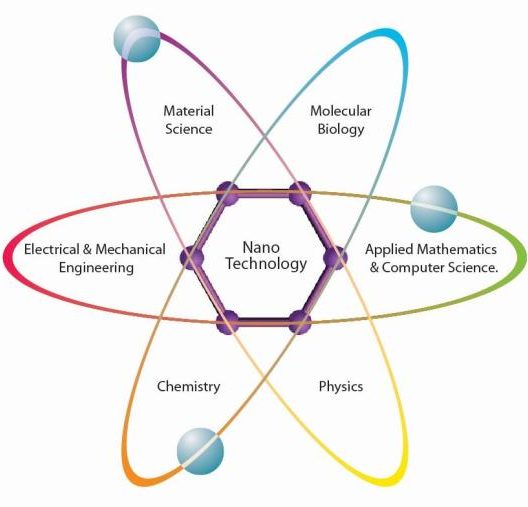
Relax. These surface-to-volume ratios only work on the nanoscale. For example, if we were a metal, say gold, the spectrographic analysis would show that due to the S/V ratio being different, the color of a macroscopic (seen) bar of gold would be different on the nanoscale (in many cases, blue or other colors) because the S/Vs are different.
It is a gross and stark illustration that as we exponentially increase in population, we’re exponentially decreasing the ability to feed our population. The fraction’s denominator did not change, but you can bet feeding the first humans in Africa was a lot simpler math than eight billion. The first thing learned in kindergartens for the 99% is to share. One presumes the first thing learned in nurseries for plutocrats is how to hoard.
Therefore, the castes of royalty, race, and inequality justify hoarding resources in a siphon-up operation (the antonym of “trickledown”). Billionaires, like kings, influence through propaganda the justification of resource theft. To ensure the running of this machine, you need some willing advocates (e.g., Kyrsten Sinema, Boris Johnson, Joe Manchin, Rishi Sunak) in world governments such that the obscenely wealthy will pay little or nothing in taxes in their respective countries. Camouflage the theft with drivel like “free markets” or “God’s will.” Having a compliant court system to define “money as free speech” helps magnify your megaphone and hides where and from what country your campaign donations are coming [from]. Social media, with the protection of Section 230, can proverbially “shout fire in crowded theaters” without consequences, except the empty “we’ll do better” promises. They pay for Members of Parliament, Senators, House Members, and presidents to enact their agendas, despite their nation’s constitutions. Democracy is, thus, anathema to avarice.
We have a global hierarchal social construct. Instead of the distribution of resources that ensures the health, safety, and welfare of the human tribe, a justification is given to those more “worthy” of the resources: bloodlines, divine right, “good genes” (eugenics), going to the “right” schools, being born on the “right” side of the tracks, “talented tenths”; secret fraternal orders, and open orgies of oligarch opulence like Davos. It is the justification of high crimes and misdemeanors committed in plain sight. It is the framework of how we justify the “haves” and the “have-nots.” It is a form of societal cognitive dissonance. It has justified the grand theft of natural resources, political power, and, thus, wealth over millennia. It has no analog in nature and does not guarantee species survival.
The dinosaurs did not perish from arrogance. They [simply] had no science to tell them that the meteor was coming.







 Physics and Nano