"The one exclusive sign of thorough knowledge is the power of teaching." Aristotle | Disclaimer: The views and opinions expressed on this Wordpress website are the views and opinions of the content creator, Dr. Reggie Goodwin, and should not be construed as shared, or sourced from The Environmental Protection Agency, or any organizations with which they have cooperative, or business relationships.
How it works: illustration of the quantum twisting microscope in action. Electrons tunnel from the probe (inverted pyramid at the top) to the sample (bottom) in several places at once (green vertical lines) in a quantum-coherent manner. (Courtesy: Weizmann Institute of Science)
When the scanning tunneling microscope debuted in the 1980s, the result was an explosion in nanotechnology and quantum-device research. Since then, other types of scanning probe microscopes have been developed, and together they have helped researchers flesh out theories of electron transport. But these techniques probe electrons at a single point, thereby observing them as particles and only seeing their wave nature indirectly. Now, researchers at the Weizmann Institute of Science in Israel have built a new scanning probe – the quantum twisting microscope – that detects the quantum wave characteristics of electrons directly.
“It’s effectively a scanning probe tip with an interferometer at its apex,” says Shahal Ilani, the team leader. The researchers overlay a scanning probe tip with ultrathin graphite, hexagonal boron nitride, and a van der Waals crystal such as graphene, which conveniently flopped over the tip like a tent with a flat top about 200 nm across. The flat end is key to the device’s interferometer function. Instead of an electron tunneling between one point in the sample and the tip, the electron wave function can tunnel across multiple points simultaneously.
“Quite surprisingly, we found that the flat end naturally pivots so that it is always parallel with the sample,” says John Birkbeck, the corresponding author of a paper describing this work. This is fortunate because any tilt would alter the tunneling distance and hence strength from one side of the plateau to the other. “It is the interference of these tunneling paths, as identified in the measured current, that gives the device its unique quantum-wave probing function,” says Birkbeck.
Topics: Civics, Civil Rights, Democracy, Existentialism, Fascism, Human Rights
Dildo (noun): an object shaped like and used in place of a penis for giving sexual pleasure; (mainly US offensive): a stupid person, especially a man. Cambridge Dictionary
Note: In light of recent events, and the pregnant homophone, it was too good to pass up.
As an engineer in Austin, Texas, working at Motorola, I emailed Mr. Adams (we both used what is now the ancient Internet service provider, AOL) a story idea about being volunteered for a project in an engineering group that I didn’t work in to change a process that I wasn’t responsible for. Then, in another meeting, I was taken off the project AFTER I had researched the business unit – Diffusion – and made the process changes. Scott turned it into a strip overnight, replying, “GREAT story idea!” At least, that’s how I took it.
The strip above showed up the NEXT day (Saturday). Maybe I read too much into the coincidence, but I made it for a time, my screen saver, just to needle the management types. None of them suspected they or their absurdity was the subject of the strip.
“Dilbert” was brilliant in that it sourced many of its stories from “the field.” Engineers working in semiconductors, STEM types working for engineering firms. Government engineers could also relate to the archetype “pointy-haired manager” (a personification of the devil), and every bad technical manager that went to “bad manager school,” most of them either hadn’t done engineering in years or weren’t ever engineers at all. Catbert, the evil HR director, was self-explanatory. I have no idea what “Ratbert” was supposed to represent. Until his racist YouTube rant, I did proudly cart around a stuffed Dogbert in my home or work office prior to the familiar orange “bigly” pompadour on his latest work that leaves no doubt about his politics. As a US veteran, I took an Oath to “protect and defend The Constitution against all enemies foreign and domestic.” I don’t share his viewpoint on a glorious time of “great again” or insurrection. I was by no means unique or solitary to have sent Mr. Adams a story idea and him choosing to use it or ignore it. At one point, he showed a Pareto chart of each engineering segment he got story ideas from (semiconductors were far to the left on the abscissa). He seemed beyond culture, class, and classification. He got us, the nerds in hamster cubicles who made the modern age possible.
I now choose Scott Adams to ignore you.
The once widely celebrated Adams, who has been entertaining extreme-right ideologies and conspiracy theories for several years, was upset Wednesday by a Rasmussen poll that found a thin majority of Black Americans agreed with the statement “It’s okay to be White” — a phrase sometimes associated with racist memes.
“If nearly half of all Blacks are not okay with White people … that’s a hate group,” Adams said on his live-streaming YouTube show. “I don’t want to have anything to do with them. And I would say, based on the current way things are going, the best advice I would give to White people is to get the hell away from Black people … because there is no fixing this.”
Adams, 65, also blamed Black people for not “focusing on education” during the show and said, “I’m also really sick of seeing video after video of Black Americans beating up non-Black citizens.”
It took me a while, but I finally stuck it out enough in graduate school to get a Ph.D. in Nanoengineering. Oh, and by the way, my physical features, you would identify as black.
I’m saying my “physical features” because, until 1681, there was no such thing as “white” people. That was created by the United States and propagated throughout the world. The first 1790 Census was explicit in its hatred of anything other than “white.” I put the name in quotes because, due to the need to maintain numerical dominance, “white” has been a fungible word. Czechs, Italians, Irish, Jews, and Russians were once not considered “pure” enough to be “white.” Humans are adaptive to the environments they inhabit.
Thus, Mr. Adams, you are exactly what anyone would expect an African to look like after approximately 40,000 years of not getting direct equatorial sunlight near the equator and closer to the north pole. Your ancestors in Europe would have no need for the protection of Melanin. Their hair would thin and mat to trap heat. Their noses would narrow due to the cold. I would expect humans on a Martian colony not to look as good as the actors on Star Trek: lower gravity, further from the sun, and higher radiation; the humans would not only look different, they would find the gravity well on earth crushing. Race is a social construct. If you read beyond what appears to have been conspiratorial sites, you would know that. The engineer you once were, the satirist of corporate silliness you became while simultaneously holding your engineering job, has gone the way of the dinosaurs and the Dodo.
I am not, nor have I ever been, part of a hate group. I have never called for segregation, as humans cannot “segregate” unless we’re going to different sectors of the universe. They can create enclaves with restrictive covenants – but we breathe the same air and consume the same products on the same planet. A formula that you, Elon Musk, and Ron DeSantis should imbibe: Racism = Prejudice + Political Power. I derived the formula from an interview with the comedian Paul Mooney. Black people can be prejudiced. They have never however, wielded power large enough or long enough to create laws to affect any other group, as yours has mine for centuries of this nation’s history, a history you probably don’t want to be reviewed or taught. Besides, I think you’d be terrible at picking tobacco or cotton.
Whatever demons you’ve been channeling since the Covid crisis that you deny, I hope one day, you excise them and join the rest of humanity in the light of diversity.
Along with Dogbert, the book products I purchased as a fan went out yesterday with Thursday’s garbage collection.
I guess now that a once brilliant cartoonist is insane.
“Scott Adams is a disgrace,” Darrin Bell, creator of “Candorville” and the first Black artist to win the Pulitzer Prize for editorial cartooning, told The Post on Saturday. “His racism is not even unique among cartoonists.” Bell compared Adams’s views to the Jim Crow era and more recent examples of White supremacy, including “millions of angry people trying to redefine the word ‘racism’ itself.”
Anson Mount as Captain Christopher Pike in Star Trek: Strange New Worlds
Topics: Civilization, Climate Change, Democracy, Existentialism, Octavia Butler, Star Trek
Life imitates art far more than art imitates life—Oscar Wilde, “The Decay of Lying”
This year, the Science and Security Board of the Bulletin of the Atomic Scientists is moving the hands of the Doomsday Clock forward, largely (though not exclusively) because of the mounting dangers of the war in Ukraine. The Clock now stands at 90 seconds to midnight—the closest to global catastrophe it has ever been.
The war in Ukraine may enter a second horrifying year, with both sides convinced they can win. Ukraine’s sovereignty and broader European security arrangements that have largely been held since the end of World War II are at stake. Also, Russia’s war on Ukraine has raised profound questions about how states interact, eroding norms of international conduct that underpin successful responses to a variety of global risks.
And worst of all, Russia’s thinly veiled threats to use nuclear weapons remind the world that escalation of the conflict—by accident, intention, or miscalculation—is a terrible risk. The possibility that the conflict could spin out of anyone’s control remains high.
The above is a publication from the Bulletin of the Atomic Scientists, trying to warn us away from the precipice since mankind opened the proverbial nuclear Pandora’s box.
It’s easy to assume that Earth’s history in Star Trek is the same as the real world before Vulcans made First Contact with humanity in 2063, but there are numerous unique divergences. Star Trek: The Original Series established that a devastating global conflict called the Eugenics Wars gripped the Earth in the 1990s, which was followed by World War III in the 21st century. TOS and Star Trek: Enterprise episodes touched upon aspects of World War III, which led to 600 million deaths and the capitals of every major country on Earth destroyed. Star Trek: First Contact showed the aftermath of World War III as the human race was still picking up the pieces a decade after the war ended. Further, the Star Trek: Discovery season 2 episode “New Eden” revealed that the Red Angel (Sonja Sohn) transported a group of World War III survivors to a planet in the Beta Quadrant.
After Captain Pike realized that Kiley 279 reverse-engineered Starfleet’s warp technology to build a warp bomb to use against each other in their civil war, he broke General Order One and used Earth’s World War III history as a cautionary parable in Star Trek: Strange New Worlds’ premiere. In perhaps the most significant download of information about past wars in Star Trek, Pike revealed that the United States of America actually had a second Civil War at some point in the late 20th century, which erupted over freedoms and rights. The second Civil War was soon followed by the Eugenics Wars in the 1990s when genetic engineering created Augments who became global warlords, chief among them Khan Noonien-Singh (Ricardo Montalbán). After the Augments were defeated, there was a period of peace, as seen in Star Trek: Picard season 2, before World War III erupted in 2026 and lasted for thirty years.
Pike further revealed that World War III was a nuclear holocaust that resulted in the death of 30% of the Earth’s population. In addition, 600 million lifeforms were lost on the planet, which consists of untold flora and fauna. In order to preserve nature that would be lost on a planet irradiated by nuclear weapons, scientists launched seedpods into space that eventually grew in orbit. Amazingly, when the human race became a spacefaring society, Starfleet built Starbase One around the seed pods, which explains the domed forests surrounding the space station. Thankfully, Pike’s Earth history lesson had the desired effect on Kiley 279’s leadership and population. The Enterprise’s Captain brokered peace on Kiley 279 so that they didn’t repeat the Terran homeworld’s tragic mistakes.
The above is fiction. 30% of the Earth’s population is 2.4 billion souls wiped out, in addition to the disease, death, and wholesale dystopia that would be the planet post-civilization.
Caveat: It doesn’t appear that Zephram Cochrane has been born yet. There are no Vulcans to Deus ex Machina [rescue] us from ourselves. We’re on our own to survive or become extinct in societal suicide like Octavia Butler’s “smooth dinosaurs.”
We need the stars… We need purpose! We need the image of Destiny to take root among the stars and give us of ourselves as a purposeful, growing species. We need to become the adult species that Destiny can help us become! If we’re to be anything other than smooth dinosaurs who evolve, specialize, and die, we need the stars…. When we have no difficult, long-term purpose to strive toward, we fight each other. We destroy ourselves. We have these chaotic, apocalyptic periods of murderous craziness.
Images of six candidate massive galaxies, seen 500-800 million years after the Big Bang. One of the sources (bottom left) could contain as many stars as our present-day Milky Way but is 30 times more compact. Credit: NASA, ESA, CSA, I. Labbe (Swinburne University of Technology); Image processing: G. Brammer (Niels Bohr Institute’s Cosmic Dawn Center at the University of Copenhagen)
Topics: Astronomy, Astrophysics, Cosmology, Research
Nobody expected them. They were not supposed to be there. And now, nobody can explain how they had formed.
Galaxies nearly as massive as the Milky Way and full of mature red stars seem to be dispersed in deep-field images obtained by the James Webb Space Telescope (Webb or JWST) during its early observation campaign. They are giving astronomers a headache.
These galaxies, described in a new study based on Webb’s first data release, are so far away that they appear only as tiny reddish dots to the powerful telescope. By analyzing the light emitted by these galaxies, astronomers established that they were viewing them in our universe’s infancy, only 500 million to 700 million years after the Big Bang.
Such early galaxies are not in themselves surprising. Astronomers expected that the first star clusters sprung up shortly after the universe moved out of the so-called dark ages — the first 400 million years of its existence when only a thick fog of hydrogen atoms permeated space.
But the galaxies found in the Webb images appeared shockingly big, and the stars in them were too old. The new findings are in conflict with existing ideas of how the universe looked and evolved in its early years and don’t match earlier observations made by Webb’s less powerful predecessor, the Hubble Space Telescope.
Topics: African Americans, Diversity in Science, Women in Science
NASA Engineer, Concha Reid
Many people can reflect on their childhoods and identify the one moment that sparked their passion, ultimately illuminating their path to reach their career goals. For Concha Reid, the absence of light in her Virgin Islands hometownignited her interest in power systems.
“We frequently had power outages on the island when I was growing up,” said Reid. “The reliability of the electrical grid wasn’t as robust as the United States, and hurricanes knocked out electrical power for lengthy periods of time.”
Reid saw the potential for power systems to be more reliable and realized that studying math and science was an avenue to solving real-world problems. Her school on the island of St. Thomas didn’t have advanced placement courses, but her teachers recognized her love of learning and mentored her along the way.
*****
Social Media Lead Courtney Lee
“When I started on the Nancy Grace Roman Space Telescope team, many people would say that our symbol looked like the alien from Space Invader. And I thought, what if we play into that and create a video game around the idea? It took a few months, but I pitched it, and the team absolutely loved it. We got the funding, worked with the developer, and got it done; we created the Roman Space Observer video game last year and released it on June 2nd.
“I love video games and thought we should meet people where they are, which is another way of creating content with people in mind. Just because we can create content doesn’t mean we should create content, so I want to ensure that everything we develop answers a question and has a purpose.
“I wanted to create a game because right now, a lot of what we [at NASA] make is geared toward people who already know the science and are interested in NASA. But there are huge audiences out there who, like me, didn’t realize that they could love or be intrigued with NASA because it was never where they were. It’s not on these video game platforms. It’s not on YouTube beauty channels. Do you know what I mean? It’s not where people are watching.
*****
Project Manager Dr. Marcus Johnson
“In acting, a method actor becomes the thing, right?
“I hear and see a lot about techniques in technology in certain areas like AI. My personality tends to levitate toward wanting to try things out, wanting to build and break, as opposed to watching from the stands. So, it may not be with every piece of technology, but every year, I try to take one or two things I want to learn and get some hands-on experience. I ensure I have time within my day to think about the bigger picture. Think about things that haven’t been created yet, instead of just working the here and now.
“For example, [outside my work as the project manager for the Advanced Capabilities for Emergency Response Operations (ACERO)], I took training to be qualified as a Type 2 Wildland Firefighter. Part of my interest was to better understand who I was developing technology for and how they would use it. So, I went through many training courses and got my certification this year. I hope that sometime this fire season, I can get an opportunity to go out and help out with the fires, particularly in California.
“And likewise with my drone’s pilot license. My kids were interested in my drone work, and during the last extended furlough, I decided to learn a new skill in flying drones. And so, [outside of my work on uncrewed aircraft systems], I got a drone pilot license and showed my kids how to fly drones.
A research group from VTT Technical Research Center of Finland has unlocked the secret behind the extraordinary mechanical properties and ultra-light weight of certain fungi. The complex architectural design of mushrooms could be mimicked and used to create new materials to replace plastics. The research results were published on February 22, 2023, in Science Advances.
VTT’s research shows for the first time the complex structural, chemical, and mechanical features adapted throughout the course of evolution by Hoof mushroom (Fomes fomentarius). These features interplay synergistically to create a completely new class of high-performance materials.
Research findings can be used as a source of inspiration to grow from the bottom up the next generation of mechanically robust and lightweight, sustainable materials for various applications under laboratory conditions. These include impact-resistant implants, sports equipment, body armor, and exoskeletons for aircraft, electronics, or windshield surface coatings.
In a democratic society, the numerical majority wins, rules, and decides. The theoretical rights of a minority may or may not be respected, especially if they are a planned minority. Numerical population power is the power that comes to those groups that acquire power through their sheer size. The black population peaked in the 1750s when slaves and free blacks accounted for approximately 33 percent of the total population. The high numerical strength of blacks caused fear and concern among whites. They feared the loss of their own numerical power. Word of black Haitians’ successful slave revolt in the 1790s had spread across America and reportedly ignited several slave revolts in Southern states.
The First U.S. Congress enacted the first naturalization law that declared America a nation for “whites only.” The naturalization act and other income incentives attracted a mass influx of legal and illegal European ethnicities, followed by Asian and Hispanic immigrants a century later. The immigration quota for blacks remained zero until their total population percentage declined to nine percent. By making blacks a planned numerical minority, white society assured dominance in a democratic societywhere the majority always wins. Source: Sample chapter
*****
If current trends continue, the demographic profile of the United States will change dramatically by the middle of this century, according to new population projections developed by the Pew Research Center.1
The nation’s population will rise to 438 million in 2050, from 296 million in 2005, and 82% of the growth during this period will be due to immigrants arriving from 2005 to 2050 and their descendants. (Figure 1)
Of the 117 million people added to the population during this period due to the effect of new immigration, 67 million will be the immigrants themselves, 47 million will be their children, and 3 million will be their grandchildren.
The Center’s projections indicate that nearly one in five Americans (19%) will be foreign-born in 2050, well above the 2005 level of 12% and surpassing the historical peaks for immigrants as a share of the U.S. population—14.8% in 1890 and 14.7% in 1910. (Figure 2)
By 2050, the nation’s racial and ethnic mix will look different than it does now. Non-Hispanic whites, who made up 67% of the population in 2005, will be 47% in 2050. Hispanics will rise from 14% of the population in 2005 to 29% in 2050.Blacks were 13% of the population in 2005 and will be roughly the same proportion in 2050. Asians, who were 5% of the population in 2005, will be 9% in 2050.
If you do the math: the BIPOC in these statistics adds up to ~51 to 53%, a clear majority.
What is intersectionality?
The concept of intersectionality describes how systems of inequality based on gender, race, ethnicity, sexual orientation, gender identity, disability, class, and other forms of discrimination “intersect” to create unique dynamics and effects. For example, when a Muslim woman wearing the Hijab is being discriminated against, it would be impossible to dissociate her female* from her Muslim identity and to isolate the dimension(s) causing her discrimination.
“Race,” as we have been conditioned to understand it, is a social construct. Yet, every employment application asks me to choose a category that best describes me: I chose Black/African American because that is my culture. I am a human being, a terrestrial inhabitant born on planet Earth. We fill out the Census because it is our “civic duty” and our habit, born of ignorance and not questioning why things are the WAY they are.
So racial capitalism was basically built based on the idea that capitalism itself is not distinct from racism. The way we think of racism is that racism is a by-product of capitalism. That is, capitalism emerges, and racism is a way to divide workers. It’s a way to extract greater value from enslaved people, Indigenous people, etc. But Cedric argued that the grounds of the civilization in which capitalism emerges are already based on racial hierarchy. If you think of race as assigning meaning to whole groups of people, ideologically convincing others that some people are inferior to others, that some people are designed as beasts of burden, then what you end up getting is a system of extraction that allows for a kind of super-exploitation of Black and brown people. And racial capitalism also relies on an ideology or racial regime. The racial regime convinces a lot of white people, who may get the crumbs of this extraction through slavery, through Jim Crow, convince them to support or shore up a regime that seems to benefit whiteness based on white supremacy but where their own share of the spoils is actually pretty minuscule. Slam poet Saul Williams commenting on the Intercept Podcast: The Rebellion Against Racial Capitalism. Facebook
*****
The Census is crafted from the same crucible. Every ten years, we count the number of citizens, or residents, in the nation. We craft, actually, gerrymander districts based on these demographic numbers. The absurdity is evident not too far from me: my Alma Mater, North Carolina A&T State University, the largest Historically Black College and University in the nation, was split in two to dilute the impact of student voting and participation in the franchise. That was thankfully remedied, and students are voting in record numbers. It is thus important which party controls the White House (I think it should be called the Presidential Mansion) during the ten-year cycle. We’re looking at the next election in 2024. What will be of paramount importance is which party gets to draw congressional districts after the election of 2028.
Fifty years of precedent were repealed in jettisoning Roe vs. Wade: why? Perhaps it is that “for the last 70 years, fertility rates have decreased worldwide, with a total 50% decline. Reasons include women’s empowerment in education and the workforce, lower child mortality, and the increased cost of raising children. Lower fertility rates, coupled with increased life expectancies worldwide, create an aging population, putting pressure on healthcare systems globally.” (World Economic Forum) Comparing national birthrates in 2020:
It makes sense, in a macabre, sociopathic, psychopathic “logic.” If your birthrates are falling, you open the floodgates to all births by repealing abortion rights; the health and career aspirations of women be damned. Similarly, for the LGBTQ community, the right to marry “who you love” contradicts the desires of capitalism: replacement workers, which can be done through surrogate parenthood. Still, these are Neanderthal minds crafting our society. The closet was valuable to them because you could, in sham marriages, procreate in public and copulate in secret. Dr. Claude Anderson stated in “Black Labor, White Wealth” that enslaved Africans and their descendants were a “planned numerical minority.” “White” is a fungible concept: as numbers declined in America, Czechs, Italians, Jews, and Russians were added to the “white” column and instructed how to address the designated pariah “others.” This façade would inevitably crash on the weight of its own hubris.
“Race” is a social and political construct. Suppose you happened to have won the “sperm lottery” and were born in “Leave it to Beaver Villes” with a prepondering lack of Melanin (and lack of empathy for those possessing it). In that case, you’re likely comfortable with the status quo as it is; reducing inequality doesn’t interest you in the slightest; therefore: you want to “conserve” what you know and are comfortable with it. And if you can’t gerrymander, voter suppress, or intimidate “others” into their diminished places, January 6, 2021, showed us conclusively that their last ditch, “in case of democracy, break glass” last move, they will resort to deadly violence to uphold a chimera. 40,000+ video security footage given to the CIA reject at Fox Propaganda ensures the next coup will have a roadmap to once-secret places. The Capitol is the scene of past and future crimes.
Intersectionality is another word for cooperation. We will have to cooperate to address the challenges of climate change, to take the mythology out of it, “it’s THOSE people, not US,” to solve the problem together. It’s not Ron DeSantis-Stan at risk of higher water levels due to climate change: it is an American state, American citizens, and, as illustrated in 2005 with Hurricane Katrina, American climate refugees and, sadly, casualties.
Dr. Martin Luther King Jr. gave a speech on April 4, 1967, “Beyond Vietnam: A Time to Break the Silence.” He condemned the Vietnam War, which would result in over 50,000 American casualties, as immoral and unjust. He was assassinated, supposedly by James Earl Ray, on April 4, 1968.
Dr. King was in Memphis, Tennessee, for the rights of Sanitation Workers, carrying signs stating the obvious, “I am a man,” that wasn’t to the time (and since the public execution of Tyre Nichols feet from where King was assassinated) being respected. It was an extension, or arm of the Poor People’s Campaign, an effort to unify the poor in urban cities and Appalachia, in other words: intersectionality.
So, it’s not a fear of Black History/CRT, or drag queen story hour (if you don’t support it, don’t go), Hispanic Heritage Month, Queer History Month, Women’s History Month: it’s the Venn Diagram that intersects each of these groups under a common foe that is determined to maintain that status quo by closing polling booths, voter purging, voter suppression. Book bans discourage intersectionality through ignorance, such that each can build coalitions to the point they could become the 53% voting majority in a majoritarian nation.
South African Apartheid existed as “white” Afrikaans declined to a numerical minority.
America might try something like this for 47%, and the continuously psychopathic 1% would like to maintain.
There is another formula:
99% = 46% + 53%, which is > 1%.
The old world had castles, kings, queens, dukes, and duchesses, with serfs willing to subjugate themselves to a monied elite because of “divine will,” not sociopathy.
The new world has mansions, billionaires, hedge fund managers, and corporations, with a bewildered herd willing to subjugate themselves to a monied elite because the propaganda they pump them says they are “blessed,” not kleptomaniacs.
Intersectionality = cooperation = survival. Authoritarian autocracy does not.
Accelerated climate change is a major and acute threat to life on Earth. Risingtemperaturesarecaused by atmospheric methane, which is 30 times more potent than CO2 at trapping heat. Microbes are responsible for generating half of this methane. Elevated temperatures are also accelerating microbial growth and thus producing more greenhouse gases than can be used by plants, thus weakening the earth’s ability to function as a carbon sink and further raising the global temperature.
A potential solution to this vicious circle could be another kind of microbes that eats up to 80% of methane flux from ocean sediments that protect the Earth. How microbes serve as both the biggest producers and consumers of methane has remained a mystery because they are very difficult to study in the laboratory. In Nature Microbiology, surprising wire-like properties of a protein highly similar to the protein used by methane-eating microbes are reported by the Yale team led by Yangqi Gu and Nikhil Malvankar of Molecular Biophysics and Biochemistry at Microbial Sciences Institute.
The team had previously shown that this protein nanowire shows the highest conductivity known to date, allowing the generation of the highest electric power by any bacteria. But to date, no one has discovered how bacteria make them and why they show such extremely high conductivity.
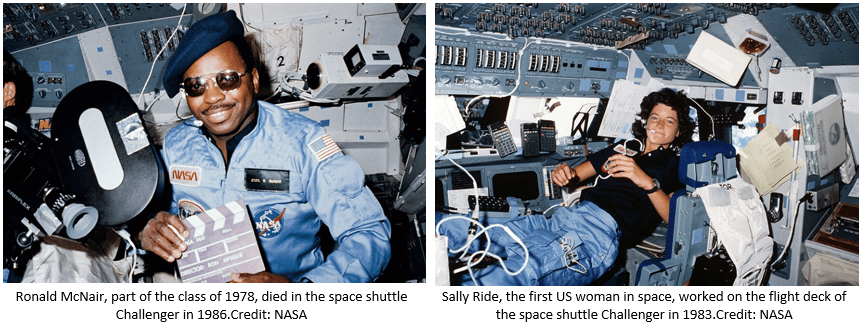
Growing up in racially segregated South Carolina in the 1950s, Ronald McNair saw door after door slammed in his face. The public pool was for white people only, so he could not learn to swim. When he was nine years old, a librarian called the police on him for trying to borrow calculus books.
McNair fought the racism and went on to study physics at the North Carolina Agricultural and Technical State University in Greensboro — a historically Black institution — and at the Massachusetts Institute of Technology in Cambridge. In 1978, NASA chose him as a finalist to be an astronaut, in the first group to contain women, people of color, and scientists. His pioneering class included Sally Ride, who would become the first US woman in space; Ellison Onizuka, the first Asian American in space; and Guion Bluford, the first African American in space.
With The New Guys, Meredith Bagby, a film producer and former journalist has produced a broad and easily readable narrative about this group of US astronauts. She does not break new ground in outlining their experiences and the team’s role in space history. But she does illuminate the historic nature of their selection — and, significantly, how they helped to shape NASA’s space shuttle program, from its first flight in 1981 until its end in 2011.
NASA’s first astronaut class, chosen in 1959, was the iconic Mercury Seven which included John Glenn, Alan Shepard, and Gus Grissom. The next six groups were similar: all white, male military pilots lionized for having “the right stuff.” Then came the class of 1978. Of the 35 new astronauts, 14 were civilians, 6 were women, and 4 were men of color.
It was a time of huge change for NASA. The Apollo Moon program had wound down, and NASA had set its sights on developing a reusable space plane that would launch like a rocket and land like an airplane. Astronauts on this vehicle would deploy military and scientific satellites into space. It was time for a new type of astronaut for a new type of spaceship.
Breaking through prejudice
Bagby views the shuttle era through the experiences of its astronauts, with a focus on women moving into new roles. They include Ride, a gay woman who remained in the closet while at NASA because the agency would not hire her otherwise; geologist Kathryn Sullivan; physicians Rhea Seddon and Anna Fisher; biochemist Shannon Lucid; and engineer Judith Resnik.
In the late 1970s, the view in much of NASA’s ranks was that the agency had lowered its standards to admit a more diverse class, and the class acquired the soubriquet “Those Fucking New Guys.” John Glenn and Chuck Yeager, the quintessential “right stuff” pilots, were among those who fought against hiring women as astronauts. Opposition from Yeager had probably helped to keep Ed Dwight, a Black test pilot, from joining a previous class.
Note: Younger me, off Dr. McNair’s left shoulder looking down at the floor. Someone dropped their keys, I reacted, and the faux pas is preserved for all Internet eternity.
Topics: Archaeology, Astronomy, Astrophysics, History
In 1900 diver Elias Stadiatis, clad in a copper and brass helmet and a heavy canvas suit, emerged from the sea shaking in fear and mumbling about a “heap of dead naked people.” He was among a group of Greek divers from the Eastern Mediterranean island of Symi who were searching for natural sponges. They had sheltered from a violent storm near the tiny island of Antikythera, between Crete and mainland Greece. When the storm subsided, they dived for sponges and chanced on a shipwreck full of Greek treasures—the most significant wreck from the ancient world to have been found up to that point. The “dead naked people” were marble sculptures scattered on the seafloor, along with many other artifacts. Soon after, their discovery prompted the first major underwater archaeological dig in history.
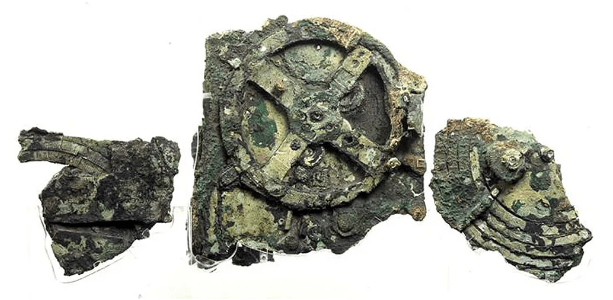
One object recovered from the site, a lump the size of a large dictionary, initially escaped notice amid more exciting finds. Months later, however, at the National Archaeological Museum in Athens, the lump broke apart, revealing bronze precision gearwheels the size of coins. According to historical knowledge at the time, gears like these should not have appeared in ancient Greece or anywhere else in the world until many centuries after the shipwreck. The finding generated huge controversy.
The lump is known as the Antikythera mechanism, an extraordinary object that has befuddled historians and scientists for more than 120 years. Over the decades, the original mass split into 82 fragments, leaving a fiendishly difficult jigsaw puzzle for researchers to put back together. The device appears to be a geared astronomical calculation machine of immense complexity. Today we have a reasonable grasp of some of its workings, but there are still unsolved mysteries. We know it is at least as old as the shipwreck it was found in, which has been dated to between 60 and 70 B.C.E., but other evidence suggests it may have been made around 200 B.C.E.
One of the central researchers in the early years of Antikythera research was German philologist Albert Rehm, the first person to understand the mechanism as a calculating machine. Between 1905 and 1906, he made crucial discoveries that he recorded in his unpublished research notes. He found, for instance, the number 19 inscribed on one of the surviving Antikythera fragments. This figure referenced the 19-year period relation of the moon known as the Metonic cycle, named after Greek astronomer Meton but discovered much earlier by the Babylonians. On the same fragment, Rehm found the numbers 76, a Greek refinement of the 19-year cycle, and 223, for the number of lunar months in a Babylonian eclipse-prediction cycle called the saros cycle. These repeating astronomical cycles were the driving force behind Babylonian predictive astronomy.
The second key figure in the history of Antikythera research was British physicist turned historian of science Derek J. de Solla Price. In 1974, after 20 years of research, he published an important paper, “Gears from the Greeks.” It referred to remarkable quotations by the Roman lawyer, orator, and politician Cicero (106–43 B.C.E.). One of these described a machine made by mathematician and inventor Archimedes (circa 287–212 B.C.E.) “on which were delineated the motions of the sun and moon and of those five stars which are called wanderers … (the five planets) … Archimedes … had thought out a way to represent accurately by a single device for turning the globe those various and divergent movements with their different rates of speed.” This machine sounds just like the Antikythera mechanism. The passage suggests that Archimedes, although he lived before we believe the device was built, might have founded the tradition that led to the Antikythera mechanism. It may well be that the Antikythera mechanism was based on a design by Archimedes.






 Physics and Nano