"The one exclusive sign of thorough knowledge is the power of teaching." Aristotle | Disclaimer: The views and opinions expressed on this Wordpress website are the views and opinions of the content creator, Dr. Reggie Goodwin, and should not be construed as shared, or sourced from The Environmental Protection Agency, or any organizations with which they have cooperative, or business relationships.
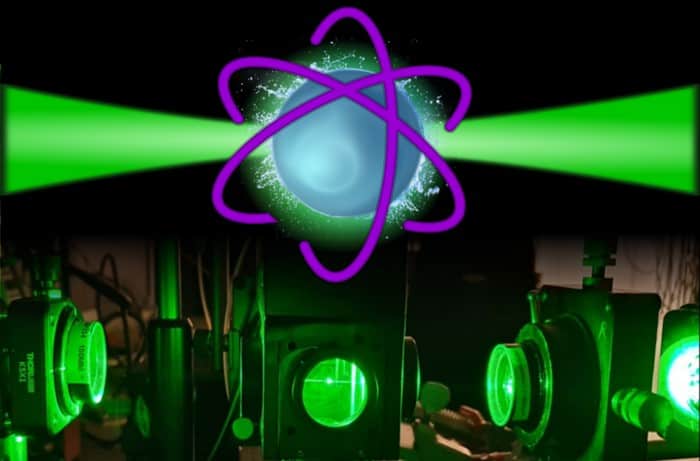
Atomic analog: when a beam of light is shone into a water droplet, the light is trapped inside. (Courtesy: Javier Tello Marmolejo)
Topics: Modern Physics, Optics, Quantum Mechanics, Quantum Optics, Research
Light waves confined in an evaporating water droplet provide a useful model of the quantum behavior of atoms, researchers in Sweden and Mexico have discovered. Through a simple experiment, a team led by Javier Marmolejo at the University of Gothenburg has shown how the resonance of light inside droplets of specific sizes can provide robust analogies to atomic energy levels and quantum tunneling.
When light is scattered by a liquid droplet many times larger than its wavelength, some of the light may reflect around the droplet’s internal edge. If the droplet’s circumference is a perfect multiple of the light’s wavelength inside the liquid, the resulting resonance will cause the droplet to flash brightly. This is an optical example of a whispering gallery mode, whereby sound can reflect around a circular room.
This effect was first described mathematically by the German physicist Gustav Mie in 1908 – yet despite the simplicity of the scenario, the rich array of overlapping resonances it produces can create some incredibly complex patterns, some of which have yet to be studied in detail.
Optical Tweezers
To explore the effect in more detail, Marmolejo and the team devised an experiment where they confined water droplets using optical tweezers. They evaporated the liquid by heating it with a fixed-frequency laser. As the droplets shrank, their circumferences will sometimes equal a multiple of the laser’s wavelength. At these “Mie resonances,” the droplets flashed brightly.
As they studied this effect, the researchers realized that the flashing droplets are analogous to the quantum behaviors of atoms. In these “optical atoms,” orbiting electrons are replaced with resonating photons. The electrostatic potential that binds electrons to the nucleus is replaced by the droplet’s refractive index, which tends to trap light in the droplet by internal reflection. The quantized energy levels of an atom are represented by the droplet sizes where Mie resonances occur.
Will a possible breakthrough for room-temperature superconducting materials hold up to scrutiny?
This week researchers claimed to have discovered a superconducting material that can shuttle electricity with no loss of energy under near-real-world conditions. But drama and controversy behind the scenes have many worried that the breakthrough may not hold up to scientific scrutiny.
“If you were to find a room-temperature, room-pressure superconductor, you’d have a completely new host of technologies that would occur—that we haven’t even begun to dream about,” says Eva Zurek, a computational chemist at the University at Buffalo, who was not involved in the new study. “This could be a real game changer if it turns out to be correct.”
Scientists have been studying superconductors for more than a century. By carrying electricity without shedding energy in the form of heat, these materials could make it possible to create incredibly efficient power lines and electronics that never overheat. Superconductors also repel magnetic fields. This property lets researchers levitate magnets over a superconducting material as a fun experiment—and it could also lead to more efficient high-speed maglev trains. Additionally, these materials could produce super strong magnets for use in wind turbines, portable magnetic resonance imaging machines, or even nuclear fusion power plants.
The only superconducting materials previously discovered require extreme conditions to function, which makes them impractical for many real-world applications. The first known superconductors had to be cooled with liquid helium to temperatures only a few degrees above absolute zero. In the 1980s, researchers found superconductivity in a category of materials called cuprates, which work at higher temperatures yet still require cooling with liquid nitrogen. Since 2015 scientists have measured room-temperature superconductive behavior in hydrogen-rich materials called hydrides. but they have to be pressed in a sophisticated viselike instrument called a diamond anvil cell until they reach a pressure of about a quarter to half of that found near the center of Earth.
The new material, called nitrogen-doped lutetium hydride, is a blend of hydrogen, the rare-earth metal lutetium, and nitrogen. Although this material also relies on a diamond anvil cell, the study found that it begins exhibiting superconductive behavior at a pressure of about 10,000 atmospheres—roughly 100 times lower than the pressures that other hydrides require. The new material is “much closer to ambient pressure than previous materials,” says David Ceperley, a condensed matter physicist at the University of Illinois at Urbana-Champaign, who was not involved in the new study. He also notes that the material remains stable when stored at a room pressure of one atmosphere. “Previous stuff was only stable at a million atmospheres, so you couldn’t really take it out of the diamond anvil” cell, he says. “The fact that it’s stable at one atmosphere of pressure also means that it’d be easier to manufacture.”
Topics: Diversity in Science, Education, Research, STEM, Theoretical Physics
The American Association for the Advancement of Science has announced the 2023 winners of eight longstanding awards that recognize scientists, engineers, innovators, and public servants for their contributions to science and society.
The awards honor individuals and teams for a range of achievements, from advancing science diplomacy and engaging the public in order to boost scientific understanding to mentoring the next generation of scientists and engineers.
The 2023 winners were first announced on social media between Feb. 23 and Feb. 28; see the hashtag #AAASAward to learn more. The winners were also recognized at the 2023 AAAS Annual Meeting, held in Washington, D.C., March 2-5. The winning individuals and teams were honored with tribute videos and received commemorative plaques during several plenary sessions.
Six of the awards include a prize of $5,000, while the AAAS David and Betty Hamburg Award for Science Diplomacy award the winning individual or team $10,000, and the AAAS Newcomb Cleveland Prize awards the winning individual or team $25,000.
Learn more about the awards’ history, criteria, and selection processes via the AAAS awards page, and read on to learn more about the individuals and teams who earned the 2023 awards.
*****
Sekazi Mtingwa is the recipient of the 2023 AAAS Philip Hauge Abelson Prize, which recognizes someone who has made significant contributions to the scientific community — whether through research, policy, or civil service — in the United States. The awardee can be a public servant, scientist, or individual in any field who has made sustained, exceptional contributions and other notable services to the scientific community. Mtingwa exemplifies a commitment to service and dedication to the scientific community, research workforce, and society. His contributions have shaped research, public policy, and the next generation of scientific leaders, according to the award’s selection committee.
As a theoretical physicist, Mtingwa pioneered work on intrabeam scattering that is foundational to particle accelerator research. Today a principal partner at Triangle Science, Education and Economic Development, where he consults on STEM education and economic development, Mtingwa has been affiliated during his scientific career with North Carolina A&T State University, Harvard University, the Massachusetts Institute of Technology, and several national laboratories.
His contributions to the scientific community have included a focus on diversity, equity, and inclusion in physics. He co-founded the National Society of Black Physicists, which today is a home for more than 500 Black physicists and students. His work has also contributed to rejuvenating university nuclear science and engineering programs and paving the way for the next generation of nuclear scientists and engineers. Mtingwa served as the chair of a 2008 American Physical Society study on the readiness of the U.S. nuclear workforce, the results of which played a key role in the U.S. Department of Energy allocating 20% of its nuclear fuel cycle R&D budget to university programs.
“I have devoted myself to being an apostle for science for those both at home and abroad who face limited research and training opportunities,” said Mtingwa. “Receiving the highly prestigious Philip Hauge Abelson Prize affirms that I have been successful in this mission. Moreover, it provides me with the armor to press onward to even greater contributions.”
Note: This is an advertisement on Nature Portfolio discussing that there may be a silver lining in the pandemic we’ve all experienced.
Lipid nanoparticles (LNPs) transport small molecules into the body. The most well-known LNP cargo is mRNA, the key constituent of some of the early vaccines against COVID-19. But that is just one application: LNPs can carry many different types of payload and have applications beyond vaccines.
Barbara Mui has been working on LNPs (and their predecessors, liposomes) since she was a Ph.D. student in Pieter Cullis’s group in the 1990s. “In those days, LNPs encapsulated anti-cancer drugs,” says Mui, who is currently a senior scientist at Acuitas. This company developed the LNPs used in the Pfizer-BioNTech mRNA vaccine against SARS-CoV-2. She says it soon became clear that LNPs worked even better as carriers of polynucleotides. “The first one that worked really well was encapsulating small RNAs,” Mui recalls.
But it was mRNA where LNPs proved most effective, primarily because LNPs are comprised of positively charged lipid nanoparticles that encapsulate negatively charged mRNA. Once in the body, LNPs enter cells via endocytosis into endosomes and are released into the cytoplasm. “Without the specially designed chemistry, the LNP and mRNA would be degraded in the endosome,” says Kathryn Whitehead, professor in the departments of chemical engineering and biomedical engineering at Carnegie Mellon University.
LNPs are an ideal delivery system for mRNA. “COVID accelerated the acceptance of LNPs, and people are more interested in them,” says Mui. LNP-mRNA vaccines for other infectious diseases, such as HIV or malaria, or for non-communicable diseases, such as cancer, could be next. And the potential doesn’t end with mRNA; there is even more scope to adapt LNPs to carry different types of cargo. But to realize these potential benefits, researchers first need to overcome challenges and decrease toxicity, increase their ability to escape from the endosomes, increase their thermostability, and work out how to effectively target LNPs to organs across the body.
Another potential application for LNPs is immunotherapy. Genetically modifying lymphocytes such as T cells or NK cells with chimeric antibody receptors (CARs) has proven useful in blood cancers. Often this process involves extracting lymphocytes from the blood of the person receiving the treatment, editing the cells in culture to express CARs, and then reintroducing them into the blood. However, LNPs could make it possible to express the desired CAR in vivo by shuttling CAR mRNA to the target lymphocytes. Mui has been involved in vivo studies showing this process works in mouse T cells (Rurik, J.G. et al. Science 375, 91-96, 2022). And Vita Golubovskaya, VP of research and development at ProMab Biotechnologies, presented preliminary data (available here) at the CAR-TCR Summit in September 2022 regarding LNPs that direct CAR-mRNA to NK cells, which can then kill target cells. “The RNA-LNP is a very exciting and novel technology that can be used for delivering CAR and bi-specific antibodies against cancer,” she says.
Judge Royce Lambert said Jacob Chansley’s role as a leader among those who went into the Senate chamber and disrupted the electoral vote tally compelled a serious prison sentence. | Photo by Win McNamee/Getty Images | Politico
Note: The title of this post is from the famous movie Apocalypse Now, which was popular during my senior year in high school.
Nathaniel P. Grimes is a Theologian, someone who “dedicates her or his life to the scholastic vocation of seeking after knowledge of God and the things of God.” In other words, graduate school. Dr. Grimes published a paper that I feel should have gotten much more traction and explains the abject lunacy on the right: “The Racial Ideology of Rapture.” In it, he posits that the viewpoint was not scriptural; it was political, as in an existential crisis for a South who had brainwashed themselves after losing the Civil War, or more aptly, mass cognitive dissonance before Leon Festinger.
Cognitive dissonance was first investigated by Leon Festinger, arising out of a participant observation study of a cult that believed that the earth was going to be destroyed by a flood, and what happened to its members — particularly the really committed ones who had given up their homes and jobs to work for the cult — when the flood did not happen.
While fringe members were more inclined to recognize that they had made fools of themselves and to “put it down to experience,” committed members were more likely to re-interpret the evidence to show that they were right all along (the earth was not destroyed because of the faithfulness of the cult members). Source: Simply Psychology
They lost the Civil War after Chief Justice Taney spouted the worst Supreme Court decision to Dred Scott that a black man “has no rights that a white man should respect.” The institution of slavery, whether they owned any or not, meant that due to a lack of Melanin, the so-called “white” peasantry was magically “superior” to enslaved Africans. They didn’t have to do anything to be superior. The society was exquisitely designed to reinforce the claptrap in the science of the day and from the pulpit that, upon further examination, was the framework for pseudoscience. As formerly enslaved Africans began running for office, gaining property, and establishing successful townships, [for] the psyche of the southern poor who risked life and limb to defend plantation oligarchs’ ownership of other humans was an existential crisis. If the “whites” were not “superior,” then what were they? The surviving confederate soldiers and their descendants got the battle ensign of Robert E. Lee (popularly, but inaccurately, the flag of the insurrectionist Confederacy) and shell shock.
The plantation oligarchs got reparations from the US government, the foundation for generational wealth passed down to their posterity. Equally, the descendants of potentates and peasants are hellbent on “conserving” the sadistic societal status quo.
Anglo-Futurism
John Nelson Darby was the “OG” of dispensationalism eschatology, or epochs in which humanity would be judged and punished, similar to the plagues of the Old Testament. John Scofield was a Confederate deserter (a broken clock can be right once or twice). After a conversion experience, he began writing dispensationalist literature, Rightly Dividing the Word of Truth, the foundation for the Dallas Seminary, and his Scofield’s Reference Bible, which many trained theologians used during their graduate studies. His 1917 reference Bible referenced Genesis 9 as a “prophetic declaration” that “Ham will descend an inferior and servile posterity,” probably the fanciest way I’ve seen someone use the n-word without using the n-word. Scofield’s reputation was built on an “anti-black, anti-Catholic, anti-Jewish theology.” Moody followed in his footsteps, as his vision of a “perfect, raptured Heaven” was of “the Scotsman, the Englishman, the Frenchman, the German, the Italian, the Russian”: all those who “hungered after righteousness.” It was White-topia before Levittown.
Rapture was the escape hatch from Reconstruction and the previously enslaved Africans, newly by the 14th Amendment African Americans, to gain genuine electoral power and some property. The paper mentioned a diagram of the Earth’s population in 1886 that I’ve seen in various forms. This was surrounding the International Prophetic Conference, showing the population of the world to premillennialists as “white squares” and “black squares,” the noir geometry representing “Jews, Catholics, Mohammedans, and Heathens.”
On page 219 of the paper: “in order to hasten Christ’s coming, **the conditions here on earth must decline dramatically.** So they chose to pull back from social reform not only because the conversion was deemed more important but because reform itself ‘delayed the Second Coming and deluded those who would be converted.”
“Conditions on earth must decline dramatically”:like climate change? Diversity, equity, and inclusions? Income inequality? Debt ceiling default? Social justice and police reform? Elections in a federal republic? Governing? Bodily autonomy for women, the transgender? What’s the reserve against prosecuting wars all over the globe? We relocated the US Embassy to Jerusalem in the last administration. The current administration hasn’t moved it back since there’s a sizeable percentage of the electorate that wants to hurry apocalypse like it’s a “GI Joe: Real American Hero” Saturday morning cartoon where we do battle with Cobra, lasers blasting, and no one really wounded or dying. If premillennialists apparently had the “mess up the room, so the parent shows up” theory of the Second Coming, their descendants still have it. There will definitely be a “new Heaven and a new Earth” as the first Heaven and first Earth (the current one) passes away (Revelation 21) after the throws of a nuclear exchange. Seas probably would dry up if they hadn’t overflowed from melted poles causing rising tides or becoming so irradiated for thousands of years. Your favorite salmon, lobster, or tilapia would, from then on, be aquatic SPAM.
This attitude fuels one political party currently in charge of the House of Representatives. The “weaponization of the government” hearings are going about, as well as Jim Jordan was in not protecting his athletes from sexual assault. Dr. Barbara Rossing, author of “The Rapture Exposed,” starts her first chapter with these words reminiscent of Smedley Butler: “The Rapture is a Racket.” Throughout the book, she shows that basing our Middle East strategy on “clean up on aisle 5” is part of why there hasn’t been a “two-state solution” in Israel/Palestine. “The conditions on earth must decline dramatically.”
People like Dr. Martin Luther King Jr used the Bible, the fact that pastors essentially had confidential meeting halls, to motivate a nonviolent movement to change the country for the better: “I want to go to Heaven, but I want some shoes down here!” He practiced “here-and-now” ministry and left it for history and the universe to judge him.
Or, we can have the eschatology of the insane. We can have faux theists that follow a cruel, psychopathic nincompoop that they’ve built a graven image while a disturbed man parades the Capitol in buffalo horns, war paint, and buckskin. Like QAnon, the eschatology of the insane “rationalizes the fantastical” and makes a few insurrectionists chairs of a “weaponization of government” committee, ignoring the last administration when the weaponization occurred.
The idea of white supremacy rests simply on the “fact” that white men are the creators of civilization (the present civilization, which is the only one that matters; all previous civilizations are simply “contributions” to our own) and are, therefore, civilization’s guardians and defenders. Thus, it was impossible for Americans to accept the black man as one of themselves, for to do so was to jeopardize their status as “white” men. But not so to accept him was to deny his human reality, his human weight and complexity, and the strain of denying the overwhelmingly undeniable forced Americans into rationalizations so fantastic that they approached the pathological. – James Baldwin, “Notes of a Native Son.”
Very soon in the founding of a new nation, however, White Christians began to establish their well-being by using the resources, bodies, and lives of others. Through their own “witchcraft,” European Christians employed a mysterious and threatening potency that was the practice of using the other for their own gain. In [James W.] Perkinson’s description, through the projects of modern Christian empire “a witchery” of heretofore unimaginable potency ravaged African and aboriginal cultures…For Perkinson, the witchcraft of White supremacy was conjured through racial discourse as an ideological and practical frame that he identifies as the ‘quintessential witchery of modernity.’… In Perkinson’s chilling words, “Whiteness, under the veneer of its ‘heavenly’ pallor, is a great grinding witch tooth, sucking blood and tearing flesh without apology.”
A laser fusion power plant proposed by Longview Fusion Energy Systems would generate 1000 MWh or more of electricity. The plant would compress fusion fuel by using an indirect drive, the same approach used at the National Ignition Facility, which in December announced that it had produced ignition and gain, the first time that fusion researchers have attained those milestones.
Topics: Futurism, Lasers, Modern Physics, Nuclear Fusion
The attainment of fusion ignition and energy gain on the world’s most energetic laser late last year was indisputably a major scientific accomplishment. But the road to fusion as a viable source of energy will be a long one, if not a dead end. And if it does ultimately become a reality, most experts say that it is unlikely that a laser-driven fusion power plant will be based on the approach taken by the National Ignition Facility (NIF), where the fusion milestone occurred.
The December shot, which produced 1.5 times the 2 MJ of energy that was fired on the fusion fuel, has silenced skeptics who said that ignition could never be created by bombarding tiny capsules of deuterium–tritium fuel with lasers. (See “National Ignition Facility surpasses long-awaited fusion milestone,” Physics Today online, 13 December 2022.) “They have done something very important: demonstrating ignition and burn,” says Stephen Bodner, a retired head of the laser fusion branch at the US Naval Research Laboratory who once was a persistent critic of NIF’s approach.
And the milestone is likely to open the floodgates to new investments in the handful of startups that are pursuing inertial fusion energy (IFE). “I think you will see a proliferation of companies devoted to IFE or aspects of IFE because of this and because of investor interest,” says Todd Ditmire, a University of Texas at Austin physicist who is chief technology officer of Focused Energy, an IFE startup.
Yet despite the fanfare greeting the announcement, the fact is that the fusion energy yield from the successful shot amounted to less than 1% of the 300 MJ taken from the electricity grid to power NIF’s 192 beams. And the energy released was enough to boil about 10 tea kettles. Many experts say that economically viable fusion will require fusion reactions yielding energy gains of at least 100 times the energy deposited on the fuel capsule—two orders of magnitude greater than the NIF shot.
Working four days instead of five—with the same pay—leads to improved well-being among employees without damaging the company’s productivity. That’s the recently reported result of a four-day workweek test that ran for six months, from June to December 2022 and involved a total of 61 U.K. companies with a combined workforce of about 2,900 employees.
During the COVID pandemic, many workers experienced increased stress and even burnout, a state of exhaustion that can make it difficult to meet work goals. “It’s a very huge issue,” says independent organizational psychologist and consultant Michael Leiter, who was not involved in the new report. “You see it, particularly in health care, where I do much of my work. It’s making it much more difficult to hold on to talented people.” He explains that stress in the workplace makes it difficult for companies in health care and many other fields to recruit new hires and keep existing employees. But greater awareness of burnout and related issues can have a positive effect, Leiter adds. “People are demanding more changes in how the work is organized,” he says.
That demand is what led the independent research organization Autonomy, in conjunction with the advocacy groups 4 Day Week Global and 4 Day Week Campaign and researchers at the University of Cambridge, Boston College, and other institutions, to publish a report on what happens when companies reduce the number of days in a workweek. According to surveys of participants, 71 percent of respondents reported lower levels of burnout, and 39 percent reported being less stressed than when they began the test. Companies experienced 65 percent fewer sick and personal days. And the number of resignations dropped by more than half compared with an earlier six-month period. Despite employees logging fewer work hours, companies’ revenues barely changed during the test period. In fact, they actually increased slightly, by 1.4 percent on average.
WASHINGTON — The Biden-Harris administration, through the U.S. Department of Commerce’s National Institute of Standards and Technology, today launched the first CHIPS for America funding opportunity for manufacturing incentives to restore U.S. leadership in semiconductor manufacturing, support good-paying jobs across the semiconductor supply chain, and advance U.S. economic and national security.
As part of the bipartisan CHIPS and Science Act, the Department of Commerce is overseeing $50 billion to revitalize the U.S. semiconductor industry, including $39 billion in semiconductor incentives. The first funding opportunity seeks applications for projects to construct, expand or modernize commercial facilities for the production of leading-edge, current-generation, and mature-node semiconductors. This includes both front-end wafer fabrication and back-end packaging. The department will also be releasing a funding opportunity for semiconductor materials and equipment facilities in the late spring and one for research and development facilities in the fall.
“The CHIPS and Science Act presents a historic opportunity to unleash the next generation of American innovation, protect our national security and preserve our global economic competitiveness,” said Secretary of Commerce Gina M. Raimondo. “When we have finished implementing CHIPS for America, we will be the premier destination in the world where new leading-edge chip architectures can be invented in our research labs, designed for every end-use application, manufactured at scale, and packaged with the most advanced technologies. Throughout our work, we are committed to protecting taxpayer dollars, strengthening America’s workforce, and giving America’s businesses a platform to do what they do best: innovate, scale, and compete.”
The CHIPS and Science Act is part of President Joe Biden’s economic plan to invest in America, stimulating private sector investment, creating good-paying jobs, making more in the United States, and revitalizing communities left behind.
CHIPS for America also today released a “Vision for Success,” laying out strategic objectives building on the vision Secretary Raimondo shared in her speech last week at Georgetown University’s School of Foreign Service. To advance U.S. economic and national security, the department aims to reach the following goals by the end of the decade: (1) make the U.S. home to at least two new large-scale clusters of leading-edge logic chip fabs, (2) make the U.S. home to multiple high-volume advanced packaging facilities, (3) produce high-volume leading-edge memory chips, and (4) increase production capacity for current-generation and mature-node chips, especially for critical domestic industries. Read more about these goals in the Vision for Success paper here.
How it works: illustration of the quantum twisting microscope in action. Electrons tunnel from the probe (inverted pyramid at the top) to the sample (bottom) in several places at once (green vertical lines) in a quantum-coherent manner. (Courtesy: Weizmann Institute of Science)
When the scanning tunneling microscope debuted in the 1980s, the result was an explosion in nanotechnology and quantum-device research. Since then, other types of scanning probe microscopes have been developed, and together they have helped researchers flesh out theories of electron transport. But these techniques probe electrons at a single point, thereby observing them as particles and only seeing their wave nature indirectly. Now, researchers at the Weizmann Institute of Science in Israel have built a new scanning probe – the quantum twisting microscope – that detects the quantum wave characteristics of electrons directly.
“It’s effectively a scanning probe tip with an interferometer at its apex,” says Shahal Ilani, the team leader. The researchers overlay a scanning probe tip with ultrathin graphite, hexagonal boron nitride, and a van der Waals crystal such as graphene, which conveniently flopped over the tip like a tent with a flat top about 200 nm across. The flat end is key to the device’s interferometer function. Instead of an electron tunneling between one point in the sample and the tip, the electron wave function can tunnel across multiple points simultaneously.
“Quite surprisingly, we found that the flat end naturally pivots so that it is always parallel with the sample,” says John Birkbeck, the corresponding author of a paper describing this work. This is fortunate because any tilt would alter the tunneling distance and hence strength from one side of the plateau to the other. “It is the interference of these tunneling paths, as identified in the measured current, that gives the device its unique quantum-wave probing function,” says Birkbeck.
Topics: Civics, Civil Rights, Democracy, Existentialism, Fascism, Human Rights
Dildo (noun): an object shaped like and used in place of a penis for giving sexual pleasure; (mainly US offensive): a stupid person, especially a man. Cambridge Dictionary
Note: In light of recent events, and the pregnant homophone, it was too good to pass up.
As an engineer in Austin, Texas, working at Motorola, I emailed Mr. Adams (we both used what is now the ancient Internet service provider, AOL) a story idea about being volunteered for a project in an engineering group that I didn’t work in to change a process that I wasn’t responsible for. Then, in another meeting, I was taken off the project AFTER I had researched the business unit – Diffusion – and made the process changes. Scott turned it into a strip overnight, replying, “GREAT story idea!” At least, that’s how I took it.
The strip above showed up the NEXT day (Saturday). Maybe I read too much into the coincidence, but I made it for a time, my screen saver, just to needle the management types. None of them suspected they or their absurdity was the subject of the strip.
“Dilbert” was brilliant in that it sourced many of its stories from “the field.” Engineers working in semiconductors, STEM types working for engineering firms. Government engineers could also relate to the archetype “pointy-haired manager” (a personification of the devil), and every bad technical manager that went to “bad manager school,” most of them either hadn’t done engineering in years or weren’t ever engineers at all. Catbert, the evil HR director, was self-explanatory. I have no idea what “Ratbert” was supposed to represent. Until his racist YouTube rant, I did proudly cart around a stuffed Dogbert in my home or work office prior to the familiar orange “bigly” pompadour on his latest work that leaves no doubt about his politics. As a US veteran, I took an Oath to “protect and defend The Constitution against all enemies foreign and domestic.” I don’t share his viewpoint on a glorious time of “great again” or insurrection. I was by no means unique or solitary to have sent Mr. Adams a story idea and him choosing to use it or ignore it. At one point, he showed a Pareto chart of each engineering segment he got story ideas from (semiconductors were far to the left on the abscissa). He seemed beyond culture, class, and classification. He got us, the nerds in hamster cubicles who made the modern age possible.
I now choose Scott Adams to ignore you.
The once widely celebrated Adams, who has been entertaining extreme-right ideologies and conspiracy theories for several years, was upset Wednesday by a Rasmussen poll that found a thin majority of Black Americans agreed with the statement “It’s okay to be White” — a phrase sometimes associated with racist memes.
“If nearly half of all Blacks are not okay with White people … that’s a hate group,” Adams said on his live-streaming YouTube show. “I don’t want to have anything to do with them. And I would say, based on the current way things are going, the best advice I would give to White people is to get the hell away from Black people … because there is no fixing this.”
Adams, 65, also blamed Black people for not “focusing on education” during the show and said, “I’m also really sick of seeing video after video of Black Americans beating up non-Black citizens.”
It took me a while, but I finally stuck it out enough in graduate school to get a Ph.D. in Nanoengineering. Oh, and by the way, my physical features, you would identify as black.
I’m saying my “physical features” because, until 1681, there was no such thing as “white” people. That was created by the United States and propagated throughout the world. The first 1790 Census was explicit in its hatred of anything other than “white.” I put the name in quotes because, due to the need to maintain numerical dominance, “white” has been a fungible word. Czechs, Italians, Irish, Jews, and Russians were once not considered “pure” enough to be “white.” Humans are adaptive to the environments they inhabit.
Thus, Mr. Adams, you are exactly what anyone would expect an African to look like after approximately 40,000 years of not getting direct equatorial sunlight near the equator and closer to the north pole. Your ancestors in Europe would have no need for the protection of Melanin. Their hair would thin and mat to trap heat. Their noses would narrow due to the cold. I would expect humans on a Martian colony not to look as good as the actors on Star Trek: lower gravity, further from the sun, and higher radiation; the humans would not only look different, they would find the gravity well on earth crushing. Race is a social construct. If you read beyond what appears to have been conspiratorial sites, you would know that. The engineer you once were, the satirist of corporate silliness you became while simultaneously holding your engineering job, has gone the way of the dinosaurs and the Dodo.
I am not, nor have I ever been, part of a hate group. I have never called for segregation, as humans cannot “segregate” unless we’re going to different sectors of the universe. They can create enclaves with restrictive covenants – but we breathe the same air and consume the same products on the same planet. A formula that you, Elon Musk, and Ron DeSantis should imbibe: Racism = Prejudice + Political Power. I derived the formula from an interview with the comedian Paul Mooney. Black people can be prejudiced. They have never however, wielded power large enough or long enough to create laws to affect any other group, as yours has mine for centuries of this nation’s history, a history you probably don’t want to be reviewed or taught. Besides, I think you’d be terrible at picking tobacco or cotton.
Whatever demons you’ve been channeling since the Covid crisis that you deny, I hope one day, you excise them and join the rest of humanity in the light of diversity.
Along with Dogbert, the book products I purchased as a fan went out yesterday with Thursday’s garbage collection.
I guess now that a once brilliant cartoonist is insane.
“Scott Adams is a disgrace,” Darrin Bell, creator of “Candorville” and the first Black artist to win the Pulitzer Prize for editorial cartooning, told The Post on Saturday. “His racism is not even unique among cartoonists.” Bell compared Adams’s views to the Jim Crow era and more recent examples of White supremacy, including “millions of angry people trying to redefine the word ‘racism’ itself.”








 Physics and Nano