"The one exclusive sign of thorough knowledge is the power of teaching." Aristotle | Disclaimer: The views and opinions expressed on this Wordpress website are the views and opinions of the content creator, Dr. Reggie Goodwin, and should not be construed as shared, or sourced from The Environmental Protection Agency, or any organizations with which they have cooperative, or business relationships.
Researchers report plasmons in boron-doped diamond; quantum applications Diamond, often celebrated for its unmatched hardness and transparency, has emerged as an exceptional material for high-power electronics and next-generation quantum optics. Diamond can be engineered to be as electrically conductive as a metal, by introducing impurities like the element boron.
Researchers from Case Western Reserve University and the University of Illinois Urbana-Champaign have discovered another interesting property in diamonds with added boron, known as boron-doped diamonds. Their findings could pave the way for new types of biomedical and quantum optical devices—faster, more efficient, and capable of processing information in ways that classical technologies cannot. Their results are published recently in Nature Communications.
Potential advancements in quantum devices, biosensors, solar cells The researchers found that boron-doped diamonds exhibit plasmons—waves of electrons that move when light hits them—allowing electric fields to be controlled and enhanced on a nanometer scale. This is important for advanced biosensors, nanoscale optical devices, and for improving solar cells and quantum devices. Previously, boron-doped diamonds were known to conduct electricity and become superconductors, but not to have plasmonic properties. Unlike metals or even other doped semiconductors, boron-doped diamonds remain optically clear.
Oligarchy (noun): government by the few; a government in which a small group exercises control especially for corrupt and selfish purposes, Merriam-Webster
In Dwight D. Eisenhower’s Farewell Address, he warned of the military-industrial complex.
“In the councils of government, we must guard against the acquisition of unwarranted influence, whether sought or unsought, by the military-industrial complex. The potential for the disastrous rise of misplaced power exists and will persist.” National Archives
In Joseph R. Biden’s Farewell Address, he warned of oligarchy, run by the tech-industrial complex, which ironically spells the acronym: “T.I.C.”
“Today, an oligarchy is taking shape in America of extreme wealth, power, and influence that really threatens our entire democracy, our basic rights and freedom, and a fair shot for everyone to get ahead.” Reuters
Tick (noun): any of a superfamily (Ixodoidea) of bloodsucking acarid arachnids that are larger than the related mites, attach themselves to warm-blooded vertebrates to feed and include important vectors of infectious diseases. Seems appropriate.
Why do Republicans believe so much stuff that is simply not true? What is their problem with reality?
Stay with me on this for a second….
In 1976 Republicans lost a Presidential election with an incumbent candidate to an unknown peanut farmer. This rocked them to the core.
After the election, they used a new methodology (focus group studies) to try to figure out how to win elections in the future. Their efforts identified one narrow path to victory for Republicans in national elections. They had to divide the country along the lines of religion and race to win. Ronald Reagan used this to great effect in 1980. In making this change Republicans switched their base from fiscal conservatives to religious conservatives. This fundamentally changed the nature of the Republican Party.
Previously Republicans were a pragmatic group of people looking for workable solutions to the problems of the country. Here is what Barry Goldwater had to say about this change.
“Mark my word, if and when these preachers get control of the [Republican] party, and they’re sure trying to do so, it’s going to be a terrible damn problem. Frankly, these people frighten me. Politics and governing demand compromise. But these Christians believe they are acting in the name of God, so they can’t and won’t compromise. I know, I’ve tried to deal with them.”
This switch turned the Republican Party from a group of political pragmatists to a faith community. In short, the most important issues to Republicans were group loyalty and shared belief.
The problem you have when a group is centered on its beliefs as opposed to its goals is that if any of the beliefs do not line up with the facts, it is going to be very hard to change them. This goes double if these beliefs are wrapped up in their religion such that they believe that they came from God.
The solution for Republicans was “alternative facts.” Their beliefs were the most important thing to them, but the facts were less so. They were much more willing to create facts that aligned with their beliefs and then believe those facts than change their beliefs.
This is cowardice and if it continues will create even worse disasters for the U.S. Policy has to align with the facts. Beliefs are not terribly important in politics. The facts and policies that align with those facts need to be the focus.
I haven’t watched the confirmation hearings, though I’ve been asked if I did. I have seen excerpts posted on YouTube that have been decidedly nauseous. Despite that most of the candidates’ slim “qualifications” should bar them from selection, they have the votes in the Senate on party lines alone, especially if they throw out the filibuster for the minority party and 60-vote threshold as I expect them to do.
This kabuki theater isn’t supposed to put forward the best and brightest minds, or anyone qualified for the positions. Sycophancy is the “secret sauce” of political expediency. “Deconstructing the administrative state” (Bannon, the Leninist) means defying the norms that have held the republic together since its inception, but like any physical momentum, it eventually meets the Entropy of friction over time and distance. Their despise of the “deep state” means what they want is a shallow alternative, where expertise can be ignored for the almighty, all-powerful “gut,” “hunch,” or claims of communication with spirits through dreams. Preparation can be substituted for crowdsourcing “concepts of plans,” otherwise known as conspiracy theories. Quantum mechanics can be mastered in a few clicks: Who needs a degree in Physics? Who needs those stinking, liberal-biased facts?
Where does this lead us?
Kakistocracy (noun): government by the worst people.
Kleptocracy (noun): government by those who seek chiefly status and personal gain at the expense of the governed.
Idiocracy (noun): 1. a society governed or populated by idiots 2. government by idiots.
Our nation is turning into an idiocracy.—Neil deGrasse Tyson
As we lurch toward idiocracy—the real thing, not the movie—we must change course.—John Kass – definitions and quotes from Merriam-Webster.
We hold these truths to be self-evident, that all men are created equal, that they are endowed by their Creator with certain unalienable Rights, that among these are Life, Liberty and the pursuit of Happiness.
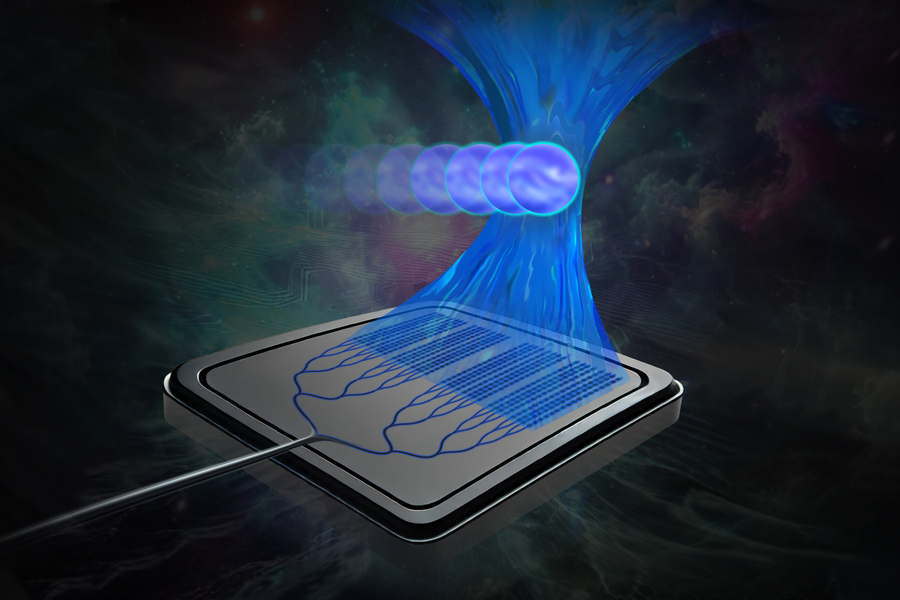
This chip-based “tractor-beam,” which uses an intensely focused beam of light to capture and manipulate biological particles without damaging the cells, could help biologists study the mechanisms of diseases. Credits: Credit: Sampson Wilcox, RLE
Topics: Biology, Biotechnology, Optical Tweezers, Research
MIT researchers have developed a miniature, chip-based “tractor beam,” like the one that captures the Millennium Falcon in the film “Star Wars,” that could someday help biologists and clinicians study DNA, classify cells, and investigate the mechanisms of disease.
Small enough to fit in the palm of your hand, the device uses a beam of light emitted by a silicon-photonics chip to manipulate particles millimeters away from the chip surface. The light can penetrate the glass coverslips that protect samples used in biological experiments, enabling cells to remain in a sterile environment.
Traditional optical tweezers, which trap and manipulate particles using light, usually require bulky microscope setups, but chip-based optical tweezers could offer a more compact, mass manufacturable, broadly accessible, and high-throughput solution for optical manipulation in biological experiments.
However, other similar integrated optical tweezers can only capture and manipulate cells very close to or directly on the chip surface. This contaminates the chip and can stress the cells, limiting compatibility with standard biological experiments.
Using an integrated optical phased array, MIT researchers have developed a new modality for integrated optical tweezers that enables trapping and tweezing of cells more than a hundred times further away from the chip surface.
A new transistor made from semiconducting vertical nanowires of gallium antimonide (GaSb) and indium arsenide (InAs) could rival today’s best silicon-based devices. The new transistors are switched on and off by electrons tunnelling through an energy barrier, making them highly energy-efficient. According to their developers at the Massachusetts Institute of Technology (MIT) in the US, they could be ideal for low-energy applications such as the Internet of Things (IoT).
Electronic transistors use an applied voltage to regulate the flow of electricity – that is, electrons – within a semiconductor chip. When this voltage is applied to a conventional silicon transistor, electrons climb over an energy barrier from one side of the device to the other, and it switches from an “off” state to an “on” one. This type of switching is the basis of modern information technology, but there is a fundamental physical limit on the threshold voltage required to get the electrons moving. This limit, which is sometimes termed the “Boltzmann tyranny” because it stems from the Boltzmann-like energy distribution of electrons in a semiconductor, puts a cap on the energy efficiency of this type of transistor.
Highly precise process
In the new work, MIT researchers led by electrical engineer Jesús A del Alamo made their transistor using a top-down fabrication technique they developed. This extremely precise process uses high-quality, epitaxially-grown structures and both dry and wet etching to fabricate nanowires just 6 nm in diameter. The researchers then placed a gate stack composed of a very thin gate dielectric and a metal gate on the sidewalls of the nanowires. Finally, they added point contacts to the source, gate and drain of the transistors using multiple planarization and etch-back steps.
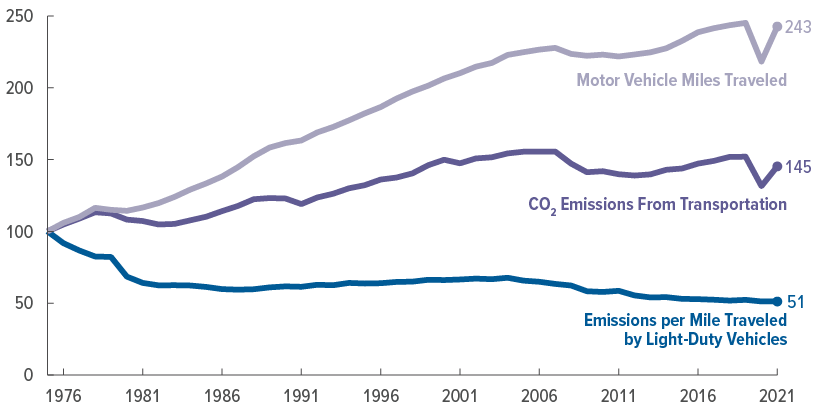
Emissions of Carbon Dioxide in the Transportation Sector, Motor Vehicle Miles Traveled, and Emissions per Mile Traveled by Light-Duty Vehicles Measured as a Percentage of Their Value in 1975 – Transportation sector emissions have not risen nearly as much as vehicle miles traveled because gains in fuel economy have reduced emissions per mile of travel.
Topics: Chemistry, Climate Change, Environment, Existentialism, Global Warming
Comment: Americans go above and beyond anything suggested, even if the goal is to improve things. Americans in particular, and humans in general like “quick fixes” that don’t disrupt their lives and approximate what they’re used to doing already. Lithium is an energetic element, number 3 on the Periodic Table, following Hydrogen and Helium. Its properties as an anode are why we use the element in battery technology. It’s now “trendy” to own an Electric Vehicle, when during the pandemic (see the dip above in Fig. 10 from the CBO report), the simplest solution – at least short term – would be to drive less. This might entail telework agreements to come into the office on set days in a pay period. It could also mean an infrastructure centered around public transportation, Maglev trains such as in China, Japan, and Korea. A longer-term solution would be a total revision of what we regard as capital, earnings, and quarterly profits, which seem shortsighted and not strategically positioned for the global environment or species survival.
Lithium is an essential component of clean energy technologies, from electric vehicles (EVs) to the big batteries used to store electricity at power plants. It is an abundant mineral, but to be used it must be extracted from the earth and processed.
Today, there are two main ways to pull lithium from the ground. Until recently, most lithium mining occurred in Chile, where lithium is extracted from brines: salty liquid found at the Earth’s surface or underground. To extract lithium, that liquid is pumped from the earth and then placed in pools where the water can evaporate, leaving behind lithium and other elements.
Elsewhere, lithium mining looks more traditional. In 2017, Australia overtook Chile as the dominant lithium producer. Companies there blast a lithium-rich mineral called spodumene out of open pits. Today, Australia produces roughly half of the globe’s supplies.1 More than 80 percent of that rock then travels to China, where it’s further processed to yield lithium.2
Though Australia and Chile dominate production, the rise of clean energy has spurred a growing hunger for lithium, so other mining operations have cropped up in numerous other places. Global lithium production has grown from about 37,000 tons a decade ago to 130,000 tons in 2022.1,3
“We’ve just seen an explosion of proposed projects in the planning, piloting, demonstration stage across a much wider array of countries,” says Caroline White-Nockleby, a PhD candidate who studies renewable energy transitions in MIT’s doctoral program in History and anthropology; and Science, Technology, and Society.
It’s perhaps historically appropriate that the word “ironic” contains “iron.” Mining and smelting minerals like iron represented technological highs at the Roman Empire’s peak. But those activities also produced enough lead pollution to impair its citizens’ IQs, according to a new study in PNAS.
“Detailed ice core records of Arctic lead pollution, together with sophisticated atmospheric modeling and modern epidemiology, indicate that human industrial activities were measurably damaging human health more than 2,000 years ago,” says Joe McConnell, a scientist at the Desert Research Institute and lead author of the study.
Scholars have debated lead poisoning’s impact on Roman history for decades. Some have even argued that lead poisoning played a role in the downfall of the Roman empire. Most of those arguments have focused on ancient writings and archeology that provide hints about lead’s impact — circumstantial evidence, if you will.
Now a team of researchers has provided hard evidence linking pollution and ancient intellect. They identified the level of pollutants in three ice cores that dated between 500 B.C.E. through 600 C.E. — the era spanning the rise of the Roman Republic through the fall of the Roman Empire. Then they compared those levels with how lead pollution affected the general public during its peak in the 1970s, before it was banned from gasoline.
According to the study, the lead in the air in Roman times affected IQs by about a third as much as in the late 1970s, when the U.S. Clean Air Act went into effect, and about twice as much as in the early 2010s.
“Elites and non-elites in cities and rural areas alike were affected by the background air pollution — no one could escape the health effects,” says McConnell.
Ref: https://litkicks.com/ingatsbystracks/, In Gatsby’s Tracks: Locating the Valley of Ashes in a 1924 Photo. The ash heap was a metaphor for the rot and decay of modern life as the author depicted it in the novel:
The spot where Fitzgerald had a vision would soon become world famous because the trash-burning operation at Flushing Meadows was closed shortly after The Great Gatsby was written. The creeks were drained and turned into artificial lakes, and the Long Island Expressway, Van Wyck Expressway, and Grand Central Parkway were all built to carry the massive automobile traffic between New York City and Long Island that they still carry today. Beautiful Flushing Meadows Park was developed on the large square of land circumscribed by these three highways, encompassing the creek and its valley. This park hosted the 1939 Worlds Fair and then the 1964-65 Worlds Fair. Shea Stadium was built to host the New York Mets on the northern side and was then replaced by CitiField on the same spot. Every year the US Open Tennis Tournament is held at the Billie Jean King Tennis Center south of the baseball fields. Here’s what the same spot looks like in an aerial photograph from 2009. Shea Stadium is on the top left, and the US Open tennis courts are on the bottom left.
The hashtag #FAFO is apropos here. Noam Chomsky’s book is a pamphlet. It is short and meant to be absorbed in one sitting. In 1991, Chomsky was 65. He’s knocking on the door of his 99th birthday, and we buried President Carter yesterday who was 100. My fear: will anyone ever read anything brief, in paperback, and offline before Chomsky expires?
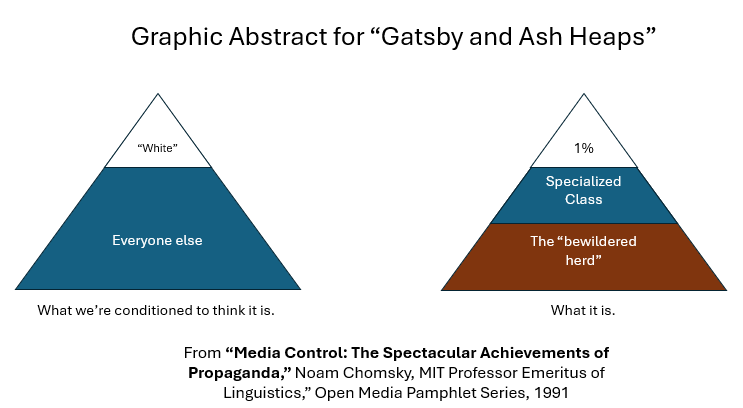
Chomsky begins by asserting two models of democracy—one in which the public actively participates, and one in which the public is manipulated and controlled. According to Chomsky “propaganda is to democracy what the bludgeon is to a totalitarian state,” and the mass media is the primary vehicle for delivering propaganda in the United States. From an examination of how Woodrow Wilson’s Creel Commission “succeeded, within six months, in turning a pacifist population into a hysterical, war-mongering population,” to Bush Sr.’s war on Iraq, Chomsky examines how the mass media and public relations industries have been used as propaganda to generate public support for going to war. Chomsky touches on how the modern public relations industry has been influenced by Walter Lippmann’s theory of “spectator democracy,” in which the public is seen as a “bewildered herd” that needs to be directed, not empowered; and how the public relations industry in the United States focuses on “controlling the public mind,” and not on informing it.
What Orwell feared were those who would ban books. What Huxley feared was that there would be no reason to ban a book, for there would be no one who wanted to read one.Orwell feared those who would deprive us of information. Huxley feared those who would give us so much that we would be reduced to passivity and egoism. Orwell feared that the truth would be concealed from us. Huxley feared the truth would be drowned in a sea of irrelevance.Orwell feared we would become a captive culture. Huxley feared we would become a trivial culture, preoccupied with some equivalent of the feelies, the orgy porgy, and the centrifugal bumblepuppy.
Morpheus: This is your last chance. After this, there is no turning back. You take the blue pill – the story ends, and you wake up in your bed and believe whatever you want to believe. You take the red pill – you stay in Wonderland and I show you how deep the rabbit hole goes.The Matrix
I worked alongside H-1B visa recipients with no stigma whatsoever. They worked alongside me, a graduate of the largest HBCU in the nation, and the largest supplier of graduate engineers and scientists in the STEM pipeline. I spoke at conferences. I published proceedings. I never once felt inferior, nor did I feel that Motorola, Advanced Micro Devices, or Applied Materials did me a “favor.” It’s ludicrous. It’s self-defeating and stupid. Instead of a faux halcyon “great again,” it’s the blueprint for the reinstitution of serfdom.
The giveaway was Elon and Vivek disparaging “American” workers, which means all of us, and all ages. This is what I expect in their ketamine-fueled thought process that will lead us to perdition:
1. “Break” the economy (Elon’s words) – sending the U.S. into a recession.
2. Layoffs, particularly of African American, Hispanic/Latino, Asian-Pacific Islander, and white American talent.
3. Wait a few months and lower salary price points.
4. Hire H-1Bs at LOWER than even that lowered rate. Companies don’t have to and usually don’t, but they have that option and have always had it. What about all of that African American, Hispanic/Latino, Asian-Pacific Islander, and white American talent? They can apply for “black jobs,” plentiful after the forcible expulsion of undocumented immigrant labor from home and commercial builder sites, fields, and meat processing plants. Someone’s got to do it. Don’t worry. They won’t go anywhere. They’ll be working alongside you as leased labor from for-profit prisons. It will keep salaries down. The “minimum wage” will become an urban myth. “Social security” was always a communist plot.
5. All leverage will be with the employer. Don’t like your job? Quitting will get your H-1B revoked and you’ll be sent back to your country. Fired at will? Break the law? See the first and third sentences of item 5.
6. (Added) Look for stiff competition on “Who will be the world’s first trillionaire?”
A reporter once asked John D. Rockefeller, the founder of the Standard Oil Company, the first billionaire of the United States of America, and once the richest man on Earth, “How much money is enough?” He calmly replied, “Just a little bit more.”CNBCTV
Where does it leave American workers? Well, the pesky, “woke” DEI thing is history. Industries have abandoned it for the simple reason that it’s no longer profitable. It’s ridiculous to think that corporations will “do the right thing.” They only think in quarters and the bank accounts of shareholders, life on Earth be damned. Unions will be in the vein of Tyrannosaurus and the Dodo. Income inequality will be SOLVED because rural and urban workers will be in a goulash of poverty. Training to be in the “specialized class” will become irrelevant. Social mobility will be eliminated by the financial canyon erected between the have-nots by the Hoarding Disorder kleptocratic haves! We’re at the same income inequality that preceded the French Revolution. Brian Thomson and Luigi Mangione might be the harbinger of things to come.
I call it “tech bro servitude,” or “lords, and serfs.” If you’re not a billionaire, you’re probably a serf. Again, I fear the result of the blowback. Unfortunately, imposed totalitarian regimes don’t crumble without a lot of bloodshed and violence.
“The most dangerous creation of any society is a man who feels he has nothing to lose.”
“People have changed the climate of the world. Now they’re waiting for the old days to come back.”—Lauren Olamina, “Parable of the Sower” by Octavia E. Butler
I called my cousin, our family historian last night, to check on her. She calmly told me she lived about 15 miles from the Palisades, where the fires are fueled by a dry winter and climate change. I was checking to see if she received my payments for our family reunion planned for Los Angeles this summer and my concern for her safety. I signed us up for the tour of Hollywood, thinking that fate and the summer would be “normal” in this environment of climate crisis and science denial. She assured me that she had packed her “Mo-bag” and if the authorities told her to go, she’d go. This post hits home more than any other I’ve produced. We said “I love you” before we hung up. I’ll keep checking on her.
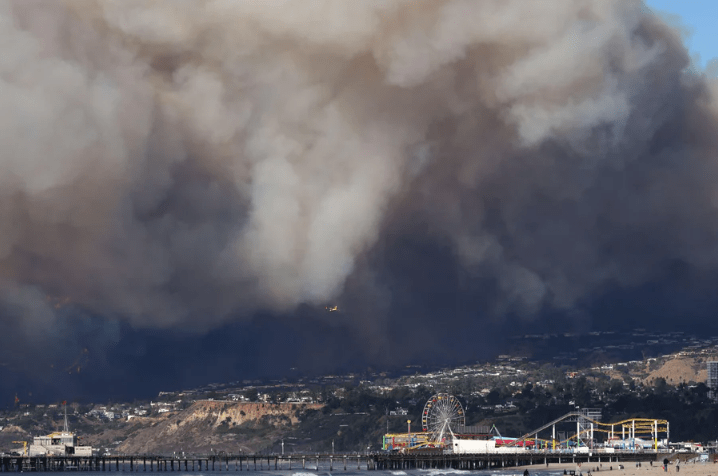
The nature of the Santa Ana winds makes them perfectly suited to fueling blazes like the Palisades Fire, and climate change is increasing the risk.
Editor’s Note (1/8/25): This story is being updated as the situation unfolds.
Another explosive wildfire in California, driven by the region’s notorious Santa Ana winds, has burned hundreds of buildings and has forced thousands to evacuate from their homes. The Palisades Fire began at 10:30 A.M. local time on Tuesday near Los Angeles’s Pacific Palisades neighborhood. Much of the neighborhood is under evacuation orders, which extended to northern Santa Monica. As of Wednesday afternoon, the fire had scorched more than 15,000 acres and destroyed more than 1,000 structures.
Another blaze, the Eaton Fire, erupted on Tuesday evening in Altadena, Calif., just north of Los Angeles. As of late Wednesday, it had burned more than 10,000 acres and resulted in at least five deaths. Both fires had caused numerous injuries, according to officials.
On Wednesday evening, another fire began in the heart of Los Angeles just north of Hollywood. The fire grew rapidly to cover at least 20 acres as it spread downhill in Runyon Canyon. Though winds were not as high as Tuesday night, they were still pushing the fire and carrying embers that started spot fires.
Forecasters had warned that the risk of fire was extremely high this week, reaching “particularly dangerous situation” status as the ferocious winds combined with tinder-dry vegetation after a lack of rain during the beginning of what would usually be the wet season.
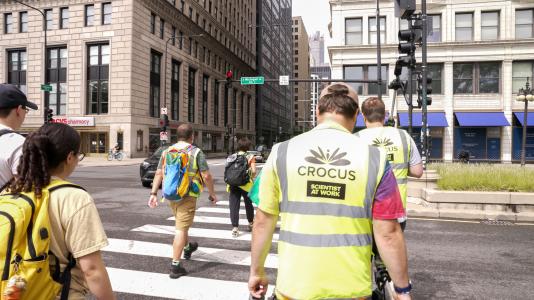
CROCUS researchers crossed Chicago’s Michigan Avenue as they collected data on how buildings, streets, and greenspaces impact temperature and air quality. (Image by Argonne National Laboratory.)
Topics: Civilization, Climate Change, Environment, Global Warming, Thermodynamics
CROCUS’s Urban Canyon campaign captured data on heat islands and air quality while also helping scientists understand how to conduct a major research initiative in the heart of one of America’s largest cities.
When you picture atmospheric scientists, you might think of them monitoring cloud cover on the open plains or even chasing a twister through a cornfield. You probably don’t imagine teams of people launching weather balloons in the center of one of the largest cities in the U.S.
But that’s what happened this past July during the CROCUS Urban Canyon Campaign in Chicago. Funded by the U.S. Department of Energy’s (DOE) Office of Science, Biological and Environmental Research program, the Community Research on Climate and Urban Science (CROCUS) effort studies urban climate change and the impact it has on local homeowners and businesses.
An urban canyon is a dense city street with buildings on both sides. These confined spaces trap heat, leading to an urban heat island effect. This effect is one factor contributing to cities being warmer than surrounding areas. It can impact energy use, air quality, and overall climate patterns. The goal of the Urban Canyon campaign was to collect data at the street level, where people live and work, and in the boundary layer, where air from the city mixes with the atmosphere.
Over two weeks, CROCUS researchers from Chicago and around the region converged on the city to conduct two intensive measurement sessions. They measured temperature, air quality, and airflow in and around Chicago’s mix of skyscrapers, highways, and neighborhoods. Their data will help inform strategies to mitigate extreme heat and weather while protecting property and infrastructure.
Backed by the support of community partners Blacks in Green (BIG) and the Puerto Rican Agenda, more than 40 scientists and staff collaborated to make the campaign successful. Throughout their work, they snapped pictures of research in action.
Topics: Chemistry, Civilization, Climate Change, Entropy, Environment, Global Warming
The “good news”: you can download the PDF for free by registering an email, or read the report from the National Academies of Science and Medicine here. Citizenship takes work and effort to be informed. It would be nice to carry on a little longer than the dinosaurs.
2023 shattered global climate records as the warmest year in the modern record, bringing with it devastating impacts on human and natural systems. About 60% of methane emissions come from human activities and are a major contributor to global warming, second only to carbon dioxide (CO2). Methane is relatively short-lived in the atmosphere but is 80 times more potent than CO2 at trapping heat over a 20-year period. Together with reducing CO2 emissions, rapid and sustained reductions in methane emissions are critical to limit both near- and long-term warming in future decades. However, given the many barriers to achieving needed emissions reductions at scale, researchers are exploring the potential of technologies to remove methane from the atmosphere.
A Research Agenda Toward Atmospheric Methane Removal is the first report of a two-phase study to assess the need and potential for atmospheric methane removal. This report identifies priority research that should be addressed within 3-5 years so that a second-phase assessment could more robustly assess the technical, economic, and social viability of technologies to remove atmospheric methane at climate-relevant scales. The research agenda presented in this report includes foundational research that would help us better understand atmospheric methane removal while also filling knowledge gaps in related fields, and systems research that seek to address what developing and/or deploying atmospheric methane removal at scale would entail. A Research Agenda Toward Atmospheric Methane Removal also assesses five atmospheric methane removal technologies that would accelerate the conversion of methane to a less radiatively potent form or physically remove methane from the atmosphere and store it elsewhere.




 Physics and Nano