"The one exclusive sign of thorough knowledge is the power of teaching." Aristotle | Disclaimer: The views and opinions expressed on this Wordpress website are the views and opinions of the content creator, Dr. Reggie Goodwin, and should not be construed as shared, or sourced from The Environmental Protection Agency, or any organizations with which they have cooperative, or business relationships.
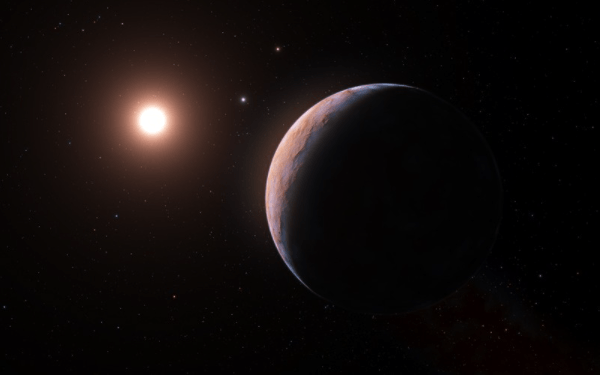
An artist’s impression of the newly discovered planet orbiting Proxima Centauri.Credit: ESO/L. Calçada
Topics: Astronomy, Astrophysics, Exoplanets, Space Exploration, Spaceflight
Astronomers have discovered a third planet orbiting Proxima Centauri, the star closest to the Sun. Called Proxima Centauri d, the newly spotted world is probably smaller than Earth and could have oceans of liquid water.
“It’s showing that the nearest star probably has a very rich planetary system,” says Guillem Anglada-Escudé, an astronomer at the Institute of Space Sciences in Barcelona, Spain, who led the team that, in 2016, discovered the first planet to be seen orbiting Proxima Centauri.
Astronomer João Faria and his collaborators detected Proxima Centauri d by measuring tiny shifts in the spectrum of light from the star as the planet’s gravity pulled at it during orbit. The team used a state-of-the-art instrument called the Echelle Spectrograph for Rocky Exoplanets and Stable Spectroscopic Observations (ESPRESSO) at the Very Large Telescope, a system of four 8.2-meter telescopes at the European Southern Observatory in Cerro Paranal, Chile. The results were published on 10 February in Astronomy & Astrophysics.
Topics: Civics, Civil Rights, Existentialism, Fascism, Human Rights, Propaganda
Note: I will be attending the funeral of my brother-in-law. I will take a blog break to mourn.
[A] fifth column, clandestine group or faction of subversive agents who attempt to undermine a nation’s solidarity by any means at their disposal. The term is conventionally credited to Emilio Mola Vidal, a Nationalist general during the Spanish Civil War (1936–39). As four of his army columns moved on Madrid, the general referred to his militant supporters within the capital as his “fifth column,” intent on undermining the loyalist government from within.
A cardinal technique of the fifth column is the infiltration of sympathizers into the entire fabric of the nation under attack and, particularly, into positions of policy decision and national defense. From such key posts, fifth-column activists exploit the fears of a people by spreading rumors and misinformation, as well as by employing the more standard techniques of espionage and sabotage. Source: Britannica.com
When I saw this, it was usually on a UHF channel after school. The subtle racist trope against Japan happens at the 2:42 mark, tarnishing its brilliance. (In light of our current appeal to diversity, equity, and inclusion, I’m preparing you for the shock.) The cartoon was produced in 1943, and the stated Axis powers were Germany, Italy, and Japan. Inclusivity wasn’t the point: rage to continue the fight, then, and now, delivers a potent message. The cartoon served as a simple illustration of what a fifth column infiltrator, or in this case, internal grey-colored collaborator mouse, A.K.A. Tucker Carlson, looks like.
“My office is now getting calls from folks who say they watch Tucker Carlson and are upset that we’re not siding with Russia in its threats to invade Ukraine, and who want me to support Russia’s ‘reasonable’ positions,” Rep. Tom Malinowski (D-N.J.) said in a tweet on Monday afternoon.
Do you know whose parents immigrated from Ukraine? Leonard Nimoy, who gave us the “live long and prosper” Mr. Spock salute from his Jewish synagogue traditions.
Public-opinion polling shows that Trump’s low opinion of American elections has practically become Republican Party orthodoxy. According to a Reuters/Ipsos poll released on Friday, Republicans have an “unprecedented” level of “concern and mistrust in the system.” Roughly 70 percent of Republican voters believe that if Hillary Clinton wins the election, it’ll be due to fraud. In both this poll and an NBC News/SurveyMonkey poll, only half of Republicans say they’d accept a Clinton victory. (In the latter poll, by contrast, 82 percent of Democrats said they would accept a Trump victory.)
This suspicious Republican electorate is joined by growing ranks of conservative politicians, pundits, and intellectuals. They’re all increasingly willing to say that the existing American political system is hopelessly flawed and needs to be rolled back to the days before blacks and women could vote. On the most obvious level, this can be seen in moves by Republican governors all over America to make voting more difficult, through stringent voting ID laws, new hurdles to registration, and the curtailment of early-voting options. Equally significant has been the gutting of key provisions of the Voting Rights Act by conservative Supreme Court justices in the 2013 Shelby Country v. Holder ruling.
Speaking of mice: Tennessee is blocking the graphic novel, Maus (I ordered it). 1/27/2022 yesterday was the 77th anniversary of the liberation of Auschwitz. The 1619 Project by Nicole Hannah-Jones is being referred to BY name and blocked. Reich Wing governments in red states are blocking Toni Morrison’s “The Bluest Eye” and “Beloved.” “To Kill a Mockingbird” by Harper Lee can hurt fragile feelings, this sentiment from people who mocked the left, and wore t-shirts to tell us: “F Your Feelings.” Yeah.
On Wednesday, the Harvard University scholar Henry Louis Gates Jr. appeared on Oprah Winfrey’s celebratory post-election special. After learning the news, Gates says, “we jumped up, we wept, we hooped and hollered.” It is hard to overestimate the historical significance of the election of the first black U.S. President. For many blacks, and certainly, for much of the country and world, Obama’s victory is an extraordinary step toward the redemption of America’s original 400-year-old sin. It is astonishing not least for its quickness, coming just 145 years after President Abraham Lincoln issued the Emancipation Proclamation effectively ending slavery and four decades after the assassination of Martin Luther King Jr. And it is even more astonishing for its decisiveness — Obama carried Virginia, once the home of the Confederacy, a place whose laws just five decades ago would have made the interracial union of his parents illegal. (See pictures of Barack Obama’s family tree.)
What Obama’s election meant to White America was the eruption of racist tropes in the form of Obama-as-Hitler, Obama-as-Medicine-Man-Voodoo-Mystic, Obama-hung-in-effigy. The right-Reich-wing echo chamber kicked into high gear on television, podcasts, the Internet, and AM talk radio. White America was telling Black America precisely what they thought of having a black president. We weren’t in “post-racial America,” and the years of detente between the cultures was a smokescreen, a strong delusion.
Despite the fact that the 46th president has appointed more judges than any other president, despite the fact that the economy has grown faster than my senior year in college as an undergrad (1984), the Orwellian programming has his numbers in the statistical toilet. My theory is because 1. he’s competent, 2. he’s boring, which is largely what he promised after four years of 140-character COVFEFE-misspelled rage tweeting and genuflecting to Vladimir Putin from his megalomaniacal predecessor. What matters in our entertainment-first-news-later fourth estate of “journalism” is rage viewing, ratings, and clicks. We have forgotten what “normal” looks like if we ever knew.
We are ignoring the fifth column among us. They are armed. They want to “take their country back,” as Glenn Beck (unvaccinated, caught covid TWO times) led chants at the Lincoln Memorial on August 27, 2010. “In 2012, a Fairleigh Dickinson University survey reported that Fox News viewers were less informed about current events than people who didn’t follow the news at all.” (This is FORBES! Read that again at the link.) The fifth column is pissed that they have to now share with “others”: African Americans, Asian Americans, First Nation Peoples, Hispanics, Immigrants, LGBT, women, and haven’t shared well since kindergarten. Sharing power is what happens when a democracy diversifies, and they have shown – from their electorate, their elected officials, their contrived laws to block votes, their propaganda outlets, and their brown shirts, to have little interest in doing that.
Watch what you’re watching Fox keeps feeding us toxins Stop sleeping Start thinking outside of the box And unplug from the Matrix doctrine But watch what you say,
Big Brother is watching
Watch what you’re watching Fox keeps feeding us toxins Stop sleeping Start thinking outside of the box And unplug from the Matrix doctrine But watch what you say,
We are whistling in the dark on the road to fascism.
2 Thessalonians 2:11 “And for this, cause God shall send them strong delusion, that they should believe a lie: 12 That they all might be damned who believed not the truth, but had to pleasure in unrighteousness.”
“Those who can make you believe absurdities can make you commit atrocities.” Voltaire
NIST researcher Megan Cleveland uses a PCR machine to amplify DNA sequences by copying them numerous times through a series of chemical reactions. Credit: M. Cleveland/NIST
Topics: Biology, Biotechnology, COVID-19, Diversity in Science, NIST, Research, Women in Science
Scientists track and monitor the circulation of SARS-CoV-2, the virus that causes COVID-19, using methods based on a laboratory technique called polymerase chain reaction (PCR). Also used as the “gold standard” test to diagnose COVID-19 in individuals, PCR amplifies pieces of DNA by copying them numerous times through a series of chemical reactions. The number of cycles it takes to amplify DNA sequences of interest so that they are detectable by the PCR machine, known as the cycle threshold (Ct), is what researchers and medical professionals look at to detect the virus.
However, not all labs get the same Ct values (sometimes also called “Cq” values). In efforts to make the results more comparable between labs, the National Institute of Standards and Technology (NIST) contributed to a multiorganizational study that looked at anchoring these Ct values to a reference sample with known amounts of the virus.
Researchers published their findings in the journal PLOS One.
SARS-CoV-2 is an RNA virus: Its genetic material is single-stranded instead of double-stranded like DNA and contains some different molecular building blocks, namely uracil in place of thymine. But the PCR test only works with DNA, and labs first must convert the RNA to DNA to screen for COVID-19. For the test, RNA is isolated from a patient’s sample and combined with other ingredients, including short DNA sequences are known as primers, to transform the RNA into DNA.
A quantum probe for gravity: Physicists have detected a tiny phase shift in atomic wave packets due to gravity-induced relativistic time dilation – an example of the Aharonov-Bohm effect in action. (Courtesy: Shutterstock/Evgenia Fux)
Topics: General Relativity, Gravity, Modern Physics, Quantum Mechanics
The idea that particles can feel the influence of potentials even without being exposed to a force field may seem counterintuitive, but it has long been accepted in physics thanks to experimental demonstrations involving electromagnetic interactions. Now physicists in the US have shown that this so-called Aharonov-Bohm effect also holds true for a much weaker force: gravity. The physicists based their conclusion on the behavior of freefalling atomic wave packets, and they say the result suggests a new way of measuring Newton’s gravitational constant with far greater precision than was previously possible.
Yakir Aharonov and David Bohm proposed the effect that now bears their name in 1959, arguing that while classical potentials have no physical reality apart from the fields they represent, the same is not true in the quantum world. To make their case, the pair proposed a thought experiment in which an electron beam in a superposition of two wave packets is exposed to a time-varying electrical potential (but no field) when passing through a pair of metal tubes. They argued that the potential would introduce a phase difference between the wave packets and therefore lead to a measurable physical effect – a set of interference fringes – when the wave packets are recombined.
Seeking a gravitational counterpart
In the latest research, Mark Kasevich and colleagues at Stanford University show that the same effect also holds true for gravity. The platform for their experiment is an atom interferometer, which uses a series of laser pulses to split, guide and recombine atomic wave packets. The interference from these wave packets then reveals any change in the relative phase experienced along the two arms.
Topics: Fermilab, High Energy Physics, Modern Physics, Neutrinos, Particle Physics
Solving big mysteries
The Deep Underground Neutrino Experiment is an international flagship experiment to unlock the mysteries of neutrinos. DUNE will be installed in the Long-Baseline Neutrino Facility, under construction in the United States. DUNE scientists will paint a clearer picture of the universe and how it works. Their research may even give us the key to understanding why we live in a matter-dominated universe — in other words, why we are here at all.
An illustration of a black hole and its event horizon. (Image credit: Nicholas Forder/Future Publishing )
Topics: Astronomy, Astrophysics, Black Holes, Cosmology, Einstein, General Relativity
“Small” black holes are estimated to make up 1% of the universe’s matter.
Scientists have estimated the number of “small” black holes in the universe. And no surprise: It’s a lot.
This number might seem impossible to calculate; after all, spotting black holes is not exactly the simplest task. Because there are as pitch-black as the space they lurk in, the light swallowing cosmic goliaths can be detected only under the most extraordinary circumstances — like when they’re bending the light around them, snacking on the unfortunate gases and stars that stray too close, or spiraling toward enormous collisions that unleash gravitational waves.
But that hasn’t stopped scientists from finding some ingenious ways to guess the number. Using a new method, outlined Jan. 12 in The Astrophysical Journal, a team of astrophysicists has produced a fresh estimate for the number of stellar-mass black holes — those with masses 5 to 10 times that of the sun — in the universe.
And it’s astonishing: 40,000,000,000,000,000,000, or 40 quintillions, stellar-mass black holes populate the observable universe, making up approximately 1% of all normal matter, according to the new estimate.
So how did the scientists arrive at that number? By tracking the evolution of stars in our universe they estimated how often the stars — either on their own or paired into binary systems — would transform into black holes, said first author Alex Sicilia, an astrophysicist at the International School of Advanced Studies (SISSA) in Trieste, Italy.
Topics: Civics, Civil Rights, Existentialism, Fascism, Human Rights
Note: title inspired by a tweet from Congressman Adam Schiff.
In Congress, July 4, 1776
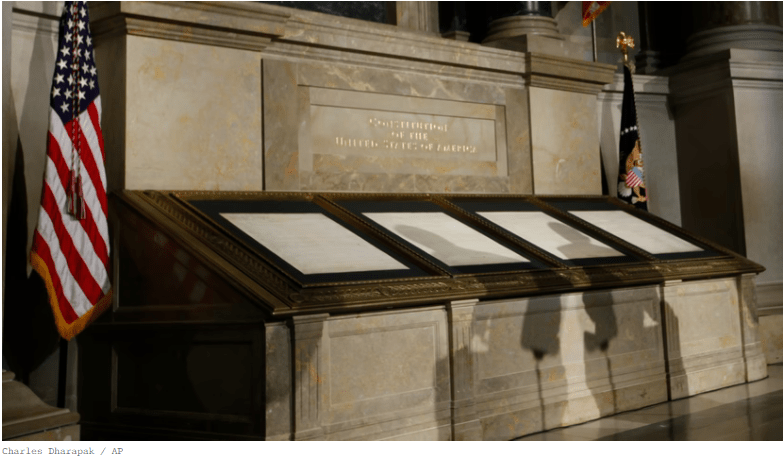
The unanimous Declaration of the thirteen united States of America, When in the Course of human events, it becomes necessary for one people to dissolve the political bands which have connected them with another, and to assume among the powers of the earth, the separate and equal station to which the Laws of Nature and of Nature’s God entitle them, a decent respect to the opinions of mankind requires that they should declare the causes which impel them to the separation.
We hold these truths to be self-evident, that all men are created equal, that they are endowed by their Creator with certain unalienable Rights, that among these are Life, Liberty and the pursuit of Happiness.–That to secure these rights, Governments are instituted among Men, deriving their just powers from the consent of the governed, –That whenever any Form of Government becomes destructive of these ends, it is the Right of the People to alter or to abolish it, and to institute new Government, laying its foundation on such principles and organizing its powers in such form, as to them shall seem most likely to affect their Safety and Happiness. Prudence, indeed, will dictate that Governments long established should not be changed for light and transient causes; and accordingly, all experience hath shown, that mankind is more disposed to suffer, while evils are sufferable than to right themselves by abolishing the forms to which they are accustomed. But when a long train of abuses and usurpations, pursuing invariably the same Object evinces a design to reduce them under absolute Despotism, it is their right, it is their duty, to throw off such Government, and to provide new Guards for their future security. Source: National Archives
Just spitballing, but “We hold these truths to be self-evident that all [rich, cisgender, propertied white] men are created equal” is probably how the “founding fathers” understood, wrote, and read the text. Conservatives are after all, all about “original intent.”
Thom Hartmann has a nationally syndicated talk show discussing political opinions that I generally agree on. One particular essay on his blog (short for weblog, which is the ultimate digital spitballing), talked about Russell Kirk, the architect of arguably the Bible on conservatism: The Conservative Mind. An excerpt:
All over social media people are asking, “Why would anybody embrace fascism? Why would they be willing to overthrow a functioning democratic republic?”
The answer is simple: safety.
Safety is at the foundation of Maslow’s Hierarchy of Human Needs. If a person doesn’t feel safe, they’re not able to even think about other dimensions of life. And, increasingly, working-class white men in America are feeling unsafe. It’s a new and shocking feeling for a group that’s been in power for over 400 years, and producing a predictable backlash.
In 1981 Ronald Reagan and the GOP began a 40-year project to disempower and gut the American middle class, including white people in that economic basket.
He wanted to take away their safety.
There was an actual rationale for this, laid out by Russell Kirk in his 1951 book The Conservative Mind. Kirk argued that without clearly defined classes and power structures, society would devolve into chaos. He essentially predicted in 1951 that if college students, women, working people, and people of color ever got even close to social and political power at the same level as wealthy white men, all hell would break loose.
Joe Manchin just lied about changing the filibuster to a talking filibuster, and a simple majority vote is “unprecedented.” News flash: it’s not.
“In total, 161 exceptions to the filibuster’s supermajority requirement have been created between 1969 and 2014, according to an analysis by the Brookings Institution’s Molly Reynolds.” The Filibuster, Explained, Tim Lau, The Brennan Center
Just spitballing, but if I, a non-lawyer, can find this info, what contempt do Manchin, Sinema, and every Republican senator HAVE for American citizens? They frankly think the electorate is dumber than a box of rocks, and their actual constituents are their donors.
We treat our founding documents as sacred political texts, but not as in the translated kind that can be read by all (King James is a translation into at the time, the common “street language” of the day). In this case, the text regresses; devolves. It requires some legal training to discern the ins and outs of its machinations, like one used to need Hebrew and Latin to read and understand scripture. It requires citizens to be trained in civics to KNOW what their rights, privileges, and responsibilities are as citizens.
“One of the things taken out of the curriculum was civics,” Zappa went on to explain. “Civics was a class that used to be required before you could graduate from high school. You were taught what was in the U.S. Constitution. And after all the student rebellions in the Sixties, civics was banished from the student curriculum and was replaced by something called social studies. Here we live in a country that has a fabulous constitution and all these guarantees, a contract between the citizens and the government – nobody knows what’s in it…And so, if you don’t know what your rights are, how can you stand up for them? And furthermore, if you don’t know what’s in the document, how can you care if someone is shredding it?” “Notes From the Dangerous Kitchen,” a review and a quote from Frank Zappa, Critics at Large, also: Apathy, Crises, and Zappa.
Van Bullock (R.I.P.) was my ninth-grade Social Studies Teacher. He was a short, stocky man with an impressive bearing and presence, white-haired mop hairdo kind of like Moe Howard of the Three Stooges in wire progressive lenses. It was 1976, our country’s Bicentennial year, 8 years after the assassinations of Martin Luther King and Bobby Kennedy as the country tried mightily to build bridges in the place of previous De Jure and De Facto walls. Mr. Bullock’s teaching technique was using stenciled notes he passed out to all of us, particularly me and Ve Pauling (my Kappa Alpha Psi fraternity brother), lecturing with the fire of a camp meeting preacher.
Van Bullock would lecture and captivate a crowd of 25 fourteen-year-old teens that HAD the notes in front of us: we still took notes in the margins, on the back of each stenciled page. Tests were open book, open note, and challenging: he expected great detail and essay answers. The name of the class was Social Studies, but what he was teaching was lessons of citizenship: Civics.
Mr. Bullock was teaching Civics because he had the freedom to do so. He was not held to the standard of preparing students for a high-stakes standardized test because no such machination existed from the testing industrial complex.
Van Bullock was teaching all of us, in a forced-bused integrated class in East Winston the rudimentary fundamentals of citizenship. Though forced, it exposed us beyond our cultures and expanded our tolerance, friendships, and spheres of influence. We were learning – side-by-side – together. We looked different, we lived on different sides of town and if we attended worship centers probably had different perspectives on that as well. We could all agree that learning those building blocks to take on the responsibilities of adulthood and the world we were all growing up into was important. We had classroom debates; mock elections: history came alive in that man’s room! We learned (hopefully putting a few at ease), to make, change or ABOLISH a Constitutional Amendment it takes a 2/3 majority in both houses of congress (67 senators; 292 house members) and 3/4 of the states – 38 in our case – to ratify it in their legislatures. I tried to capture and emulate that magic every time I taught physics and math at Manor High School. Sometimes I was successful; sometimes I wasn’t.
I assumed wrongly that this would always be the focus of our nation’s education enterprise, preparing citizens for ownership of our federal republic.
I am sadly aware Mr. Bullock, quite clearly, that it is not. Source: Van Bullock
Just spitballing, maybe ignorance and fascism was always the “break glass” scheme in case of expanded democracy (“too much democracy“) overwhelmingly demanded by marginalized groups? “All hell breaking loose” if you’re a Russell Kirk conservative. EVERYBODY voting beyond rich, cisgender, property owners is a catastrophe to fascists. Am I the only one who feels our historical poetry of this nation’s origins amounts to four centuries of self-gaslighting? Did climate change, income inequality pointed out since Occupy Wall Street, science denialism, the pandemic, and January 6, 2021, just rip the scales off our eyes, and REVEAL who we truly are?
I don’t think we’ll ever know.
And we sadly didn’t clone Mr. Bullock for a time such as this.
“The reason they call it the American Dream is that you have to be asleep to believe it.” George Carlin
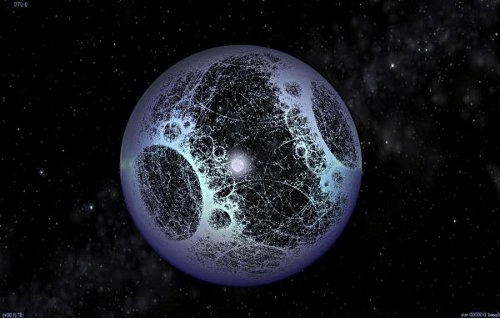
Although the so-called Dysonian SETI has been much in the air in recent times, its origins date back to the birth of SETI itself. It was in 1960 – the same year that Frank Drake used the National Radio Astronomy Observatory in Green Bank, West Virginia to study Epsilon Eridani and Tau Ceti – that Freeman Dyson proposed the Dyson sphere. In fiction, Olaf Stapledon had considered such structures in his novel Star Maker in 1937. As Macy Huston and Jason Wright (both at Penn State) remind us in a recent paper, Dyson’s idea of energy-gathering structures around an entire star evolved toward numerous satellites around the star rather than a (likely unstable) single spherical shell.
We can’t put the brakes on what a highly advanced technological civilization might do, so both solid sphere and ‘swarm’ models can be searched for, and indeed have been, for in SETI terms we’re looking for infrared waste heat. And if we stick with Dyson (often a good idea!), we would be looking for structures orbiting in a zone where temperatures would range in the 200-300 K range, which translates into searching at about 10 microns, the wavelength of choice. But Huston and Wright introduce a new factor, the irradiation from the interior of the sphere onto the surface of the star.
This is intriguing because it extends our notions of Dyson spheres well beyond the habitable zone as we consider just what an advanced civilization might do with them. It also offers up the possibility of new observables. So just how does such a Dyson sphere return light back to a star, affecting its structure and evolution? If we can determine that, we will have a better way to predict these potential observables. As we adjust the variables in the model, we can also ponder the purposes of such engineering.
Think of irradiation as Dyson shell ‘feedback.’ We immediately run into the interesting fact that adding energy to a star causes it to expand and cool. The authors explain this by noting that total stellar energy is a sum of thermal and gravitational energies. Let’s go straight to the paper on this. In the clip below, E* refers to the star’s total energy, with Etherm being thermal energy:
When energy is added to a star (E∗ increases), gravitational energy increases and thermal energy decreases, so we see the star expand and cool both overall (because Etherm is lower) and on its surface (because being larger at the same or a lower luminosity its effective temperature must drop). A larger star should also result in less pressure on a cooler core, so we also expect its luminosity to decrease.
And then there were two—maybe. Astronomers say they have found a second plausible candidate for a moon beyond our solar system, an exomoon, orbiting a world nearly 6,000 light-years from Earth.Called Kepler-1708 b-i, the moon appears to be a gas-dominated object, slightly smaller than Neptune, orbiting a Jupiter-sized planet around a sunlike star—an unusual but not wholly unprecedented planet-moon configuration. The findings appear in Nature Astronomy. Confirming or refuting the result may not be immediately possible, but given the expected abundance of moons in our galaxy and beyond, it could further herald the tentative beginnings of an exciting new era of extrasolar astronomy—one focused not on alien planets but on the natural satellites that orbit them and the possibilities of life therein.
There are more than 200 moons in our solar system, and they have an impressive array of variations. Saturn’s moon Titan possesses a thick atmosphere and frigid hydrocarbon seas on its surface, possibly an analog of early Earth. Icy moons such as Jupiter’s Europa are frozen balls that hide subsurface oceans, and they may be prime habitats for life to arise. Others still, such as our own moon, are apparently barren wastelands but could have water ice in their shadowed craters and maze-like networks of tunnels running underground. An important shared trait among these worlds, however, is their mere existence: six of the eight major planets of our solar system have moons. Logic would suggest the same should be true elsewhere. “Moons are common,” says Jessie Christiansen of the California Institute of Technology. “In our solar system, almost everything has a moon. I am very confident that moons are everywhere in the galaxy.”
On a recent morning, in Lower Manhattan, 20 scientists, including me, gathered for a private screening of the new film Don’t Look Up, followed by lunch with the film’s director, Adam McKay.
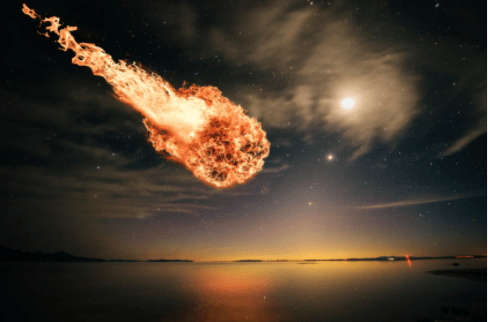
The film’s plot is simple. An astronomy graduate student, Kate Dibiasky (Jennifer Lawrence), and her professor, Randall Mindy (Leonardo DiCaprio), discover a new comet and realize that it will strike the Earth in six months. It is about nine kilometers across, like the one that wiped out the dinosaurs 66 million years ago. The astronomers try to alert the president, played by Meryl Streep, to their impending doom.
“Let’s just sit tight and assess,” she says, and an outrageous, but believable comedy ensues, in which the astronomers wrangle an article in a major newspaper and are mocked on morning TV, with one giddy host asking about aliens and hoping that the comet will kill his ex-spouse.
At last, mainstream Hollywood is taking on the gargantuan task of combatting the rampant denial of scientific research and facts. Funny, yet deadly serious, Don’t Look Up is one of the most important recent contributions to popularizing science. It has the appeal, through an all-star cast and wicked comedy, to reach audiences that have different or fewer experiences with science.
Don’t Look Up isn’t a movie about climate change, but one about planetary defense from errant rocks in space. It handles that real and serious issue effectively and accurately. The true power of this film, though, is in its ferocious, unrelenting lampooning of science deniers.
After the screening, in that basement theater in SoHo, McKay said: “This film is for you, the scientists. We want you to know that some of us do hear you and do want to help fight science denialism.”






 Physics and Nano