"The one exclusive sign of thorough knowledge is the power of teaching." Aristotle | Disclaimer: The views and opinions expressed on this Wordpress website are the views and opinions of the content creator, Dr. Reggie Goodwin, and should not be construed as shared, or sourced from The Environmental Protection Agency, or any organizations with which they have cooperative, or business relationships.
The design concept of BWXT Advanced Nuclear Reactor. BWX Technologies
Topics: Applied Physics, Alternate Energy, Climate Change, Nuclear Power
According to the US Energy Information Administration, the US uses a mixture of 60.8% fossil fuel sources to generate 2,504 billion kilowatt hours of energy. Our nuclear expenditure is a paltry 18.9%. The totality of renewable sources (wind, hydropower, solar, biomass, and geothermal) is a little higher: 20.1%. This is the crux of the “Green New Deal.”
Though I long for the cleaner, neater version of nuclear power in fusion, it’s kind of hard to mimic the pressures and magnetic fields necessary to spark essentially a mini sun on the planet. I think the resistance to nuclear fission is cultural: from the atomic bomb, Oppenheimer quoting the Bhagavad-Gita at the first successful testing, a classic “what have we done” trope. Popular fiction emphasizes doomsday scenarios and radioactive zombies. Honorable mention: Space 1999, which like zombies I doubt could ever happen, but it kept my attention in my youth. There are also genuine concerns about Chernobyl (still in Ukraine), Three-Mile Island, and Fukushima Daichi that come to the public’s mind.
The reason the percentages on fossil fuels are so high is that they release extreme amounts of energy to superheat water for turbines to turn magnets superfast in copper coils. That is how most of the electricity we consume is made.
France currently generates 70% of its energy from nuclear power plants, with plans to reduce this to 50% as they mix in renewables. This is proportional to the percentage the US already has in renewables. My only caveat is an obsolescence plan for solar panels (they have to be implanted with caustic impurities to MAKE them conductive, and after twenty years, could end up in a landfill near humans). Battery-operated vehicles are fine, but Lithium has to be mined, it requires a lot of water, typically the indigenous peoples near the mines don’t make a profit, and their land and resources are spoiled.
If we truly are going to transition from fossil fuels to “cleaner energy,” I think we should realize that power plant designs have improved greatly since the aforementioned disasters.
As an engineer, I always tried to follow this edict from my father: “Experience isn’t the best teacher: other people’s experiences are the best teacher.” In short, learn from others’ mistakes, and try to not repeat them. It works in other nontechnical areas of life as well.
I (fingers crossed) assume nuclear power plant design engineers follow something similar to improve on future designs for safety, and as we’ve been exposed to with the war in Ukraine, global energy security.
I’m proposing an “everything on the table strategy,” not Pollyanna. By the way, our “carbon footprint” appears to be a boondoggle by the industries that caused our current malaise.
The U.S. Department of Energy’s Advanced Reactor Demonstration Program commonly referred to as ARDP, is designed to help our domestic nuclear industry demonstrate its advanced reactor designs on accelerated timelines. This will ultimately help us build a competitive portfolio of new U.S. reactors that offer significant improvements over today’s technology.
The advanced reactors selected for risk-reduction awards are an excellent representation of the diverse designs currently under development in the United States. They range from advanced light-water-cooled small modular reactors to new designs that use molten salts and high-temperature gases to flexibly operate at even higher temperatures and lower pressures.
All of them have the potential to compete globally once deployed. They will offer consumers more access to a reliable, clean power source that can be depended on in the near future to flexibly generate electricity, drive industrial processes, and even provide potable drinking water to communities in water-scarce locations.
So what exactly is a constitutional crisis? We should be clear about what does — and, more importantly, does not — merit this description. It’s possible to have a major political crisis even if the Constitution is crystal clear on the remedy or to have a constitutional crisis that doesn’t ruffle many feathers.
Political and legal observers generally divide constitutional crises into four categories:
1. The Constitution doesn’t say what to do.
The U.S. Constitution is brief and vague. (Compare it to a state constitution sometime.) This vagueness has one major advantage: It makes an 18th-century document flexible enough to effectively serve a 21st-century society. But sometimes the Constitution leaves us without sorely needed instructions, such as when William Henry Harrison became the first president to die in office in 1841. At the time, it wasn’t clear whether the vice president should fully assume the office or just safeguard the role until a new president could somehow be chosen. (It wasn’t until 1967 that the 25th amendment officially settled the question.) When Vice President John Tyler took over, no one was sure if he was the real president or merely the acting president, nor was anyone certain what should happen next. Tyler asserted that he was, in fact, the new president, and since then, vice presidents who have had to step into service as chief executive have been treated as fully legitimate, but early confusion took its toll on the perceived legitimacy of Tyler’s presidency.
2. The Constitution’s meaning is in question.
Sometimes the Constitution’s attempt to address an issue is phrased in a way that could allow multiple interpretations, leaving experts disagreeing about what it means and making it difficult or impossible to address a pressing problem. In this way, both the Great Depression and the Civil War created constitutional crises. The problem sparked by the Civil War is obvious: The fight rested on a bunch of unsettled constitutional questions, the biggest of which was about slavery and the federal government’s ability to control it, a subject on which the Constitution was silent. And while the Constitution provided information on how a state could join the union, it didn’t say whether one could leave it or how it would go about doing so. It obviously took a war to resolve this crisis.
3. The Constitution tells us what to do, but it’s not politically feasible.
This category of constitutional crisis can crop up when presidential elections produce contested and confusing results. In the 2000 presidential election, when George W. Bush and Al Gore were separated by just a few hundred votes in Florida, the tipping-point state whose electoral votes would determine the winner, the state’s election results remained contested for weeks due to a number of irregularities and a secretary of state who seemed determined to cut a recount short. In theory, the Constitution allowed for various solutions to this problem: Congress could have decided which of Florida’s electors to recognize, or Congress could have determined that neither candidate had achieved a majority in the Electoral College and let the House of Representatives decide on a president (per the process spelled out in the 12th Amendment). Such outcomes, while certainly constitutional, would have been politically infeasible, creating a significant legitimacy crisis for the new president.
4. Institutions themselves fail.
The Constitution’s system of checks and balances sets the various branches against each other for the laudable purpose of constraining tyranny. However, due to partisan polarization, individual corruption, or any number of other reasons, sometimes the political institutions in these arrangements fail, sending the governmental system into a crisis. This was the type of constitutional crisis commentators were seemingly referring to in describing reports that Customs and Border Protection agents (members of the executive branch) weren’t following orders from the judicial branch.
Occam’s razor: a scientific and philosophical rule that entities should not be multiplied unnecessarily which is interpreted as requiring that the simplest of competing theories be preferred to the more complex or that explanations of unknown phenomena be sought first in terms of known quantitiesMerriam-Webster
So, what do we call this?
Too many people who know that you’re supposed to keep official records (Secret Service, Homeland Security) aren’t keeping official records.
The GOP had CPAC in Vicktor Urban’s authoritarian country (he’s apparently not a big fan of diversity, and by extension, neither is the GOP).
Homeland Security: a lot of angst about the name came up post 9/11 because it sounded so – “Nazi.” This is, sadly, when Alex Jones gained a lot of traction. He popularized “9/11 truthers” before he saw where his depraved bread was buttered with Sandy Hook, lying about dead children, and anything else he could glom onto for a fast buck that I hope he’s finally being separated from his exchequer. It’s like the chips all fell in place for the Joker to take over Arkham, and Batman is TDY across the universe with the Justice League.
Dumbo Gambino lied to 9/11 victims about going after the Saudis (15 of the 19 highjackers) to their faces in the height of their grief and loss. That hasn’t stopped the sociopath from hosting the LIV golf tournament at his Bedminster course, because that would take something he has ZERO in his emotional fuel tank: empathy. It’s all about money and protecting those who he thinks will give him boatloads more.
Malcolm Nance’s new book: “They Want to Kill Americans” couldn’t be starker. The Introduction had me up past midnight! He’s gone back to Ukraine to help them win the war. I sometimes think it’s safer than America right now.
Orange Satan didn’t do this by himself. He had a lot of complicit help that doesn’t mind turning our high-sounding Constitution into toilet paper (for flushing). He just saw where the wind was blowing after the country elected its first and so far, only black president, and lost its collective mind!
Coup. Insurrection. Insurgency. They’re all words. We went from Obama’s tan suit and Michelle Obama’s bared arms controversies to the Grand Pooh-Bah storming the Capitol to save us from whatever addles their loose minds. For the record: the 1995 Million Man March was a peaceful exercise of the First Amendment that resulted in no Capital Police Officers’ deaths, storming of the Capital, the display of an insurrectionist flag, Grand Pooh-Bahs howling at the moon, or the deposit of urine and feces.
The only option Malcolm gives in interviews about his book is to vote. Vote in record numbers every election. Vote for the proverbial dog catcher. Nothing is trivial. Fascism is a fungus on the body politic. You can’t give it any room to grow, otherwise, we’ll have a January 6 in 50 state Capitols. Dysfunction equals dystopia, not democracy or civilization.
Maybe we’re not calling it a constitutional crisis because four decades of dumbing down a previously “informed citizenry” has led to the dichotomy of proletariat drones carrying “smart phones.”
Also from the previous blog post:
“One of the things taken out of the curriculum was civics,” Zappa went on to explain. “Civics was a class that used to be required before you could graduate from high school. You were taught what was in the U.S. Constitution. And after all the student rebellions in the Sixties, civics was banished from the student curriculum and was replaced by something called social studies. Here we live in a country that has a fabulous constitution and all these guarantees, a contract between the citizens and the government – nobody knows what’s in it…And so, if you don’t know what your rights are, how can you stand up for them? And furthermore, if you don’t know what’s in the document, how can you care if someone is shredding it?“
Topics: Lasers, Modern Physics, Quantum Computer, Quantum Mechanics
Physicists have devised a mind-bending error-correction technique that could dramatically boost the performance of quantum computers.
When the ancient Incas wanted to archive tax and census records, they used a device made up of a number of strings called a quipu, which encoded the data in knots. Fast-forward several hundred years, and physicists are on their way to developing a far more sophisticated modern equivalent. Their “quipu” is a new phase of matter created within a quantum computer, their strings are atoms, and the knots are generated by patterns of laser pulses that effectively open up [a] second dimension of time.
This isn’t quite as incomprehensible as it first appears. The new phase is one of many within a family of so-called topological phases, which were first identified in the 1980s. These materials display order not on the basis of how their constituents are arranged—like the regular spacing of atoms in a crystal—but on their dynamic motions and interactions. Creating a new topological phase—that is, a new “phase of matter”—is as simple as applying novel combinations of electromagnetic fields and laser pulses to bring order or “symmetry” to the motions and states of a substance’s atoms. Such symmetries can exist in time rather than space, for example in induced repetitive motions. Time symmetries can be difficult to see directly but can be revealed mathematically by imagining the real-world material as a lower-dimensional projection from a hypothetical higher-dimensional space, similar to how a two-dimensional hologram is a lower-dimensional projection of a three-dimensional object. In the case of this newly created phase, which manifests in a strand of ions (electrically charged atoms), its symmetries can be discerned by considering it as a material that exists in higher-dimensional reality with two-time dimensions.
“It is very exciting to see this unusual phase of matter realized in an actual experiment, especially because the mathematical description is based on a theoretical ‘extra’ time dimension,” says team member Philipp Dumitrescu, who was at the Flatiron Institute in New York City when the experiments were carried out. A paper describing the work was published in Nature on July 20.
Opening a portal to an extra time dimension—even just a theoretical one—sounds thrilling, but it was not the physicists’ original plan. “We were very much motivated to see what new types of phases could be created,” says study co-author Andrew Potter, a quantum physicist at the University of British Columbia. Only after envisioning their proposed new phase did the team members realize it could help protect data being processed in quantum computers from errors.
The ore pass at the Sanford Underground Research Facility in South Dakota. (Courtesy of Sanford Underground Research Facility, CC BY-NC-ND 4.0.)
Topics: Applied Physics, Modern Physics, Particle Physics, Theoretical Physics
The Deep Underground Neutrino Experiment (DUNE) will be the world’s largest cryogenic particle detector. Its aim is to study the most elusive of particles: neutrinos. Teams from around the world are developing and constructing detector components that they will ship to the Sanford Underground Research Facility, commonly called Sanford Lab, in the Black Hills of South Dakota. There the detector components will be lowered more than a kilometer underground through a narrow shaft to the caverns, where they will be assembled and operated while being sheltered from the cosmic rays that constantly rain down on Earth’s surface.
For at least two decades, the detector will be exposed to the highest-intensity neutrino beam on the planet. The beam will be generated 1300 km away by a megawatt-class proton accelerator and beamline under development at Fermilab in Batavia, Illinois. A smaller detector just downstream of the beamline will measure the neutrinos at the start of their journey, thereby enabling the experiment’s precision and scientific reach.
Beetling along: Under the influence of moisture, the color of the 3D-printed beetle changes from green to red, and back again to red. (Courtesy: Bart van Overbeeke)
Topics: 3D Printing, Additive Manufacturing, Biomimetics
Researchers in the Netherlands have produced models of a beetle that changes color and a scallop shell that opens and closes in response to changing humidity in the surrounding air. Inspired by iridescent structures in nature, Jeroen Sol and colleagues at the Eindhoven University of Technology showed that they could integrate a specialized liquid crystal into standard 3D-printing techniques, creating “4D printed” devices that react to their changing environments.
Over millions of years, many organisms have evolved micro-scale structures in their anatomies that allow them to change their vibrant iridescent colors in response to stimuli. Recently, researchers have developed inks that change color in the same way and have begun to experiment with incorporating them into 3D-printed structures.
This technology has been dubbed 4D printing, where the fourth dimension represents reversible, time-varying changes to the structures after printing. One widely used technique in 4D printing is to deposit ink directly onto 3D printed structures. This approach can accommodate many types of material, as well as a versatile range of printing temperatures, speeds, and path designs.
Credit: Amanda Montañez; Source: “Political Environment and Mortality Rates in the United States, 2001-19: Population-Based Cross-Sectional Analysis,” by Haider J. Warraich et al., in BMJ, Vol. 377. Published online June 7, 2022
During the COVID-19 pandemic, the link between politics and health became glaringly obvious. Democrat-leaning “blue” states were more likely to enact mask requirements and vaccine and social distancing mandates. Republican-leaning “red” states were much more resistant to health measures. The consequences of those differences emerged by the end of 2020 when rates of hospitalization and death from COVID rose in conservative counties and dropped in liberal ones. That divergence continued through 2021 when vaccines became widely available. And although the highly transmissible Omicron variant narrowed the gap in infection rates, hospitalization and death rates, which are dramatically reduced by vaccines, remain higher in Republican-leaning parts of the country.
But COVID is only the latest chapter in the story of politics and health. “COVID has really magnified what had already been brewing in American society, which was that, based on where you lived, your risk of death was much different,” says Haider J. Warraich, a physician and researcher at the VA Boston Healthcare System and Brigham and Women’s Hospital in Boston.
In a study published in June in The BMJ, Warraich and his colleagues showed that over the two decades prior to the pandemic, there was a growing gap in mortality rates for residents of Republican and Democratic counties across the U.S. In 2001, the study’s starting point, the risk of death among red and blue counties (as defined by the results of presidential elections) was similar. Overall, the U.S. mortality rate has decreased in the nearly two decades since then (albeit not as much as in most other high-income countries). But the improvement for those living in Republican counties by 2019 was half that of those in Democratic counties—11 percent lower versus 22 percent lower.
Topics: Civics, Civil Rights, COVID-19, Dark Humor, Existentialism, Fascism, Human Rights
Steven Bannon’s “medieval,” take-no-prisoners defense rested yesterday. The three-shirt Troglodyte didn’t take the stand in his defense on advice from counsel. He said more outside the courtroom than he did inside. Today is closing arguments.
The January 6th Committee ended “season 1” yesterday as well, promising more hearings in September, just in time to keep the subject fresh in voters’ minds before the midterms. I hope my Fraternity Brother, Bennie Thompson, heals soon from his Covid infection.
The 45th occupant of the Oval Office looked small yesterday. The hearings didn’t drop so many bombshells, in my opinion. It presented a so-called “white” privileged man that could not, and cannot, admit he lost the 2020 election. He is using that narcissism in the “Big Lie” that infects so much of our politics now. It presented that a man who can’t admit after six bankruptcies he sucks at business, a con artist who steals money through fake real estate schools, border wall scams, and teasing his cult following that he’s going to run again for president (any day now), is simply a spoiled, entitled brat. It’s no wonder he and Bannon found each other. I’m not a right-wing podcaster with millions of listeners, many of whom he scammed with a “build the wall” boondoggle. Three-shirts, Senator Hawley, who had an impressive sprinting form on January 6th, and Baby Huey are all so-called “white” privileged men who know how to manipulate their enraged constituents, who they enraged.
They’re enraged because someone told them they are “white,” that God is “white,” and that “white” is blessed, exalted, and privileged. All other colors fall below the apogee of the American hierarchy and caste system.
They’re enraged by critical race theory, which is not taught in K-12, but what they fear is accurate history that doesn’t show so-called “white” privileged men in a good light.
They’re enraged because Rush Limbaugh told them to be enraged about “Feminazis” and anyone who didn’t look like so-called “white” privileged men like him.
They’re enraged because it’s better for those who scam and steal money from 99% of the population to keep them engaged with the Reich-Wing media complex that keeps them angry at the “other.” It’s the “others” who took the jobs their fathers used to privilege their way to lifetime employment, pensions, and retirement. It couldn’t possibly be the so-called “white” privileged multimillionaire and billionaire class, the gods that they actually worship. It can’t be them: they look like (other, poorer so-called “white” men). But those same so-called “white” privileged men were in the boardrooms deciding to send those jobs overseas for profits. They don’t live with you, and they don’t care about you.
Their rage causes them not to invest in books or education, but in arsenals. Their rage merges lethality with hoarding disorder, the stress of no longer being the center of the citizenry, and Norman Rockwell-type images depicting diversity, driving some stark raving mad. Every human, despite shades of Melanin, can only fire one gun type once. There is no credible animal that is hunted by AR15s, Sig Sauers, or Kalashnikovs. The only animal that they have hunted are those they consider fellow human beings, and “others.”
This rage caused (I believe) the Secret Service to delete text messages from January 5th and 6th, and no other days, even after Congress asked for them. Did the Secret Service follow their Comms Plan? Preserving records and evidence is the first duty of law enforcement. If law enforcement isn’t upholding the law, there is no “rule of law.”
Despite the incredible pictures from the James Webb Space Telescope, I am struck by two things:
If we were to read the spectrograph of some distant exoplanet’s atmosphere, we might see something resembling ourselves. The distance between us is prohibitive, we’re not likely to see this world in a human lifetime. Because they’re so far, arrival will be after conditions would have evolved, or dissolved over millennia.
If there have ever been other intelligent beings in the universe, they may have died off: a victim of their own misplaced hierarchical privilege and abject stupidity inhibiting spacefaring.
Topics: Civilization, Climate Change, Environment, Global Warming
Humans can survive up to 108.14 F, or 42.3 C before our brains and constitutions (bodies) start turning to mush. As a species, we’re going to have to decide if enriching a handful of global oligarchs is more important than survival. Wealth cannot be measured on a dysfunctional planet.
Nobody in Ashish Agashe’s seven-story apartment building in Thane, a suburb of Mumbai, had air conditioning 20 years ago. Today, his apartment is one of only two of the 28 units without it.
“Once you make peace with sweating,” says Agashe, “it is easy to survive this weather.” He decided against air conditioning because it gives him a “faux feel,” and he doesn’t believe his income should determine his lifestyle choices. Later, he was “chuffed” to learn that his choice is better for the planet.
Unlike Agashe, many Indians are adopting air conditioning to deal with more frequent and more intense heat waves. Earlier this year, temperatures in parts of India and Pakistan surpassed 120 degrees Fahrenheit.
At age 37, Agashe hopes temperatures do not rise high enough in his lifetime to require air conditioning in Mumbai, a humid and densely populated city on India’s west coast that today rarely sees temperatures above 40 degrees Celsius (104 degrees Fahrenheit). But even if the climate stopped changing, he worries that the heat produced by all the air conditioners in his building, which spills in through his open window, may force him to install air conditioning, too.
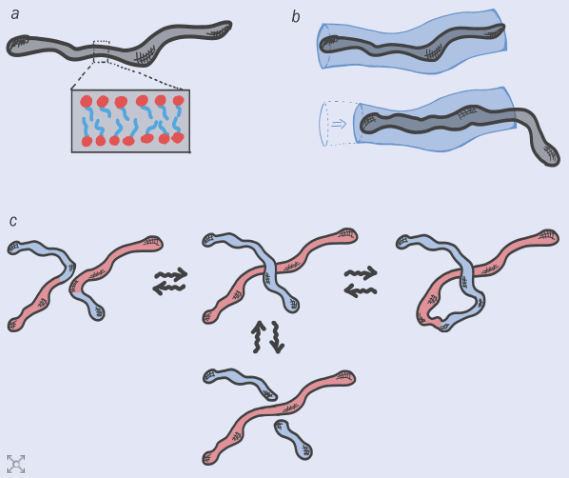
1 Soap, shampoo, and worm-like micelles Soaps and shampoos are made from amphiphilic molecules with water-loving (red) and water-hating (blue) parts that arrange themselves to form long tubes known as “worm-like micelles”. Entanglements between the tubes give these materials their pleasant, sticky feel. b The micelles can, however, disentangle themselves, just as entangled long-chain polymer molecules can slide apart too. In polymers, this process can be modeled by imagining the molecule sliding, like a snake, out of an imaginary tube formed by the surrounding spatial constraints. c Worm-like micelles can also morph their architecture by performing reconnections (left), breakages (down), and fusions (right). These operations occur randomly along the backbone, are in thermal equilibrium, and are reversible. (Courtesy: Davide Michieletto)
Topics: Biology, Biotechnology, DNA, Molecules
DNA molecules are not fixed objects – they are constantly getting broken up and glued back together to adopt new shapes. Davide Michieletto explains how this process can be harnessed to create a new generation of “topologically active” materials.
Call me naive, but until a few years ago I had never realized you can actually buy DNA. As a physicist, I’d been familiar with DNA as the “molecule of life” – something that carries genetic information and allows complex organisms, such as you and me, to be created. But I was surprised to find that biotech firms purify DNA from viruses and will ship concentrated solutions in the post. In fact, you can just go online and order DNA, which is exactly what I did. Only there was another surprise in store.
When the DNA solution arrived at my lab in Edinburgh, it came in a tube with about half a milligram of DNA per centimeter cube of water. Keen to experiment with it, I tried to pipette some of the solutions out, but they didn’t run freely into my plastic tube. Instead, it was all gloopy and resisted the suction of my pipette. I rushed over to a colleague in my lab, eagerly announcing my amazing “discovery”. They just looked at me like I was an idiot. Of course, solutions of DNA are gloopy.
I should have known better. It’s easy to idealize DNA as some kind of magic material, but it’s essentially just a long-chain double-helical polymer consisting of four different types of monomers – the nucleotides A, T, C, and G, which stack together into base pairs. And like all polymers at high concentrations, the DNA chains can get entangled. In fact, they get so tied up that a single human cell can have up to 2 m of DNA crammed into an object just 10 μm in size. Scaled up, it’s like storing 20 km of hair-thin wire in a box no bigger than your mobile phone.
A nurse prepares a COVID-19 vaccine in Guwahati, India, on 10 April. A new subvariant named BA.2.75 that was first detected in India has surfaced in many other countries. ANUPAM NATH/AP IMAGES
Ed Rybicki, a virologist at the University of Cape Town in South Africa, concentrated his article in Scientific American on the viruses dominating the news cycle in the early 2000s: Ebola, Marburg, and HIV. Not comforting, but he said, “HIV, which is thought to have first emerged in humans in the 1930s, is another kind of virus, known as a retrovirus.” Not mentioned, but the H1N1 comes from the 1918 Flu Pandemic, and a friend in Texas lost his girlfriend to it also in the early 2000s. Retro means “a process that reverses the normal flow of information in cells” and relates to a bridge between the first forms of life on this planet. In an e-brief, I wrote my first year at JSNN, an article in Nature: Education posits that viruses are not ‘alive’ because they don’t have metabolic processes, one of the four criteria for life (“organized, metabolism, genetic code, and reproduction”). The last part is important: they cannot reproduce asexually (unicellular division), or sexually with genders, spermatozoa, and an incubation period before birthing a copy. In other words, they aren’t “alive,” but they aren’t dead either. They manage to replicate themselves by invading a host. Usually us.
It DOES mention three possible mechanisms as to origins: The Progressive Hypothesis, i.e., “bits and pieces” of a genome gained the ability to move in and out of cells (retroviruses like HIV given as an example); The Regressive Hypothesis, meaning the viruses evolved from some common ancestor to their current state (reductio ad absurdum), lastly The Virus-First Hypothesis, which puts any anthropocentric notions away and their hypothesis that viruses existed before mortals as “self-replicating units.”
I am as ready for this pandemic to be over as anyone else. However, this read from AAAS didn’t give me hope that a societal “all-clear” will be uttered, or that we’ll overcome our shared arrogance and stupidity:
In the short history of the COVID-19 pandemic, 2021 was the year of the new variants. Alpha, Beta, Gamma, and Delta each had a couple of months in the Sun.
But this was the year of Omicron, which swept the globe late in 2021 and has continued to dominate, with subvariants—given more prosaic names such as BA.1, BA.2, and BA.2.12.1—appearing in rapid succession. Two closely related subvariants named BA.4 and BA.5 are now driving infections around the world, but new candidates, including one named BA.2.75, are knocking on the door.
Omicron’s lasting dominance has evolutionary biologists wondering what comes next. Some think it’s a sign that SARS-CoV-2’s initial frenzy of evolution is over and it, like other coronaviruses that have been with humanity much longer, is settling into a pattern of gradual evolution. “I think a good guess is that either BA.2 or BA.5 will spawn additional descendants with more mutations and that one or more of those subvariants will spread and will be the next thing,” says Jesse Bloom, an evolutionary biologist at the Fred Hutchinson Cancer Research Center.
But others believe a new variant different enough from Omicron and all other variants to deserve the next Greek letter designation, Pi, may already be developing, perhaps in a chronically infected patient. And even if Omicron is not replaced, its dominance is no cause for complacency, says Maria Van Kerkhove, technical lead for COVID-19 at the World Health Organization. “It’s bad enough as it is,” she says. “If we can’t get people to act [without] a new Greek name, that’s a problem.”





 Physics and Nano