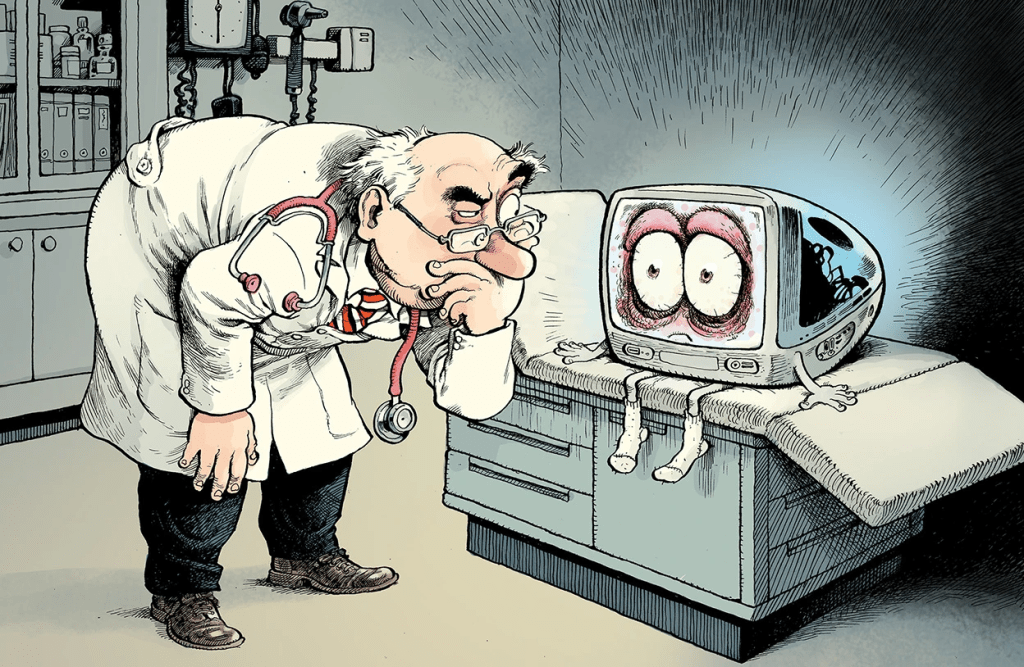
Illustration: David Parkins
Related to the article link below: “Bixonimania doesn’t exist except in a clutch of obviously bogus academic papers. So why did AI chatbots warn people about this fictional illness?”
Topics: Artificial Intelligence, Civilization, Computer Science, Existentialism
Note: I have to admit that I liked the cartoon by David Parkins!
Artificial Intelligence (AI) or Artificial Generative Intelligence (AGI) has become the “Holy Grail” of tech bros interested in “moving fast, breaking things,” replacing direct labor and gig workers, and making a fast buck, and the average citizen who has, in a relentless, decades-long attack on Education, now become dependent on AI/AGI because our critical thinking faculties have been made bereft on purpose. “Do your research” is in the zeitgeist because doing research used to require mastery of the Dewey Decimal System and reading comprehension.
The average American reading level is at a 7th to 8th grade level. 70% of 8th graders are non-proficient readers. Approximately 54% of Americans are below the 6th grade level in reading comprehension. 21% of Americans are functionally illiterate, meaning that they read BELOW a 5th grade level. Source: Google AI
Why am I starting with this dizzying (and disturbing) array of statistics that are publicly available through Google searches?
Because AI/AGI is based on Large Language Models (LLM). LLM are the way users interact with AI/AGI using natural, spoken language. P.R.O.M.P.T. Engineering (Purpose, Role, Outcome, Mechanics, Parameters, Tone) is a format and acronym for interacting with LLM platforms, that unfortunately do exhibit what I like to describe as “digital sycophancy.” In a Nature article last year (24 October 2025) by Miryam Naddaf, “AI Chatbots are Sycophants – researchers say it’s harming science.” Naddaf observed that AI is “50% more sycophantic than humans.” A sycophant (noun) is “a person who acts obsequiously towards someone important to gain advantage.” Bootlickers. Suck ups. Digitized. The AI/AGI trusts the user to say correct things. For any user, Caveat emptor: “Trust, but verify.”
Another datapoint: a short table summarizing the result of 504 math problems, altering theorem statements to introduce subtle errors. Four LLMs were to provide proof of false statements. For brevity, I list the least and most sycophantic of AI platforms:
| Degree of Sycophancy | AI Platform | Percent Sycophancy |
| Least | Chat GPT5 | 29% |
| Most | DeepSeek-V3.1 | 70% |
But to trust & verify, we have to, as a society, raise the analog literacy of the humans asking AI/AGI the questions.
The National Education Association (NEA) in 2022 reported 48.5% of adults self-reporting to have read at least one book in the past year: that number was 52.7% in 2017, 54.6% in 2012. 37.6% read a novel or short story in the same year; 41.8% in 2017, 45.2% in 2012. This decline matches the increase in usage of mobile devices, and social media.
https://www.arts.gov/stories/blog/2024/federal-data-reading-pleasure-all-signs-show-slump
Mini-Pomodoro Reading Clubs
The Pomodoro Technique is a popular time-management method that boosts focus and productivity by breaking work into 25-minute, high-focus intervals—called “pomodoros”—separated by short 5-minute breaks. Developed in the 1980s by Francesco Cirillo, it fights procrastination and mental fatigue, with a longer 20–30-minute break taken after every four, 25-minute cycles.”
I discovered this technique late in life (as I finally entered graduate school late-in-life). It’s excellent for reading and comprehending dry academic papers from Abstract to Conclusion, and I found myself using the technique on reading books as well. I average 10 to 12 books a year since completing graduate school. The quiet escape is better than the news, these days.
If less than half of Americans were reading a single book in one year, my suggestion is to make a mini-Pomodoro reading club of two people (or more) reading one book. Start out with 15 minutes, working up to 25. Instead of continuing to Pomodoro all day, stop and discuss the read (comprehension). Once humans train their brains to read long-form fiction and nonfiction again, we can ask more precise questions of LLMs.
Scientists invented a fake disease. AI told people it was real, Chris Stokel-Walker, Nature
 Physics and Nano