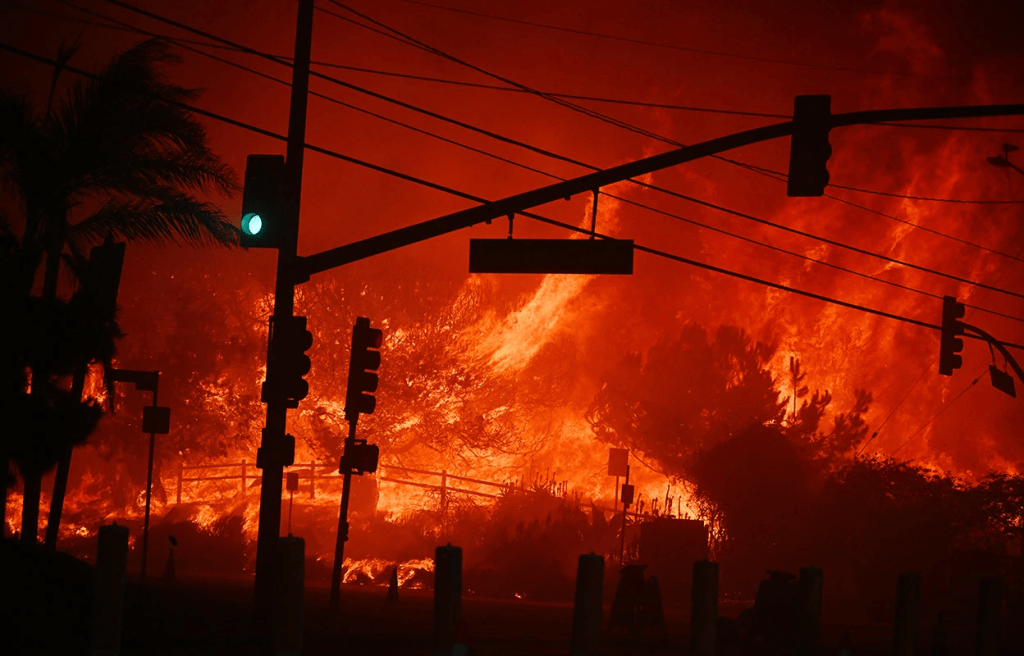
In January, 2025, a highly destructive wildfire in Pacific Palisades, California, damaged thousands of houses and buildings. Credit: Robyn Beck/AFP via Getty
Topics: Climate Change, Economics, Entropy, Environment, Existentialism, Global Warming, Thermodynamics
Note: My apologies. My posting is sporadic due to my commute to and from work (1 hour, 6 minutes in GOOD traffic on IH-40). I have sent myself stories to post, but time and exhaustion take over my evenings. I’ve sadly decided that if this venue is to exist at all, I will make my post in the least impactful evenings during my week: Thursday for this Friday, and Friday to post on Saturday. Thank you to everyone who has ever “checked in” on this WordPress blog. Dr. RLG
Zeroth Law of Thermodynamics: “If two systems are each in thermal equilibrium with a third system, they are in thermal equilibrium with each other.” https://www1.grc.nasa.gov/beginners-guide-to-aeronautics/zeroth-law-thermal-equilibrium/
First Law of Thermodynamics: “Energy cannot be created, or destroyed, only transferred or converted from one form to another.” The internal energy change ∆U is the difference between heat added (Q) and work done by the system (W), or ∆U = Q – W, The Law of Conservation of Energy. https://www.sciencedirect.com/topics/chemistry/first-law-of-thermodynamics
Second Law of Thermodynamics: “The total Entropy (disorder) of an isolated system can never decrease over time and is constant only for reversible processes.” Heat flows from hotter to colder objects, not colder to hotter objects. 100% energy conversion is impossible. “Time’s Arrow” is derived from the Second Law. https://www1.grc.nasa.gov/beginners-guide-to-aeronautics/second-law-entropy/
Third Law of Thermodynamics: Entropy (disorder) of a perfect crystal approaches zero as the temperature approaches absolute zero (0 degrees Kelvin, or -273.15 °C). Time, a measure of increased Entropy, stops in all practicality. Molecular motion slows to a minimum, and a substance cannot be cooled to absolute zero in a finite number of steps. https://www.nature.com/articles/ncomms14538
*****
The past 11 years (2015-2025) have been the hottest on record, with last year being the second or third warmest year since observations began, according to a report released today by the World Meteorological Organization (WMO).
“We seem to be entering this new era where temperatures will be significantly higher than what they were ten years ago,” says climate scientist Sarah Perkins-Kirkpatrick, who is from the Australian National University in Canberra. The past three years have seen large changes in temperature that could only be a result of climate change, she adds.
Energy imbalance
For the first time, the report includes a measure of the accumulation of heat on Earth and in the atmosphere. The indicator, called the Earth’s energy imbalance (EEI), has been used by climate scientists for at least a decade, and is the difference between the amount of energy that the Earth receives from the Sun and the amount radiated back into space. It allows scientists to monitor the rate of global warming. A positive EEI value means that the total amount of heat stored on Earth is increasing. https://wmo.int/media/news/new-study-shows-earth-energy-imbalance
Last year, the EEI reached its highest level since observations started in 1960, the report states. The increased concentration of greenhouse gases in the atmosphere traps heat on Earth, reducing the amount of warmth that is radiated back into space.
Thomas Mortlock, a climate analyst at the University of New South Wales in Sydney, Australia, says that the inclusion of EEI in the WMO report is notable. Typically, the rise in surface temperatures is what makes headlines, but the atmosphere absorbs just 1% of the planet’s excess heat so using it to gauge the severity of global warming is “quite misleading”, he says. More than “91% of all of the excess heat that has been received by the Earth since the 1970s has been absorbed in the oceans”, he adds.
Mortlock suggests that the planet’s energy imbalance is a much better descriptor to understand the true impact of global warming.
Freund adds that EEI is also a clearer measure of long-term changes than comparing average temperatures, which can fluctuate year to year owing to events with short-term impacts, such as volcanic eruptions or the La Niña weather pattern.
The world just lived through the 11 hottest years on record — what now?
Rachel Fieldhouse, Mohana Basu, Nature
 Physics and Nano